Rohit Saha Named SAE/AEM Outstanding Young Engineer
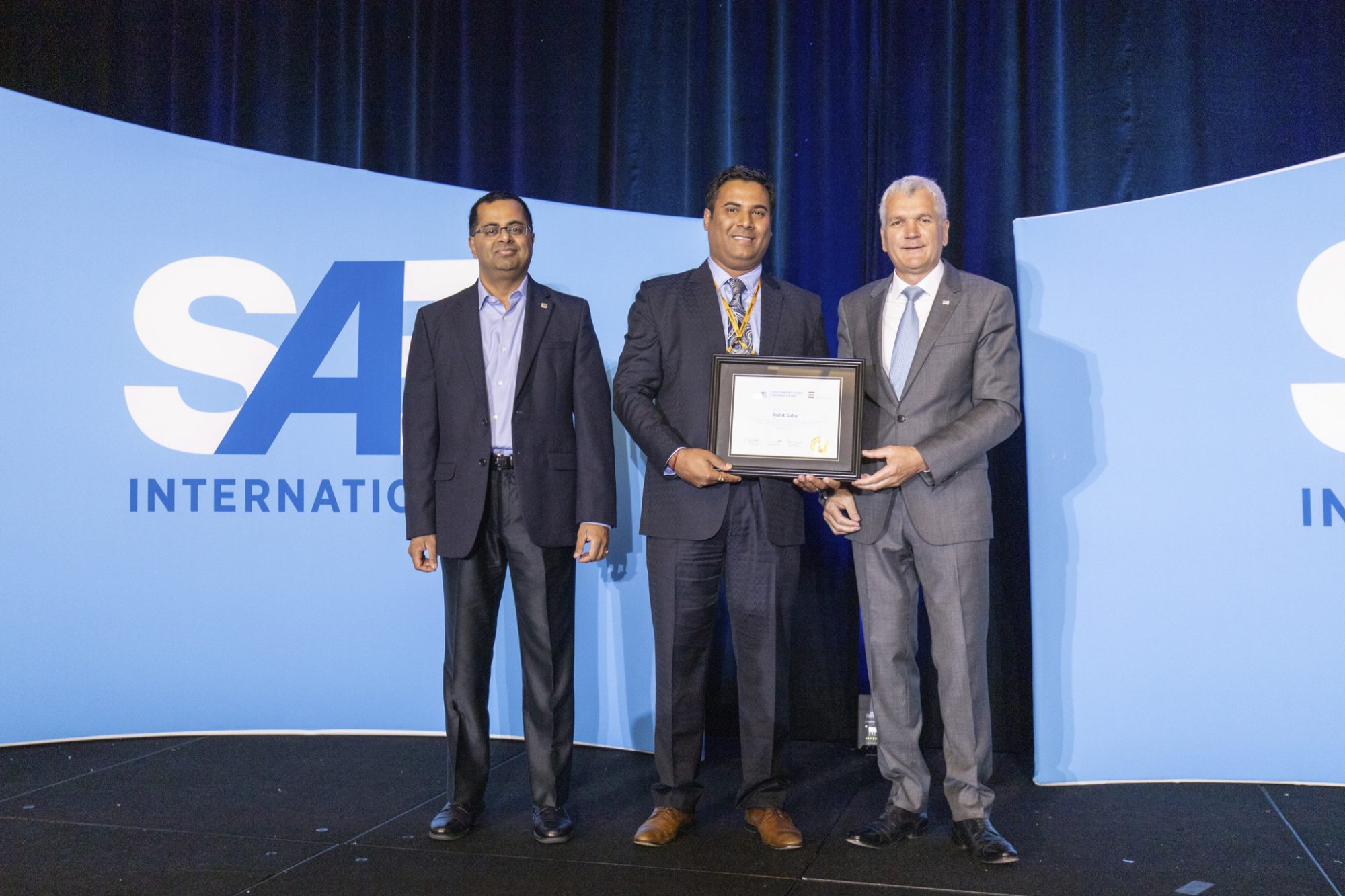
Rohit Saha, Machine Simulation-Senior Technical Specialist with Cummins Inc., has received the SAE/AEM Outstanding Young Engineer award for 2019.

The Association of Equipment Manufacturers (AEM) and SAE International established the award in 1996 to recognize an outstanding young engineer in the off-highway or powerplant industry.

Rohit received the award at the recent SAE COMVEC event in Indianapolis, Ind.

“We are pleased to support SAE and recognize the next generation as we promote industry workforce development and excellence,” stated Mike Pankonin, AEM’s senior director, technical and safety services. “We commend Rohit for his work and dedication and wish him continued success.”

SAE provided background on Rohit:

Rohit Saha is currently Machine Simulation- Senior Technical Specialist at Cummins. He specializes on industrial powertrains (performance & FE) and 3D CFD system level simulation like under-hood cooling, & external aerodynamics on both On-Highway and Off-Highway machines.

He has published over 12 SAE technical papers and 10 patents at various stages of approval. He has been providing engineering design and analytical services to Cummins’ OEMs for overall machine level multi-domain optimization since 2011. He holds a BS in Civil Engineering from Indian Institute of Technology, and an MS in Mechanical Engineering from the Texas A&M University.


AEM is the North America-based international trade group representing off-road equipment manufacturers and suppliers with more than 1,000 companies and more than 200 product lines in the agriculture and construction-related industry sectors worldwide. The equipment manufacturing industry in the United States supports 1.3 million jobs and contributes roughly $159 billion to the economy every year.

SAE International is a global association committed to advancing mobility knowledge and solutions for the benefit of humanity. By engaging nearly 200,000 engineers, technical experts and volunteers, we connect and educate mobility professionals to enable safe, clean, and accessible mobility solutions.

FHWA Repeals Rule Limiting Innovation on Highway and Bridge Construction

The Sept. 26 Federal Highway Administration (FHWA) repeal of a 103-year-old federal procurement rule is a major victory for motorists that should spur deployment of new technologies to help save lives, minimize congestion and improve the performance of the nation’s highways, according to the American Road & Transportation Builders Association (ARTBA).

The FHWA formally rescinded 23 CFR 635.411 (commonly known as the “proprietary products rule”), a federal regulation that prohibits state and local governments from using patented or proprietary products on highway and bridge projects that receive federal funding—unless those products qualify for limited exceptions. The rule was adopted in 1916 by the U.S. Department of Agriculture, which then managed the emerging federal-aid highway program.

ARTBA formally petitioned the U.S. Department of Transportation (U.S. DOT) in March 2018 seeking repeal. In response, the agency issued a “Notice of Proposed Rulemaking” in November 2018.

“This archaic regulation was a roadblock to innovation,” ARTBA President & CEO Dave Bauer said. “The status quo is the only thing that should be off the table as we seek to deliver and fund transportation solutions.”

In its decision, FHWA characterized the rule as a “barrier to innovation in highway technology” and noted that its repeal “best provides State DOTs [Departments of Transportation] greater flexibility to use innovative technologies in highway transportation.”

“We would like to thank Secretary of Transportation Elaine Chao and Federal Highway Administrator Nicole Nason for their nonstop pursuit of President Trump’s directive to cut bureaucratic obstacles to infrastructure improvements,” Bauer added.

The FHWA action will free up states to use federal highway funds on a host of patented or proprietary road and bridge technologies that can help deliver a safer and more efficient roadway system for American motorists and businesses. These include reflective road lane dividers that deter tired motorists from drifting into oncoming traffic, traffic signs that minimize injury by collapsing at the slightest impact and road barriers on wheels that provide physical but movable walls between traffic and construction workers.

“This is only the first step in an important process,” Bauer noted. “We must continue to explore how best to integrate new technologies into the transportation marketplace and ensure that new, beneficial ideas are not prevented from reaching the driving public.  At the same time, we have confidence transportation agencies will work to protect the integrity of procurement processes in their respective states,” Bauer said.

ARTBA was assisted in the petition action by the Washington, D.C., law firm, Venable, LLP.  The Venable team was led by former U.S. Secretary of Transportation James Burnley.

Established in 1902, ARTBA represents the U.S. transportation construction industry before Congress, the White House, federal agencies, courts, news media and the general public.

What Can You Control?

There’s a prayer for serenity that people like to alter to get a laugh. While waiting on Hurricane Dorian, which thankfully did not cause damage in the county where I live, and watching various computer techs manipulate my desktop to fix problems caused by hackers, I contemplated what I can and can’t control. One of AsphaltPro’s advertisers and long-time friends, A.J. Ronyak, has referred to computer hackers and “complainers” as “people who don’t have cable.” They are people who sit around, bored, looking for something to complain about or trouble to stir up. I’m paraphrasing his actual words, of course.

We can’t control neighbors who might complain about truck traffic or asphalt odor, but what aspect of that scenario can we control? As an industry, we have already come up with odor solutions (i.e. Ronyak’s product) and ways to route trucks away from popular or sensitive commutes. We can attend zoning and planning meetings to help MPOs understand the lunacy of building high-price residential luxury condos a hundred or so yards from an existing quarry’s active face. Yes, I exaggerate, but you get the point.

We can’t control the attitude of an entire generation of latch-key kids raised by Netflix and microwave meals, but what aspect of these new workers can we control? As an industry, we have already reached into high schools and trade schools to proselytize a career in asphalt paving. We can hand out copies of Asphalt Lane (published by AsphaltPro) to the younger kids and we can implement training programs like the Asphalt Paving 101 online course (also from AsphaltPro) for new employees, but attitude is everything. Those younger kids are where it’s at.

We can control the upcoming attitude toward our industry.

We should be sharing with sons, daughters, nieces, next door neighbors, kids in Sunday School, the whole Little League team, that a career in asphalt construction is rewarding. At the end of a day paving, you can see the fruits of your labor. You get instant gratification, which kids can relate to.

Making sure the next generation understands that construction workers are working hard to build, create, engineer new transportation ideas, keep our economy moving, keep our infrastructure safe, and recycle and reuse materials, gives the next generation a positive picture of construction workers. The attitude of sneering at the dirt or grime of working with your hands has got to go. Working with your hands to build an infrastructure is incredible. It’s worthy. It’s laudable. It’s an image we can control.

Editor Sandy Lender

Get Consistent Results in the Plant Lab

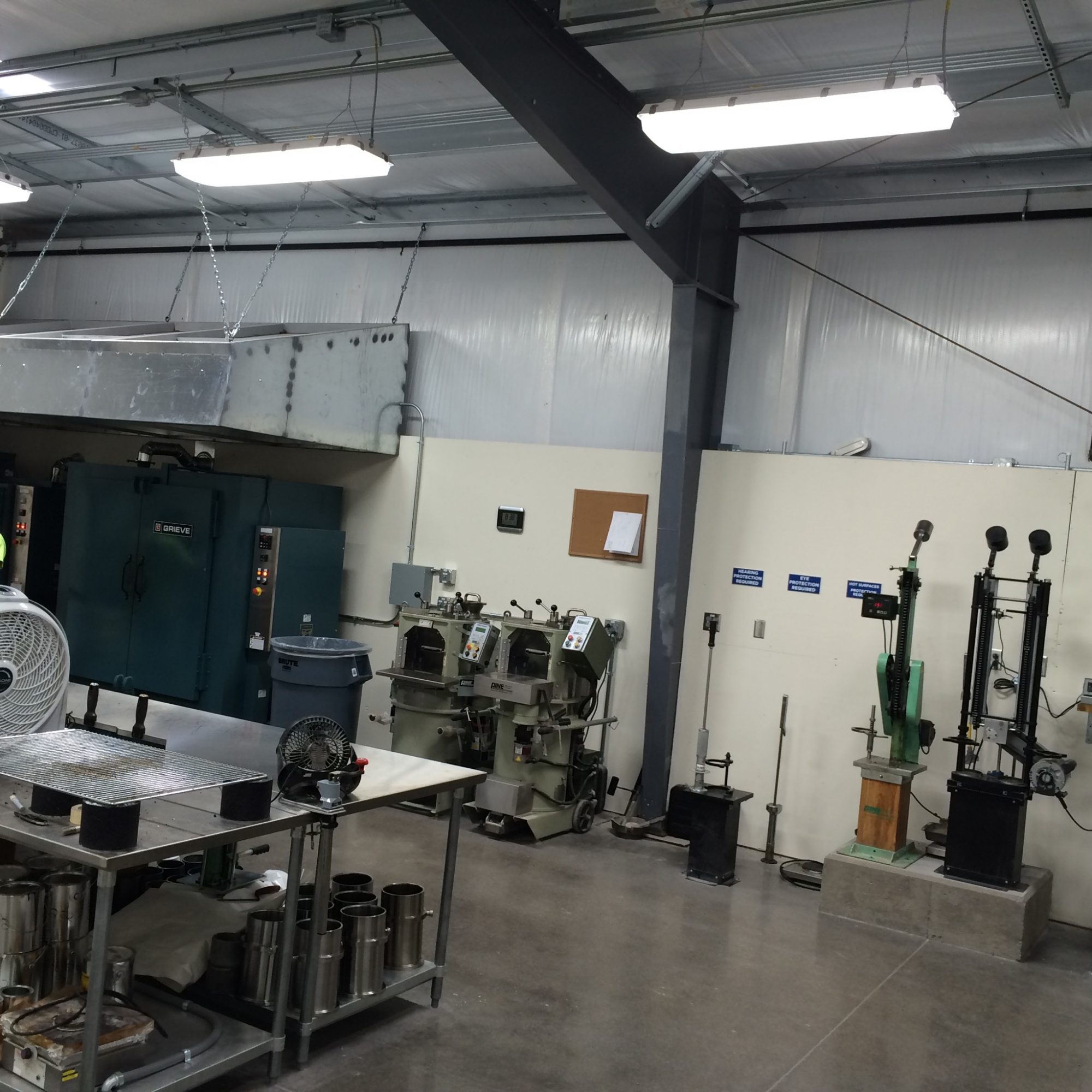
For the toolbox tips this month, we’re concentrating on quality control/quality assurance, which means attention to detail. For the lab, let’s look at the way you make gyratory specimens. Quality results stem from a quality start, right? Here are a few ideas to improve the uniformity of the asphalt specimen.

Consistency in the specimens will build the confidence in the test results down the line. To improve all of this, start with the consumables in the process. It’s surprising how such a simple thing can affect the end result, but studies have shown that the non-glossy paper disks you use in preparing the specimens matter. Paper disks with different surface textures and thicknesses will generate different specimen densities. If your lab produces its own paper disks from whatever paper stock is available, you’re not saving money; you’re adding variability and inconsistencies.

Three Steps Can Improve Your QC

You might not have thought of your mold assemblies as consumables, but the components may need replacing after time and wear. Monitor the wear of the mold and end plate so all mold assemblies remain consistent in size. Minimum clearance between the end plate and the mold surface should be 0.15 mm. Maximum clearance is 0.70 mm. If one assembly is at the minimum allowable size and another is at the maximum allowable size, you have variation creeping in. One source showed you can expect to see a bulk specific gravity difference of 0.020 per millimeter.

Also, be careful when “handling” the mix so you prevent segregation from the get-go. You might want to re-think the use of a funnel for filling the mold. The free-fall through the funnel can encourage material segregation. Instead, you can place the hot mix in a half-round of PVC pipe, lay the mold on its side, and then slide the loaded PVC pipe into the mold. When you stand the mold upright, the mix falls as a mass into the mold.

R18 Certifies Higher Calibration Costs

Or you can place the hot mix on a flexible mat, roll the mat into a tube, lay the mold on its side, and then slide the rolled mat/tube into the tube. Then you discharge the mix into the mold by standing the mold upright.

Be sure to double-check the gyratory compactor’s internal angle. AASHTO T312 wants it at 1.16 degrees (+0.02 degrees). If the angle is too low, you’ll get less compaction of the specimen.

Produce Consistent Gyratory Specimens

And double-check the gyratory compactor’s operating pressure. AASHTO T312 Section 4.1 wants it at 600 +18 kPa. If compaction pressure drops like a 1970s Robert Palmer song, you’ll lower the bulk specific gravity.

You want to get the compaction of the specimen consistently correct before testing can even begin.


Sign up here to receive tips like this to your inbox every Monday!

Use of Recycled Asphalt Reaches New High

The use of recycled asphalt has reached a new high, according to the latest industry survey by the National Asphalt Pavement Association (NAPA) in partnership with the Federal Highway Administration (FHWA).

The survey concluded that new asphalt pavements contain an average of 21.1 percent material reclaimed from old roads and parking lots–the highest level since the survey began in 2009.

Since the survey’s inception, NAPA and the FHWA have found that nearly 100 percent of RAP is put to beneficial uses, primarily new asphalt pavements.

The most recent survey, conducted in the first quarter of 2019, found that 82.2 million tons of RAP, along with 1.05 million tons of recycled asphalt shingles (RAS) were used in 389.3 million tons of new asphalt pavement mixes in the United States during 2018. An additional 8.8 million tons of RAP and RAS were used as aggregate, in cold-mix asphalt, and other road-building activities. The survey also found that at year-end 2018 about 111.7 million tons of RAP and RAS was stockpiled for future use across the country.

“Over the years, we’ve seen steady advancement in the amount of RAP being used across the country,” said NAPA President & CEO Audrey Copeland. “This has been the result of concerted engineering efforts by industry and road owners to research and apply best practices to ensure we maintain or improve performance while increasing the use of recycled materials.”

In total, more than 85 million tons of recycled materials — primarily RAP and RAS — were used in new asphalt pavement mixtures during the 2018 construction season, a 7.6 percent increase from the amount of recycled materials used in 2017. The use of RAP and RAS alone resulted in cost savings of more than $2.9 billion compared to the use of virgin materials.

Although national usage estimates were not calculated, respondents to the survey reported recycling some 1.8 million tons of recycled tire rubber, steel and blast furnace slags, cellulose fiber, and other reclaimed and waste materials into nearly 12.3 million tons of asphalt paving mixtures during 2018.

The asphalt pavement industry also continues to make significant use of energy-saving warm-mix asphalt (WMA) technologies. In 2018, 157.4 million tons of asphalt pavement mixture was produced using WMA technologies. More than half of this tonnage was produced at reduced temperatures, meaning less energy was required in manufacturing. The most common WMA technology used is plant-based foaming, which injects a small amount of water into the asphalt during production. A number of environmental, worker safety, and construction benefits have been realized through the adoption of WMA technologies.

“A decade ago, WMA technologies were a novel idea. In 2018, though, more than half the asphalt pavement mixture tonnage produced in 23 states used WMA technologies, and in six of those states, it was more than 75 percent of the tonnage,” stated John Harper, 2019 NAPA Chairman and Senior Vice President of Construction Partners Inc. in Dothan, Alabama. “While there remains room to grow their use, WMA technologies have become just another tool we can use to produce the best asphalt mixture to meet a given project or agency need.”

The survey was conducted in the first quarter of 2019. Results from 272 companies with 1,329 plants in 49 U.S. states, the District of Columbia, and two U.S. territories, along with data from state asphalt pavement associations for 33 states, were used to compile the report. A copy of the full survey report, including a state-by-state breakdown of data, is available here.

Celebrate National Construction Appreciation Week!

Construction positively affects the lives of every American. The buildings in which we work, play, and live; the cell phone towers that power our connectivity; and the roads and bridges that enable us to get to our destinations all depend on the development and empowerment of the construction industry workforce.

That’s why we’re celebrating Construction Appreciation Week September 16-20, 2019, to acknowledge and thank the hardworking men and women in the construction industry.

According to the Associated General Contractors of America (AGC), a leading association for the construction industry and an I Build America partner, the construction industry has more than 680,000 employers with seven million employees and creates $1.3 trillion worth of structures each year.

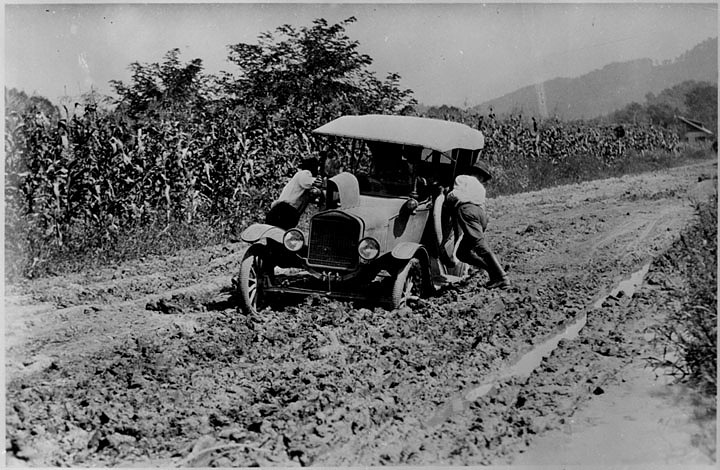
Just think…without you, our roads would look like this:

Founded in 2018 and sponsored by I Build America, Construction Appreciation Week is a national movement focused on building pride in the construction industry, educating the public on the value of construction, and recruiting the next generation of construction professionals. I Build America was founded in 2016 by HCSS CEO Mike Rydin to tell the story of American construction workers.

This week, we ask you to  get involved by posting your construction photos on social media using  the hashtags #ThanksForBuilding and #ConstructionAppreciationWeek, and sharing official Construction Appreciation Week videos, stories and graphics on your social channels.

You can also get involved by participating in national Construction Appreciation Week contests:

  • The Building America Together Contest: Tell us why you appreciate a construction professional and you could win a $200 Amazon gift card. This contest begins at 12 a.m. Sept. 2, 2019 and ends at 11:59 on Sept. 13, 2019.
  • The Thanks for Building Contest: Let us know what your favorite structure is and you could win a $200 Amazon gift card. This contest begins at 12 a.m. Sept. 16, 2019 and ends at 11:59p.m. Sept. 27, 2019.

Click here to learn more about the contests and to enter.

Thanks for building!