Get Clean Production Next Season

To gear up for season shutdown, you’re probably making your maintenance plans. Over the next few pages, original equipment manufacturers (OEMs) and others show off the components and services they can offer to help you through the winter. An OEM tangentially related to our industry offered some ideas for cleaning your heating elements. Let’s look at getting scale off the boiler tubes before it becomes a hazard.

For boilers that produce hot water and steam for industrial activities, scale buildup can creep into operations without you realizing it. The team at Cortec® Corporation explained scale forms when minerals such as calcium carbonate in the water combine and create scale deposits on boiler internals. The thicker the buildup, the harder it is for water or steam to flow through the pipes. This means heat transfer efficiency drops, demanding more energy to heat the boiler water and create steam.

Not all heating systems look alike but the concept remains the same. Preventing liquid asphalt cement coking or scale buildup on different heating elements protects those elements from inefficiencies and potential ruptures or breakdowns.

Scott Bryan, CWT and technical sales manager of Water Treatment at Cortec® Corporation, summarized, whenever scale is forming in any system, “If you are starving that system of its needed heat transfer efficiency, you are hurting the performance of that whole process.”

As discussed in the October issue of AsphaltPro, it takes a good overall controls system to monitor all the parts and pieces of a plant. Not every asphalt plant will employ steam heat these days, but if you’ve got it and your system doesn’t alert when there’s a change in flow or heat transfer efficiency, your facility could experience scale buildup problems long before realizing their effects. Bryan explained, if this proceeds too far, it could result in a boiler pipe that ruptures without warning, leading to major problems.

“A boiler will blow a tube and cause the whole system to come down, and that could create a catastrophic event at worst and an unplanned maintenance shutdown at best,” Bryan said. In either case, at least some plant operations will grind to a halt.

Anti-scalants have chemistries to keep dissolved minerals such as calcium carbonate from combining and depositing on the metal. This buildup prevents efficient heat transfer.

Scale Prevention

To avoid such serious problems, it’s important that boiler owners and managers take preemptive steps. The best plan is to minimize the formation of scale deposits by adding an anti-scalant to the normal water treatment program. These chemistries keep dissolved minerals such as calcium carbonate from combining and depositing on the metal. Cortec advises its own product, the S-14 Series, be added to standard water treatment formulations.

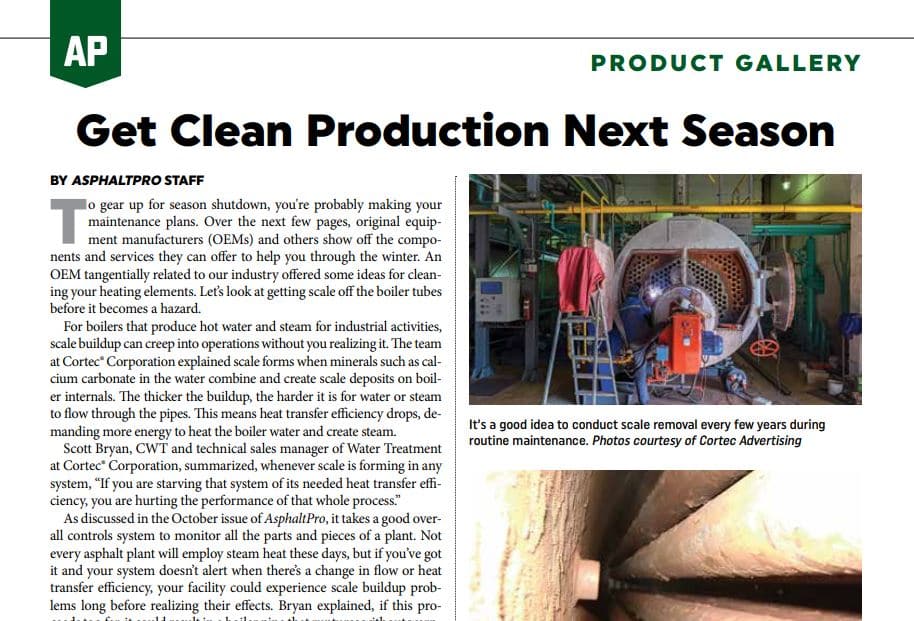
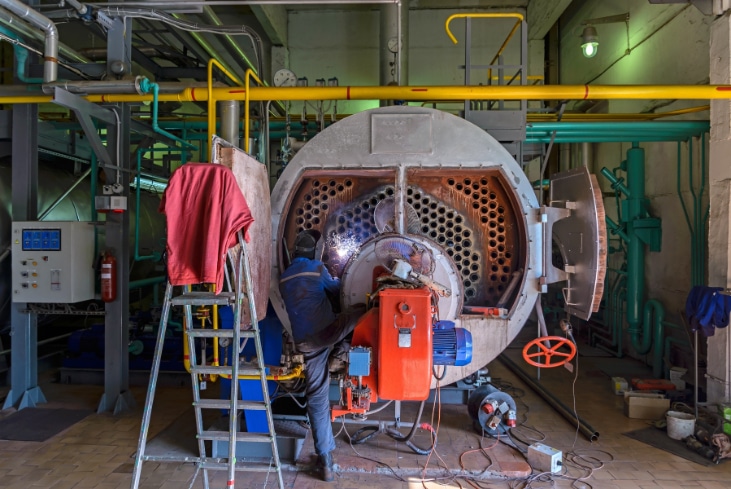
It’s a good idea to conduct scale removal every few years during routine maintenance. Photos courtesy of Cortec Advertising

Scale Removal

The second step is to periodically remove scale that has formed. This should be done whenever pressure increases and heating demands rise. However, since these indicators can be difficult to detect in a boiler, it is a good plan to conduct scale removal every few years during routine maintenance. Cortec advises using a product like EcoClean® Biodegradable Scale and Rust Remover, which is designed to dissolve scale.

Scale is a normal nuisance in boilers. However, by catching the problem early, boiler owners can avoid the most serious issues that come from scale-induced surprises such as melting or bursting boiler tubes.

For more information, contact the Cortec team at https://www.cortecvci.com/contact-us/.


https://theasphaltpro.com/product-gallery-almix-unveils-two-story-control-house-for-enhanced-asphalt-plant-operations/

https://theasphaltpro.com/product-gallery-ammann-america-launches-high-capacity-counterflow-drum-mix-plant-for-enhanced-asphalt-production/

https://theasphaltpro.com/product-gallery-astec-industries-enhances-fiberbed-mist-collector-with-charcoal-filters-for-improved-odor-control/

https://theasphaltpro.com/product-gallery-brock-llc-unveils-versatile-asphalt-cement-tanks-with-enhanced-features/

https://theasphaltpro.com/product-gallery-eagle-crusher-hosts-aem-manufacturing-express-to-celebrate-american-manufacturing/

https://theasphaltpro.com/product-gallery-major-unifies-mining-and-aggregate-solutions-with-enhanced-app-update/

https://theasphaltpro.com/product-gallery-masaba-inc-breaks-ground-on-new-steel-fabrication-facility-to-boost-production/

https://theasphaltpro.com/product-gallery-major-unifies-mining-and-aggregate-solutions-with-enhanced-app-update/

https://theasphaltpro.com/product-gallery-meeker-equipment-introduces-advanced-baghouses-for-enhanced-dust-management/

https://theasphaltpro.com/product-gallery-process-heating-company-analyzes-asphalt-heating-costs-across-multiple-fuels/

https://theasphaltpro.com/product-gallery-rotochopper-expands-rd-innovation-center-with-new-12000-square-foot-facility/

https://theasphaltpro.com/staar-lubricants-introduces-eco-friendly-trick-shot-asphalt-release-agent/

5 Ways to Pay for Your Plant Controls

You could see a ROI quickly with a plant controls system update investment

By this point, all hot-mix asphalt (HMA) producers understand the value of using a robust controls system at the plant for mix design, production, ticketing and so much more. In simple terms, controls packages give everyone from plant operators, managers and ground crew to owners, bean counters and FOB customers, valuable insight and information in real time and—after a project—on demand for quality product, improved uptime, streamlined operations, trackable data and so much more.

If a plant didn’t come with a full controls system plugged into every aspect of production and loadout, or if you’ve pieced together a plant from components salvaged from multiple sites, you may be looking at the return on investment for installing controls after the fact. Here are five tips Stansteel/Hotmix Parts & Service of Louisville, Kentucky, shared for offsetting the cost in short order.

The Accu-Track Advantage system from Stansteel offers the plant operator alarms for multiple components. In the event something goes wrong, the controls system lets the operator know what the problem is and where it is.

1. Calibrate belt scales in the controls

Many producers calibrate belt scales during the down season and call it good. Let’s make this a higher priority item. You could have a built-in calibration deviation alert for your belt scales and your liquid asphalt cement (AC) metering within your controls.

2. Regulate AC extractions in the controls

Many producers send start-up and shutdown mix to the waste pile as a quality control/quality assurance (QC/QA) measure. This is a good best practice to adhere to, but you don’t have to lose 100 tons (or more) each week to these “pulldown piles” of wasted material. You can use your controls to regulate AC extractions and meter material back into the system as recycle, thus saving big costs.

How to Hack-proof Asphalt Plant Controls

3. Tweak AC percentages with your controls

Speaking of extractions, do you ever have to wait for extraction and gradation test results to “tweak” AC percentages in your mix designs and production? If your mix designs are tested, tried and approved, then saved in your control system database, you have a leg up on Day 1 of a project.

Stansteel pointed out: “If your operations are like many plants, it really can’t get started, particularly on critical government jobs, until the first run of mix is checked for AC content and gradations. Sometimes, people are adjusting it every day or certainly every week. If you can avoid this, you may start up immediately. Instead of having delays and penalties on a job, get paid bonuses for being on-spec with your AC, always hitting the target.”

5 Ways to Improve Asphalt Plant Control

 4. Troubleshoot with confidence for get-back-uptime

Your control system should allow you to “alarm” components in a way that lets you find and resolve issues efficiently. Stansteel pointed out that a feeder no-flow situation, a fines/dust plugged situation, an empty AC tank or a high-level alert in the silos could take some time to find if you don’t have a control system with an alarm showing you where the problem is occurring.

“With a general industry condition of fewer plant operators and grounds people who have many tasks to take care of in a day, it’s almost impossible to watch and monitor everything on a plant, with truck traffic, loader feed and aggregate control.” By installing a controls system, like the Accu-Track Advantage the company offers, the system monitors hundreds of points on the plant multiple times per second.

“Any upset will either give an alarm or sequentially shut the plant down, depending on how critical it is to the operation and integrity of the mix.” Having a system that pinpoints the problem for efficient troubleshooting helps you get back in business more quickly, and that’s a cost saver.

How to Start Up Your HMA Plant

5. Update for cost-savings

As you see in the New Tech department every month, technologies and services in the asphalt industry are changing all the time. As controls systems advance for asphalt plants, you may find new ways to save on time and costs.

Stansteel acknowledges this: “As technology and materials advance, there will likely be more and more demand for adding more ingredients, whether it be hydrated lime, liquid anti-strip, chemical foamers, rejuvenators, RAS and more. If the control system you have is a relic of the past, it might prevent you from doing this correctly. It could result in the manufacturer having a huge cost to make the modification or doing it in a cobbled-up manner.”

By investing in updated controls, you can invest in a system that gives you more flexibility, better efficiency and a faster return on investment.

For more information from Stansteel, visit stansteel.com

Walbec Updates, Integrates, Innovates with Command Alkon’s Apex

It was in 1922 that Walter Bechthold partnered with Max Payne and Barney Dolan to form Payne and Dolan in Illinois. Having begun his career in 1917 at the State Highway Department before working as a county engineer for Racine County and later the Racine County Highway Commissioner, Bechthold brought valuable experience to the company as it purchased its first asphalt paving machines in the 1930s and performed work for military complexes and airports during World War II.

After buying out Payne’s interest and splitting the company in two (Dolan maintained ownership of Payne and Dolan in Illinois and Bechthold maintained ownership of Payne and Dolan in Wisconsin), Bechthold and his successors either founded or acquired several other companies to make up Walbec Group’s six vertically integrated companies that exist today.

Eurovia Atlantic Coast Implements Apex

“In the last decade, we’ve rebranded our family of companies as the Walbec Group in honor of Walter [Bechthold],” said Walbec Strategic Improvement Leader Linda Pawlak. “[As Payne and Dolan], we started off primarily doing asphalt paving and road construction, but now we are a vertically integrated family of companies that produce high quality construction materials and deliver unparalleled professional design, engineering and construction services.”

Despite the benefits vertical integration brings to customers of the Walbec Group, it isn’t without challenges. For example, it makes a seamless and efficient workflow all the more important. To achieve the level of efficiency the Walbec Group and its companies desired, they often had to develop their own technology solutions.

“Up until about 15 years ago, our appetite for technology was stronger than what the marketplace had to offer, so we developed a culture of building our own technology,” Pawlak  said. This included the company’s bidding, payroll and job costing software. To date, Walbec continues to use its homegrown scheduling software. Then, in 2010, the company replaced its homegrown bidding software with a solution from HCSS.

“Throughout that process, we worked closely with the leadership at Command Alkon to say, ‘Here’s the good, the bad, the ugly’. We’ve always looked for vendors who are interested in a partnership, not just a sale.” — Linda Pawlak

When Walbec decided it was time to replace its enterprise resource planning (ERP) system, the company decided it was an optimal time to identify other technologies it should implement in advance of the replacement.

“The ERP is the heartbeat of integration for our organization,” Pawlak said. “One of the foundational aspects of choosing the right ERP was choosing one that could integrate with our already-valued third-party vendors.”

When Walbec identified its ticketing system as one project to resolve before replacing its ERP, Pawlak said they “went out to the marketplace and entertained several vendors, but ultimately chose Libra because of their experience ‘swinging the gates’ of the asphalt plant.”

When Walbec decided it was time to replace its ERP system, the company decided it was an optimal time to identify other technologies it should implement in advance of the replacement. Its ticketing system was identified as one project to resolve before replacing its ERP, Pawlak (right) said.

Acquisition and Implementation

It was in 2020 that Walbec began implementing Libra production, loadout and e-ticketing software at all its aggregate sites and asphalt plants, according to Tim Schmidt, Apex operational lead at Walbec. He shared the goal was automating e-ticketing, “which is really valuable to the project managers in the field as well as our customers at the DOT level.”

The Walbec Group had just finished implementing Libra software in its facilities when Command Alkon, Birmingham, acquired Libra. “We found ourselves caught in the worst possible timing of [that acquisition],” Pawlak said. “We had just finished the implementation process with Libra, so transitioning again was a heavy lift for us.”

Command Alkon Apex Scale Ticketing Software

According to Schmidt, Walbec already had a punch list of issues they were working to resolve with Libra before the acquisition occurred. All of a sudden, they faced the challenge of resolving these issues with new partners while Command Alkon’s own staff was familiarizing itself with Libra.

“After Command Alkon had a moment to catch their breath, they really showed up to fix some of our red-hot issues,” Schmidt said. For example, trying to get all of Walbec’s relevant facilities on the same platform; all of its sites had been on Libra at the time of the acquisition and then had to be moved over to the Libra/Apex version prior to its ERP system being installed.

Throughout the implementation process, Schmidt said Command Alkon’s staff was “very present.”

The Walbec Group performs more than 2,500 projects per year, primarily asphalt work, that range in size and scope from commercial parking lots to large highway jobs.

“They had people front and center at our asphalt plants to work through some details on their initial offering of putting Apex and Libra together,” he added. “There were weeks on end that they had people here to support and train our people through that transition.” After all of Walbec’s plants were running Apex/Libra, Schmidt said, “things got pretty steady for us.”

Once the ‘red-hot’ issues were resolved, Command Alkon set about working through Walbec’s punch list of remaining requests. “We could begin integrating the best of what Libra was already offering us with what Apex brought to the table,” Pawlak said.

In addition to marrying the best of each system, the partnership Walbec established with Command Alkon illustrated to Walbec that Command Alkon was willing to learn and eager to listen. “Throughout that process, we worked closely with the leadership at Command Alkon to say, ‘Here’s the good, the bad, the ugly’,” Pawlak said. “We’ve always looked for vendors who are interested in a partnership, not just a sale.”

Once that trust was established, Walbec began to play a role in shaping some of the features Command Alkon might want to include in its next generation of software, Apex 7.8, which acts as a unified Apex/Libra solution, as opposed to two systems with an interface between them.

Command Alkon Apex Scale Ticketing Software

The new software has addressed Walbec’s remaining punch list items. For example, day-end reporting features from Libra that weren’t initially available on the Apex platform. Apex 7.8 also allows credit card processing through a strong integration with BASYS.

“We think the beta version we’re running now will be superior to both what Libra and Command Alkon brought to the table initially,” Pawlak said. “I think the new version of the software is really a result of the collaboration between us.”

“Up until about 15 years ago, our appetite for technology was stronger than what the marketplace had to offer, so we developed a culture of building our own technology.” — Linda Pawlak

The success of the transition from Libra to Apex/Libra to Apex 7.8.XX has also encouraged Walbec to consider some of Command Alkon’s other offerings. “Command Alkon has a lot of relevant technology for us to look at, not only on the asphalt side but also at our ready mix plants, so they’ve become an obvious choice for us to consider when we have an appetite for new technology,”Pawlak said. “As we plan out our next project and our next project, we see them as a partner we can count on to innovate farther out than our appetite for today.”

“Innovation is one of our company’s core values, so we strive to find partners who share that value,” Pawlak said, adding that when Walbec chose its third-party ticketing software, they were looking for a vendor that could grow with them. Command Alkon has become that partner. “They aren’t waiting for us to say what we need next. They are out there figuring out what the marketplace needs.”

Command Alkon’s commitment to innovation—a core value shared by Walbec—made the companies a great fit. “It’s really about finding the right partners who are a good fit for us culturally,” Pawlak said, “partners who innovate, partners who integrate.”

Integration, she adds, is a key word for the company, both in terms of vertical integration of services and technological integration between software. After the full implementation of Apex, Walbec has since wrapped up the implementation of its new ERP with integration to Apex as well. “Being vertically integrated means making the process seamless for our customers, and that’s true of the technology partners we choose to partner with.”

Digitize Beyond eTickets

With the Federal Highway Administration’s (FHWA’s) Every Day Counts eTicketing initiative, contractors, suppliers and departments of transportation (DOTs) across the country were introduced at a broad scale to technology in a way our industry hadn’t seen before. In digitizing material tickets, we have made work zones safer, have made information easier to track down, have made payment quicker and have freed up space in our construction trailers, but our work is not complete. As eTicketing matures and becomes more standardized, the onus falls upon all of us to seize the momentum that was created and continue to advance digital construction.

HaulHub’s EDOT shows the status of equipment and material in the field to match the digital systems.

At the Delaware Department of Transportation (DelDOT), we have taken that step, and are incrementally working toward our goal of a completely connected work zone. A work zone that doesn’t just provide an electronic version of a paper ticket, but one where the equipment itself provides estimated quantities, reports on quality control metrics, reports its emissions for inclusion in Environmental Product Declarations (EPDs), provides information for asset management, and most importantly, provides its status to the traveling public to make the work zone itself even safer.

This screenshot shows the work zone on the Waze app, showing when workers are present in the work zone.

Real-World Connection

This screenshot shows the work zone within the EDOT app when transmitting.

In fall 2023, DelDOT and its partners, Greggo & Ferrara Inc. (G&F), HaulHub Technologies and iCone Products, completed two trials of a connected work zone. G&F, the contractor and supplier, volunteered to connect its Caterpillar paver and Hamm rollers, as well as iCone’s Temporary Traffic Control devices, to HaulHub’s EDOT portal for two separate weekend partial road closures. In doing so, we collected some of the first information on what we hope will become a standard practice across the industry.

Regarding the smart work zone aspect, many DOT projects can have multiple locations under a single contract, so having just the eTicket information is not sufficient to determine what location may be active on a given day. Recognizing this was one of the impetuses to connect the contractor’s equipment to HaulHub’s portal. In doing so, we gained the GPS location of the equipment and knew exactly which work zone on that multi-location project was active. We then harnessed this “active” status and provided it to Waze in a dynamic manner, giving Waze reliable information that workers were present in the work zone. Waze, in turn, was able to broadcast that information to its users.

To use the equipment’s GPS data, we first needed to define the work zone within HaulHub’s EDOT app. This, in turn, created a geofence for the contractor’s connected equipment to broadcast as active.

While the work zone definition is currently an intuitive process, it is still entirely manual.  However, we are investigating ways to get the work zones defined automatically based upon the digital plan information, and our own publicly available linear reference system, eliminating the need for multiple points and further reducing the burden on the inspection staff.

Real-World Duration

Creating and activating a work zone is not the only consideration when it comes to traffic safety implementation. We must also consider the deactivation of the work zone notification, for both the planned duration and unplanned events such as weather interruptions.

In fact, on our second trial weekend, we experienced a weather interruption.

At this early stage in our trial, the work zone deactivation within Waze was operating based upon a planned duration. With the weather interruption, the team had to manually deactivate the work zone. Subsequently, HaulHub made quick adjustments within the platform to introduce automation into the deactivation of the work zone based upon both the equipment status and eTickets.

While DelDOT’s own traffic notification showed the site as still active, the equipment was no longer operating, and material was no longer being shipped. By all accounts, it was clear in the portal that the site was no longer active, but DelDOT’s current process is dependent on a manual process with multiple layers. With a connected work zone, we are one step closer to harnessing available information to automatically prompt staff to deactivate the public notification, which doesn’t just aid traffic flows, but also improves trust in work zone notifications.

This screenshot shows the work zone boundary within the EDOT app.

Real-World Information

While notifications to the public for active work zones are a significant focus of our early efforts, we do not intend to stop there. DelDOT has partnered with Iowa, Nebraska, Louisiana, HaulHub, Iowa State University, WSP, and WAP Consulting and was recently awarded $4 Million grant from FHWA. Collectively, we intend to use this grant to begin connecting various pieces of equipment throughout our states. Because we are only in the initial phases of this effort, we focused on simple information—where is the equipment, is the equipment operating, when is the data being sent, which is all that is relevant for a safety feed.

As our efforts become more mature, we intend to gather more equipment information like the width of the screed, the depth of the screed, the depth of the mill, the slopes, etc. This type of information can provide, at the very least, a check against calculated numbers or perhaps even replace information collected by inspection staff once we build confidence in those systems. The goal though, is to give the department another way to verify that 3,046 tons of mix were placed on DE-72 on our first trial date, or that 14,350 SY-IN of bituminous concrete were milled on our second trial date.

To this point, we have engaged with equipment manufacturers to understand what is currently available on their equipment, what sensors can be easily added to their equipment and what else we can do as we move forward. Can we add a thermal sensor on the pavers or rollers? Can we get theoretical densities off the roller? With the next version of our Connected Machinery Special Provision, DelDOT will be asking for some of those additional data points (See the Sidebar).

As we build this database of information, we will grow our efforts to start getting information on quantities directly from the equipment itself. We will have geolocation data on where that work was done to feed into our asset management systems. We can use run times to determine the A5 component of EPDs on a project-wide or material-focused basis. These are no longer theoretical goals to obtain far in the future. In many cases the information is there today; it exists. We simply need to join together and capture it in a standardized manner.

That is the goal of our project.

Personally, I feel the next five years in construction will be as transformative as the preceding 15 years, as we see various technologies finally begin to come together. From eTickets, to digital as-builts, to building information management (BIM) and beyond. Connected machinery and a connected work zone are where all these things come together. Construction is the final link in the lifecycle of information for infrastructure, and connected machinery is the key to that link. We encourage all our partners in highway construction, from equipment manufacturers to contractors to suppliers to fellow agencies, to reach out to our ADCMS team and join us in bringing these innovations to fruition.

If you’d like to read more about DelDOT’s first trial project and view the information in an interactive way, please visit https://bit.ly/AsphaltProDelDOT

Expand into Production: Plant Ticketing Software Basics

Editor’s Note: For 2024, AsphaltPro Magazine allows experts in the industry to share how to expand your operations to the next phase of business. Are you ready to take the plunge and start making your own mix? Let’s turn to some professionals who have equipment, services, software and tenure to help you expand to mix design, production, hauling and more. This month’s installment from Command Alkon takes a look at the top considerations to keep in mind for ticketing software.

Ticketing software is the backbone of efficient operations and amplified productivity in your asphalt production facility, but selecting the perfect ticketing software can be a daunting task. It requires careful consideration of potential pain points and taking proactive measures to address them. Choosing a scale ticketing system that doesn’t quite jive with your asphalt production plant can have negative impacts on your operation. It can lead to inaccurate measurements and data, resulting in discrepancies and potential financial losses. This can occur due to errors in weight calculations or incorrect entry of information.

You also must be careful not to choose a scale ticketing system that lacks essential features for your production processes, such as real-time tracking and reporting, which would make it difficult to monitor production levels and identify bottlenecks. Moreover, an inefficient scale ticketing system can result in delays and errors in invoicing, leading to customer dissatisfaction and strained business relationships. By choosing the right ticketing software, you can unlock the full potential of your facility, streamline operations and boost productivity like never before.

Here are the top pain points to consider when approaching ticketing software at your asphalt production facility:

1. Seamless Data Flow

One of the key pain points could be the lack of integration between the ticketing software and other systems used in the facility. Without seamless integration with systems such as inventory management, sales, loadout or financial systems, manual data entry becomes necessary. This can lead to potential errors and inefficiencies. Choosing ticketing software that allows for seamless processes and data flow reduces the room for error and enhances overall efficiency.

2. Complex User Interface

A complex or unintuitive user interface can be a significant pain point for your employees. When the ticketing software is difficult to navigate or understand, it can result in mistakes, delays and frustration among users. How often have you gotten pushback from your people about a new system because they don’t have the time to learn how to use it? Opting for ticketing software with a user-friendly interface can help streamline processes and improve onboarding and user satisfaction.

Benevento Enhances Asphalt Operations with HaulHub, CONNEX

3. Limited Customization Options

Another pain point to consider is the limited ability to customize the ticketing software to match the specific workflows and processes of your plant. Lack of customization may mean the value of the system that you spend a lot of money on can never truly be realized because you are changing business processes to fit your technology. Look for ticketing software that allows for flexibility and customization to align with your facility’s unique requirements.

4. Inaccurate Data and Reporting

Accurate and real-time data and reporting are crucial for effective decision-making. If the ticketing software does not provide reliable data and reporting, it can be difficult for management to make informed decisions. This can result in delays in addressing issues, lack of visibility into production metrics and potential revenue loss. Make sure that the ticketing software you choose offers accurate and real-time data and reporting features.

Various functionalities in ticketing software can help keep drivers in the cab and out of harm’s way at the asphalt plant, thus improving safety for all.

5. Lack of Mobile Access

In an asphalt plant, employees often need to access ticketing software on mobile devices while working on the plant or in the field. If the software lacks a mobile-friendly interface or does not provide mobile access at all, it can hinder productivity and create additional challenges for users. Consider ticketing software that offers mobile compatibility for seamless access and increased efficiency.

6. Difficulty in Scaling

As your asphalt operation grows or new features and functionalities are required, the ticketing software should be able to scale and accommodate the increased demands. Difficulty in scaling can result in performance issues, system crashes and potential disruptions to production operations. It can also limit your ability to add trucks to your fleet, take on more customers, address heavy seasonal needs, grow market share and more. Choose ticketing software that can easily adapt to your facility’s evolving needs.

Eurovia Atlantic Coast Implements Apex

7. Compatibility with Industry Standards

Ensuring that the ticketing software adheres to industry standards and has compatibility with commonly used systems and formats is essential. Lack of compatibility can create difficulties in exchanging data with customers, suppliers or regulatory bodies. This can lead to delays, compliance issues and increased administrative burdens.

8. Training and Onboarding

The ease of training and onboarding new employees is crucial for a smooth transition. If the ticketing software requires extensive training or has a steep learning curve, it can result in delays, mistakes and frustration among staff. Look for a scale ticketing software provider that offers comprehensive training resources to facilitate a seamless onboarding process.

How to Hack-proof Asphalt Plant Controls

9. Supports Safety

In addition, add-on automation technologies can work in tandem with the scale ticketing software to safely get trucks in and out of the plant with minimal human interaction. Some examples include radio frequency identification (RFID) kiosks that streamline the check-in process—drivers can enter the location via a ‘fast track’ lane, swipe their card and receive product/loading directions into the quarry. Tablets in loaders keep loader operators in sync with the check-in process, so the loader operator knows exactly what truck, product and target weight to load and doesn’t have to get out of the truck to talk to plant personnel. Remote printer enclosures mounted at the exit of outbound scales enable the scale ticketing software to print tickets for drivers, who can pick them up without ever leaving the comfort and safety of the cab.

Selecting the right ticketing software for your asphalt production facility is essential to ensure efficient operations and maximize productivity. Failure to address the pain points associated with ticketing software can lead to inaccuracies, reduced efficiency, customer dissatisfaction and financial losses. By considering factors such as integration, user interface, customization options, data accuracy, mobile access, customer support, scalability, compatibility with industry standards, cost considerations, and training and onboarding, you can make an informed decision that will unlock the full potential of your facility. Choose wisely and empower your asphalt production facility with a ticketing software solution that streamlines operations, boosts productivity and supports your business growth.

Greg Fleisch is a solutions specialist at Command Alkon. For more information, contact him at (205) 616-9952 or visit https://commandalkon.com/asphalt-producer/.

How to Become Your Own Hot-Mix Supplier

Editor’s Note: For 2024, AsphaltPro Magazine allows experts in the industry to share how to expand your operations to the next phase of business. Are you ready to take the plunge and start making your own mix? Let’s turn to some professionals who have equipment, services, software and tenure to help you expand to mix design, production, hauling and more. This month’s installment from Asphalt Drum Mixers (ADM) takes an overarching look at the whole plant purchase; upcoming installments drill down into the points raised herein.

At some point in the life cycle of any successful asphalt paving business the question of whether a company should purchase an asphalt plant to begin supplying its own hot-mix asphalt (HMA) is likely to come up. There are clearly many benefits for asphalt paving businesses to add mix production to the company’s list of services. From savings in labor, material and truck expense, to the ability to lay more asphalt and complete more projects, to increased return on investment (ROI), the purchase of a paving company’s own asphalt plant can be an all-around positive experience for any paving business.

There are numerous considerations, however, for helping determine whether paving companies will benefit from the purchase of their own asphalt plant. This article outlines some of the reasons purchasing an asphalt plant might be right for paving companies’ businesses, the key considerations to help in making the decision, and one asphalt paving company’s journey to becoming its own HMA supplier.

Mix-and-Match Asphalt Plants

French Broad Paving is a medium-sized asphalt pavement company located in Madison County, North Carolina. The company is family owned and operated by Donnie and Regina Reed and T.J. Reed and has been in the paving business for the past 26 years. The parents-and-son team recently made the decision to purchase their own HMA plant. Regina Reed was instrumental in the company’s decision to purchase the plant and put her heart and soul into the project to help it come to fruition.

Since the 2022 season, French Broad Paving has been producing asphalt for its own paving company’s use, as well as selling asphalt to outside paving companies under the name of Madison Asphalt. French Broad Paving runs the gamut in types of paving jobs including federal and state contracts, department of transportation (DOT) projects, city projects, infrastructure projects, and private projects including residential and commercial.

There are many reasons for buying your own asphalt plant and for deciding on the particular manufacturer and plant model to purchase. T.J. Reed is the president, French Broad Paving and its asphalt production company, Madison Asphalt. According to T.J., the main reason for deciding to purchase their company’s own plant was availability. They also liked the idea of controlling their own mix.

T.J. explained, “Having your own plant adds a lot of benefits to your company especially when you own your own pavement company. Having your own plant, you control the mix that you want, when you want it, the type of mix you want, the material that goes into your mix, how you want your mix done. If you want virgin mix, you can fire it up and make virgin mix. If you’re doing infrastructure city jobs, you can add RAP (reclaimed asphalt pavement) percentages to your mix to save money on your mix.”

French Broad Paving President T.J. Reed explained the company recently won its first state job for 16,000 tons of asphalt because the company now has full control of its mix design, production and laydown. This photo is of a past paving project the crew is proud of.

French Broad Paving purchased their specific plant, the ADM EX 7636 counterflow drum plant, because they felt it offered the best technology and was the most efficient for their county of operation due to the county’s many regulations.

When it came to choosing a particular asphalt plant manufacturer, T.J. said, “One of the reasons that we chose ADM was that it was a turnkey project for us… We wanted somebody that could handle everything from the silos to the cold feed bins, to the storage tanks, to the RAP, and grizzly, to the control house, the control panels, the wiring, the scales, everything comes as a total package. It was really easy because we just had to contact one person or a couple of people, and all our questions were answered.”

According to ADM, the manufacturer, determining if a paving business would benefit from owning an asphalt plant may seem overwhelming. Breaking the task into smaller chunks by evaluating each of several factors, one at a time, can make the task much more manageable and lead to an informed decision. Many considerations come into play to help in deciding whether the purchase of an asphalt plant is right for a particular asphalt paving business. Some considerations include:

  • Market size
  • Asphalt plant location
  • Initial investment and start-up costs
  • Asphalt plant features
  • ROI expectations

Market Size

ADM recommends that paving contractors put themselves to task to uncover the following to see if owning their own asphalt plants may be lucrative to the bottom line.

  • Determine your business’ total annual asphalt usage and the attendant cost to your business.
  • Consider how many additional jobs your business could accommodate annually without the wait time buying asphalt from outside sources.
  • Assess the potential for asphalt sales to competitive paving companies (and not just making HMA for your own contracts).
  • Check the availability of aggregates in your area, ensuring that there are nearby aggregate sources available to fulfill your production needs through peak paving months.
  • Determine if there are large asphalt producers already in your marketing area who may consume the bulk of available aggregates supplies, thus impairing your ability to obtain adequate aggregate to manufacture your own asphalt.
  • Determine the number and size of paving companies that already work in the area.
  • Determine the number of contracts that are awarded in your locale each year.

According to T.J., consideration of several of the above market-size factors helped lead French Broad Paving to its asphalt plant purchase decision. T.J. and his team were able to determine that there was enough raw material available in their area to be able to make their own asphalt and fulfill their asphalt production needs during peak months.

Enhance EPDs with Burner Tech

T.J. said, “We also knew we could sell more paving jobs since mix availability wouldn’t be a problem. We would no longer be at the mercy of the local asphalt suppliers who were bidding the same jobs against us, and with whom it was hard to compete, and to get asphalt to suit our needs, instead of getting just whatever the supplier had that day to sell.”

“Beyond that,” T.J. explained, “We could also do more paving jobs because we could abide by our own asphalt production timelines, getting our asphalt when we needed it for night jobs, and not being cut off by having to pick it up on outside suppliers’ hours.”

T.J. and his team also knew there was a market to sell to other pavers. He said, “Our market area has a lot of mom-and-pop paving businesses in the same position as we were, having trouble getting asphalt from the local suppliers when they needed it. Madison Asphalt sells about 25% of the asphalt we make to other pavers, and provide them a more cost-effective solution for their asphalt.”

Sizing the plant for immediate and future capacity is important. If the company purchases a plant that is too small, they may not be able to effectively support in-house and customer demand. Purchasing a bigger plant with a capacity that greatly exceeds demand is wasteful and unprofitable. While price is certainly a large factor in choosing a plant, focusing on what type of plant makes the most sense for the current market situation and future potential is the best approach.

Asphalt Plant Location

Where your company’s plant will be located is another key consideration and one that should be determined very early on in the process. Location is a broad term, pertaining to several factors, from how your locale impacts permitting, to transport of an asphalt plant, to the appropriate plant type you buy. Consider these factors relative to location.

Permitting rules and fees vary greatly from one locality to another and are different state by state, as well. Where one state may list exact permit fees for various activities, another will calculate fees based on asphalt production quantity, diesel generator kilowatt hours, and gallons of diesel fuel burned. Acquiring a permit can take six to 12 months, so it’s important to plan ahead and start the process early.

Local environmental regulations may affect a company’s ability to obtain a permit, depending on the specific plant design for which the business is applying. Modern HMA plants burn much cleaner than older ones, but it’s always best to check with a company’s locality for which plant designs could pose permitting concerns.

Transport restrictions may apply to the selected area. As a new producer, it’s important to establish trucking provisions to transport material from the plant to the job site if that hasn’t already been established.

The type of plant a company purchases will also impact the location of the plant. Plants may be portable or relocatable. Portable plants are the best choice in areas where jobs are a considerable distance apart, a market has minimal growth and small population density, and where workloads shift from one area to another due to seasonal factors.

Top Plant Fixes to Plan for Winter Downtime

Typically, it is easier to get a permit for a portable plant location than for a relocatable unit. Portable permits may be granted for one main location, and then, depending upon the state, subsequent temporary permits for operating locations will be easier to obtain or may not even be required.

French Broad Paving decided to purchase a relocatable plant. T.J. said, “It can be relocated, it can be moved, but it sits on footers at the moment, and we chose that for numerous reasons. One reason was the size of our lot. We’re inside of a rock quarry, so our lot is only so big. ADM helped us with the size, helped us with locating where our bins go, where our material goes, where everything is, helped us maximize the size available to us, which was a great help.”

Regarding the acquisition of a permit, T.J. said, “Getting a permit was the hardest part of installing our own asphalt plant. It was a long, hard road, but once we got operating, the cost was well worth it. No more sleepless nights wondering if we’d be able to get the hot mix we needed to fulfill our contracts.”

French Broad Paving purchased an ADM EX 7636 counterflow drum plant for its expansion into hot-mix asphalt production. Photos courtesy of ADM

Initial Investment and Start-up Costs

Purchasing an asphalt plant is a serious investment for any company, large or small. Consideration should be given to the size of the plant to purchase. A first-time buyer will often make the mistake of letting the price of the plant dictate the decision and end up purchasing a plant that isn’t the ideal size. Once a company has control of its own asphalt supply, it will be able to sell mix and lay down considerably more material. If the company purchases a plant that is too small, they may not be able to effectively support the demand.

Purchasing a bigger plant won’t necessarily be the right decision either. A plant with a capacity that greatly exceeds demand is wasteful and unprofitable. While price is certainly a large factor in choosing a plant, focusing on what type of plant makes the most sense for the current market situation and future potential is the best approach.

Beyond plant cost, it is also important to look at how much the total start-up investment will be. The first start-up consideration is the cost of plant installation. T.J. Reed sheds light on the many factors that go into installing a plant. “When it came to installation, we got lots of prices through plumbers, electricians, all kinds of people from different aspects that would have to be involved with bringing up the plant from the ground up.”

Maintain it Before it Breaks

J. continued, “This being our first plant, we didn’t really realize what we were getting into. I knew there would be some environmental, I knew there would be some zoning issues. I knew there would be people who weren’t happy that the plant was going (in). We were up in a rural area, and it takes a lot of different aspects when your plant first goes up, whether it’s air modeling, whether it’s stack testing.”

T.J. added, “We weren’t prepared for those things. You have to have special companies that are prepared for those things. The sales team at ADM guided us in what to look for in finding companies for our needs and helped us pick cost-effective companies that were worth our time and budget, because cheaper is not always better and vice versa.”

According to ADM, once installation is priced and meets budgetary constraints, consideration must then be given to the coordination and scheduling of plant installation to make the process go as smoothly and cost efficiently as possible.

T.J. illustrated, “ADM designed our plant layout. When we poured the footers, everything was laid out exactly how it needed to be. When the deliveries or the trucks came, they came in certain orders, so we had to start in certain positions to make sure everything lined up and fit exactly right. ADM was just a great help all the way through. From the plumbing, they had diagrams, electrical, they had diagrams, everything that had to be done, they were there on the spot to help us.”

Start-up investment extends beyond physical costs, to an investment in company-management’s time. T.J. explained, “When we began building out our own plant, it was quite an undertaking… We’d never done it before, so it came at us from lots of different angles. It involved permitting, environmental, it involved dealing with the public, it involved all kinds of different aspects that we’d just never done before, weren’t prepared for, so ADM was a huge help.”

T.J. said, “When I called ADM and I told them about the permitting process, and how I needed professionals that are in the industry to come down and speak with the boards, agencies, and the people that we had to go in front of, they sent down representatives, they sat through hearings, they went to board meetings, they went to commissioner’s meetings… They went out of their way for us, which really earned our respect and our business.”

Start-up investment also includes such costs as labor and mix components cost. This will help paving companies calculate how much they will need to charge per ton to turn a profit (if selling to competitive paving businesses), and how much they will save on their own material costs, using asphalt they produce instead of purchasing it from an outside source.

Five Recycle Pain Points You Can Resolve

Asphalt Plant Features

A variety of asphalt plant features can greatly impact a paving company’s bottom line, so it’s important as paving businesses research plant models to know the characteristics that can help guarantee a better ROI.

ADM suggests considering the following to help in selecting asphalt plant features that will benefit a particular asphalt paving company’s business the most.

  • Modern plants burn much cleaner, and newer components provide superior emissions control and dust handling, than plants of the past.
  • Plants with counterflow technology, like the ADM EX Series, will maximize fuel efficiency while minimizing hydrocarbon pollution. Clean-burning plants will also extend the life of the baghouse, and the efficiency of counterflow technology will result in increased production.
  • A plant with an isolated mixing zone, such as the ADM MileMaker Series, will allow more mix flexibility, a benefit that will pay off in the long run. By using this type of plant, additives and RAP can be introduced into the drum mixer while remaining isolated from the drying and combustion zones.
  • Easy calibration lowers the risk of drifting out of spec, which in turn gives producers confidence in the product they are producing while helping to guarantee customer satisfaction. Easy calibration is especially important when producing mix for Superpave jobs.

5 Ways to Improve Asphalt Plant Control

ADM also suggests, as companies compare plant prices and determine what is included with each model, to consider the plant’s operating costs and production capacities. A plant may cost less initially, but if it isn’t fuel-efficient or doesn’t produce enough tons per hour for efficient operation, it will cost more over the course of its lifetime. In the case of Madison Asphalt, T.J. said, “We don’t really have accessibility to natural gas, so we chose a plant that was fuel efficient for the fuel that we use in the plant and for our product.”

According to ADM, an initial consultation at the onset of considering an asphalt plant purchase is helpful to the process of determining the features a company will need in a potential purchase. When French Broad Paving first decided to take on the project of purchasing and installing their own asphalt plant, they called a lot of different manufacturers.

Relative to the consultation process, T.J. said, “ADM was really quick to answer our phone calls, answer our questions, and even flew someone out to sit and talk to us about what we wanted to do, how we wanted to do it, and what they said that we needed in a plant. Whether it came from bin size to a tons per hour rating on a plant, the whole size of the plant.”

As companies compare plants and prices, it is also helpful to visit asphalt plant facilities to see these kinds of plants/features in operation. T.J. said, “ADM went so far as to help set up a trip for us to look at some other ADM plants that they’d already set up. We really liked those plants. They have been up for years, running good in our area, in our asphalt business. We’ve been in an asphalt paving business for more than 25 years. In those years I’ve been to lots of asphalt plants all over North Carolina, Tennessee, Virginia, South Carolina. I’ve seen lots of asphalt plants. I was impressed with the product. I was impressed with how clean it still was, how it was well taken care of, well-maintained. I was just impressed with the whole deal.”

Beyond plant features, another key consideration in choosing a plant manufacturer, is the manufacturer’s service after the sale. T.J. said, “I had high expectations when we built this plant. ADM went far and beyond, but one thing that you’re never prepared for is breakdowns, parts. Whether you’re buying a brand new RV or you’re buying a brand new house, there’s always going to be something that’s not right when it’s up and finalized.”

T.J. continued, “Throughout the process, after running so much mix and so many hours of work and laying down thousands of tons of asphalt and putting it out, there’s things that are going to go wrong, from maintenance to parts. We’ve had problems and we’ve called ADM. They’ve had parts overnight, RedBox shipped to us, all kinds of things right there. As soon as I have a problem, they’re a phone call away with parts availability to ship to us. They have large technical support, large customer service.”

How to Control Dust During Production

ROI Expectations

While some paving companies will produce enough asphalt to cover their plant and start-up costs within a year, it may take other producers several years. According to ADM, most contractors who are able to consistently produce around 50,000 tons per year, or even less for some, will find that the benefits will quickly outweigh the costs. A number of money-saving factors contribute to a relatively fast ROI.

Paving companies that get their hot mix from an outside source understand labor costs, traveling to get the mix, waiting in long and time-consuming lines for the asphalt to be loaded (especially during peak season), the time delivering the asphalt to the job site, the crew’s time waiting for delivery, and the expense of operating trucks.

ADM said, other cost-savings in supplying your own asphalt includes:

  • Contractors’ ability to lay more asphalt and complete more projects, faster.
  • Less transport time contributing to increased efficiency. Rather than having to commute to a competitor’s plant, a contractor with a portable plant can place it where it’s most convenient for their operation.
  • Shorter hauls also mean fewer trucks to get a sufficient amount of asphalt to crews.

The combination of these factors usually results in at least a 50% better truck utilization for a paving contractor who enters the production market. T.J. said, “We have saved a lot on haul costs by having our own plant. We have also saved a lot of man hours, having to previously wait in line behind 20 trucks to get asphalt from a supplier, and the man hours for workers waiting on the site for the mix. Then, there’s the fact that our day is no longer cut short. We can get more projects done in a day.”

Also, according to ADM, a paving company that moves into its own asphalt production will have greater efficiency through control of their own asphalt supply and material cost. Add in the fact that the company is now producing a product to sell (if it so chooses), the ROI typically will occur quickly. Every plant will be different, but the majority of new asphalt plants will realize a return in just a few years.

T.J. said, “Selling asphalt to other paving companies in the area through Madison Asphalt, our asphalt production company side of the business, has not only added to our businesses’ revenues because we are able to supply them cheaper than competitive asphalt suppliers and improve our ROI overall, but I have pride in the projects other pavers are doing with our asphalt.”

According to T.J., the purchase of their asphalt plant met their expectations. Madison Asphalt’s ROI in just the second season of producing mix enabled them to build a lab, which in turn enabled French Broad Paving’s ability to start winning state projects. T.J. said, “We were recently awarded our first state job for 16,000 tons of asphalt, all because we now have full control of our mix, and that’s really the only way you can meet the state’s spec requirements and be a player.”

In summary, the benefits to paving companies owning and operating their own asphalt plants are measurable, and clearly show how much productivity can increase and costs can decrease for an improved bottom line.

For those paving companies that have made the decision to purchase an asphalt plant and aren’t sure what asphalt plant is right for their operation, look to a manufacturer that offers fast response, expert advice and customized solutions to help improve ROI.

In addition to ADM, French Broad Paving received quotes from two other manufacturers. At the end of the day, according to T.J., they felt ADM had the best price for the money, the best technology, the best plant to fit their needs, and the best customer service.

He stated, “People answered the phone right when we called. Somebody was always available, no matter what questions I had. If somebody wasn’t available or away from the phone when we called, they were prompt to call us right back and quick to respond to us.”