PFAS Update

ATL offers guidance for potential PFAS contamination from airport millings out of New York

The subject matter experts at Atlantic Testing Laboratories (ATL), headquartered in New York, have examined the issue of per- and polyfluoroalkyl substances (PFAS) occurring in the pavements milled during pavement maintenance activities at airfields. As discussed in the January 2024 issue at this link, PFAS are a group of man-made chemicals, including perfluorooctanesulfonic acid (PFOS) and perfluorooctanoic acid (PFOA). The PFAS from firefighting foam is the specific concern for the asphalt maintenance and preservation industry that we’ll focus on here because the foam has been used in training operations at airfields and other locations where contractors now mill and overlay.

Cheyenne J. Dashnaw, P.E., is a senior engineer at ATL and wrote recently of the hazards contractors may encounter when milling at airports and other locations with a history of using firefighting foam. Contractors collecting contaminated recycled asphalt pavement (RAP) and/or recycled concrete aggregate (RCA) need to be aware of potential environmental and legal consequences.

“If contaminated RAP or RCA are relocated to a different site, the contractor could be considered a potential generator and transporter of hazardous materials,” Dashnaw wrote. He explained to AsphaltPro readers how the contractor could be seen as a “generator” in this circumstance.

“If you have a project that may require sampling for PFAS or any other environmental analyte, ATL, a WBE certified company, has experienced environmental professionals located throughout New York State to perform sampling and coordinate applicable analysis.”

“The definition for generator is ‘any person, by site, whose act or process produces hazardous waste…or whose act first causes a hazardous waste to become subject to regulation.’” In these cases, the United States Environmental Protection Agency (USEPA) and the New York State Department of Environmental Conservation (NYSDEC) “would generally view the site owner as generators for most hazardous wastes, but could consider site owner and contractor as co-generators of certain hazardous wastes, especially for the scenario of a material being relocated to a different site without yet knowing it is a hazardous waste,” Dashnaw shared. “Additionally, if the materials are used as fill or an ingredient in new pavements, there is a risk of contaminating multiple other sites.”

In Defense of Segregation

The New York State Department of Transportation (NYSDOT) allows up to 30% RAP in its mix designs, according to Materials Method 5.16. Of course, the RAP material must meet spec. The NYSDOT Standard Specifications section 703-09 states:

“The aggregate component of the RAP shall meet the requirements of section 703, Aggregates. The bitumen component of the RAP shall be asphalt cement and shall be free of significant contents of solvents, tars, or other contaminating substances that will make the RAP unacceptable for recycling as determined by the Department.”

Dashnaw shared that in January 2021, NYSDEC Division of Environmental Remediation (DER) released a technical guidance document titled, “Sampling, Analysis, and Assessment of Per and Polyfluoroalkyl Substances (PFAS),” requiring sampling and analysis of environmental media for PFAS as part of remedial programs under 6 NYCRR Part 375. This guidance document has since been updated, with the current version dated April 2023.

Currently, NYSDEC DER requires the use of EPA Method 1633 for analysis of PFAS in all environmental media (not including drinking water), Dashnaw wrote. The background on EPA Method 1633 and PFAS cleanup is found at this link.

“Guidance values for limits in soil have been developed for sites in New York State, but soil cleanup objectives (SCO) are not planned to be established until at least a proposal and approval in a future revision to 6 NYCRR Part 375-6. The current guidance gives limit values for PFOA and PFOS based on the anticipated site use for soil and groundwater. While regulations are in progress, it is important to rely on knowledgeable environmental scientists and engineers to ensure that sampling and analysis are completed reliably and in accordance with the most recent and updated regulatory standards.”

Only the Paranoid Survive

Dashnaw clarified: “While the guidelines include soil cleanup objectives based on site use conditions, these are not yet established as regulatory standards and future regulatory standards may differ. If millings are known to be contaminated with PFAS, disposal at a permitted facility should be considered to err on the side of caution. At the very least, I would recommend deferring to the guidance value for Unrestricted Use, which is 0.66 ppb for PFOA and 0.88 ppb for PFOS. If you have samples exceeding these concentrations, disposal should be strongly considered.

“It is important to note that there is a risk that SCO could end up being lower than the current guidance values (and SCO could be developed for additional PFAS compounds other than PFOA and PFOS), but should at least work within the bounds of existing guidance.”

If a contractor suspects PFAS contamination, it’s wise to keep those incoming materials in their own stockpile. “Being able to separate materials is always beneficial, albeit not always obvious or practical,” Dashnaw said. “If a material does end up being discovered as contaminated, and it was managed separately, it is more efficient to track and less costly for subsequent removal and disposal.”

For more information, contact Cheyenne Dashnaw at (315) 386-4578 or info@atlantictesting.com.

Milling Out Asbestos in Canada

“There are some roads in Quebec, usually those with very heavy truck traffic, where they’ve put asbestos in the roads.” — Denis Lussier

According to the International Agency for Research on Cancer, modern industrial use of asbestos dates back to 1880 when the Quebec chrysotile fields began to be exploited. In the following decades, the use of asbestos grew until new research on the safety of asbestos resulted in its rapid decline between 1970 and 1990. As a result, writes Quebec-based environmental services specialists Lab’eau-air-sol, “Quebec found itself with an abundance of chrysotile residues and no buyers.”

“After years of discussion and laboratory testing, the use of chrysotile in bitumen became common practice [in Quebec] in the ‘90s,” Lab’eau-air-sol continues, adding that chrysotile asbestos is a “highly resistant fibrous material, enabling significant reinforcement of bitumen matrix,” while the mixture’s non-friability makes its use in roads relatively safe for road users. However, Lab’eau-air-sol writes, there remains significant exposure risk when these roads are demolished, resulting in special measures to protect workers and increased removal costs than conventional asphalt.

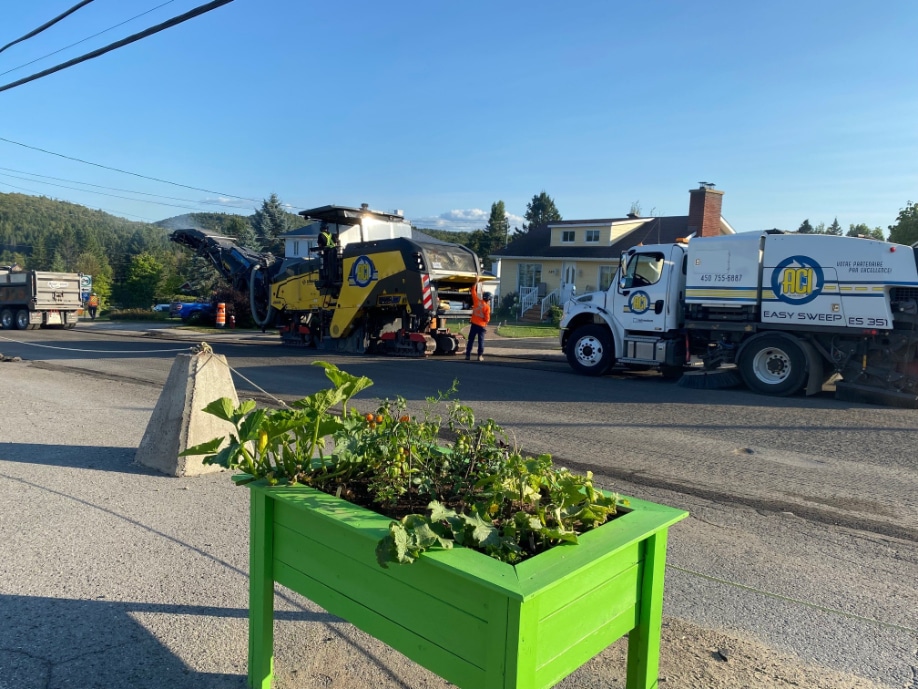
According to Lussier, ACI has completed 50 asbestos-coated asphalt projects since 2010 and is one of a handful of companies in Quebec equipped to work with asbestos-coated asphalt. However, he added, “Asbestos projects represent a small percentage of annual planning and will continue to decrease because the Ministry of Transport removed asbestos-containing mixes from its standards in 2011.”

As companies like ACI are brought in to mill the remaining pavements containing asbestos–“usually those with very heavy truck traffic,” Lussier said–the company must follow all safety procedures and best practices. Lussier said there are two ways to handle these types of roads: stabilization and dry method. “When choosing the stabilization approach, a bitumen emulsion is introduced into the leveled layers of the surface, allowing asbestos particles to bind together,” Lussier said. “This process helps prevent the release of hazardous dust or fumes.” In the case of the dry method, he added, the pavement material is gathered, enclosed in large stitched bags, and then disposed of at a landfill site authorized by the Ministry of Sustainable Development, Environment, and the Fight Against Climate Change.

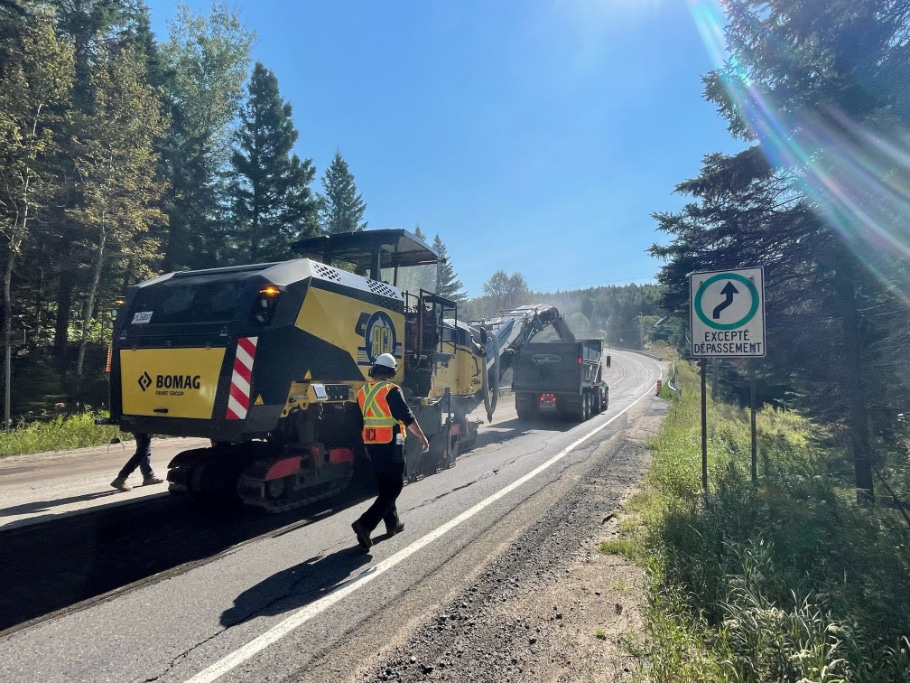
“The second method can be very expensive, so we prefer the first method, but ultimately the choice is up to the Transportation Ministry,” Lussier said. ACI has retrofitted one of its milling machines to handle the first method. When the company must utilize the second method, it would prefer to use its BOMAG milling machine in order to benefit from the ION DUST SHIELD, given that the asbestos particles are also quite fine. However, the machine isn’t quite large enough to make sense on the types of roads that contain asbestos. “If we had a larger BOMAG mill, we would definitely be using it on those jobs.”

How to Mill With Less Dust

Canadian companies turn to ion technology to combine fine dust, clear air for milling crews.

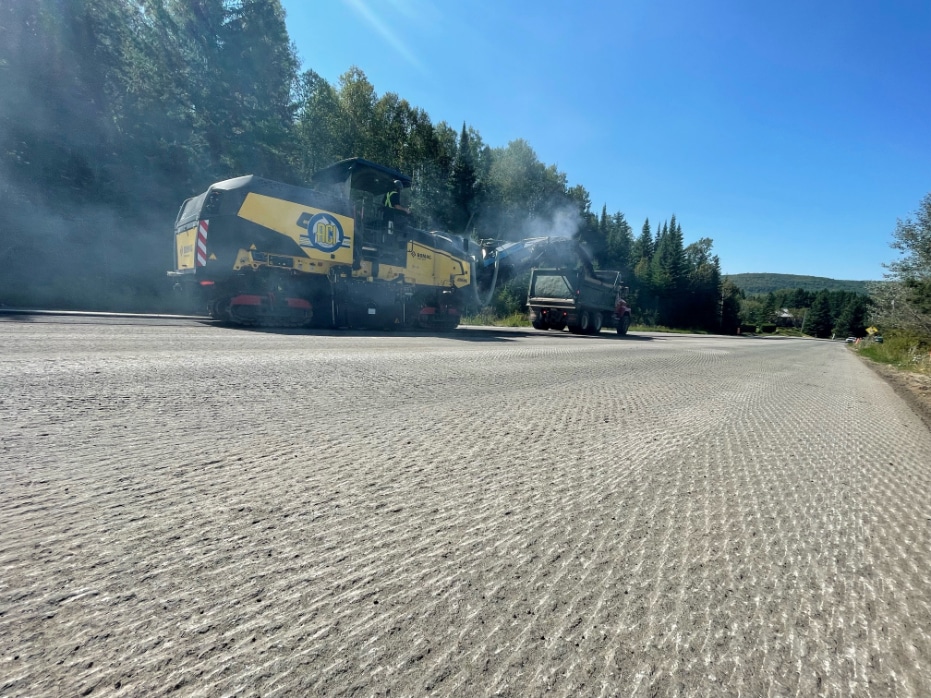
Denis Lussier remembers how dusty the work could be when he started as a milling machine operator at ACI, Joliette, Quebec, in 2007. “Sometimes, there would be so much dust it looked as though a cloud of dust was moving forward down the highway,” Lussier said.

Throughout the past two decades, original equipment manufacturers (OEMs) have worked hard to reduce the amount of dust around their milling machines—to much success. “All of the companies that make these machines have innovated to reduce the amount of dust the operators experience when using these machines,” Lussier said, from water systems that suppress the dust to vacuum systems that collect the dust.

Although this has had profound impacts on the amount of visible dust, these innovations have also reduced the amount of fine dust surrounding the milling machine. Fine dust, while invisible to the naked eye, is actually more hazardous to workers’ health than visible dust, according to the Occupational Safety and Health Administration (OSHA).

While larger dust particles often fall to the ground quickly, fine dust particles can remain aloft much longer. Furthermore, our bodies are better-equipped to handle larger dust particles, which are often captured by our nose hairs, for example, whereas our bodies lack defenses against fine particles that can make their way into the lungs and cause health issues.

Bomag’s ION Dust Shield

In an effort to take silica dust suppression to the next level, ACI invested in a BOMAG BM 2200/65 equipped with the company’s innovative ION DUST SHIELD technology in June 2023. “The system makes it so we have almost zero dust on our jobs,” Lussier said. Now, he’s a technical advisor and training manager at ACI, making decisions that impact the company’s current generation of equipment operators—like the company’s new BOMAG milling machine with ION DUST SHIELD.

“This is a hard job, but this innovation makes it a bit easier,” Lussier said. “The system is easy to use, easy to clean, and it’s a very good step for our industry to prevent employees from breathing in dangerous silica dust.”

Founded in 1998, ACI specializes in cold asphalt recycling and is the largest milling company in Quebec, operating throughout the entire province. Since ACI’s inception, the company has milled approximately 1.6 billion square feet (150 million square meters) of the Quebec road network.

How the ION DUST SHIELD Works

The ION DUST SHIELD is an addition to BOMAG’s standard dust extraction system. The system, which received the silver medal of the BAUMA Innovation award in 2019, reduces the amount of hazardous fine dust by 88%, according to the manufacturer.

The system works by applying an electrical charge as the fine dust passes through the ION DUST SHIELD. The positively charged fine dust becomes unstable and tries to stabilize by bonding with other fine dust particles. As more fine particles clump together, they form coarse dust that can then be ejected with the milled material via the conveyor belt.

The ION DUST SHIELD does not rely on filters, which reduces the need to clean, service and dispose of these filters as a hazardous material.

“As people have learned about the ION DUST SHIELD, interest in the system is growing,” said BOMAG Product Manager for Cold Milling Dennis Frenzius, adding that the greatest interest so far has been in Europe. “There’s a lot of focus on fine particles in Europe as a result of conversations about reducing fine dust from standard mechanical brakes on cars.”

How to Dispose of Silica Dust

Furthermore, BOMAG has performed tests on the ION DUST SHIELD with health institutes in both Germany and France that have illustrated the system’s capabilities to reduce fine dust by 88% or more. “Now, we’re working on having similar discussions and tests with organizations in North America,” Frenzius said.

Although the North American tests have yet to occur, interest in the ION DUST SHIELD has been growing in these markets, Frenzius said, adding that every BOMAG milling machine with a front loading conveyor sent to Canada this year has been equipped with the ION DUST SHIELD. “Having the ION DUST SHIELD in the market improves visibility for this technology,” he added. “Whenever people become aware that there are new technologies to manage fine dust particles, that drives the discussion forward.” For example, World of Asphalt 2024 in Nashville drove a lot of interest in the system in the U.S. market.

“Our customers are very interested in protecting their operators from silica dust,” Frenzius said, adding that it’s also a matter of employee attraction and retention. “Interest in running a piece of machinery like this will be impacted if the operator’s health is at risk. That makes the ION DUST SHIELD even more important, because it offers the operator the highest level of protection available.”

Prioritizing silica dust suppression is not only important for operator health, but the health of others in the project area, such as the sweeping, paving and road marking crews behind the milling machine and pedestrians.

Frenzius stresses the importance of positive protection from silica dust, such as the ION DUST SHIELD, which is a useful addition to the PPE. Frenzius also recommends not relying exclusively on water systems, as fine dust is often too small to bind with water due to the surface tension of the water droplets.

Frenzius stresses the difference between coarse dust, which is often visible to the human eye, and fine dust (the type of dust targeted by the ION DUST SHIELD). Fine dust, while invisible to the naked eye, is actually more hazardous to workers’ health than visible dust.

Stay Ahead of New Standards

Although masks currently aren’t required on most milling projects in Canada, companies are preparing for a day when the silica dust standards become more strict. “In Europe, there are inspectors who come out to test the dust around these machines,” Lussier said, “and that’s eventually how it will be in Canada.”

On the other side of the country, Command Equipment Ltd., Edmonton, is also getting ahead of anticipated changes. “We don’t have inspectors coming to our jobs or anything, but they are starting to get stricter up here in Canada,” said Doug Booth, superintendent of Command Equipment’s milling division. “We want all our employees to be safe and healthy, and it’s important for us to investigate solutions to the problems they face.”

Command Equipment began using the ION DUST SHIELD in summer 2023. The company already had one BOMAG BM 2200/65 and needed another for a mill-and-fill project on Queen Elizabeth II Highway from Lacombe to Red Deer (18.6 miles/30 kilometers) for the Alberta Ministry of Transportation. The second BOMAG was equipped with the ION DUST SHIELD, so Command Equipment decided to put the new technology to the test.

“That’s a heavy commuter route, because it’s the main highway from Edmonton to Calgary,” Booth said, adding that the road had experienced significant surface cracking as a result of age and heavy use. Command Equipment was hired to mill to a depth of 2.4 inches (60 millimeters) and repave overnight to reopen each section of fresh pavement by the following morning.

Broce Manufacturing Leads the Way in Silica Dust Control for Sweepers

They milled one lane (7.2 feet or 2.2 meters) with their BOMAG with ION DUST SHIELD and one lane with another milling machine. “It was really good to perform a side by side comparison,” Booth said. “The guy running the BOMAG said he wasn’t getting as much dust and stuff blowing back at him as on the other machines.”

Command Equipment’s milling division operates four milling machines and performs almost exclusively highway work throughout Alberta and into the Northwest Territories nearly up to Yukon.

Booth has worked at Command Equipment for 15 years and in the company’s milling division for seven before being promoted to superintendent last year. “Whenever a new machine comes in, I like to kick the operator off and try it out, like it’s a new toy,” he said. “I like that the ION DUST SHIELD is easy to use. You don’t have to do anything. It’s just there and it just works.”

“Although the ION DUST SHIELD doesn’t make us run better or faster, it does make the environment healthier for the operator and ground crew,” Booth said. “Our company is all about investing in the safety of its employees, so this was an investment they made to make our lives a little better.”

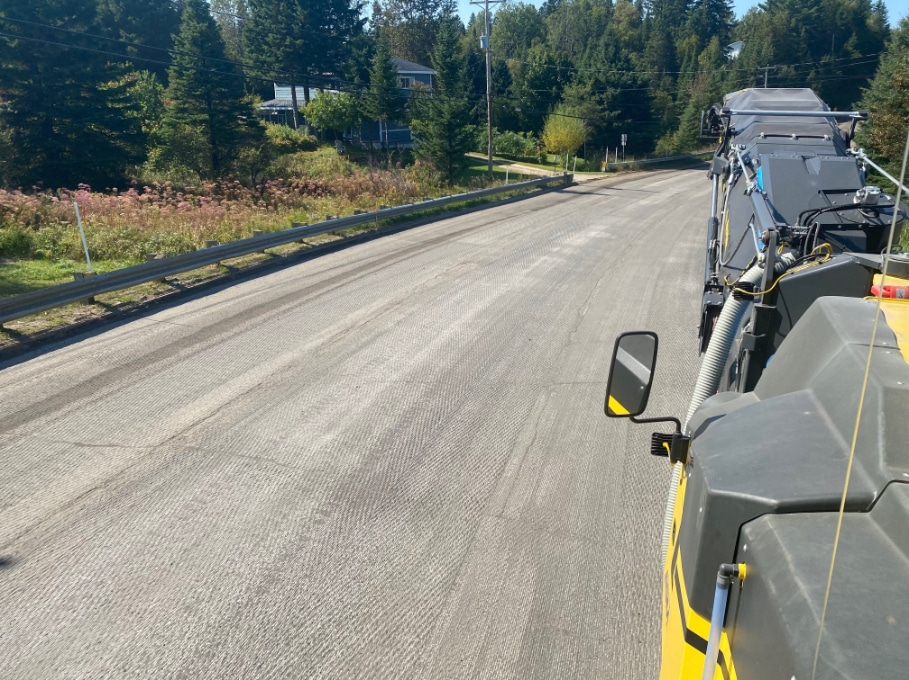
The ION DUST SHIELD is an addition to BOMAG’s standard dust extraction system. The system works by applying an electrical charge as the fine dust passes through the ION DUST SHIELD, seen here atop the conveyor.

Relationships & Results

ACI first rented the BOMAG BM 2200/75 in 2020. The company has long had a great relationship with SMS Equipment Inc., which became a BOMAG distributor in 2019. “We find we have better service from SMS than from other dealers,” Lussier said. “Milling machines are prone to breaking down given the job they do, so it is very important to have good service.”

After the company had used the machine for a while, BOMAG invited ACI employees to Charlotte to see the new BM 2200/65 model, to discuss their experience with the machine, and to brainstorm the features they’d like to see on the next generation of BOMAG mills. “We’ve learned that BOMAG is a company that really listens to their customers,” Lussier said.

For example, ACI found the earlier version of the BM 2200/75 they rented several years ago was a bit too noisy. On the BOMAG BM 2200/65 ACI purchased in 2023, BOMAG put the fan at a 45-degree angle at the back of the machine for a quieter work environment for the operator. The new machine also came with the ION DUST SHIELD included. “That wasn’t something we had to choose to add on or pay extra for,” Lussier said. “It is a useful feature that comes standard in Canada.”

According to Lussier, the company considers the amount of dust they anticipate on a project when deciding which jobs to send its BOMAG mill out on. For example, if the company is planing concrete or milling in confined areas such as tunnels and under bridges. It’s also great when milling into the wind. “The water and VCS systems work well to suppress dust in most situations, but it’s been great to have the ION DUST SHIELD, too, when we have to mill into the wind,” Lussier said.

Where the BOMAG BM 2200/65 has most excelled for ACI is on projects where the crew must immediately pave after milling—for example, when the company recently milled and repaved highways 40, 35 and 10 overnight and had to reopen them by 5 a.m.

“On these types of jobs, we have to put down less water so the surface is ready for paving shortly behind the milling machine,” Lussier said, estimating that they run the water systems at 20% on these jobs compared to 100% on jobs without this time constraint. “When we must use less water, the ION DUST SHIELD is perfect because it can help capture that extra dust.”

According to Lussier, ACI has 14 employees trained to use the BOMAG mill. “They all like the ION DUST SHIELD very much,” Lussier said. “They say that when they run this machine, they experience no issues with dust.”

AWP Introduces Automated Flagger Assistance Devices

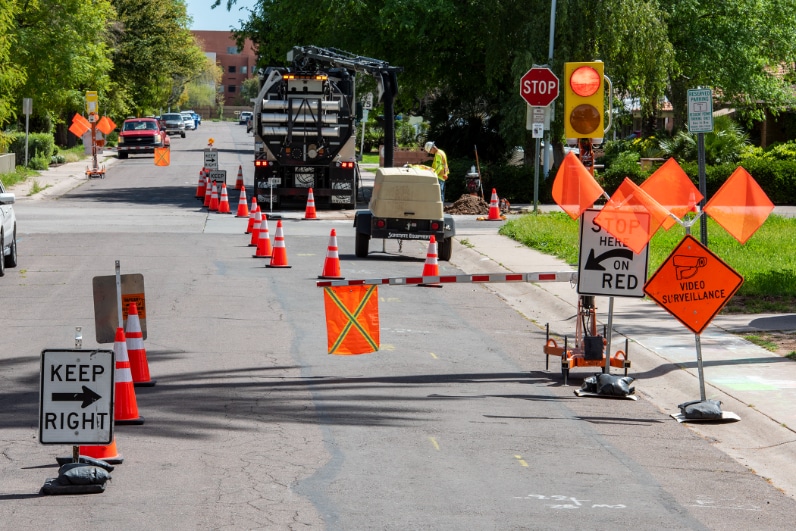
Imagine your average paving project on a two-lane road. One lane is closed for the paving crew to do its job and the other is accommodating both directions of travel, controlled by flagging operations at each end of the job site.

Then, all of a sudden, a semi speeds around a turn leading up to the work zone and, unable to stop in time, slams into the flagging operation. An alarm blares, notifying the paving crew of the work zone intrusion. Thankfully, the semi comes to a stop before reaching the crew. And, because the job site was equipped with an Automated Flagger Assistance Device (AFAD), the flagger is also safe and sound.

That’s because, in early 2023, AWP Safety, North Canton, Ohio, announced a partnership with Site 20/20 to deploy its Guardian SmartFlagger AFADs on AWP’s work zones in more than 20 states across the country.

Oldcastle’s AWARE System Makes Every Second Count

AWP Safety’s services range from work zone flagging to design and engineering for transportation management plans, as well as equipment sales, rentals and support in 28 U.S. states and four Canadian provinces.

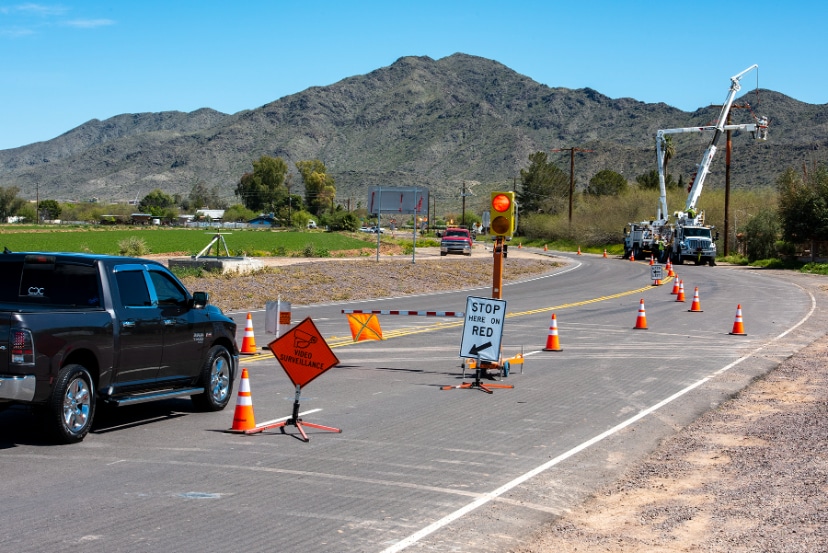
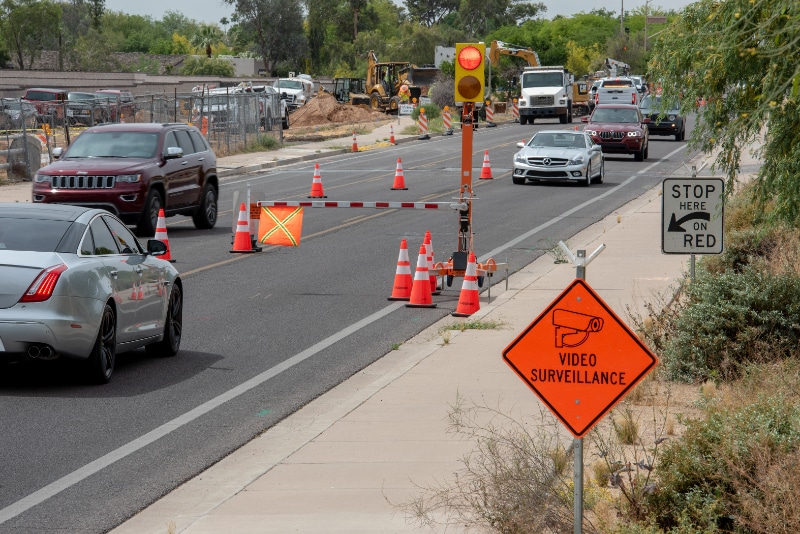
AFADs allows an operator to monitor and control traffic through the lens of two HD cameras. Using a smart tablet instead of a flag, operators can perform their duties at a distance.

Recognized by the American Traffic Safety Services Association (ATSSA) for advancing roadway safety, Guardian SmartFlagger aims to increase motorist compliance and improve work zone safety. Since its inception, these devices have been used by more than 100 traffic control companies in North America.

The Road to Autonomy

According to Greg Ryan, vice president of AWP Safety’s north business division, the technology behind AFADs has been around for 20 years. “I first learned of the Guardian SmartFlagger five years ago, but I didn’t think the technology was 100% ready or that the market was ready for such a device,” he said. Then, in 2020, Ryan decided it was time to reconsider the concept.

“In 2020, we started facing an even more acute workforce shortage and began looking for alternative solutions to achieve the capacity we needed,” he said. “We began investigating what autonomy could do and learned of all the additional features Site 20/20 has added over the last five years.”

Meet a Woman of Asphalt: R.K. Hall’s Mindy King

These improvements included integrations with Google/Waze, reducing the weight of the device by half and adding video recording capabilities and the ability to pair up to four devices. In that time, the devices had also been tested according to the Manual for Assessing Safety Hardware (MASH), a standard for testing work zone traffic control devices from the American Association of State Highway and Transportation Officials (AASHTO).

“They were something we were ready to run with,” Ryan said. “Once we were in that mindset, the next question was ‘How do we get our customers to adopt this?’”

Customers Hop Aboard

AFADs boast a number of benefits, from the safety of construction workers by removing flaggers from the flow of traffic to reducing labor costs and improving operational efficiency.

Ryan said some of AWP’s customers got on board with the idea right away, but others were initially resistant to the change. The first step was developing support for the idea across AWP’s organization. “Today, we have at least one local champion for the device in every office,” Ryan said. “They use these devices every day.”

According to Ryan, the most resistant customers were what he calls the “old school” individuals. “They’d say, ‘I trust people, not machines,’” Ryan recalled. Most would open up to the idea once AWP showed them data that the general public actually responds better to these than they do a human flagger. “When they see the data and see them in action, they start to understand the benefits.”

For example, Guardian SmartFlaggers were deployed on a job site where a car plowed through the AFAD’s gate arm. The gate arm fell off, the alarm sounded to notify the crew, and the car stopped before it reached the crew. A customer resistant to the use of AFADs who was on the job turned to Ryan and cited the event as evidence the AFAD didn’t work as intended.

Does Hands-Free Driving Hinder Safety?

“I told him it worked exactly as planned,” he said. “The car stopped, the crew is safe, and I’m not calling an ambulance for a struck flagger. The only damage done was a scratch on the intruding vehicle, and we have video showing them to be at fault.”

Ryan shared an event where a motorist drove through the gate arm and attempted to sue the contractor performing the work. “The contractor reached out to us, we found the video of the lady as she hit the gate arm showing both her hands were on her phone,” Ryan said. “We sent that to the contractor and that was that.”

“The flagger is 100% safer if they’re operating the AFAD from a safe distance instead of standing out there for a traditional flagging operation,” Ryan said. The other benefit that brought customers around was the increased capacity these devices afford. “When we implement AFADs on appropriate jobs, it means we have additional manpower to use for jobs where AFADs don’t make sense,” Ryan said, for example, double lane closures or any job that calls for arrow boards or similar devices/setups.

According to Ryan, one person can control up to four AFADs, however, on a typical closure with one lane of split traffic, he said AWP still utilizes one person per AFAD. Often, customers prefer a mile-long work zone in order to optimize paving efficiency. “But you’ll usually have a number of side streets, driveways, etc. along a mile-long work zone,” Ryan said. “Normally, we’d need three or four people out there to account for that level of complexity. With the AFADs, we can do it with two people, one operating the ends and one controlling the ins and outs to ensure folks aren’t turning left when traffic’s going right.”

With the use of AFADs, AWP is also able to locate its flaggers closer to the crew for improved communication and allow for cool down and warm up breaks without having to find someone to relieve the flagger. “When we’re able to do more for less while providing better safety, that’s hard for a customer to say no to,” Ryan said.

AWP has also found a number of creative uses for its AFADs. For example, traffic assessments/car counting and storm responses. “We got a call in the middle of the night to reroute traffic around an icy road,” Ryan said. “We didn’t initially plan to use AFADs for storm work, but we quickly learned that’s one more option for them.”

How SmartFlagger Works

Guardian SmartFlagger is designed to fit in the back of a standard pickup truck and boasts a 60-hour battery life. It’s equipped with extendable legs for level operation on all types of terrain and can run either on the cellular network or on an independent network in areas without cellular service.

Ryan said setup of the device is as simple as placing an AFAD where it’s needed and putting down the gate arm to safely set up the rest of the work zone and remaining AFADs. “Then, all you have to do is turn the tablet on and it senses however many devices you have out there,” he said. “Then, the operator selects the AFADs he or she will control and will be able to see the camera view from the AFAD to begin operating the device.” The HD cameras offer a 360-degree view and include night vision capabilities and up to 80 hours of recording time.

Ryan said one of his favorite features is the system’s integration with Google/Waze, instantly informing those apps of the active work zone. “Studies show that notifying drivers of an active work zone results in a 20 to 25% reduction in traffic,” Ryan said. “Anytime you can go from having 100 cars driving past a work zone to 75, I’ll take that deal.”

In the event that a vehicle drives around or hits the fully detachable gate arm, Guardian SmartFlagger automatically triggers a 115-decibel intrusion alarm to notify workers. The operator can also manually trigger this alarm.

Lakeside Industries Shares a Winning Safety Strategy

Another feature Ryan appreciates are the built-in redundancies to prevent accidentally opening a gate. “The system asks several times if the operator is sure they want to open the gate,” he said, adding that the operator can also enter the speed limit and size of the work zone into the system to receive estimated gate times. “If you set the speed right and the distance right, the app might suggest that it would take a car 32 seconds to clear from gate one to gate two. If you try to close a gate before that lower limit, the app asks you several times if you are sure.”

The system will also inform the operator if traffic is heavier in one direction and suggest how much longer to keep open the busier direction for optimal traffic flow. “It does a lot of the things our folks naturally do on a daily basis,” Ryan said.

Site 20/20 also makes the Guardian Cone, the 2022 winner of ATSSA’s Innovation Award. Guardian Cone monitors vehicle speeds and detects work zone intrusions to alert workers of danger. AWP Safety utilizes both Guardian Cone and SmartFlagger to improve work zone safety. “Guardian Cone is one more technology we can use to watch our backs and our customers’ backs,” Ryan said.

Improve Flagger Safety on National Traffic Directors’ Day

The Future of Traffic Control

AWP Safety rolled out its first Guardian SmartFlagger devices in 2020 in central Ohio and Indiana. “By the end of the year, we had more than 50 units between the two states,” Ryan said. Now, the company has more than 200 units deployed in 27 of the 28 states in which AWP operates. “The only reason we haven’t introduced them in the last state yet is because we’re working through the final DOT approvals there,” Ryan said. “With the size and scale of our operation and our role as leaders in the market, this technology is definitely something we will be pushing for in the future.”

Ryan doesn’t see a future where AFADs replace qualified safety professionals, but he does see a future where AFADs enhance AWP’s workforce. “We still require the same certified person to operate the AFAD,” he said. “The AFADs simply assist us in what we do to protect our employees, customers and the traveling public.”

According to AWP Safety’s Chief Commercial Officer Josh Shipman, introducing new work zone safety technologies will continue to be a constant priority for the company. “Keeping our roads and highways safe as they continue to bear new levels of traffic will require trained professionals and even better tools for the job, and we believe we are working with the best available,” he said. “As the complexity of transportation projects grows, so too must our safety procedures.”

Common Mistakes to Avoid During an OSHA Inspection

Undergoing an inspection from the Occupational Safety and Health Administration can be a stressful and intimidating experience. However, going into the process informed can not only help you reduce stress, but can also reduce the chances of making one of the following mistakes.

During his 33 years in the occupational safety and health field and 25 years as an OSHA compliance safety and health officer, Matthew Humphreyville has seen it all. Now a senior industrial hygienist and safety consultant at Universal Engineering Sciences (UES) following his retirement, Humphreyville shares some of the mistakes he’s seen during OSHA inspections.

Mistake #1: Not having a safe, OSHA-compliant job site in the first place

This one may be obvious, but the biggest mistake a company can make is not having a safe job site in the first place.

“We all understand a solid safety and health plan is important,” Humphreyville said. For example, he added, “When the compliance officer is on the job is the wrong time to be thinking about fall protections.”

“Preparing an inspection plan helps you avoid penalty fees and abatement costs into the thousands of dollars,” Humphreyville said. In the example of fall protection, the gear, the procedures, and training should be purchased, discussed and implemented long before OSHA shows up. “The capital costs can be high getting these things figured out up front, but in the long term, you’re going to save yourself money,” he added.

Use OSHA’s NEP to Keep Workers from Overheating

Mistake #2: Not understanding what prompts an OSHA inspection

“A lot of people believe an inspector can just drive down the road, pick out a site, drive in there and do an inspection,” Humphreyville said. “But that’s not legal. If [an inspector] does that, you need to call their department on it.”

Reasons for an OSHA inspection include catastrophes, fatalities, complaints, referrals from other government agencies and program inspections for construction.

Under the plain view doctrine, a compliance officer can also cite any imminent dangers he or she may see. For example, if an officer is driving down the street and sees a 20-foot trench with type C soil with water in the bottom, spalling off the side, the spoil pile right on the side and three guys inside, Humphreyville said the officer can stop and inspect the site. “The plain view doctrine means that if I see a hazard not related to my inspection, I can start investigating that hazard,” he said.

Mistake #3: Not resolving citations by pre-inspection, when possible

When OSHA receives a report of a lower risk hazard, Humphreyville said OSHA may not send out an inspector. Instead, they might call, fax or email the employer to let them know they’ve received a complaint.

“They give [the employer] five working days to look into the issue and reply with a written response,” Humphreyville said. Some of the information that may be helpful in resolving a complaint without an inspection include photographs showing resolution of the issue, safety product purchases and invoices, or conducting employee training.

“If [your response] satisfies the OSHA office, they’ll normally close that [complaint] out,” Humphreyville said. “If you don’t respond, or they have additional questions, they’ll call you. Sometimes, they may actually perform an inspection.”

Mistake #4: Not notifying OSHA yourself in the event of a qualifying incident

“In the event of a fatality on your job site, you have eight hours to call OSHA,” Humphreyville said. “You have 24 hours for loss of an eye, amputation or an inpatient hospitalization other than for observation.” Humphreyville notes that if a person is hospitalized overnight for observation, it may be recordable, but it’s not reportable.

“A lot of times, what happens is the employer thinks the worker’s compensation company is going to report it [to OSHA],” Humphreyville said. Although some districts may be okay with the report coming from other organizations, such as workers compensation or the police department, others want the report to come directly from the contractor. Ultimately, filing that report in the proper time frame is the contractor’s responsibility.

Mistake #5: Not establishing a point of contact within your company to work with OSHA

“You should always have a point of contact with the company to deal with OSHA,” Humphreyville said. “I don’t know how many times I walked onto a site, introduced myself to the foreman, and they didn’t know who to call.”

When that would happen, he would usually suggest calling the person’s direct boss. “But instead of me walking that person through what I think is best, the company should have that process in place.”

The OSHA contact point should have information on the company’s safety program, injury/illness prevention program, the company’s safety manual, hazardous assessments, PPE requirements, logs, equipment records, daily inspection reports and the like. “You don’t have to give all this to the compliance officer right off the bat, but you should have them ready in case they ask for it,” Humphreyville said.
Each ALED unit is 75 pounds, so it can be transported in a pickup truck bed and rolled like a suitcase to where it’s needed.

Mistake #6: Not knowing your rights when OSHA shows up at your job site

“The first thing [an OSHA compliance officer] is supposed to do when they show up to your site is show you their credentials,” Humphreyville said. “They should also be able to tell you why they’re there. Always ask the reason for the visit.”

Humphreyville also recommends checking the officer’s paperwork during the opening conference to ensure the address listed is actually your address. It’s not unheard of for officers to show up at the wrong address; if you don’t check, you may undergo an unnecessary inspection. “It’s incumbent on you to ask those questions, to verify these things when they get there, to know your rights,” Humphreyville said. “They aren’t going to get mad at you; they expect you to ask questions.”

During the opening conference, the officer should provide you with a copy of any complaints and review the employer’s rights, including the right to refuse entry. Although Humphreyville was only refused entry once in his career, it is the employer’s right. In that event, he said OSHA must be granted a warrant before returning for the inspection, which can take anywhere from a few days to a few weeks.

“I don’t recommend this because, in the inspector’s mind, they’ll wonder why you’re refusing them,” Humphreyville said. Although officers aren’t supposed to treat a company differently, he said refusing entry could cast suspicion in the officer’s mind. “They might look a little closer than they normally would.”

During the opening conference, the officer will ask basic questions about the company, including number of employees, management structure, contact information and similar details. “They may ask if there’s a union representation, because the union has a right to be a part of [the inspection], either in the same opening conference or in a separate opening conference,” Humphreyville said.

Mistake #7: Being a jerk to the compliance officer

“Be respectful and courteous,” Humphreyville said. “Even if they’re a nitwit or act like a cop who wants to flex their muscles, just be professional. If you have a problem with a compliance officer, you can always take it up with the area office.”

Calculate the Cost of Occupational Injuries & Illnesses with OSHA’s Safety Pays

Mistake #8: Not following proper safety procedures during the inspection walk-around

Humphreyville said the officer may conduct a walk-around, if necessary. During the walk-around, be sure to wear the appropriate PPE and ensure the OSHA representative also has the appropriate PPE. “You want to show some initiative here,” he said.

If the compliance officer sees something during the walk-around, Humphreyville recommends taking some kind of immediate corrective action if possible. For example, taking the machine in question out of service.

Mistake #9: Not taking your own photos and notes during the inspection

“As the walk around occurs, if the [compliance officer] takes a picture, I recommend you take the same picture,” Humphreyville said. If they write down an issue, you should write it down, too, he continued.

Mistake #10: Giving the compliance officer more information than requested

“Don’t offer information unless the compliance officer requests it,” Humphreyville said. “Don’t be evasive and don’t lie, but don’t roll out the red carpet and start throwing information at them.”

Although it’s an obvious mistake to lie during an OSHA inspection, Humphreyville said the types of actions that are most likely to result in a criminal review include mail fraud, lying to investigators or sending false documents. “Those are the types of cases that tend to get picked up by the Department of Justice,” Humphreyville said.

There’s also some information you aren’t required to supply. For example, a copy of your incident report. Although this was something Humphreyville always asked for, he added that “the investigator is supposed to investigate that on his own. The reason I asked for it was I wanted to see what internal processes [a company] has in place to investigate these events for future improvement.”

Furthermore, Humphreyville stressed the importance of providing the officer with copies of any documentation you supply. “Don’t ever give them your original.”

Keep OSHA Away with Less Dusty Pavement Repair

Mistake #11: Not understanding your employees’ rights

According to Humphreyville, OSHA now performs employee interviews at almost every inspection. During these interviews, the officer will ask employees questions, write down his or her answers, and request that the worker sign his or her statement.

“Employees have the right to talk to the [compliance officer],” Humphreyville said. “They can request to talk to them and the employer cannot refuse the employee’s request.” If an employee cannot speak English but wants to speak to the officer, OSHA will get an interpreter.

If an employee brings up issues beyond the scope of the investigation, Humphreyville added, the officer is supposed to focus on the specific inspection. However, any additional information provided may be featured in the report or may instigate a separate complaint.

On the other hand, employees also have the right to refuse to talk to OSHA. They also don’t have to sign their statement if they don’t want to. Humphreyville said he’s seen some employers’ lawyers advise them never to sign a statement or even read it. “[These attorneys] look at [the statement] as if it’s notes on the conversation,” he said.

Humphreyville said it’s also relatively common for employers to try to oversee employee interviews. Although some employees may agree to this, he adds that the employee has the right to talk to OSHA by themselves or have their own designated representative with them.

“When you cross the line into management personnel, then you can have a company representative in there,” Humphreyville said.

Mistake #12: Not asking questions during the closing conference

After the inspection is concluded, the compliance officer is supposed to hold a closing conference. Humphreyville said this is an ideal time to ask any questions and request an abbreviated version of what they’ve found.

“I’d also ask if they think they’ll need to come back for more interviews, more walk-arounds, etc.” Humphreyville said, to get an idea of what’s to come. He said this also provides a time to review citations and even to request that serious citations be reduced to other than serious. “Sometimes that’s a way to settle [disputes],” Humphreyville said.

Mistake #13: Not following proper procedure in the event of a citation

“When you get a citation, you’re supposed to post that for employees to view,” he said, for three days or until the hazard is abated.

“Failure to abate is when you don’t abate a violation; a violation repeat is when you fix the violation but it reoccurs,” Humphreyville said, adding that OSHA can cite you for a repeat on a different standard so long as it’s closely related to the original citation.

New Online Portal Simplifies Application Process for OSHA’s Voluntary Protection Programs

Mistake #14: Promising corrective measures you can’t deliver on

In the event of OSHA proposing corrective measures, Humphreyville said it’s acceptable to request more time to research potential solutions “so long as it’s in good faith.”

“Take the time to look into solutions, to research them, to see if that’s really something you’re going to be able to do,” Humphreyville said. “You don’t want to tell OSHA something and then have to backtrack.”

Mistake #15: Not going above and beyond OSHA’s standards when necessary to maximize employees’ safety

“Remember, OSHA standards are minimal safety standards,” Humphreyville reminds us. There may be safety best practices above and beyond OSHA’s requirements, including state or local standards or even requirements from the general contractor on the job.

“OSHA can’t cite you for [breaking] an employer’s rule,” he said. For example, if a GC requires hardhats on a site where OSHA doesn’t require them and a subcontractor doesn’t follow the GC’s rule, that is not an OSHA issue. But, it may still be necessary to improve safety on that particular job site.

And we should all be doing our best to maximize employee safety—not only to avoid OSHA citations, but because it is the right thing to do.

Light the Job Site with an Autonomous Drone

From capturing photos of job sites to measuring aggregate stockpiles, drones are nothing new to the asphalt industry. However, the Autonomous Aerial LED (ALED) portable light from Blue Vigil, Sterling, Virginia, illustrates a new frontier for the use of drones: lighting nighttime job sites.

“Currently, towed light towers are the de-facto standard for a majority of nighttime roadside, bridge, overpass and other horizontal construction sites,” said Blue Vigil CEO Robert Schumann. “We have a better, and safer, solution to answer what will soon become known as ‘yesterday’s problems.’”

Earlier this year, the portable drone light received a 2023 Innovation Award at the 53rd Annual American Traffic Safety Services Association (ATSSA) trade show in Phoenix, Arizona.

The ALED can be positioned anywhere from 40 to 100 feet above the job site, providing more than 8,000 square feet of light at an intensity of 5 foot candles when flown at 100 feet.

Drone Details

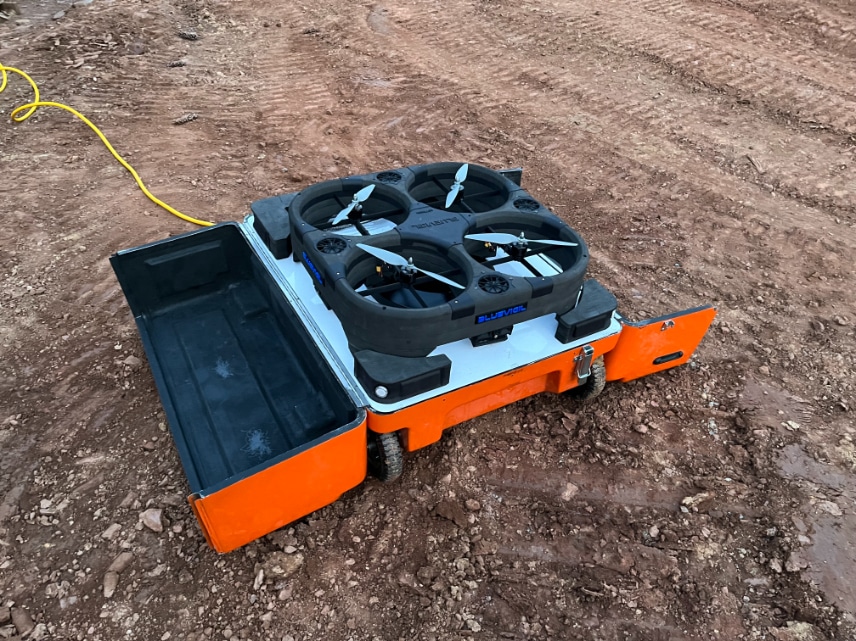
Blue Vigil’s ALED is a compact area lighting system that mounts a high-intensity LED array on a tethered Unmanned Aerial Vehicle (UAV), also known as a drone. The ALED can be positioned anywhere from 40 to 100 feet above the job site, providing more than 8,000 square feet of light at an intensity of 5 foot candles when flown at 100 feet.

“The ALED Portable Light will dramatically improve work zone safety and operational efficiency by putting more usable light on the ground where it’s needed,” Schumann said. “Illuminating a work area from directly above eliminates dangerous shadows or glare that create hazardous conditions for workers and motorists.”

Schumann recommends flying the ALED at a height of 80 to 100 feet, with a minimum of at least 40 feet. Anything lower than 40 feet, he said, would result in the same issues ground-based lighting solutions often present.

Drones are Benefitting Earthmoving Operations

The exact height a crew might choose to fly the ALED depends on the OSHA requirements for that job site and the type of work the crew is performing, Schumann said. “If you need more light, you can bring the light lower to achieve higher lumens,” he said. “For example, if you’re doing detail work like the guys at the paver, you might want to fly it lower than 100 feet.”

The ALED can be powered by wall/shore power, a portable 3000-watt generator, or a common vehicle inverter. “You can literally use one of those little Honda generators that you use for camping,” Schumann said. “Power comes up the tether, so the unit can stay in the air as long as you have a power supply.”

Because the ALED is classified as a drone, Schumann said a Part 107 licensed pilot must be on site to monitor each ALED. However, customers receive free registration for the Part 107 course for two operators per ALED.

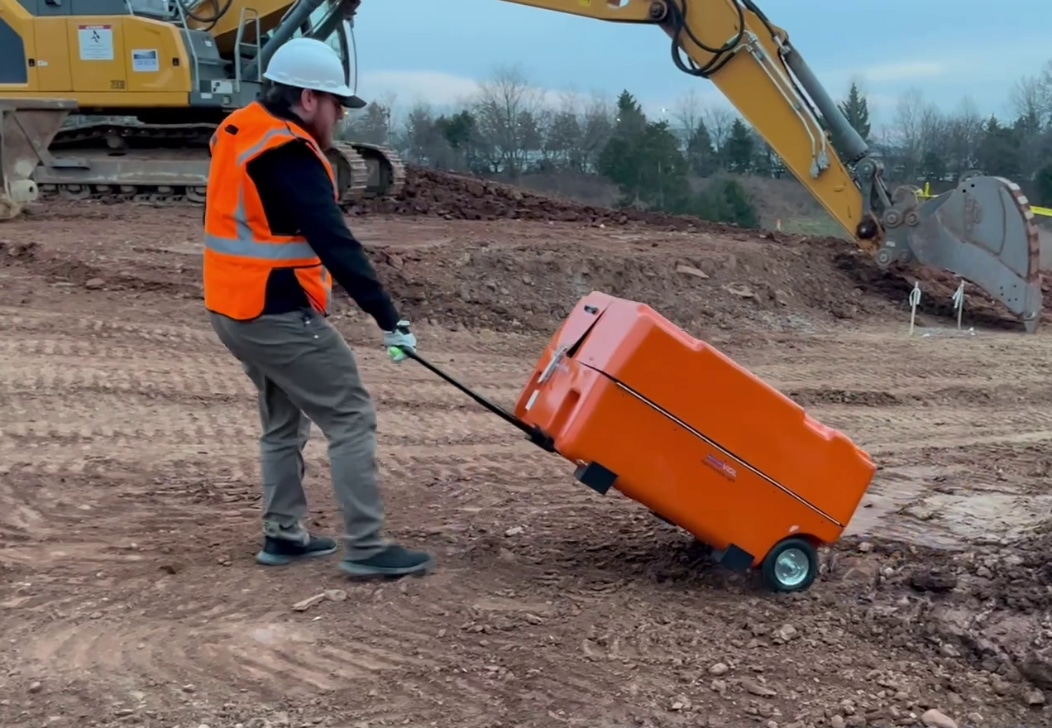
Each ALED unit is 75 pounds, so it can be transported in a pickup truck bed and rolled like a suitcase to where it’s needed.

Although the drones do not require manual control once set up, the Part 107 licensed operator must maintain visual line of sight with the ALED at all times. So, if a crew of 10 all went through Part 107 training, they could have a maximum of 10 ALEDs on the job site.

However, aside from the Part 107 license, Schumann said there aren’t additional requirements for most work environments. One example he gave: “If you’re working on an airport or near an airport, the Part 107 training will teach you the proper procedures.”

At the ATSSA trade show, one group that showed particular interest in Blue Vigil’s drone light were companies performing night work in parking lots. “We assumed the parking lots have lights, so the crews wouldn’t need to light the job site,” Schumann said. However, most parking lot lights turn on/off automatically, so crews must provide their own lighting. “They can put four of these ALEDs in their pickup truck, drop them at the corners of the parking lot and they’ll have light all night long.”

Simple Set-Up

Blue Vigil’s all-weather ALED light is enclosed in a wheeled case (30x42x24 inches) that also serves as the base of the tethered drone.

Each ALED unit is 75 pounds, so it can be transported in a pickup truck bed and rolled like a suitcase to where it’s needed. “Today, you’ve got 1800-pound lights on wheels, which means it has to be towed. That constraint limits where it can be positioned on the job site.”

Drone Safely Over the Paving Train

Once the case is in place, the operator opens the case, plugs it into the generator, and pushes a single button to raise the light into position. “The drone is tethered to the case, so it literally can’t fly anywhere else,” Schumann said. “The controls basically consist of on/off, up/down, brightness and aiming.”

“At the end of the night, the operator hits the down button and the drone automatically lands,” Schumann said. “Just close it up and roll it back to the truck or wherever you want.”

The ALED is equipped with many safety features. As the drone, which is made of foam, goes up and down, the base will flash red and emit a beeping sound similar to a backup alarm. These audible and visual indicators will also occur in the event of low power. If the ALED loses power, both the drone and base are equipped with small backup batteries to enable the drone to safely land itself. If the tether were somehow severed, the drone would still be able to land itself, Schumann said. “We’ve designed our ALED specifically to maximize safety and ease of use.”

Blue Vigil is currently taking pre-orders for the ALED, with production planned for the last quarter of 2023 or the first quarter of 2024.