Buck Brothers Pushes Tech Advantage

Buck Brothers commits to new technology across its fleet and operations

The Buck family has been involved in asphalt and concrete paving services for the Toledo, Ohio, metropolitan area since 1947. As 5th generation owners of Buck Brothers Asphalt Paving & Concrete, Chad (founder), Jacob and Zach Buck have a solid foundation in asphalt paving and milling tools and techniques as well as a clear understanding about the importance of continuous improvement.

Recently, the company sought to resolve some inefficiencies that had begun to emerge in the firm’s paving practices. For many years, crews relied on manual lasers and an old asphalt paver to achieve grade. However, a diminishing workforce created some real challenges when performing fine grading in the company’s conventional way.

Jacob explained, “We didn’t have graders or dozers at the time, so we would run stone through an old asphalt paver to achieve grade. While it worked, it was difficult to achieve a perfect grade. It became a ‘guess and check’ process that requires considerable skill.”

He knew the company needed to find a better way to fine grade, particularly on larger projects.

“It was either learn machine control or learn to manually operate a grader/dozer. It made more sense to go the machine control route,” he said.
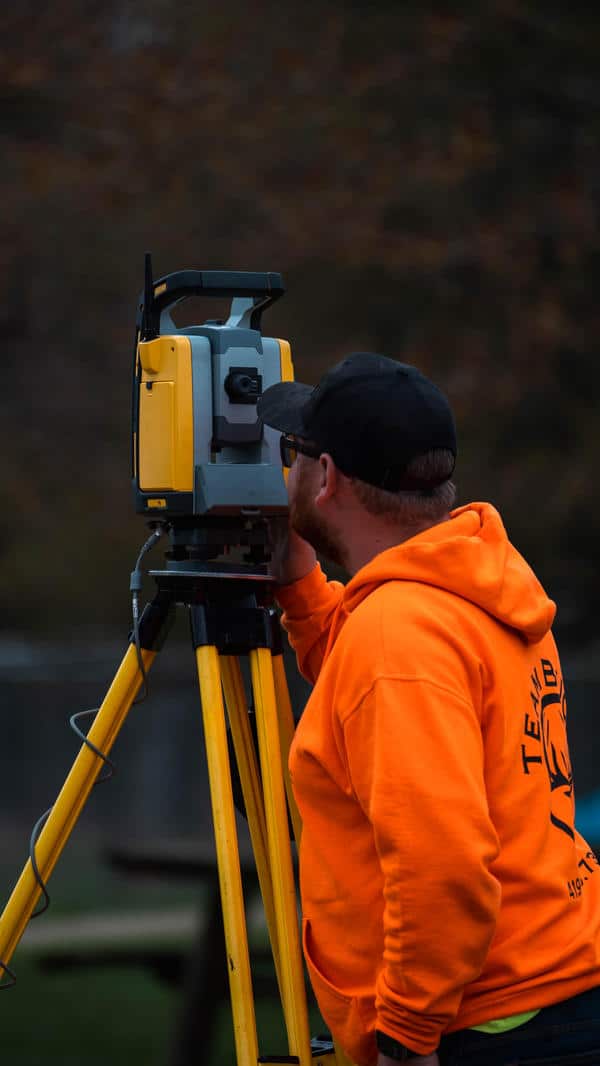
After perfecting the workflow, Jacob Buck trained team members to survey a project and send the data back to Trimble Business Center, where it can be modeled for action.

Technical Transition

In 2023, Jacob reached out to the SITECH® Ohio team, his local Cat® dealer, to get started.

He said, “They initially suggested a laser system, because, at the time, I had no AutoCAD® or 3D experience. I didn’t even know what a data collector was or how to use a total station. But I wanted the full experience.”

After some discussion, Jacob opted for a Trimble® SPS930 Universal Total Station (UTS) because it’s both a survey and machine control instrument, providing precision measurements (in the 3-mm range). The robotic and reflectorless solution is ideal for capturing field conditions like parking lots with speed and accuracy.

After a quick training session, he immediately put the instrument to work on a job. Jacob surveyed an entire project and then sent the data back to Trimble Business Center, where he modeled it.

“Remember, I went from no 3D experience to creating a full survey and grade model, plus learning machine control,” he said. “The instrument was easy to use but I needed to think more carefully about model development.”

His next step was to connect with Trimble and SITECH specialists as well as Alan Sharp from Rockpile Solutions, an authorized software development and consulting partner for Trimble. Jacob added, “With help from all of them, I was able to get a model built in one day and begin establishing a good surveying and modeling workflow.”

He would spend the next year perfecting that workflow and is now teaching other team members.

NDDOT Trials New Technologies on Hwy 14

Efficient Flow, Paved to Spec

For new construction, Jacob will set up the UTS and survey existing curbs and surrounding surfaces and structures. He explained, “I shoot everything including curbs, drainage, flush surfaces, utility lids, etc. I send that data to Trimble Business Center to be cleaned and modeled. Then, I can establish a grade off of that model.”

That model is then sent to a compact grading machine equipped with the SPS930 UTS for blade control. “The finished surface is always accurate because I’m working directly from as-built conditions, so our drainage, flushes and transitions are all going to be exactly right.”

For a reconstruction, like a mill and overlay, the process is somewhat similar.

Jacob continued, “Before we mill it, I’ll survey the existing lot and then model it in Trimble Business Center, again paying particular attention to drainage.”

Subsequently, the crew mills with Trimble 3D Roadworks on a Cat PM820 and then paves to depth with Trimble 2D Roadworks on a Weiler P385B asphalt paver with sonics.

Not every job is modeled. Jacob said, “If it’s a sizable job, 25,000 square feet or more, or a more complex job with drainage issues, then I’ll model. There are many times I’ll model seemingly simple driveways, because drainage was not considered in the initial design. We can fix those problems with re-grading.”

In the two short months before the season closed in 2023, Buck Brothers was able to fine grade over 300,000 square feet of stone base before paving. Jacob said, “We literally cut our prep time in half and delivered effective drainage in every situation.”

Those benefits continued in 2024. For instance, Cornerstone Church in Maumee, Ohio, had a 20-year-old parking lot that deteriorated quickly and a number of drainage issues that led to potholes and unsafe conditions. When complete, the Buck Brothers crew had regraded the 100,000-square-foot area to 1/16-inch precision. The curbs and islands were optimized for drainage, and they had created 24-foot drive lanes for improved access and safety.

Another project was a 50,000-square-foot freight yard, which was a unique effort because instead of asphalt, the surface was all stone, and well above grade. Conventional methods would have required the crew mill and pave multiple times to achieve the desired thickness. Jacob recalled, “I knew we needed to come down about 4 inches—but what would that do to the drainage?”

Instead, he surveyed the existing conditions with the Trimble SPS930 UTS and modeled the final surface, drainage included. A Cat PM820 cold planer equipped with the Trimble Roadworks 3D Paving Control Platform was then used to mill the parking lot to the specified grade.

He added, “Since we are able to mill 3D, it is considerably easier to pave to depth than using traditional paving methods such as checking depth with a dipstick or using sonics. We completed the work on time and to exact specifications, all while working around the client’s ongoing operations.”
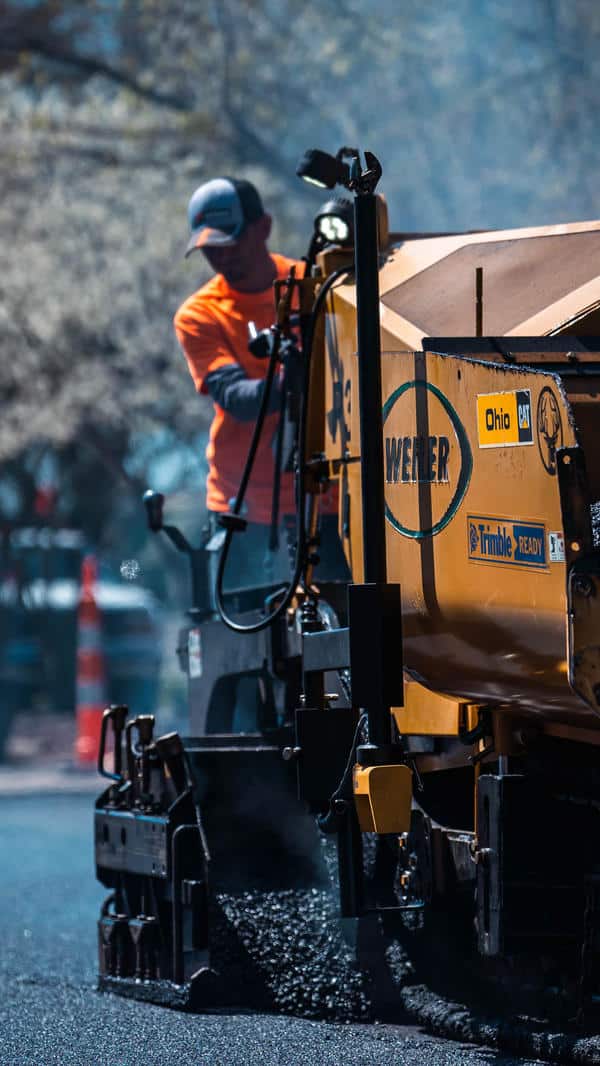
The Buck Brothers crew paves with a Weiler P385B asphalt paver with sonics equipped with Trimble 2D Roadworks.

Sustainable, Precise, Efficient

When asked about measuring the success of the company’s technology enabled workflows, Jacob noted he hasn’t run any official numbers. “For me, it’s more of a reality that I can’t do things the way we did before anymore; I needed a different solution. That said, I see value every day in this current workflow.”

He pointed to greater efficiency of materials. “With this modeling workflow, I know we’re not going to be over on asphalt. The cost savings on materials alone likely pays for the technology investment.”

Arguably, the greater benefit is confidence in the results. He continued, “Our old methods were inefficient, and sometimes inaccurate, which required rework. Now I know that everything we pave is at the right thickness and is going to drain correctly—and that’s big in the asphalt world. I can’t picture us ever going back to the way we did it before.”

Selecting Your xD for Mill-and-Fill Workflow

The satisfaction and comfort of using the 3D-modeling workflow has prompted Jacob to begin training others in the organization in how to build the models. He’s also looking to invest in other machines including a dozer and excavator.

Customer satisfaction is at an all-time high. Jacob concluded, “My customers, both owners and general contractors, are kind of in awe of what they’re seeing. Many people assume this technology is only for large scale construction sites and workflows, but we’re finding it has huge benefits for smaller sites where precision and material yields are equally important.”

Kevin Garcia is the general manager of civil specialty construction for Trimble.

Bituminous Roadways Wins with Technology Build for FedEx in Minnesota

The newly constructed, 217,000-square-foot FedEx Ground Distribution Center in Rosemount, Minnesota, may look like just a new place to sort and distribute packages. A little deeper dive reveals a powerful demonstration of how construction technology and data, especially when they are interconnected, can drive better project—and ultimately, product—delivery.

Asphalt paving firm Bituminous Roadways, Twin Cities, was tasked by R.J. Ryan Construction with paving 282,000 square yards of surface around the new facility—the largest asphalt parking lot project in the company’s history. The job required 204,000 tons of rock and 63,500 tons of asphalt.

From initial bid to delivery, the entire project was facilitated via a cohesive technology workflow that helped Bituminous Roadways deliver this award-winning project with efficiency, ease and accuracy.

Nate Larson explained the team verified data with a rover. When aerial imagery aligned with ground survey data and showed low drainage areas, the team was able to correct those areas immediately and avoid warranty issues later. “If we didn’t have these tools to find issues early on, we would likely have delays and change orders down the road,” Larson said.

Prepped with Purpose

Bituminous Roadways has long taken a strategic and transformative approach to projects. It’s a foundational principle that has kept the company at the top of the industry for more than 75 years. In today’s environment, increasingly connected technology is both integral and essential to the firm.

For the FedEx paving project, estimating software—in this case B2W Estimate—helped Bituminous Roadways do more than win the bid. Bid data went directly to the B2W performance tracking and scheduling applications to help managers establish daily field logs and assign resources according to how the job was envisioned in the bid.

“Because these systems are connected, data moves seamlessly,” explained Kim Scales, IS technology manager. “This allows us to collaborate more effectively across departments and to eliminate redundant data entry and all the wasted time and opportunity for error that go along with that.”

Data transfer efficiency continues from the field to the Viewpoint Spectrum ERP system. Labor hours, production quantities and material and equipment utilization, for example, are imported directly to the accounting system after they are recorded on daily electronic field logs.

Bituminous Roadways Inc. Celebrates 75 Years in Business

Nate Larson, construction technologist with Bituminous Roadways, said, “Our dispatchers, foremen and superintendents rely on the real-time updates and digital visualization of the scheduling software to coordinate crews, equipment, materials and up to 200 trucks daily during peak season. The daily visibility into project progress via the performance tracking software is especially important on long-term projects where scope creep can be a concern.”

In parallel, a Bituminous Roadways survey team took a Trimble® SPS986 GNSS Smart Antenna rover with a Trimble TSC7 Controller running Trimble Siteworks Software for field measurements, as well as a Trimble SPS930 Universal Total Station. A Trimble R750 GNSS Modular Receiver base station was already set up on site. And, for one of the first times, a drone was added to the field survey workflow to verify subgrade and calibrate the surface conditions.

Bituminous Roadways was awarded the 2023 Commercial Parking Lot Paving Excellence Award from The Minnesota Asphalt Paving Association (MAPA) for the FedEx paving project.

Subgrade Highs and Lows 

At the beginning of the FedEx project in 2022, Bituminous Roadways had invested in a drone and Trimble Stratus Software for as-builts and progress scans. Because of its scope and scale, the project became somewhat of a proving ground for the technology and its integration into the operational workflow.

Larson explained, “Initially we flew the entire site to verify subgrade was to spec (plus or minus 1/10-foot). Since we were new to the aerial data, we verified that data with the rover. The imagery aligned well with the ground survey data—and helped us find several issues, such as low drainage areas that would have caused warranty issues in the future. If we didn’t have these tools to find issues early on, we would likely have delays and change orders down the road.”

He pointed to one particular condition. “Because we had the rover walking the site, we found a 2-foot grade bust on one side that ended up delaying the project about a month as we waited for a redesign. If we hadn’t caught these types of issues early on, we probably would have overrun this project by 10%. Today, drone surveys are a standard tool for most jobs,” he added.

Before

A Blade of Control

Once the team was ready to begin paving, Bituminous Roadways shifted gears to jobsite production, also a technology enabled workflow that works in parallel with the bidding, estimating and jobsite planning.

The project team received a digital model from the customer that was then built out in AutoCAD. That model was shared with Trimble Business Center to develop the machine guidance files.

Lakeside Streamlines Field Data With B2W Track Mobile App

“We’ve used machine guidance solutions on our equipment for so long that I think we often underestimate the value, particularly on a large paving job,” Larson said. “It wasn’t that long ago, we’d send out two operators with a dozer and a motor grader to install the aggregate. On a project this big, we would have needed four people. Overall, I think our efficiency improvement is around 30%.”

For the FedEx job, Bituminous Roadways used a Cat 140M motor grader equipped with the Trimble Earthworks Grade Control Platform and a Cat D6T dozer equipped with the Trimble GCS900 Grade Control System. The models were sent to the machines seamlessly via Trimble WorksManager Software.

During

Of particular benefit because of the job size was the Trimble Earthworks “autos” or automatics mode. In this case, the operator controls the machine’s speed and steering, while the Trimble Earthworks system controls the blade so that it stays on grade, allowing operators to achieve high accuracy grade at a consistent rate.

“We use WorksManager on a daily basis to transport files and just navigate to different job sites,” Larson said. “As work is completed, whether it’s laying aggregate or paving, that data is uploaded back to Trimble Business Center.” At the time, the group was also evaluating the benefits of Trimble WorksOS Software for jobsite management.

“We tested it [WorksOS] out on the FedEx project to track job progress from the blades and dozers and to see how fast we’re putting in the rock, etc.,” Larson confirmed. “We see that technology as a way to get better insight into our productivity, a real-time estimate of our capabilities, whether it’s installing rock tolerancing or checking operator efficiency. It could even help with the takeoffs to supplement the drone data—and there’s no data disconnect. Everything just moves seamlessly from one system to another.”

After

Ecosystem of Opportunity 

Bituminous Roadways met and even exceeded tolerance specifications on the FedEx paving project.

“Typically, it’s a lot harder to hit estimated productions on the paving side. With this workflow, we are pretty dialed in—and that showed on the FedEx job,” Larson said. “We hit our production per crew hour thresholds, even with some additional training for our new operators.”

The advantages of technology such as grade control has them considering investment in 3D milling machines, skid blades and paving systems, while also looking to expand the use of drones in more creative ways and further build connections between various solutions.

Data, Software Tech Drive Growth at American Asphalt

Scales added, “We do over 1,000 jobs in a nine-month period in any given year. We have to be efficient and cost-effective to get all of that work done.”

Larson concluded, “Right now, from a data perspective, the schedule is our link—and that drives our digital workflow from the start, both on the operational side and in the field with survey and paving. It gives everyone, from the survey and civil team to the superintendent, a starting point. While our digital workflow is working well—it’s a source of continuous improvement and it helps to have integrated solutions and a more cohesive technology ecosystem to build on.”


Vicki Speed is a freelance writer covering the construction industry.

SDX Trial Success

Testing screed types side-by-side in the badlands of North Dakota proves industry can increase density, improve ride with patterned screed, innovation, best practices.

By paving in echelon up and down the hills of Highway 85 in the North Unit of Theodore Roosevelt National Park (TRNP), the award-winning team of Central Specialties Inc., headquartered in Alexandria, Minnesota, tested densities and smoothness achieved behind the SDX screed plate design from Caterpillar alongside the traditional SE60 screed plate design. The crew performed this 10.214-lane-mile build in spring of 2024, achieving an average density improvement on the SDX lanes of 1.7% directly behind the screed and 1.2% after the finish rollers. The overall smoothness results paint a sustainable picture for the asphalt industry.

Two Weiler windrow elevator pickup machines and two Cat AP1055F pavers with SE60 V-XW screeds worked in echelon to place two lifts. One screed was equipped with a traditional screed plate while the other was equipped with the SDX patterned screed plate.

“We increased the density by 1 to 1.5% and ride by 10% behind the paver equipped with the SDX screed compared to the traditional one,” Bryce Wuori said. He’s the proprietor of Pavewise, headquartered in Bismarck, North Dakota, and was hired by Caterpillar to serve as a consultant on the project. “We saw a 25% decrease in standard deviation. The 10,000-foot view on this project was innovation and technologies that are pushing the industry forward can be proved with this data.”

The Theodore Roosevelt National Park is divided into three parts in western North Dakota, which include a South Unit and Elkhorn Ranch Unit. CSI paved in the North Unit in the spring of 2024.

The crew built longitudinal joints during echelon paving with the notch wedge joint system from Willow Designs LLC, East Berlin, Pennsylvania.

Innovation Everywhere

Not only was the team using the innovative SDX screed plates on one of the pavers, but they also employed thermal mapping, intelligent compaction (IC) and multiple data-collection technologies to assess quality control/quality assurance (QC/QA) along the way.

One of the newer tools on hand was the GroundTruth system from Pavewise, which helped monitor environmental conditions in real time. This solar-powered, mini weather station was situated at the project site to communicate with the Pavewise software when inclement weather was rolling in. It also documented conditions for the team. For example, during southbound paving on May 29, the average ambient temperature was 64°F with an average wind speed of 9 miles per hour (MPH). That night, the area experienced 1.2 inches of rain. During northbound paving on May 30, the average ambient temperature was 57°F with an average wind speed of 11 MPH.

The crew set up Pavewise’s GroundTruth system, which helped monitor environmental conditions in real time. Here you see the solar-powered mini weather station, which communicated with the Pavewise software to alert the crew when inclement weather was rolling in and documented weather conditions.

The CSI team executed paving both lifts of more than 12,000 total tons along the 10+ lane miles in two days.

The TRNP project in McKenzie County required paving 10+ total miles from the park entrance to County Road 30 (23rd Street NW). The crew was responsible for grading, aggregate base, hot-mix asphalt (HMA), culverts, box culvert, a pedestrian walking trail, the retaining wall, signage, pavement markings and incidentals. The mix design used on the project was North Dakota’s FAA45, which uses a PG64-34H binder. The CSI team produced the mix at its parallel-flow drum plant from CWMF, Waite Park, Minnesota, which was located outside Watford City. Typical production was 610 tons per hour with a propane-fueled Hauck Eco Star 200 burner. The average mix temperature out of the trucks was 306°F.

How to Use DPS for QC in Paving

Belly-dump, live-bottom and tandem trailers delivered material ahead of two Weiler windrow elevator pickup machines, which in turn fed the two Cat AP1055F pavers with SE60 V-XW screeds vibrating at 1,200-1,400 VPM, and working in echelon.

“The paving widths were 18 feet behind the traditional screed AP1055 and 20 feet with 4-foot slough behind the 1055 with the SDX screed,” Wuori shared. See Figure 1 for more detail.

The base course was 2 inches compacted; the wearing course 1.5 inches compacted. Longitudinal joints were created with the notch wedge joint system from Willow Designs LLC, East Berlin, Pennsylvania. Jerod Willow, proprietor of Willow Designs, spoke to the efficacy of using a joint-making system with a vibrating screed.

“Screed vibration has no effect on the notch wedge device or produces no damage to the joint itself,” he said. “Willow Designs actually has options for electric vibrators on the notch wedge devices themselves because I believe using screed vibration is a good thing to a certain extent.”

Thanks to the GroundTruth system from Pavewise, the team collected environmental conditions data during the project. On May 29, while paving southbound, the average ambient temperature was 64°F with an average wind speed of 9 miles per hour (MPH). That night, the area experienced 1.2 inches of rain. The seasoned professionals at CSI have excellent stockpile management practices and know how to handle a heavy rain event. Paving northbound on May 30 saw an average ambient temperature of 57°F with an average wind speed of 11 MPH and consistently good data points in the northbound lanes.

Willow expanded on his theory and offered a tip for vibe settings. “Having screed vibration set at a moderate and manageable speed is key to help manipulate, turn and lock the aggregate in the asphalt mix together as it is protruded under the screed. A way to find manageable screed vibration per minute (VPM): stand a shovel on the catwalk of the paver screed. If it vibrates off and falls down, the VPM is too high.

“I believe too high screed VPM just causes excessive wear and tear on equipment with minimal results in increased mat density,” Willow continued. “Think about it like this: we are trying to keep the screed of the paver planted to the ground to assure a good ride quality of the pavement we are placing, but now using vibration at a high VPM is like having the screed of the paver do all these ‘micro jumps.’ Think about how vibration impacts work on roller drums. High VPM on the screed seems counterintuitive. From a highly technical standpoint, paver screeds should oscillate to be effective and produce minimal deviations of mat quality as far as smoothness and rideability.”

Shilling Construction’s Proven Screed

To assess mat temperature behind the screeds, the crew employed paver-mounted thermal profiling (PMTP). The SDX-equipped paver employed the Caterpillar thermal camera system, and it collected data showing the average lot temperature behind that screed was 267°F. It also showed a low to moderate incidence of thermal segregation. The traditional paver employed the MOBA thermal camera system, and it collected data showing the average lot temperature behind the traditional screed was 259°F. It also showed a moderate to high incidence of thermal segregation. Wuori indicated: “Thermal consistency behind the SDX produced a lower thermal segregation index than the traditional screed.”

He explained: “The 3D textured surface of the SDX screed kneads the aggregate together, forcing it to move into position. This action develops more density and thermal consistency behind the screed with this manipulation.”

Here you can see the pattern on the underneath of the SDX screed plate. The straight edge shows the “wave” or side view of the patterned plate.

Here you can see the pattern on the underneath of the SDX screed plate. The straight edge shows the “wave” or side view of the patterned plate.

Multiple steel drum Cat rollers equipped with intelligent compaction (IC) and Versa-Vibe worked in breakdown, intermediate and finish positions to achieve compaction. The IC used included a CB-460 display with Trimble Systems, VRS positioning data and WorksOS. Each of these provided the operator with a means to track passes, temperatures and impacts-per-foot to ensure the highest quality of rolling was being achieved on the project.

For the SDX-equipped paver, the rollers were a Cat CB15 in breakdown position and another Cat CB15 in the intermediate position. For the traditional-screed paver, the rollers were a Cat CB66 in breakdown position and another Cat CB66 in the intermediate position. Both paving lanes shared a Cat CB15 in static mode in the finish position.

Paving team Bradley and Jill O’Brien are a married couple who handled compaction behind the SDX screed plate. Jill operates the breakdown roller while Brad operates the intermediate and finish.

Mississippi NCHRP 10-106 Testing Shows Repeatability of Zero-Speed Inertial Profiling

They shared that the mat behind the SDX, “takes fewer passes to get density compared to the conventional screed; less water consumption. When following a rubber-tire roller, the turn around spots are smoother and all-around marks less visible. The SDX screed also prevents less mat tear marks from the steel rollers.”

Using IC was a benefit for the O’Briens as well. They explained the system allowed them to see how many passes they’d completed and where they’d already rolled. “Just like flying an airplane at night—you know where the runway is.”

The team gathered thousands of data points during and after paving to prove the award-winning team of Central Specialties Inc. executed a stellar roadway project for the Theodore Roosevelt National Park with both traditional and patterned screed plates. The data also showed overall smoothness results that paint a sustainable picture for the asphalt industry, proving the innovative use of the SDX patterned screed offers a quality option for contractors.

Smooth Results

With compactors working on the rolling pattern, the team could start gathering density data. They used a NoNuke density gauge from Instrotek Inc., Research Triangle Park, North Carolina, to collect 360 points—97 of those behind the screed—before rolling. They used the PaveScan 2.0 RDM from Geophysical Survey Systems Inc., Nashua, New Hampshire, to gather 19,609 DPS data points—9,932 of those behind the SDX screed. An operator from Robison Grinding & Profiling LLC, Gillette, Wyoming, drove the SSI Zero-Speed Inertial Profiler along the project’s base and surface/wear courses.

The results showed a high-quality job. Starting with the non-nuclear density gauge results, Wuori reported the average density directly behind the SDX screed was 91.5%; the average behind the traditional screed was 89.8%. Notice that’s not a bad number. The CSI paving crew was handling mix delivery and paving with best practices. But they were seeing a 1.7% density increase immediately behind the screed with the patterned plate.

AXENOX’s OXCLAW Screed System Creates Buzz in Asphalt Industry

John Fales, CSI paving superintendent on the project, said, “This paving crew is like a well-oiled machine. They take pride in the work they do every day and pave some of the best asphalt roads in the Midwest.”

The non-nuclear density gauge numbers behind the finish roller told a similar story. The CSI paving and rolling train was knocking it out of the park, achieving 93.6% average density in the traditional-screed-plate lane. They hit an average density of 94.8% in the SDX lane, which is a density increase of 1.2%.

Moving to the DPS data on the SDX section, both northbound and southbound driving lanes offered a dielectric value of 4.50 with a standard deviation of only 0.11. This converts to a density of 94-94.5%.

This is the gorgeous mat behind the screed equipped with the SDX patterned screed plate.

This is the gorgeous mat behind the screed equipped with the traditional screed plate.

Here you see the two mats side by side with the hot joint created down the center.

“To CSI’s credit, this was the lowest STD ever collected with the PaveScan DPS unit on an asphalt surface,” Wuori shared. “A decrease in standard deviation equals more consistent average densities. A lower standard deviation is better for percent-within-limit (PWL) projects and decreases the chances of lower/higher cores or dropping the average of a lot down to less of a pay factor.”

The DPS data on the traditional section, both northbound and southbound passing lanes, offered a dielectric value of 4.40 with a standard deviation of 0.15. This converts to a density of 93.5-94%.

The zero-speed inertial profile data is in Table 1 below. Wuori summarized the results, showing the driving lane average difference—with the SDX—was 25.77 with a decrease in roughness of 2.61. The passing lane average difference—with the traditional screed—was 23.26. “This shows us a 10% improvement with the SDX,” he shared.

Patterned Screed Plate, Smooth Mat

Despite its destructive nature, the team had to take some cores—11 random cores behind the SDX screed, 11 random cores behind the traditional screed and 10 randomly along the joint. The engineers Kadramas Lee & Jackson shared that none of the cores behind the SDX screed failed and only one of the cores behind the traditional screed failed to get above the required 92%. This testing showed a 0.44% density increase behind the SDX screed.

The CSI crew used paver-mounted thermal profiling (PMTP) to assess mat temperatures immediately behind the screeds. The SDX-equipped paver employed the Caterpillar thermal camera system, and it collected data showing the average lot temperature behind that screed was 267°F. It also showed a low to moderate incidence of thermal segregation. Consultant Bryce Wuori shared: “Thermal consistency behind the SDX produced a lower thermal segregation index than the traditional screed.”

What the pilot project on Hwy. 85 showed is the use of innovation and best practices brought a slew of data to the industry. This data proves the innovative use of the patterned screed plate, PMTP and IC can offer improved densities and a smoother ride for the taxpayer. When asphalt pavements have a solid and sound foundation, they last longer and offer not only a quality driving experience for the end user, but also a more sustainable option for agencies/owners. The use of such innovative technologies is a win all the way around.

How to Combine, Compare E-Ticketing, PMTP, IC Data with Veta

Free software Veta can be used to fuse data from e-ticketing, paver-mounted thermal profile and intelligent compaction technology.

What happens when some of the cores taken from a paving job don’t hit density specs? You might go home and spend the evening wondering why. Was it the roller operator’s performance? Were some of the trucks not tarped, creating issues with temperature segregation? Was there an issue at the plant? Were the paver settings off?

“How do we know which, if any, of those factors came into play?” asked George Chang, director of research at The Transtec Group, Inc., Austin, Texas, during his presentation at World of Asphalt 2024. “If we don’t measure [things], we won’t know.”

The goal of his presentation was to illustrate how a free intelligent construction data management (ICDM) tool called Veta can be used to combine and compare data collected by a variety of construction technologies, including e-ticketing, paver-mounted thermal profiling (PMTP) and intelligent compaction (IC). Veta, which was initially developed in 2013 with funding from the Federal Highway Administration (FHWA), is now on version 8.0 and is required in IC specifications for FHWA, the American Association of State Highway and Transportation Officials (AASHTO), and more than 20 state departments of transportation.

With Veta, information from these technologies is available within one platform, making it possible to “track down what is the culprit for failing the density” in the above example, Chang said, “so we can fix it tomorrow.”

The ultimate goal is to make asphalt paving more consistent, Chang said, citing a study which found that a 1.5% gain in density could lead to a 10% improvement in pavement life. [George, do you have a source on this number that we could cite?] Not only would improvements in consistency lead to better performance, he added, but it would also result in improved construction efficiency, cost savings and create a record of relevant project data.

“The bottom line is if you measure [this data], you can trace [low density] back to what might have happened,” Chang said. “If you do not [measure it], then it’s just a guessing game.”

Combine Data with Veta

Imagine an intelligent paving project where the haul truck arrives with an e-ticket containing source information, truck ID, amount of asphalt, route information, how long it was waiting at the job site, and when/where it was dumped into the paver (and, therefore, where each load is in the final road).

The asphalt passes through the paver and is scanned for temperature with the PMTP system behind the screed. “That will give you an idea of whether or not you have a uniform thermal profile behind the screed,” Chang said.

Then, there’s the IC-enabled roller train communicating via WiFi to coordinate and track roller passes, compaction temperatures, and level of compaction. “Then, we have dielectric profiling systems (DPS),” Chang said. This three-sensor system measures the dielectric profile on the surface behind the finish roller and correlates those measurements to cores or pucks in the lab to establish project-wide mat density. “Then, you have a very full coverage of the density on the finished mat.”

Such a project results in a massive amount of data, Chang said. “Each technology is great, but when you fuse all these technologies together, there’s a wow factor,” he added. That’s where Veta comes in. “All this data can be accessed within one interface [with Veta].”

Compare Data with Veta

Once all the data is in Veta, users can compare and contrast data in easy-to-read formats, including graphs and maps. For example, one could look at a map of the thermal profile compared to paver speed, or the average number of roller passes compared to roller speed.

Veta can also see whether the roller speed has been consistent throughout the project, and impacts per foot. “This will show you whether the combination of speed and vibration frequency are in concert [with that goal],” Chang said.

Veta also has a feature called ‘threshold value,’ where the user can set upper and lower limits, for example, on the rolling operation’s compaction temperatures. On one project, Chang said, “we set the lower limit [for compaction] to 180 degrees Fahrenheit and the upper limit of 225.” If any rolling occurs when the mat is outside this temperature range, the paving crew will be notified.

Veta in the Real World

During his presentation, Chang shared several real-world examples where Veta was used to assess and correct compaction issues. For one project, Veta was used to compare thermal profile data against paver speed to illustrate that a failed core came from a location where the paver stopped. On another project, Veta was used to look at DPS data compared to IC data, which showed that density issues along the edge of the pavement were a result of those areas only seeing one pass by the rollers instead of the two or three passes the rest of the mat experienced.

On a 2017 project, Veta was used to compare thermal profile data against paver speed/stopping. “You could see every paver stop, the duration of the stop, and the lower temperatures in those areas,” Chang said. The project also had a smoothness spec, and it was found that IRI issues on the project mirrored locations where the paver had stopped.

“By comparing one factor against another, these combinations can be used to determine why you may have passed or failed on your density,” Chang said. “If a core fails, [with Veta], you can trace where that failure comes from. Was it a result of roller passes, was it a delivery issue? All that data is at your fingertips.”


The Future of Veta

“In the next year or two, a lot of new technology is going to roll out to help you identify why your density failed,” Chang said, adding that Veta is already working on incorporating these new technologies.

“Last November, a new AASHTO standard was published related to Material Delivery Management Systems (MDMS),” Chang said. Mid-2024, he anticipates Veta’s MDMS features will be available to users. In the latter half of this year, the cloud-based version of Veta will become available.

“The last version of Veta was released in 2022,” Chang said. “We’ve spent the past two years migrating Veta to the cloud from the desktop version to make it more accessible with different technologies.”

Next year, Veta plans to incorporate ground-penetrating radar (GPR) data. “We’re currently beta-testing a pilot study with a 3D GPR company to provide us data to develop this feature,” Chang said.

“Eventually Veta will fuse e-ticketing, PMTP, IC, DPS and GPR,” Chang said. As if that weren’t enough acronyms for one sentence, Veta’s next frontier will be environmental product declarations (EPDs).

Set Yourself Apart from the Competition with QC/QA Best Practices

How to enhance paving operations, customer satisfaction and pavement life with your best quality control practices.

One of the most critical factors influencing the quality of an asphalt pavement is its density. To improve the quality, durability and life expectancy of asphalt pavement, you can reassess your current quality control (QC) procedures and introduce a plan that includes the monitoring and measurement of the in-place density of asphalt as it’s being laid. When you improve this basic best practice, potential bonus payments can be increased while claims and/or penalties that result from compaction issues can be reduced.

How We Gained Extra Air Voids

Let’s start with some facts our industry acknowledges:

  • The normal minimum target in-place density on a “dense” hot-mix asphalt pavement is 92-93% of maximum theoretical specific gravity (Gmm) or 7- 8% air voids, but the preferred in-place compacted mat density value should be between 93 and 94% or 6-7% air voids.
  • A potential 35% reduction in pavement service life can be seen from final in-place density values of between 90-92% compared to an in-place density of 93-95%.
  • Monitoring the in-place density of the asphalt as it is being laid is one of the most direct and effective measures of compaction.
  • A 1% reduction in air voids can potentially increase pavement life by up to 10%.

Let’s look at how that final point affects life cycle costs (LLC) of your project. All things being equal, if you’ve increased the density of the pavement by 1%, you could conservatively see a 10% increase in service life. On a $1 million project, that equates to an 8.8% LLC saving of $88,000. That’s significant for an agency or department of public works (DPW) wishing to extend its pavement maintenance schedule.

One way to improve density is to double-check your numbers. This crew sets the PQI 380 non-nuclear density gauge on the mat directly behind the screed to assess how much compaction they’re starting with before the breakdown roller even touches it. Photo courtesy of TransTech Systems

You might be among the paving contractors who operate in the commercial marketplace where there’s little opportunity to check the compaction and density of your work. You might rely on past projects and performance as a guide for your choice of mix and compaction process for the upcoming job. In most cases, the responsibility falls to the paving contractor to provide a fit-for-purpose finished product that meets the client’s specification on performance and durability, and there are few specification documents in place to give guidance on best practices for commercial paving.

Consider the large number of commercial paving companies serving your local market. You could be in an area with a high level of competition where you need to differentiate your paving crews from your competitors’.

You compete based on your price, timeliness and quality. You can’t really control the weather, base conditions, which mix you get from the FOB plant, the public or the client, but you can control scheduling (such as when materials arrive), communication with the client and public, safety of the crew and public, your equipment, and most importantly your paving process. Your good reputation will lead to repeat business if you manage well the things you can control.

Good Density Equals Smoothness Bonus

One of the critical elements you can control is achieving optimum density numbers through best rolling practices and monitoring the quality. Even if you receive a bad mix to work with, you can overcome that problem because the compaction aspect is so fundamental to the success of the pavement. A bad mix with good density will outperform a good mix with poor density. So, let’s ensure you get good density.

Set your rolling pattern but be flexible enough to change it if you need to. Then test the density behind the rollers.

If you’re working on a state department of transportation (DOT) project, you will likely be required to take cores for compliance testing, but this time-consuming and invasive method of checking density is rarely performed on any commercial projects. If you have rollers with intelligent compaction (IC) systems installed, your operator may be trained in the system’s use to monitor passes and assess pavement stiffness, but typical IC systems do not give a density value of the pavement. A ground penetrating radar (GPR) system also produces a high volume of data which may be better suited to a large project due to both the amount of data and the equipment’s complexity of operation. Another method of density testing is the use of a nuclear density gauge but this comes with a long list of costly licensing and restrictive procedures that any user must adhere to.

The method I propose is using a PQI 380 non-nuclear (electrical impedance) density gauge—as sold by TransTech Systems of Latham, New York—to measure the density of the pavement. The benefits to using this type of gauge include but are not limited to:

  • You receive immediate information on the level of compaction as the material is being laid, letting you make adjustments to the rolling train, if necessary.
  • Anyone can use the non-nuclear density gauge; it has no restrictions on storage, use or transportation.
  • It offers no risk of radiation leak if the gauge is damaged on site and offers less risk of back injury than other, heavier types of non-invasive testing equipment.
  • Having on-the-spot density readings will ensure that the specified percent relative compaction can be achieved, reducing the potential for claims or penalties.

The simplest and quickest method to achieve on-site assessment of the asphalt mat’s compaction is as follows:

  • Pick a location and measure the density with the non-nuclear density gauge.
  • Start the rolling pattern over that location on the mat.
  • Roll with one or two passes and take another reading with the device.
  • Continue with another two or three passes and take another reading; note the increase in density.
  • Continue the rolling and testing process until the density readings do not increase.
  • If you see a slight decrease, you’re in danger of over compacting the mix. This is called the break point and is the maximum density you will achieve on this mix with this compaction equipment.

To correlate a core to this location:

  • Once the peaked location on the mat cools, mark a spot to cut the core.
  • One the same spot, take a set of five readings with the gauge in a clover leaf pattern.
  • Take the core from the mat and determine the density by an appropriate ASTM lab test method.
  • Compare the core result to the gauge measurements at that location and calculate the difference.
  • This difference is called the offset. (The offset may be negative or positive.)
  • Input the offset value in the “Edit Mix” menu on the gauge. The device is ow correlated to that specific mix and it should not need to be changed for any future projects involving that mix.

TransTech Systems Model 380 PQI Builds on 25 Years of Non-Nuclear Tech

By using a quality control/quality assurance device like the PQI 380 non-nuclear density gauge, you can monitor and measure the density of the asphalt pavement as you work. You can adjust your rolling pattern if necessary to achieve the optimum density for a long-lasting pavement that meets your customers’ expectations.

This supports your good reputation and puts you on the short list for future bidding opportunities. In other words, your good reputation keeping quality as a priority not only offers long-lasting pavements for our industry, but it also helps you stand out from your competition.


John Lamond is the Sales Manager at TransTech Systems, Latham, New York. He presented this topic at the National Pavement Expo (NPE) 2024 in Tampa. For more information, contact him at jlamond@transtechsys.com.

How Software Consolidates, Simplifies Business, Operations

From sales leads to project management, software platforms offer assistance in paving contractors’ operations

Construction software providers wish to offer both a simplified experience for contractors and smart systems that result in more business for the user. More tons is the mantra for the asphalt professional.

During his work zone stage presentation at the National Pavement Expo (NPE) 2024 in Tampa, Jared Hislop of Bitumio, Garden City, Utah, shared facts and ideas for streamlining sales and operations in a construction company with software and automated responses. He shared with the audience on the tradeshow floor how to implement efficiencies in the back office through software and he started with how to close more sales.

Andersen Asphalt Optimizes Efficiency with App Bitumio

Respond and Propose

Whether you’re a hot-mix producer servicing FOB customers or a striping contractor seeking schools and businesses with parking lots to stripe, you want to capture and respond to every lead that comes into your shop. Hislop shared some statistics that should make us all feel the pressure to hustle more.

In terms of conversion rates, he explained, when a lead comes in, you want to capture and respond to that lead within the first five minutes of its arrival. You’ll have an eight-time higher conversion rate if you respond within the first five minutes.

You can respond via an email, a phone call or a text message, but confirming with that lead to say, “Hey I saw you, and here’s the next step that you can expect,” is critical to closing the sale.

“Additionally, following up on the lead after 30 minutes is 21 times less effective than within that first 30 minutes,” Hislop said.

Hislop’s first key takeaway of the presentation was to set up a CRM or some process that not only captures and stores leads, but that can follow up with your leads and can notify the internal staff when a new lead has come in.

The next step after responding is to get a proposal to the potential customer. Hislop shared a statistic from a company that has collected data from sending tens of thousands of proposals: “We can see that after 12 hours of that proposal request coming in, your customers start to lose interest.”

What data showed, and logic confirms, is customers reach out to more than one source for work and they start to lose track of who they reached out to. The companies they’ve reached out to blend in their minds and they can easily confuse your brand or offered services with another.

“After two to three days, they’re about half as interested,” Hislop shared. This means it’s vital to have your process in place where you can quickly send out new proposals during that first 12-hour window, when the customer’s interest is the highest.

He shared the next step is to make the proposal easy to access and “close,” stating almost half of the Bitumio proposals can be opened on mobile. “We saw that within 10 seconds of sending that proposal, the customer had opened it, viewed it and signed it.”

The key is making the process easy and painless for the customer, but don’t forget you’re incorporating processes that make it easier for your staff, as well. Hislop pointed out the need to follow up with leads who don’t respond right away or who might have questions. Building the follow-up reminders into the system is smart thinking for a company. “Almost half of salesmen give up after one contact, after one outreach.” How we improve our system is with one that follows up with the customer automatically to close more leads.

The goal for the software system you look to is to have a process that helps you quickly put together proposals, within that first 12-hour window—or at least the first two days. You want to make it extremely easy for your customers to access and open the proposal, and then you want to follow up with that prospect, at least five times after sending the proposal, “and I promise you, your close rates will thank you,” Hislop finished.

Work and Request

Once the proposal is signed and that new lead is closed, it’s time to get to work. Integrating software into your process can help on the operational side, as well. Hislop told the audience, 54% of customers have higher customer service expectations than they did a year ago. And 7% of them are willing to pay more to get it.

This comes into play not only when estimating and bidding, but also when you see repeat customers. You want to be the HMA plant all the FOB customers flock to. You want to be the sealcoating contractor all the residential property managers recommend to their BODs. You want to be the pavement maintenance contractor the DPW short-lists for the year’s PMS contract.

Hislop outlined how to be the contractor who gives the higher customer service experience—starting with communication both internally and externally. By having software that entrains all the aspects of the upcoming job, you don’t have your community operation team calling up the customer to ask basic questions about the contract or the parameters of the job. By having software that includes pre-job reminders, you can instead reach out to the customer to let them know exactly what to expect and when.

“Once the job is scheduled, or rescheduled, we’re going to be communicating that to the customer. Let them know we’re coming on this day to start the job and share more details as we’re getting closer.”

He recommended to the audience multiple pre-planning “touches” to confirm the customer’s obligations to minimize problems on the day of the project.

Expand into Production: Plant Ticketing Software Basics

“Seven days, four days, one day before the job starts, you’re sending out communications to the customer and saying, ‘Hey, we’re coming on this day,’ just so they can help you.” You want to say, “Please make sure your sprinklers are turned off. Make sure your garbage isn’t running. Make sure the cars are out of the parking lot.”

This is so your arriving crews can get to work on the customer’s project and execute a good job. The last thing you want is to have the foreman call the boss at 5 a.m. saying, “Hey, we’re at the job but there are cars that need to be towed.”

This means you must call the customer, and suddenly the experience is no longer great. By using proactive communications to set expectations, Hislop shared, you eliminate some of those situations.

One of the aspects of the job Hislop reminded the audience to do better is the final step of asking for a review. After the job is done and closed, it’s time to ask the customer, “How did we do?” You can ask for recommendations to be posted on whatever platform you’ve selected, but using software for that task can automate the ask and free your staff for the next job.

Overcome Software Integration Challenges

Lower Your Stress

Hislop explained to the audience, when building Bitumio, they wanted a user-friendly, smart system. He said they wished to place the daily repetitive tasks for contractors—such as calculating trucking, materials and travel times, and scheduling route planning—in one platform, freeing contractors to close more business on one side of the coin and streamline operations on the other. While his goal on the NPE stage was to talk about business processes and operations no matter what software platform a contractor uses, he shared a specific example from a Bitumio user that can illustrate the backup or double-checking of an app for readers.

When preparing a proposal, the staff have a detailed list of line items. When software is integrated, there are ways to work efficiency into cluster scheduling, traffic control, shared equipment, materials and so on. All team members can access the app to see what assets are available to what job and at what time. No longer should the paving foreman get 30 or 50 text messages the night before a project starts confirming start time, location and so on. All the crew members can see the details in the app.

Finally, management can double-check the margins and the parameters. The foreman can look at the app and recognize when something catastrophic is missing.

It may seem a silly example, but the line item of trucking was overlooked on an estimate before a client added the Bitumio software to help them. Hislop showed an example of estimating for a project that included a 3-inch lift of asphalt pavement. “We underbid our material costs, we underbid our equipment and for some reason, we didn’t even count for trucking in our proposal, right?” By using software to double-check the bid, the customer could narrow down their estimates, see their true margins and have improved oversight.

With this software, the contractor is “not allowed” to send out a proposal with zero material unless he or she explicitly agrees to that parameter.

Soon, Bitumio is also adding a fleet management feature to the software and incorporating AI that helps use aerial imagery to enhance estimating. By using AI, the software will assist in calculating parking stalls to stripe, the length of a job to pave and so on.

Walbec Updates, Integrates, Innovates with Command Alkon’s Apex

At this time, software is a tool to assist contractors in performing tasks they might otherwise forget or might not get to in as timely a fashion as called for in today’s climate. With the knowledge that potential customers need a response before they forget who you are, you want to pounce on every lead you can.

“No matter what system you’re using, you can do any of these things,” Hilsop said. “You don’t need the software to say, ‘every time I send a proposal, I’m going to pick up the phone, and we’re going to call that prospect five times for five days.’ Follow up. You don’t need the software to get that. You need the process, right? Same thing with communicating with the customer before a job. You don’t need the software. But software can automate and remove a lot of these processes that you have to streamline and make sure that they’re actually getting done.”