Gradation Blender by Gradation.ai Unlocks Mix Designs in Seconds

New artificial intelligence tool optimizes the process of choosing aggregate blending parameters

Whether you’re developing a new mix or optimizing an existing one, Gradation Blender by Gradation.ai takes the guesswork out of aggregate blending. The proprietary AI algorithm designed by Christian Seagren, co-founder and CEO of Xmix® Materials, analyzes millions of aggregate combinations in seconds.

With mathematical precision, it iterates through blend scenarios faster than an entire team of lab technicians could in a month. No more spreadsheets or manual calculations—just effortless, data-driven results.

Question: Traditional asphalt mix design has relied on manual calculations, spreadsheets and trial-and-error. What are some of the biggest challenges producers face when trying to achieve the right gradation?

Christian Seagren: When designing a mix at the physical properties level, much of the process depends on the skill of a lab technician to find a blend that meets a spec or desired gradation. An experienced technician, working with familiar aggregates, can often estimate what will work off the top of their head. However, for a newer technician—or even a seasoned one working with unknown materials—the barrier to entry is much higher. This can delay turnaround times for new designs or leave potential quality improvements on the table. Moreover, it limits how precisely a producer can match a desired job mix formula (JMF).

Question: What inspired you to develop Gradation.ai, and how does it change the way producers approach aggregate blending?

Christian Seagren: Like many great ideas, Gradation.ai was born out of repetition. After doing something enough times, you start asking yourself: Is there a better way? That “something” happened to be mix design. I found the process of manually adjusting blend percentages frustratingly slow and rudimentary. Depending on the situation, it could take hours—sometimes even days—to dial in the right material or blend to meet spec. Gradation.ai eliminates the guesswork by automating this process, removing subjectivity and delivering optimized results instantly.

Balance Your Mix Design for Asphalt

Question: Can you walk the reader through how someone in an asphalt lab or plant would use the Gradation Blender in their workflow?

Christian Seagren: It’s an ultra-simple process. You input your target gradation, then enter the gradations of the available materials. Once that’s set, you hit calculate, and the blender provides the exact blend percentages that will mathematically get you as close as possible to your target. This can be used at the start of every new mix design or when optimizing existing blends for better performance or material efficiency.

Question: Beyond efficiency, what are the biggest benefits producers gain by using AI for gradation blending?

Christian Seagren: Producers see multiple benefits, but at the top of the list is time savings. By reducing the blending process from hours to minutes, producers and labs can streamline design timelines and increase throughput. The second major benefit is the accuracy and quality of final blends. AI removes human bias from the equation, allowing for more precise and repeatable results.

Evaluation of the Regressed Air Voids Approach for Mix Design

Question: If you had one message for asphalt producers considering AI for mix design, what would it be?

Christian Seagren: Don’t be afraid! Rather than resisting new tools, we need to embrace them. The asphalt industry, in many ways, lags behind others in adopting technology. AI tools like Gradation.ai allow us to leap forward rather than take small steps.

Question: Closing up, as the brains behind Gradation.ai, what are some things you find fascinating about it?

Christian Seagren: There are two things I find incredibly cool about Gradation.ai.

First, its ability to reverse engineer an existing mix’s JMF. If you know the gradation of a finished asphalt mix and can provide the likely aggregates a producer is using, the AI can back-calculate the exact blend percentages that created that mix.

Second, the way it optimizes blends. Both I and some of our testers have noticed that it often suggests aggregate blends we wouldn’t have considered using—yet they work. This is because the AI operates without bias, focusing purely on optimization. It doesn’t rely on assumptions or intuition—it just finds the best mathematical solution.


Visit gradation.ai to learn more.
Artificial Intelligence Affects Heavy Equipment Performance, Maintenance, Safety

Editor’s Note: As the asphalt industry collectively understands, you can’t manage what you don’t measure. In this article, the lines between telematics systems and artificial intelligence systems tend to blur, but the reader is encouraged to recognize AI uses and learns from the data telematics captures. This article offers some benefits of using copious amounts of data to enhance procedures, either through telematics or telematics-plus-AI.

Imagine a work zone of immense proportions, populated with equipment that functions like clockwork, calibrated to execute specific tasks yet adaptable to unforeseen on-site challenges. This vision is no longer science fiction, but a reality unfolding with the aid of artificial intelligence (AI), enhancing the efficiency of heavy equipment.

The influence of AI on machinery such as cranes, bulldozers and excavators underscores a profound shift in the sector. The inception of AI-enabled monitoring systems has led to a 25% improvement in fuel efficiency and substantial reduction in maintenance downtime, according to industry statistics.

AI can be used to improve the efficiency of heavy equipment by optimizing fuel use, predicting maintenance needs and increasing operational accuracy. The real-time data provided by data-sharing technologies enables you to better manage your equipment, resulting in reduced downtime and cost savings.


Improve Equipment Performance

AI can assist with managing your heavy equipment fleet. Let’s look at predictive maintenance first.

Beyond telematics “telling” your mechanic when it’s time for routine maintenance, AI can predict when machines need extra care. This translates to better planning. You can see less unscheduled downtime and lower costs when you can fix small problems before they become catastrophic.

Real-time diagnostics from AI-powered tools keep machines healthy. Think of it like a doctor’s check-up for your equipment.

  • Alerts pop up if something looks wrong.
  • Sensors check all parts, making sure they run smoothly.
  • Errors are caught quickly, before they can cause trouble.

Will Your Next Chat Move Your Cheese?

Go Autonomous

AI takes control with autonomous operation when robots and drones do the work. Here’s what this means for equipment:

  • Machines work day and night.
  • No breaks needed means more production.
  • Tasks can be accomplished with incredible precision if machines are tethered to “talk” to each other.

Enhance Safety

Obviously, working with and around heavy equipment in industries like construction or mining comes with a level of risk. AI can boost safety for workers through sensing danger. One example is collision avoidance systems, which use AI to keep an eye on surroundings. These systems detect objects and give warnings to prevent struck-bys.

Remote monitoring—watching operations with a computer or smartphone—lets a manager or super check in on machine health and worker safety from anywhere.

Digital Disruption for Aggs

Optimize Workflow

One area where AI can help an organization is in optimizing workflows. Enhanced by smart algorithms, back-office tasks that once consumed hours can now be streamlined, making operations swifter and more cost-effective.

AI-powered tools can take over repetitive tasks such as scheduling or allocating resources for projects or maintenance, freeing employees for complex jobs. Here are a few examples.

  • Automated Scheduling: Machines decide when work starts, ensuring no downtime.
  • Self-operating Machinery: Equipment operates independently, reducing manual errors.
  • Real-time Adjustments: AI instantly tweaks tasks to suit changing conditions.

Brigade Electronics Launches AI Detection Cameras in U.S. Market

Challenges and Considerations

As AI becomes more common in heavy equipment management, it also presents unique challenges and considerations. It’s essential to address these concerns to fully harness AI’s potential. Ensuring data security and providing adequate training are crucial for the successful implementation of AI.

Protecting sensitive information amidst the adoption of AI is vital. Heavy equipment often contains critical operational data, which becomes susceptible to cyber threats when connected to AI systems.

  • Encryption: Vital for data in transit and at rest
  • Access Control: Ensures only authorized personnel can interact with AI systems
  • Regular Audits: Identifies and addresses potential security vulnerabilities

Companies must prioritize these areas to safeguard data from unauthorized access and breaches. Management must train personnel effectively in the use of AI-powered equipment and programs to reduce the risk of operational errors, safety hazards and data breaches. A strategic approach to training can significantly impact the success of AI integration in heavy equipment operations.

The integration of AI in heavy machinery heralds a new efficiency era. Advanced algorithms can enhance operational precision, minimize downtime and cut costs. Adopting smart technology is key to staying competitive in a fast-evolving sector. But such adoption requires training and smart implementation for safe, efficient, productive use in the heavy equipment landscape.

Louisa Diaz is the market operations manager at Boom & Bucket.

Analyze More Fluids for More Uptime

Volvo Construction Equipment is rolling out a new Fluid Analysis program. The service expands on its existing Oil Analysis program and now encompasses lubricants, diesel fuels, diesel exhaust fluid (DEF) and coolants.

Thunder Creek Launches New MTO Service, Fuel, Lube Trailer


Up to 75% of repair costs and downtime are related to contaminated lubricants and fuels, and about two-thirds of all bearing failures are because of lubrication issues. This new program will better equip customers to take preventive action against contamination and wear, leading to improved uptime and contributing to a lower total cost of ownership.

What’s New in Material, Equipment Transport?

“The importance of fluid analysis cannot be overstated, given that early identification of these subtle patterns and anomalies can prevent costly equipment failures, minimize downtime and extend the machine’s lifespan,” said Edward Goodchild, head of repair and maintenance at Volvo CE.

Fluid Analysis is Volvo CE’s first artificial intelligence (AI) platform-driven analysis to identify wear metals and contaminants or changes in fluid conditions. The new process uses data analysis to provide easy-to-understand reports and insights to help customers make better decisions. AI accelerates the testing process, allowing lab technicians to focus on more pressing issues such as analyzing abnormal or critical samples.

The Fluid Analysis program also increases the number of testing labs to 20 global locations (four in North America) through a partnership with an industry-leading testing provider. This will allow all dealers and customers who take advantage of the program to benefit from worldwide data, reducing lead time and simplifying the sampling and analysis process.

Streamlined Process

Customers can utilize the program through a service contract with their Volvo CE dealer or purchase an individual sample kit.

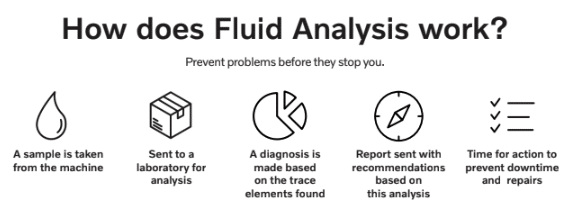
Once a fluid sample is taken from a machine, the dealer sends it to a lab where it is analyzed and diagnosed based on any trace elements found. A report with recommended actions is then shared on the Fluid Analysis portal and CHAIN. This cloud-based platform features a user-friendly interface that presents reports in a highly visual format.

Services Fluid Analysis

“With routine fluid analysis and historical data, AI algorithms can identify trends, patterns and correlations that can reduce downtime by up to 15%,” Goodchild said. “This program will make it much easier for customers to reduce downtime, optimize costs and improve operational efficiency.”

For more information, contact your local Volvo CE dealer.

Brigade Backsense Solutions Make Job Sites Safer

Between 2011 and 2020, 63% of fatal injuries to workers at road construction sites were caused by the worker being struck by a vehicle, according to the Centers for Disease Control and Prevention. This includes construction equipment operating within the work zone.

That’s why Brigade Electronics, Portland, Indiana, has spent decades developing technology to eliminate blind spots and provide real-time alerts to drivers and equipment operators when there is potential for a collision.

“Identifying humans is always the biggest concern. You can always repair a bent fender, but you can’t always repair an injured human.”—Corey Heniser

“While passive systems, such as mirrors and cameras, do help the driver to spot people and objects in blind spots, utilizing proactive technology that site managers can rely on to provide reliable alerts, no matter the conditions, are key to protecting the lives of road construction workers,” said Brigade CEO Corey Heniser.

Brigade offers a number of passive and active systems, including individual, multiple and 360-degree camera solutions; ultrasonic and radar obstacle detection; wearable RFID devices for crew members; and video recording solutions. The company also launched its first 360-degree artificial intelligence (AI) camera, SidescanPredict, in November 2021.

The company also launched its first 360-degree artificial intelligence (AI) camera, SidescanPredict, in November 2021.

Several Camera Systems

With a Backsense® radar or ultrasonic obstacle detection system, paired with Backeye®360 or other heavy-duty camera monitoring system, Brigade’s line of safety solutions can identify people and objects, whether stationary or moving, and provide the operator with in-cab visual and audible alerts.

With one or multiple cameras, the operator will be able to see the view from each camera. With Backsense®360, the operator will see on the screen in the cab both an overhead view of their vehicle and surroundings and one of four camera angles, based on direction of travel or use of turn signals.

Wear Safety on your Sleeve with Scan-Link

Back when Brigade first began offering a 360-degree solution eight years ago, Heniser said it was too expensive to justify its use on anything but the most expensive equipment. However, technological advancements have made the solution comparable in price and ease of use to Brigade’s multi-camera setup. With the 360-degree solution, Heniser said, “You get the best of both worlds.”

Audible Alerts

Brigade’s approach to audible alerts differs from the usual backup alarms, instead relying on multi-frequency alarms using a broadband sound (BBS) backup alarm, also known as a white sound backup alarm.

Wearable Technology Makes Construction Safer, More Efficient

Rather than the traditional ‘beep’ of tonal alarms, these alarms create a ‘ssh-ssh’ sound that is loudest in the direction of vehicle travel and dissipates quickly. “The result is that when a vehicle is coming toward you, you know it’s coming toward you,” Heniser said. “If it’s moving away from you, it’s not nearly as noticeable. But, you’re not in the danger area so no action is required.”

Heniser said this can reduce worker desensitization to backup alarms, since they are hearing them less frequently and usually only in situations in which they should take action. This type of system can also help reduce noise complaints related to backup alarms, for example, if you’re paving in a residential neighborhood early in the morning.

However, the white sound still meets all alarm volume requirements. “Our solutions have a microphone built in that will make sure the alarm adjusts itself automatically to be 5 decibels louder than the ambient noise,” Heniser said.

With Backsense®360, the operator will see on the screen in the cab both an overhead view of their vehicle and surroundings and one of four camera angles, based on direction of travel or use of turn signals.

Choose the Right Solution

Heniser said the right Brigade solution depends on the vehicle and its applications. “It would be nice to have one solution that fits all,” he said, “but every customer type and vehicle type has different problems.”

For example, the ultrasonic solution is common for on-road vehicles where it’s only used at low speeds as a parking assistant. For vehicles moving at higher speeds or those with larger tires (therefore covering more ground per tire rotation), Heniser recommends the radar solution.

Kokosing Saves with Lone Worker Solution

“The faster a vehicle moves, the longer the range needs to be to predict and stop an accident from occurring,” he said. Brigade’s radar solution offers a range of 15-20 feet off the shelf, with a programmable version that can operate at ranges 30-50 feet out, versus 10-12 feet for the ultrasonic solution.

Other factors to consider when selecting a solution include the direction of movement, how frequently a vehicle turns, and what else is operating nearby. “All those factors come into play,” Heniser said, both in terms of camera systems and obstacle detection.

“If backing is the only problem, then we can have a single camera application and tie a radar to that,” he said. Or, if a haul truck carrying asphalt only needs extra help when backing to the paver, the ultrasonic sensors may suffice. “It really depends on the customer’s needs.”

The company also launched its first 360-degree artificial intelligence (AI) camera, SidescanPredict (kit shown here), in November 2021.

The Next Frontier(s)

Brigade’s latest safety innovation is its AI camera solution, Sidescan® Predict.

“If an individual’s crossing [between the backing haul truck and the paver] trying to beat the two coming together, we can actually put a box around that individual [on the monitor in the haul truck] and give a different warning to the driver,” Heniser said. “We have three ranges programmed behind the camera, so [the system] will give you a green, yellow or red warning along with the corresponding audio frequency change.”

Not only does this elevate the most significant obstacle to avoid (people), but it also eliminates the need for a sensor at all.

Brigade is also working on a system that uses sensor fusion technology to combine Brigade’s range of safety devices to predict collisions and alert operators. “[Fusion] takes a lot of these individual components and networks them together so it can go one step further to offer vehicle-to-vehicle communication to prevent collisions,” Heniser said.

The company is also working on autonomous features, such as active warnings that take action automatically. For example, applying the brakes to prevent a collision if needed. “Those [technologies] will eventually filter down into everyday on-road and off-road vehicles,” Heniser said.

Although the technology may advance over time, Brigade’s goal remains the same, whether a customer deploys a single camera or an entire vehicle-to-vehicle networked solution: making the road construction job site safer.

It’s also possible to add a mobile digital recorder to any Brigade camera system. “We can record all the footage coming across the monitor, with a timestamp, and that’s admissible in court,” Heniser said. The system also tracks triggered events, saving a short clip leading up to and following an event—for example, a hard G-force braking event. When a triggered event occurs, the customer can set it up for certain employees to be notified.

Larson Electronics’ Tips to Pick Commercial Surveillance Cameras

Larson Electronics offers some tips for picking the best commercial surveillance cameras.

Larson Electronics carries explosion-proof analog cameras and network IP cameras that are designed for industrial and commercial surveillance use. However, before deciding which one is right for monitoring your tank farm or other sensitive facility areas, you will need to understand the differences between the two cameras and the pros and cons of each.

An analog camera is a type of surveillance camera that contains a CCD sensor and digitizes the image it captures for processing. Before the video image is transmitted, it has to be converted back to analog so it can be received by an analog device like a DVR (digital video recorder) or video monitor. Traditional CCTV (closed-circuit television) surveillance systems use analog cameras.

However, there are newer hybrid models of CCTV surveillance systems that combine network IP and analog video.

A network camera, or internet protocol (IP) or network IP camera, is a digital video camera with a CCD sensor that can be used for surveillance and sends and receives data either through a computer network or the internet. However, a network camera does not have to be connected to the internet in order to work, it just needs to be connected to a private computer network or intranet system.

The main difference between these two cameras is the way in which the video signal is transmitted back to a screen or recording device. Network cameras transmit video images using the transmission and security features of the TCP/IP protocol via an Ethernet cable, whereas analog cameras transmit video signals as a voltage via a coaxial cable. Analog cameras do not have built-in web servers or encoders like network IP cameras do.

The potential benefits of using network cameras include:

• The two-way audio that comes from a single network cable allows a user to listen and speak to the person on the video
• Easy installation as this camera only needs one cable to operate
• This type of camera has better video resolution, which allows the camera to zoom in closer and still produce a clear image
• These cameras have multiple sensors and can contain three or four cameras in one, which means it can cover a much larger area
• Network cameras offer more features and functionality than analog cameras
• Network IP cameras are powered mostly over the same network cable through PoE (Power over Ethernet), not multiple
• Network cameras can use a wireless network, or Wi-Fi, to transmit video
• Ability to analyze images through the use of distributed artificial intelligence (DAI)
• Data transmission is secure via encryption and WPA, WPA2, TKIP or AES authentication methods
• Live video can be accessed remotely and viewed from any device
• If there is no dedicated power supply, the camera can be operated through an ethernet cable

The potential concerns that arise with the use of a network camera include:

• Privacy issues can arise
• The cost of network cameras can be a bit higher than traditional analog cameras
• Possible security compromise due to the camera’s ability to be accessed without a video recorder
• Network cameras can be more complicated to set up
• Since network IP cameras can sometimes be connected to the internet, there is a risk that they can be hacked

The potential benefits of using analog cameras include:

• The cost of an analog camera compared to a network IP camera is lower
• Ideal for small operations and small surveillance spaces
• Analog cameras are an ideal solution for instances where there is no existing network infrastructure
• Since analog cameras have been around longer than network cameras, there are more vendors to help install them and their systems
• Analog camera technology is getting better with high definition (HD) capability

The potential concerns that arise with the use of an analog camera include:

• There is an inability to run multiple cameras on the same cable as analog cameras each need a separate power source
• This camera requires multiple cables to operate, unlike a network IP that only needs one
• Potential interference, distortion, electrical noises and poor quality connection when the camera gets further away from the DVR
• The frame rates of analog cameras are lower than network IP cameras, so they are not ideal for locations that have a lot of movement
• There is no ability to digitally zoom the camera as you can with a network IP camera
• Analog cameras cover less are than network IP cameras do

There is no encryption capability on analog cameras, which means they are vulnerable to being hacked.

For more information visit the Larson Electronics website or call (800) 297-4352.

5 Manufacturing Trends to Watch in 2019

Editor’s Note: As readers return from World of Asphalt and AGG1 2018, we have this snapshot from the Association of Equipment Manufacturers (AEM) predicting how technology will influence the OEMs you saw there as 2019 progresses.

1. Intelligent Manufacturing

The concept of intelligent manufacturing is always changing. But in the simplest sense, it can be defined as a large-scale integration of cutting-edge artificial intelligence and advanced manufacturing technology and processes. Ultimately, intelligent manufacturing serves to help companies optimize organizational systems, improve product quality, increase the efficient allocation of resources and positively impact customer service.

Advancements in digital technology drive the rise of intelligent manufacturing. It’s now possible for integrated systems to enable communication and collaboration between equipment and people, allowing for the creation of customized products to be accomplished with the efficiency of mass production. In doing so, manufacturers can increase customer engagement and positively impact relationships with equipment end users.

In fostering the development of a connected ecosystem of people and equipment communicating in real time, manufacturers are poised to better meet the needs of the industries they serve while simultaneously reducing cost and inefficiencies.

2. Data Utilization

Being able to simply manage the mounds of data generated by manufacturing processes is not enough anymore. Companies need to go beyond efficiently storing information and consider how best to go about using it to gain insights into their businesses and make actionable and informed decisions about their future.

In the most traditional sense, data management consists of harvesting company data, constructing an ecosystem to support it, and then acquiring business intelligence hardware to aid in organizational assessment and analysis. The problem is there’s often too much data to manage, so companies fail to consistently make observations or find useful takeaways from the information. In short, they’re not utilizing the data, and they’re not really even managing it, either.

Organizational data can be overwhelming to manage. But leading companies today are establishing processes and investing in tools to help increase both profits and productivity. And, as technology continue to develop and evolve, opportunities related to data utilization will become more and more prevalent with time.

3. The Internet of Things (IoT)

The marriage of networked sensors and intelligent devices with connected equipment on the manufacturing plant floor has been one of the most impactful and transformative trends the industry has seen in quite some time. The ever-developing IoT has not only turned traditional supply chains into interconnected and dynamic systems, it has:

• Fundamentally change the way in which products are made
• Increased organizational efficiency
• Improved organizational safety
• Reduced organizational costs and complexity

Look to enterprise business models for big change. More specifically, the IoT could lead to more high-value equipment being leased, as opposed to being sold outright. The machinery of the future could be outfitted with built-in sensors and marketed as both a product and service. As a result, equipment owners would then be able to monitor it remotely and provide maintenance, repairs and necessary upgrades automatically. This would allow end users to focus on the work at hand instead of worrying about the condition of the equipment, leading to increased productivity.

4. Workforce Training

There’s no overstating the seriousness of the manufacturing industry’s skilled worker shortage in 2019. Manufacturing employs roughly 9 percent of the U.S. workforce, yet it is increasingly unable to fill necessary positions with qualified people. As it stands, there are three times as many open skilled labor positions than are being filled. The skills gap is a significant problem right now.

By investing in training and education, key stakeholders inside and outside the manufacturing industry can begin to connect with the workforce of tomorrow, inspire them to strongly consider a career as skilled workers and develop them into qualified employees.

5. Artificial Intelligence

Artificial intelligence is everywhere, so it comes as no surprise that it’s beginning to be incorporated more and more info manufacturing. In the near future, manufacturing facilities will evolve into connected networks of people and machines with supply chain assets, design teams, production and quality control, all integrated into a highly intelligent engine that monitors everything and provides actionable data and insights.

Artificial intelligence can come in many forms, and the industry can expect it to make its presence more and more known in manufacturing facilities as:

• Virtual reality
• Automation
• IoT infrastructure
• Robotics

While there are concerns about artificial intelligence eventually replacing human workers in a variety of industries, what seems clear is the technology will drive increased efficiency and productivity. By incorporating the technology to help manage operational assets, companies are free to focus their time, effort and resources on product innovation and other key strategic priorities.

For more information, visit www.aem.org/think