
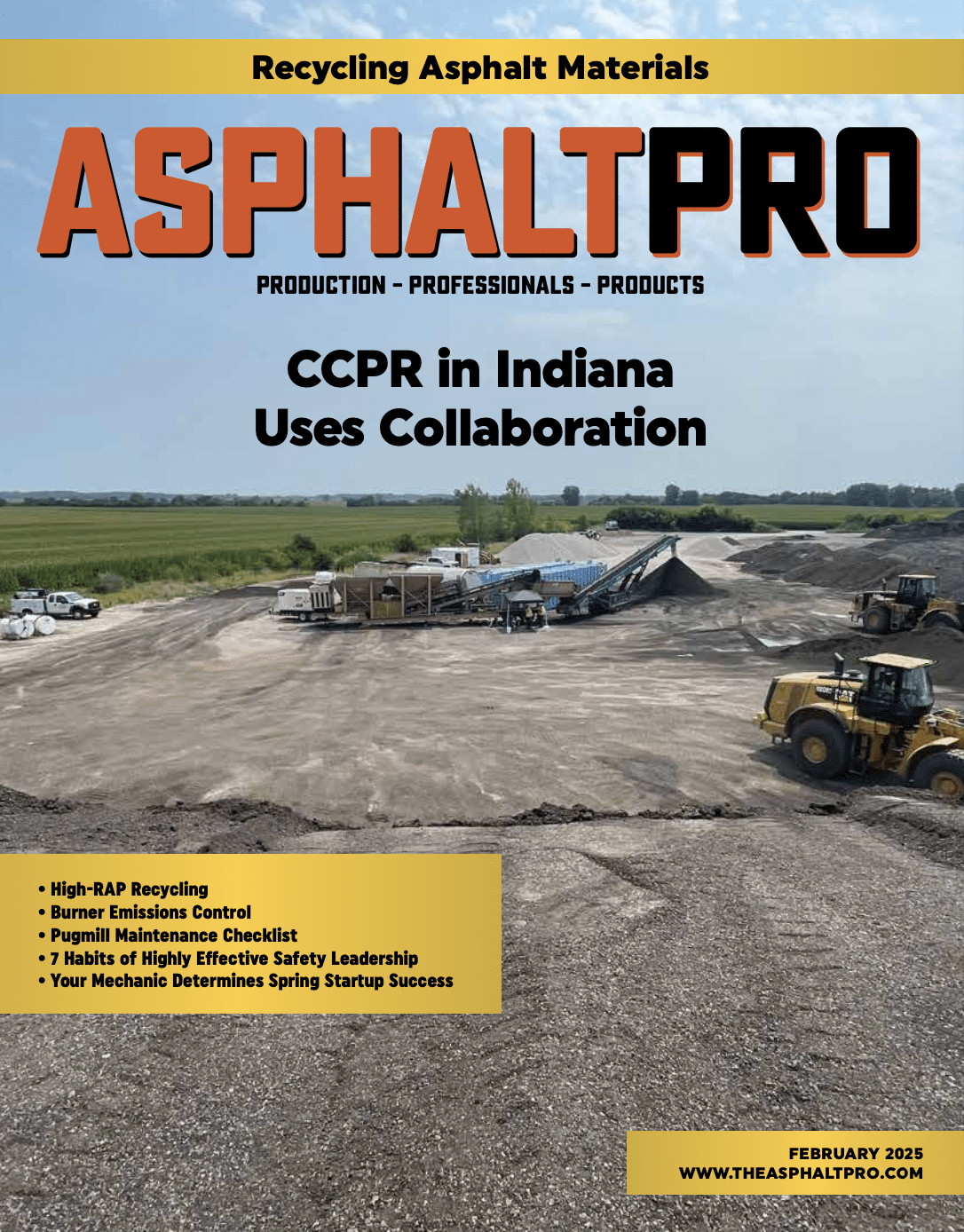
It doesn’t seem as though an entire year has passed since I last wrote on the theme of responsible reuse of materials for our annual recycling issue. As luck would have it, the asphalt industry is still on an upward trajectory of using reclaimed asphalt pavement (RAP) in fresh mix designs to build and maintain the infrastructure of the United States. Let me give you a source and some numbers for that statement and let me direct you to the high-RAP article prepared by the team at Sripath Technologies on page 30 of this issue.
First, I draw your attention to the annual Asphalt Pavement Industry Survey on Recycled Materials and Warm-Mix Asphalt Usage 2022, published by the National Asphalt Pavement Association (NAPA) in May 2024. This Information Series 138 report shares a ton of data, including the very basic idea that, yes, our industry continues to lead the way in environmental excellence through our reuse of materials. According to NAPA, “2022 data collected by NAPA showed 93 percent of asphalt mixture was used to construct new pavements, with the remainder going toward other civil construction applications…In total, asphalt mixture production increased by 2 percent from 2021 to 441.9 million tons.”
Here’s where I want to go off script for a minute.
The survey published in May 2024 includes data collected from 235 companies. Those companies pulled production data from a total of 1,305 asphalt plants, according to NAPA.
The U.S. Environmental Protection Agency (EPA) reports there are 3,600 asphalt plants in the United States. According to Jim Musselman of the Florida Department of Transportation, speaking at the December Asphalt Contractors of Florida (ACAF) winter conference, 100 of those plants produced mix for his state over the past year. That’s just Florida. Were all 100 of them included in the 1,305 of the 2022 survey?
My point is two-thirds of the industry’s data is missing, but those entities have an opportunity to contribute to something that benefits the industry.
One of the ways Behavior Expert Chase Hughes teaches to form good habits is through asking the question, “Is this going to benefit me later?”, before taking on a new task. Of course, I’ve never heard him suggest we forego helping one another if there’s no “benefit” to ourselves, but I have heard him remind his audiences of the satisfaction that comes from giving of oneself and helping our fellow man. The twist I’d like to give to Hughes’ teaching today is this: “Is this going to benefit the asphalt industry later?”
The report for RAP and WMA data collected in 2023 is coming up next from NAPA. But I want to encourage members of the industry to watch for the annual survey links that are posted around the Internet, including on AsphaltPro social media platforms, inviting you to participate in the survey. It’s anonymous. It doesn’t ask you to provide proprietary information that your competitors can use against you in bidding. Instead, it asks you to take a little time to share information that benefits an industry that is bigger than the individual. When you see the links for the 2024 RAP and WMA survey invitation, ask yourself, “Is this going to benefit the asphalt industry later?”
Stay Safe,
Sandy Lender