
Wear Strips Extend Component Life
BY Sandy Lender
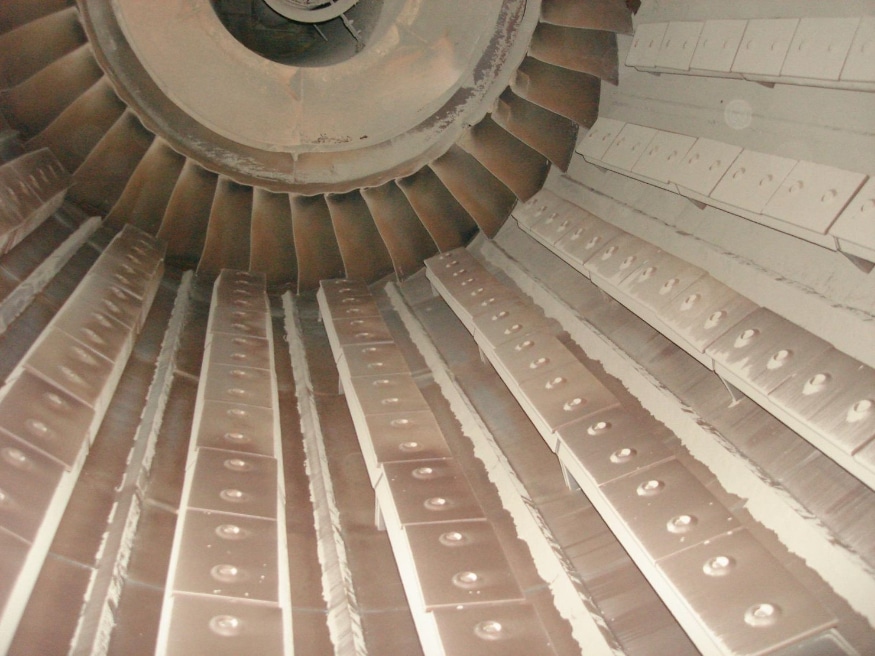
This is the time of year when many asphalt producers are completing the shoring up of equipment and routine maintenance around the plant and/or quarry. The teams at Stavola Companies, Tinton Falls, New Jersey, and Kenco Engineering Inc., Roseville, California, have worked together over the years to make the most of seasonal downtime to get long wear life from plant components as well as auxiliary equipment.
Let’s start with a look at the vertically integrated contractor with multiple sites, which, like yours, require uptime for optimum efficiency.
The group began in 1948 as Stavola Contracting Co. with the sons of Joseph and Carmela Stavola. The company has grown into multiple divisions since then, expanding into asphalt production, quarries, recycling and contracting. Stavola Asphalt Company offers mix designs required by the New Jersey Department of Transportation (NJDOT) and New York Department of Transportation (NYDOT) as well as a full line of hot-mix asphalt (HMA), warm-mix asphalt (WMA) and specialty mixes from eight plants throughout the area. Its Bridgwater and Tinton Falls facilities contain one of New Jersey’s largest drums and batch plants, according to the company’s website. Stavola Construction Materials Co. Inc. offers from four quarries crushed stone, sand, gravel, fill materials, rip rap and jetty stone; its aggregates are approved by NJDOT and NYDOT. Stavola Recycled Material has three facilities that are New Jersey Department of Environmental Protection approved Class-B recycling plants. Stavola Contracting Company offers a full range of contracting services including earthwork, excavating, utility installation, milling and paving.
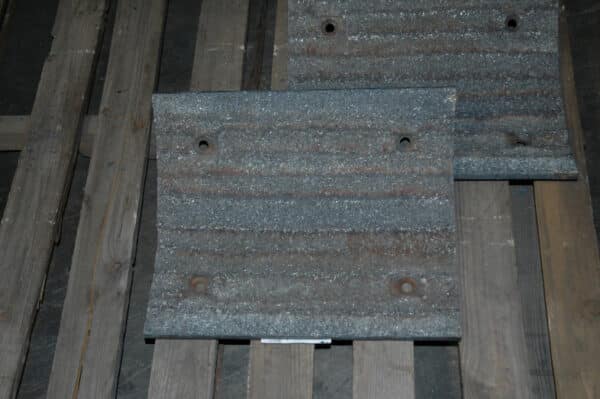
This is an example of a tungsten carbide impregnated liner for a pugmill.
For the team at Stavola, maintenance time and activities have been reduced with tungsten carbide impregnated (TCI) wear strips strategically placed around the asphalt plant. While readers may be familiar with the idea of shoring up wheel loader buckets and other high-wear, off-highway equipment, extending a component’s life can be transferred to many areas around the asphalt plant, too. The team at Kenco created TCI wear plates and wear strips to assist in this concept. At this time, the TCI technology can be purchased as wear plate kits and as long bars/strips a mechanic or ground person can cut to fit to the component that needs reinforcement during downtime.
“We use them throughout our plants,” said John Demarzo, the operations manager south, for Stavola. “We put them on our loader buckets first, then we ventured into using them around the plants. We’re using them company-wide and in the recycling centers, in the crushers. We keep the Kenco bars in stock at different locations for winter maintenance projects.”
While the use of TCI wear strips has become commonplace around the Stavola facilities, the team had a custom project for Kenco in 2023.
“Kenco reverse-engineered a 1972 pugmill we had and could no longer get parts on,” Demarzo said. “It took about six to eight months to get carbide on the liners, arms, tips.”
Here’s how that project happened for the Tinton Falls site.
Jim Alexander, the regional sales manager at Kenco, was first shown pictures of the original equipment manufacturer (OEM) parts back in 2014. “At that time the supply chain for those parts was still viable,” he said. “Inquiries for those parts continued, but the tooling costs were disproportionate to a viable sales price.”
By 2023, the supply was no longer available, and Stavola had to find a new source for parts or replace two productive plants. Demarzo reached out to Kenco. “With no other options, we decided to revisit the project.”
Brian Handshoe, who was vice president of Kenco at the time, and Keith Gramcko, who is Kenco’s engineer, flew to New Jersey to visit the Tinton Falls asphalt plant and evaluate the scope of the project. The good news is that the TCI end liners needed for the project were a part previously made for other customers; they could be incorporated into the pugmill project fairly easily. Other components would take some creativity.
“The thrust of the project was reverse engineering the primarily cast parts that would have previously required expensive tooling,” Alexander shared. The patterns, molds and casting normally made for high-volume parts had to be fabricated in a small batch environment—preferably without the high front-end costs of assembling molds and castings.
“John and I went through all remaining inventory that Stavola had on hand, and labeled and shipped a sample of one each of the needed parts to Roseville for design.” That came out to more than 40 individual items.
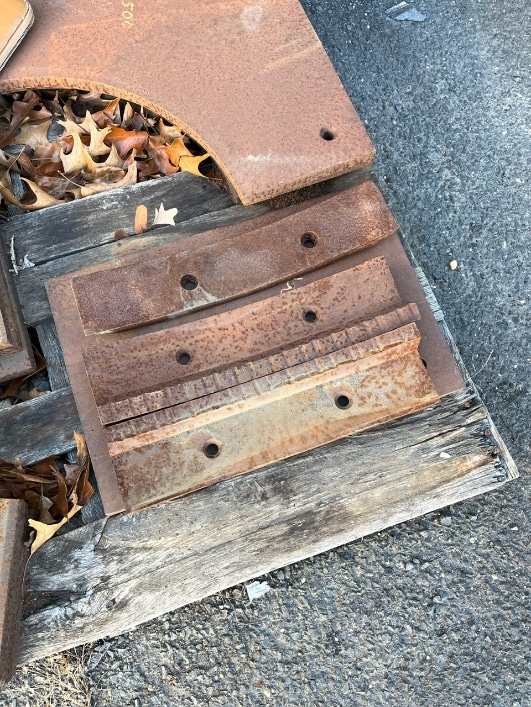
The Kenco team in California prepared to reverse-engineer the parts that could no longer be ordered and supplied for Stavola.
“Kenco incorporated its creative engineering, full fabrication and machine shops, as well as its tungsten carbide process to improve the wear life of the finished product,” Alexander explained.
“Regarding the complexity of this project, it pushed new boundaries,” he continued. “Engineering applied techniques for solid model printing to make scale models of challenging parts. They then used computer technology previously unused by Kenco to make small batch parts. The end result was replacing the original OEM shank, shroud and tip assemblies with Kenco-designed, fabricated assemblies. The finished assembly from Kenco weighed around 750 pounds each.”
“Kenco fabricated the belly liners, end liners and gate liners with our TC process,” Alexander said. “It had already proven itself in other locations at the plants and with Stavola, so it was a natural fit. Also, by designing with TC and fabrication we could avoid the cost of patterns and castings which would have made the project too costly.”
Installation was ongoing during the 2023 season as the plants were running continuously through the season. “Therefore, Stavola is installing parts as needed,” Alexander said. “Our engineering team made the parts one-to-one interchangeable so the whole plant did not need to be disassembled and rebuilt at once. Another cost savings.”
Of course, not every project requires reverse engineering obsolete parts. Producers who are looking to reinforce existing components with TCI plates or strips can schedule that kind of project in the same window they would schedule other repairs. Demarzo shared that the different technology doesn’t take an extra time commitment, saying the process may require the “[s]ame time, if not easier as parts are studded or bolt-in.” He continued, saying if wear plates are installed in new plants, the structure never gets compromised; therefore, continuing to ease maintenance.
Alexander explained, depending on the age and condition of the plant, preventive action can be taken in the beginning to keep future maintenance to a minimum. He offered some examples where TCI strips offer preventive action, starting with the RAP collar: “If the structure is compromised, then repairing the collar would be roughly the same as adding wear components during the repair. Kenco can help pre-plan and design parts to integrate repair and extend life in the same labor cycle.”
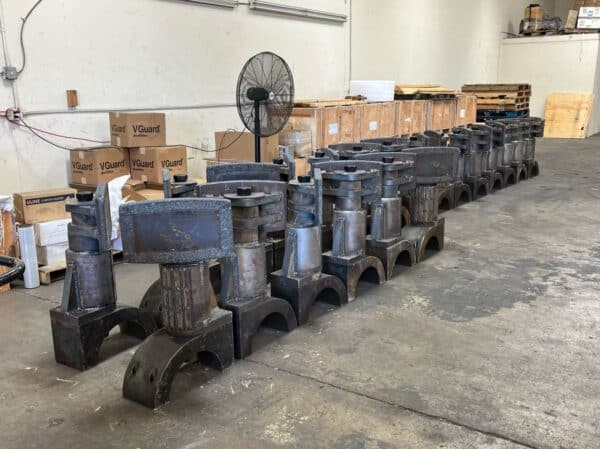
Here we see the finished shank and tip assemblies, weighing about 750 pounds each. Jim Alexander explained Kenco replaced the original OEM shank, shroud and tip assemblies with Kenco-designed, fabricated assemblies.
Discharge flights offer their own intricacies. “If installed in a new drum, life can be many times greater than OEM styles,” Alexander said. “This reduces many maintenance cycles that involve chipping the drum to allow for adjustment or replacement—sometimes multiple times in the same season. This is where the extended life of discharge flights can create secondary wear areas that can go unnoticed, such as the outer support ring. Prepping for replacement or adjustment is the biggest challenge; chipping and cleaning the discharge area is far more labor intensive than repair or replace. The life of Kenco’s discharge flights prevents the multiple chipping cycles.”
Demarzo and Alexander have worked together since 2003. When the Stavola team has areas that need attention, they turn to their reps at Kenco for advice. “They’ll tell us what a solution is for that,” Demarzo said.
Astec Launches New Portable High Frequency Screen Plant PTSC2818VM
“I personally established a relationship with Stavola in 2003 making sales calls in a new territory,” Alexander said. “This has grown to a remarkable relationship over those 20 years to develop the trust between the two companies to take on this project and continue to grow our relationship. Many of the management personnel I deal with today started on the ground in these plants and I was the new guy to the area. Guys like John [Demarzo] and Jason [Rivenburg] came up through the ranks as I did with Kenco. The relationship has grown out of trust and performance. If Kenco took on a project, they stood behind it through completion.”
Over the years, the Stavola team has been saving maintenance time and manhours by adding to the strength and life of components.
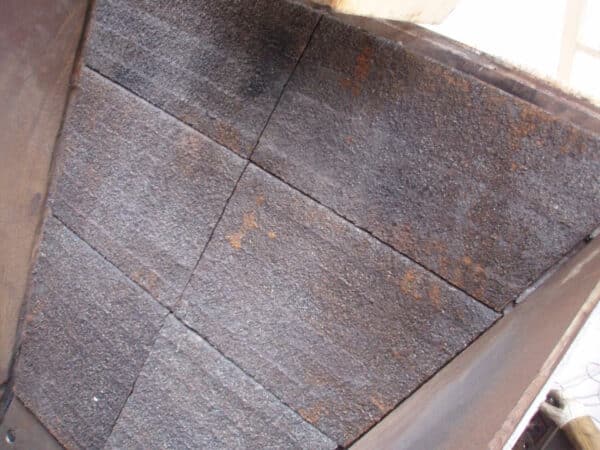
This example of a studded TCI wear plate lets us see there are no bolt holes, meaning no extra wear points.
Applications
The team at Kenco provided the list below of applications in which Stavola has used (or is using) TCI in their asphalt plants. These are some of the areas a producer could gain extended life or maintenance efficiency when using wear plating or wear strips.
Discharge flights – Most drum plants
TC gate repair bar – Oldbridge
TC end liners in H&B pugmill – Oldbridge
TC feed chute – Boundbrook
TC recycle collar scrapers and scoops – Boundbrook
TC wear bar kit for flop gate – Tinton Falls
TC wear bar at all asphalt plants used at the operator’s discretion
These are the general uses. Some of these applications have been in use for many years, and others are just being introduced.