
Stop Struck-Bys, the American Pavement Specialists Way
BY Bill Stanley
I got hit by a car the other day.
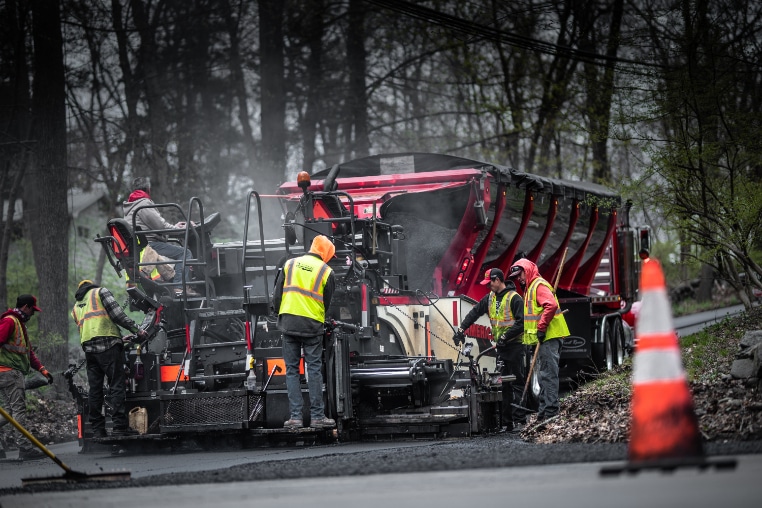
We were paving a country road just off a busy highway that’s a popular shortcut for area commuters—despite being barely wide enough for two cars at 18 feet wide. Not only is the road narrow and busy, but there’s also an S curve right at the top of a hill.
As I often do on jobs with complicated traffic control, I was directing traffic when a driver going 40 in the 25 mph zone struck me. Whether or not the driver noticed (though I’m sure he heard the thump), he certainly didn’t stop! Thankfully, my years of experience have taught me which drivers require extra attention and I’d backed up further than I otherwise might have, so he only grazed my wrist.
Anyone working in our industry for a while probably has at least one close call story like this. Struck-bys are a leading cause of injury and death in our industry, and it feels like it’s only getting worse. It used to be that people wouldn’t pay attention to anything beyond their bumper; now, they barely pay attention to anything beyond their phone.
That’s why teaching your crew how to function safely on the job site is one of the most important lessons that can be taught—because it’s literally a matter of life and death.
Struck-by incidents are the second leading cause of death among construction workers, accounting for 150 deaths and 14,000 nonfatal construction sector injuries in 2020, according to the Center for Construction Research and Training (CPWR).
Train for Situational Awareness
If I had to reduce all our safety training down to a single sentence, it would be, “Everyone has to watch everyone else’s back.” This is especially true for the new member of the crew. It isn’t that the new person on the crew lacks situational awareness, but they’re in a new situation where they don’t yet know all the threats to be aware of. And, believe me, there are a lot of threats to be aware of on our job site because there are so many moving parts!
That’s why we try to pair new crew members with experienced crew members who have strong situational awareness. We have a few people on our crew who always seem to be in the right spot at the right time. No matter what the circumstances of the job, they just know where to be and what’s around them. That’s the person I try to plant the new person next to.
We treat our jobs like an assembly line, the same way we unloaded groceries in our house when our kids were little. Everyone has their place in the line to get the job done. If I can put the new crew member between two workers with strong situational awareness, all the better!
We don’t have a formal toolbox talk every morning, but identifying hazards and communicating them to the whole crew is always the first thing we do at any job site. Maybe we’re paving around a corner and the cars are traveling fast. Maybe there are overhead wires or tree branches. We point out all the warning spots. Not only does this make everyone aware of the job’s threats, but it also sharpens that sense of situational awareness.
Avoid Internal Danger Zones
Although the traveling public is certainly a threat, so is the heavy equipment operating within the job site. A common trait among nearly all new crew members is the tendency to take the fastest route from A to B, even if it’s through a no-go zone.
In our industry, being between the paver and a backing truck is one of those no-go zones. New crew members want to be helpful, so they’ll go clean out the back of a truck or the front of the paver, and this has to be trained out of them. No one should ever walk between the paver and a backing truck!
New crew members also love to walk between machines and buildings. We train that out of them, too. I was once on a skid steer in front of a garage ripping out a tree stump when I hit a hornets’ nest. I got stung and my foot slipped off the brake. It took all of two seconds to find myself busting into the garage!
Such an event could happen to anyone on any job. What if the operator in that machine sneezes or coughs, what if they have a heart attack or have to itch their foot? You have to be prepared for the unexpected.
If you do find yourself working near heavy machinery, we train our workers to work in front of the machine (at a safe enough distance) so the operator has a good view of them. I don’t care what fancy technology might be on that machine—cameras, sensors, whatever—no one works behind or to the side of our equipment.
Know When—and Where—to Train
On our crew, training never stops. I imagine this is true on every crew, because the job site is always changing. For example, 10 years ago we had one small mill and we used it once a week. Now, we’re milling every day. Material formulas change, and new formulas require different laydown procedures. Each of these changes to the job present new safety considerations. There’s no “graduation day” for training.
We train on the job, all day, every day. However, we also try to train wisely based on the conditions of the job. I would never train anyone on something new on a job like the one where I recently got hit. On a job like that, I would (and did) tell any new member of the crew to stay on the shoulder, well away from the cone line. They’re just not ready for that.
Instead, I’ll wait until we’re paving a parking lot that isn’t very busy to train new skills. Somewhere the conditions are easy to control, somewhere there’s plenty of space between them and the rest of the crew. I want to teach a new operator on a football field, not in a shoebox!
Don’t Get Complacent
Despite all the years I’ve spent on job sites, despite the sixth sense I’ve honed, I still got hit the other day. It isn’t the first time I’ve been hit, and it isn’t even the scariest struck-by near miss I’ve witnessed.
That title belongs to a job on Route 9 in New York when a car ripped down four barrels to breach our construction zone going 60 mph, punched the gas and exited our construction zone doing 80 mph on the grass. He missed my flagger by two inches and crashed a few miles down the road. We are very lucky nobody was killed.
It’s important to remember that no matter how many years of experience you may have on the job site, an event like this can happen at any moment. Even with a well trained crew and exceptional traffic control, we cannot always control the traveling public. A key part of any training program is teaching your crew to expect the unexpected, remain aware of their surroundings, and watch each other’s backs.
Bill Stanley owns American Pavement Specialists, Danbury, Connecticut, with his wife, Colleen. Stanley has more than 50 years of experience in the asphalt industry.