
Reconstruct Airfield Runway Pavement
BY Len Hunt
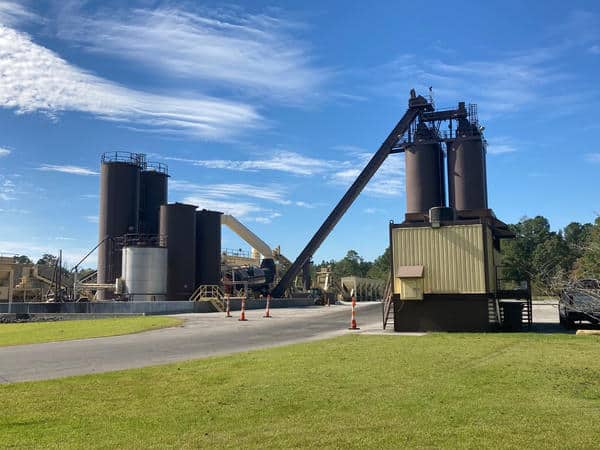
S.T. Wooten reconstructs Michael J. Smith Field runway pavement for award-winning finish
Situated alongside North Carolina’s Crystal Coast, Michael J. Smith Field serves as an important aviation hub for the communities of Beaufort and Morehead City. Supporting general aviation, emergency response and regional economic activity, the airport spans more than 400 acres and includes three asphalt runways.
As part of ongoing efforts to maintain and improve its infrastructure, the airport identified the need to reconstruct its Runway 3-21, an aging strip that had fallen out of regular use and required modernization to meet evolving standards. To carry out the $5.1 million rehabilitation, S.T. Wooten was selected to lead a comprehensive runway reconstruction project designed to meet modern specifications and support the airport’s long-term operational needs.
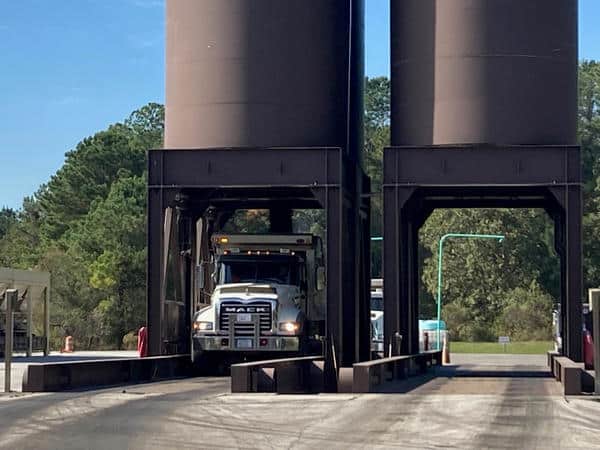
To ensure a steady, uninterrupted supply of material, insulated trucks were used to transport the mix and plant operations were closely coordinated with on-site paving progress.
Comprehensive Scope of Work
The runway reconstruction project involved full pavement removal, subgrade stabilization and the construction of a new asphalt surface to meet the Federal Aviation Administration’s (FAA’s) P-401 specs. These guidelines are among the most rigorous in the paving industry, covering everything from material composition and tolerances for smoothness, to joint quality and durability.
Crews began work by milling and removing the existing 150-foot-wide surface. The new runway geometry called for a slight alignment shift, which prompted the reclassification of the runway to 4-22.
To ensure precision throughout the site, the S.T. Wooten team relied on GPS-guided equipment and total station controls to manage grading operations. Accurate subgrade preparation was critical to achieving the smoothness and drainage performance required for airfield pavements. Using a total station positioned alongside the runway, crews guided trimming equipment to meet tight FAA tolerances and create a uniform, on-grade surface before any asphalt was placed.
Crossing the Finish on S.T. Wooten’s I-40 Overhaul in Raleigh
Innovation in Joint Construction
One of the project’s most noteworthy technical achievements was the crew’s approach to longitudinal joints, which are prone to performance issues in many pavement applications. While FAA specifications typically require saw cutting and particular compaction techniques to ensure joint durability, S.T. Wooten adopted a more innovative approach to eliminate the need for saw cuts.
For the paving work, crews used a propane-fueled joint heater mounted to the paver to preheat the cold edge of the previously placed asphalt to approximately 250°F. This closely matched the temperature of the fresh mix and enabled thermal bonding between the two mats, allowing crews to uniformly heat up to 18 inches wide and 3 inches deep. As a result, the joint performed like a continuously placed surface, eliminating the need for post-paving saw cuts.
To further improve joint density and reduce the risk of cracking or water infiltration, the team used a wedge-shaped compaction attachment to shape and compress the edge during placement. This method helped create a smooth, strong transition between lanes and contributed to the project’s superior ride quality results.
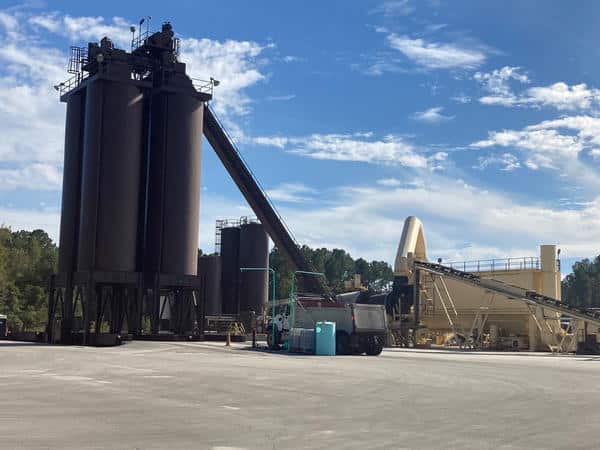
The HMA for the runway project was produced at an S.T. Wooten plant roughly 45 miles from the Michael J. Smith Field job site.
Tools of the Trade
The S.T. Wooten team relied on a range of specialized equipment to help meet the FAA’s P-401 specs. Key machinery included a Cat AP-1055 paver with Cat screed and compaction devices, and a Heat Design Equipment infrared asphalt joint heater for seamless joint construction. Compaction was achieved using Cat CB-13 and Combo CB-34 rollers, while a Roadtec SB-3000 Shuttle Buggy® material transfer vehicle ensured consistent asphalt delivery.
Crews placed approximately 8,500 tons of FAA-compliant hot-mix asphalt (HMA), formulated with an optimum asphalt cement content of 5.1%, a PG76-22 binder and 25% anti-strip additive to improve moisture resistance. The surface mix incorporated aggregate sourced from two regional quarries, with 100% passing a ¾-inch sieve, ensuring uniformity and durability.
Meticulous material handling and precise execution helped the project deliver exceptional smoothness results, achieving an average International Roughness Index (IRI) of just 1.86 inches per mile with zero areas requiring corrective grinding. This outcome stands as a testament to the team’s attention to detail and technical performance.
Mix and Delivery Challenges
The HMA for this project was produced at an S.T. Wooten plant roughly 45 miles from the site. Maintaining optimal temperature throughout the haul was essential to achieving proper compaction and surface quality.
To ensure a steady, uninterrupted supply of material, insulated trucks were used to transport the mix and plant operations were closely coordinated with on-site paving progress. Each of the two, 2-inch asphalt lifts were placed and compacted using a defined rolling pattern. Joints between the lifts were staggered to help distribute structural loads more evenly and prevent reflective cracking.
Because of the haul distance and limited paving windows, project logistics played a central role in execution. Careful planning around plant schedules, trucking routes and job site staging helped keep operations on track.
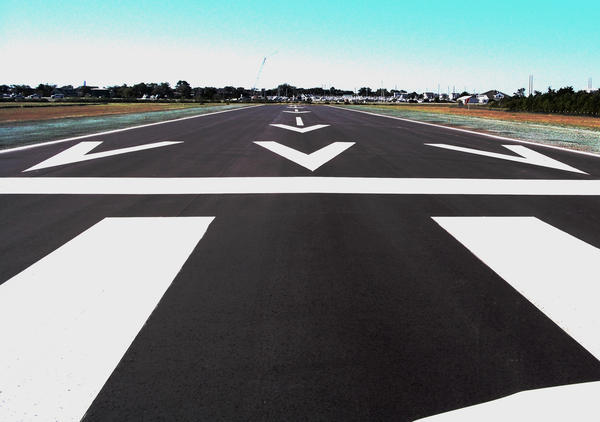
The successful reconstruction of Runway 4-22 marked a significant infrastructure improvement for Michael J. Smith Field.
A Strategic Win for the Region
Following its successful execution, S.T. Wooten’s Michael J. Smith Field project was honored with the 2024 Ray Brown Airport Pavement Award from the National Asphalt Pavement Association (NAPA). Named after pioneering asphalt researcher Dr. Ray Brown, the award recognizes projects that demonstrate excellence in workmanship, innovation and compliance with FAA standards. The award underscores the high level of quality delivered by S.T. Wooten’s team and its partners throughout the project. The recognition reinforces the team’s reputation as a trusted partner in complex infrastructure projects.
While S.T. Wooten was proud of the award, the greater win was the successful completion of the runway, marking a significant infrastructure improvement for Michael J. Smith Field. The reconstruction of Runway 4-22 ensures the airport can continue to support general aviation needs across the Crystal Coast with enhanced safety and reliability.
For S.T. Wooten, the project adds to a growing portfolio of award-winning aviation and road construction work. Thanks to the coordinated efforts of all involved, the runway was brought back to life with a special focus on quality and long-term performance.
Len Hunt is the eastern commercial division manager for S.T. Wooten Corporation.