
Eurobitume Offers LCA of PMB for EPDs and Other Studies
BY AsphaltPro Staff
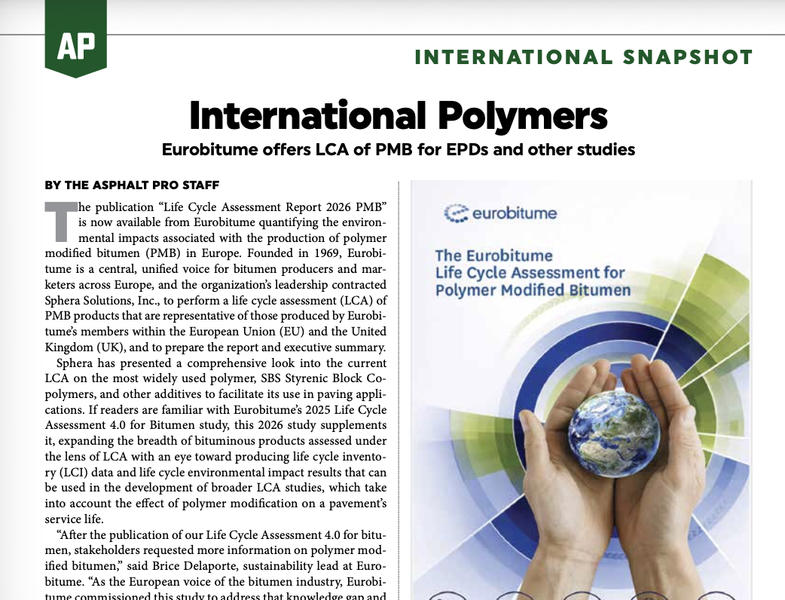
Eurobitume offers LCA of polymer-modified binder for EPD, LCI, more
The publication “Life Cycle Assessment Report 2026 PMB” is now available from Eurobitume quantifying the environmental impacts associated with the production of polymer modified bitumen (PMB) in Europe. Founded in 1969, Eurobitume is a central, unified voice for bitumen producers and marketers across Europe, and the organization’s leadership contracted Sphera Solutions, Inc., to perform a life cycle assessment (LCA) of PMB products that are representative of those produced by Eurobitume’s members within the European Union (EU) and the United Kingdom (UK), and to prepare the report and executive summary.
Sphera has presented a comprehensive look into the current LCA on the most widely used polymer, SBS Styrenic Block Copolymers, and other additives to facilitate its use in paving applications. If readers are familiar with Eurobitume’s 2025 Life Cycle Assessment 4.0 for Bitumen study, this 2026 study supplements it, expanding the breadth of bituminous products assessed under the lens of LCA with an eye toward producing life cycle inventory (LCI) data and life cycle environmental impact results that can be used in the development of broader LCA studies, which take into account the effect of polymer modification on a pavement’s service life.
“After the publication of our Life Cycle Assessment 4.0 for bitumen, stakeholders requested more information on polymer modified bitumen,” said Brice Delaporte, sustainability lead at Eurobitume. “As the European voice of the bitumen industry, Eurobitume commissioned this study to address that knowledge gap and provide robust life cycle data on PMB to support informed discussions on sustainable road infrastructure.”
According to the executive summary, “The goal of the present LCA study is to provide LCI data and life cycle environmental impact results on the production of PMB with SBS concentration of 3.5% wt/wt (i.e., standard SBS concentration) and PMB with SBS concentration of 6% wt/wt (i.e., high-performance PMB) within a refinery representative of Eurobitume members in the EU/UK region.”
The executive summary points out, “The investment in polymer modification seeks to extend the service life of the pavement to reduce lifecycle cost and environmental impact. SBS modified bitumen is widely used to enhance the performance of asphalt pavements subjected to heavy traffic or exposure to a wide range of temperatures. This report addresses two average products representative of current practices in paving application: a standard PMB (based on 3.5% SBS) and a high-performance PMB (based on 6% SBS).”
A press release issued by Eurobitume stresses; the study concentrates on PMB formulations based on SBS, which constitute a significant part of current paving applications. Other types of polymers were excluded. “Therefore, it should not be seen as representative of all PMB formulations.”
Polymer modified bitumen is a commonly used material in road construction in Europe, designed to improve pavement performance, especially under heavy traffic and varying temperatures. By increasing durability and resistance to deformation, PMB can help create longer-lasting road infrastructure. The study presents a life-cycle impact assessment of SBS-based PMB produced in refineries representing Eurobitume members across Europe. This LCA for PMB, with a cradle-to-gate scope, seeks to provide environmental data for future products, supporting more consistent environmental comparisons based on a specified functional unit.
Readers are encouraged to peruse the full report at eurobitume.eu/publications for results. Sphera states: “The intended audience of the present study is bitumen and PMB users and organizations studying environmental aspects, such as the European Commission, national official bodies, asphalt producers, road authorities, and other industry associations as well as consultants and universities.”