
How to Read a Safety Data Sheet—and Why It Matters
BY Steve Haughton

How and Why to Read the Safety Data Sheet for Additives, Chemicals
When it comes to asphalt, safety doesn’t begin on the job site; it begins on paper. More specifically, it starts with the Safety Data Sheet (SDS). Before an additive ever reaches a tank or blending system, the SDS provides critical details about the product’s chemical properties, handling and storage methods, emergency response measures, and potential hazards to workers and the environment.
Crews working with asphalt already operate in a high-risk setting, and the industry takes safety seriously when it comes to things like protecting workers from fast-moving traffic. However, the safety of the additives used needs to be given the same attention.
For example, fume-heavy conventional additives may deliver on performance but often come at a cost: watery eyes, breathing discomfort, unpleasant odors, more complex personal protective equipment (PPE) requirements, and the threat of environmental liability. There are alternative, non-hazardous additives that are designed to reduce or eliminate those dangers, but it’s still essential to review the SDS for on-the-job safety.

There are at least six sections of the safety data sheet you’ll want to be sure you review prior to bringing the material to the job site. Sections 2, 4, 7, 8, 14 and 16 offer vital information.
What is an SDS, and Why Does it Matter?
An SDS is a legally required document under the Occupational Safety and Health Administration (OSHA) regulations that outlines important safety and environmental information. During the product selection phase, the SDS is the first opportunity for decision-makers to assess an additive’s safety profile. Reviewing each product’s SDS can help avoid risks and identify safer or non-hazardous options.
These side-by-side examples of portions of two U.S. SDSs demonstrate how these documents show the level of hazard associated with each product:
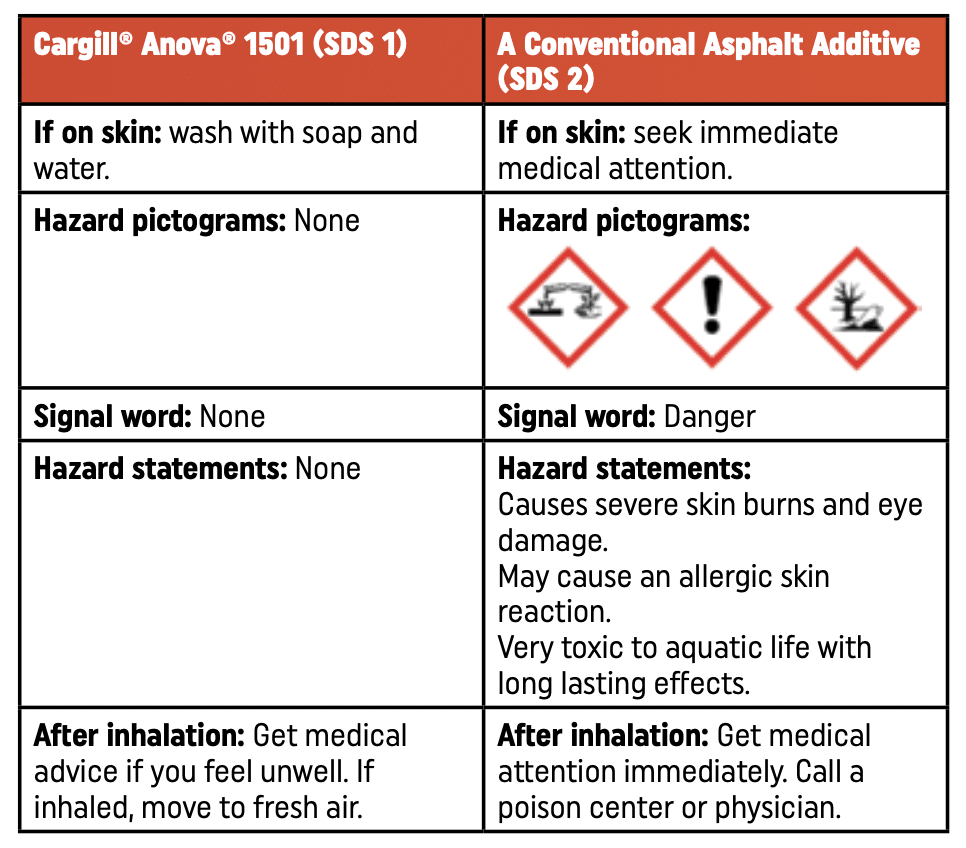
Understanding the nuances and knowing how to read and compare SDSs can mean the difference between a minor spill and a major incident—both employees and emergency response personnel need to know how to respond quickly and safely to workplace events. That’s why it’s so important to review the SDS before bringing the product on site, not just after something has gone wrong.
Comparing SDSs: Key Sections to Review
The SDS follows a standard 16-section format that lays out important safety information in detail. Always read the full SDS, as it’s the best way to get a complete picture of a product’s hazards and safety measures. However, the following sections are particularly important to review, especially when comparing products.
Section 2: Hazard Identification
Purpose: Provides information on known hazards through standardized hazard classification criteria.
What to Look Out For: Signal words (“danger” vs. “warning”), hazard pictograms, and listed classifications.
Why It Matters: These classifications affect everything from PPE requirements to transport, insurance, and community perception. Note how many hazard symbols there are, if any.
Section 4: First Aid Measures
Purpose: Explains symptoms of exposure and what immediate steps should be taken in different scenarios.
What to Look Out For: Nature of symptoms, whether professional medical treatment is required, and all possible routes of exposure, including inhalation, skin or eye contact, and accidental ingestion.
Why It Matters: Helps assess whether the product poses minor irritations or more serious health risks, and whether you’ll need special training or emergency equipment on hand.
Section 7: Handling and Storage
Purpose: Provides guidance on how to properly use and store the product, including a list of incompatible materials.
What to Look Out For: Special temperature requirements, hazardous combinations, or unique handling instructions.
Why It Matters: Simple handling and storage instructions reduce safety risks and minimize demands on PPE, logistics, and training. Complex hazards may increase these burdens.
Section 8: Exposure Controls/Personal Protection
Purpose: Lists established exposure limits and recommended PPE and engineering controls.
What to Look Out For: Whether standard PPE is sufficient or if specialized equipment is needed.
Why It Matters: Products that require minimal PPE reduce cost, simplify training, and reduce friction on the job site.
Section 14: Transport Information
Purpose: Details classification for shipping and whether the material is regulated in transit.
What to Look Out For: Department of Transportation or United Nations numbers, hazard class, and packaging instructions.
Why It Matters: If a product isn’t classified as hazardous for transport, logistics tend to be simpler, faster, and likely less expensive.
Section 16: Propriety Numerical Rating
Purpose: Provides quick reference to any additional information that doesn’t fit into other sections. For example, many suppliers will include the numeric scores from the National Fire Protection Association (NFPA) and/or the Hazardous Materials Identification System (HMIS) on health, flammability, and reactivity in this section.
What to Look Out For: Higher NFPA and HMIS scores indicate more severe hazards, while lower scores indicate less hazards to be concerned about on the job site.
Why It Matters: These additional details can offer managers or Environment, Health and Safety teams an opportunity to review additional hazard information when available. While these scores are not required, they can be a quick reference tool to review information.
Missing Data
While reviewing these key SDS sections is essential, it’s also important to be wary of missing or incomplete information. Sometimes you’ll come across phrases like “No data available” or “No specific data.” This doesn’t mean that the product is safe, but rather that the risks are not known or haven’t been evaluated. Also keep in mind that inclusion of any information in Sections 12-15 of an SDS is optional, although the information there must be truthful.
The SDS is intended to reflect the additive as sold and during some foreseeable handling and use conditions, but an SDS might not tell the full story, especially if the product could be used in unexpected ways. Additives can behave differently when used in more complex systems and SDSs can’t anticipate all use cases. A more detailed SDS often indicates better knowledge of the additive’s composition and hazards.
The Business Case for Comparing Additives
Understanding the safety nuances of products has real-world implications for your operations and your bottom line. Opting for non-hazardous, bio-based additives may offer real advantages.
Many teams will only look at an SDS when something goes wrong, but by then it’s too late to avoid harm. Reviewing the SDS before choosing a product or bringing it on site helps avoid surprises and supports better long-term outcomes. It’s also a good way to compare products side by side before making your selection.
Before choosing a product, ask for the SDS and compare not just the symbols, but also the level of detail and transparency. Cargill’s Anova® asphalt additives, for example, are backed by clear and comprehensive SDSs. For Cargill, nothing matters more than the safety and wellbeing of our people. To ensure a safe and healthy workplace, we continue building on foundational programs that have, over the past several years, contributed to significant improvements in our overall safety results.
We invite you to request one of our SDSs so you can review it and ask your current supplier for theirs to compare both documents side by side. Because when it comes to safety, the first place to look is still on the page.
Steve Haughton is the road construction business development manager for Cargill’s Asphalt Solutions team, focusing on bringing Cargill’s Anova Asphalt Solutions line of bio-based additives to asphalt mix producers, emulsion producers, refiners and paving contractors. He has 35 years’ experience in the petroleum and construction materials industries.
Breaking Down SDS Sections
Safety Data Sheets follow a consistent 16-section structure, which helps simplify the review and comparison process.
- Identification: Product name, use, and supplier contact
- Hazard Identification: Hazard classifications, signal words, pictograms, and warnings
- Composition: Ingredients and concentration ranges
- First Aid Measures: Exposure symptoms and emergency treatment
- Firefighting Measures: Extinguishing methods and risks during fire
- Accidental Release Measures: Spill response and containment guidance
- Handling and Storage: Safe use and compatibility notes
- Exposure Controls/PPE: Exposure limits and necessary protection
- Physical and Chemical Properties: Flash point, appearance, odor, etc.
- Stability and Reactivity: Conditions and substances to avoid
- Toxicological Information: Health effects, exposure routes, and toxicity data
- Ecological Information: Environmental risks and degradation
- Disposal Considerations: Safe disposal practices
- Transport Information: Shipping regulations and classifications
- Regulatory Information: Relevant compliance data
- Other Information: Preparation date, revisions, and other helpful details such as safety rating systems or handling guidance