
Expand your Business with your First Roller
BY Dan Sant Anselmo
Editor’s Note: For 2024, AsphaltPro Magazine allows experts in the industry to share how to expand your operations to the next phase of business. Are you ready to take the plunge and add more services to your arsenal? Let’s turn to some professionals who have equipment, services, software and tenure to help you expand to paving bigger, broader, more lucrative projects. This month’s installment from Hamm, a Wirtgen company, looks specifically at compaction technologies and applications for different sized projects.
As a company in the asphalt industry begins to grow, managers find themselves ready to take the next step in their business. That might mean going into utility work to commercial paving, parking lots and driveways. They could also see business opportunities in residential work as well. When you are ready for this endeavor, there are many things to consider. Just buying a paver is not the answer. In this article, we will discuss how to assess your first compactor needs.
Each tool in a toolbox is used for a specific job. Compaction equipment is much the same. There is no compaction roller that can do everything, from patch work for utilities, to mainline paving on highways. So, the first thing to consider is what kind of work you want to expand your business into. There are many areas that should be considered.
The first area that we will discuss is trench and utility work. We often see where a trench needs to be dug in order to install water lines, gas lines, cables, etc. But we can’t just dig a trench and lay down the utilities in the hole and cover it up. We need to compact the trenches to make sure that the utilities are protected in place and will not shift.

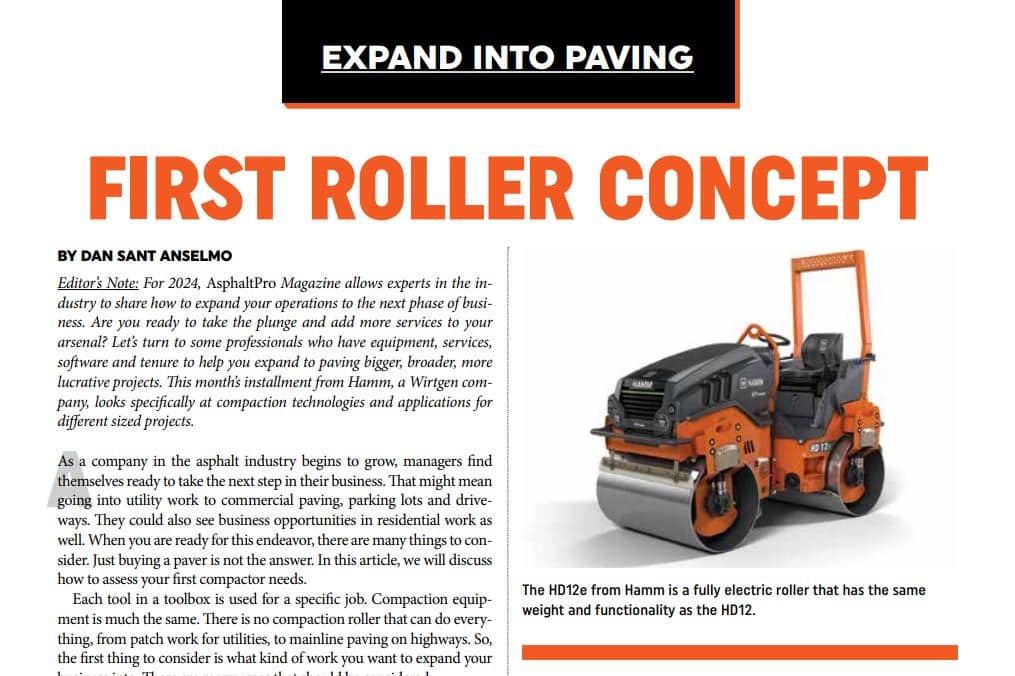
The HD12e from Hamm is a fully electric roller that has the same weight and functionality as the HD12.
For this we will use a trench compactor, like the Hamm HTC15. It is a 1.5-ton remote controlled roller that can be controlled safely from outside of the trench. Once the trench has been compacted and the utilities placed, the trench is then backfilled with material. We see this process done in new construction areas but also in areas that have already been developed, such as parking lots, commercial areas or even in roadways. When utilities have been laid in these areas, the trench then needs to be paved back over. This is usually done with a 1.5- to 3-ton roller, taking into consideration how thick the material is and how wide the trench is. We would usually recommend a HD12 VV (3-ton roller with front and rear vibration) for this type of work. New to the market for the environmentally conscience, is the HD12e. This is a fully electric roller that has the same weight and functionality as the HD12, without emitting CO2 and eliminating fuel costs. Both machines can also be used on small patchwork as well as small parking lots and driveways, so they are versatile in small job projects.
The next area to look at is big parking lots and commercial job sites. For these jobs you will need larger rollers than the machines used on utility projects. There are multiple reasons for having a larger machine on these projects, the first of which is drum width.
Typical paver widths for these projects can range from 10 to 12 feet, meaning you will need a roller with a wider drum to cover the mat width with less coverage passes. Remember, if your drum is too narrow, the roller will have a hard time keeping up with the paver and your productivity will suffer.
The second aspect of consideration is the machine weight. You need to have a machine that is heavy enough to get the job done. If we are paving on top of the subbase, we might see asphalt base material thickness of 3 inches and above, which means a heavier machine is needed to get compaction. If we are paving on top of the pre-existing base, then a thinner lift will be needed, somewhere around 2 inches. But we can utilize the same machine for both base and surface material. We will usually see a 7- to 9-ton roller for these applications. The HD+70i has a drum width of 59 inches while the HD+90i has a 66-inch drum. You can also utilize a smaller roller, like a 4.5-ton roller, for finish rolling the material and taking out any lines.
There is one last consideration to think about, and that is the drums themselves. Most common are machines that have a front and rear vibrating drum. But there are also machines that have one vibration drum and one oscillation drum.
An oscillation drum moves tangentially on the material instead of up and down, meaning that the drum has contact with the material 100% of the time. This has many benefits, including not breaking up material once it has been compacted, not crushing the stones in the mix, and providing a consistent density of the material. It can also be used on cooler material to gain density, when use of a vibratory drum is not recommended because it can break the material apart. Another benefit of using the oscillation drum is for pinching joints. We have seen a higher joint density and a longer lasting joint when using the oscillation drum.
You may also consider using a combination roller in these applications. These machines have a vibration drum in the front and rubber tires in the rear. The benefit of rubber tires is that they create a kneading motion on the material, which helps compact the larger stones in the mix towards the bottom and brings the finer materials to the top. This will help seal the mat as well as make it look aesthetically pleasing. At Hamm, we offer this option from our 2.5-ton to our 11-ton machines.
Another area of work to talk about is residential job sites. For these projects we commonly see rollers between 7 and 11 tons. These machines are more maneuverable on these projects than the large asphalt machines made for mainline paving. Typically, you will use one of these machines with a vibration drum on both front and rear as a breakdown roller (the first roller behind the paver).
In the finish roller position, you can have a multitude of options. Once again, an oscillation machine can be utilized as well as a combination roller to achieve the required density and make the final product look extremely smooth. In smaller areas, a 4.5-ton roller may be used as a finish roller as well because it is even more maneuverable than its big brothers.
If you have an area with multiple cul de sacs, roundabouts and tight turns, then a split drum roller could benefit you. This machine will have a drum that is split in the middle and the two drums work independently of each other while in a turn, slowing down the inside drum and speeding up the outside drum, to reduce forces on the material. This will create fewer tears in the material during those sharp turns, reducing the need to spend time correcting a mark in the mat.
There are many things to think about when it comes to purchasing your first roller. It is not just a machine that only goes backwards and forwards. This machine is the last one on the material before your customer sees it. It is important to understand that the roller will not only get you the compaction and density that you need but will also make the final product look how your customer expects it to. To have a quality final product, then a quality piece of equipment is needed.
Your equipment also needs properly trained operators that understand the process of paving asphalt. A tool is only as good as the hands that it’s in. Here at Wirtgen, we strive to make quality products as well as take the time to properly train the operators so that you, the customer, are happy with the equipment and the final product they produce.
Dan Sant Anselmo is the Hamm applications support manager for the Hamm product line at the Wirtgen Group, Antioch, Tennessee. He has certifications from Middle Tennessee State University in road construction technology and has taught courses on compaction principles at Wirtgen America’s Center for Training and Technology. For more information, contact him at (615) 501-0600 x220 or Daniel.Santanselmo@wirtgen-group.com.