
Increasing BMD Efficacy with Technology: Part 2
BY Sandy Lender
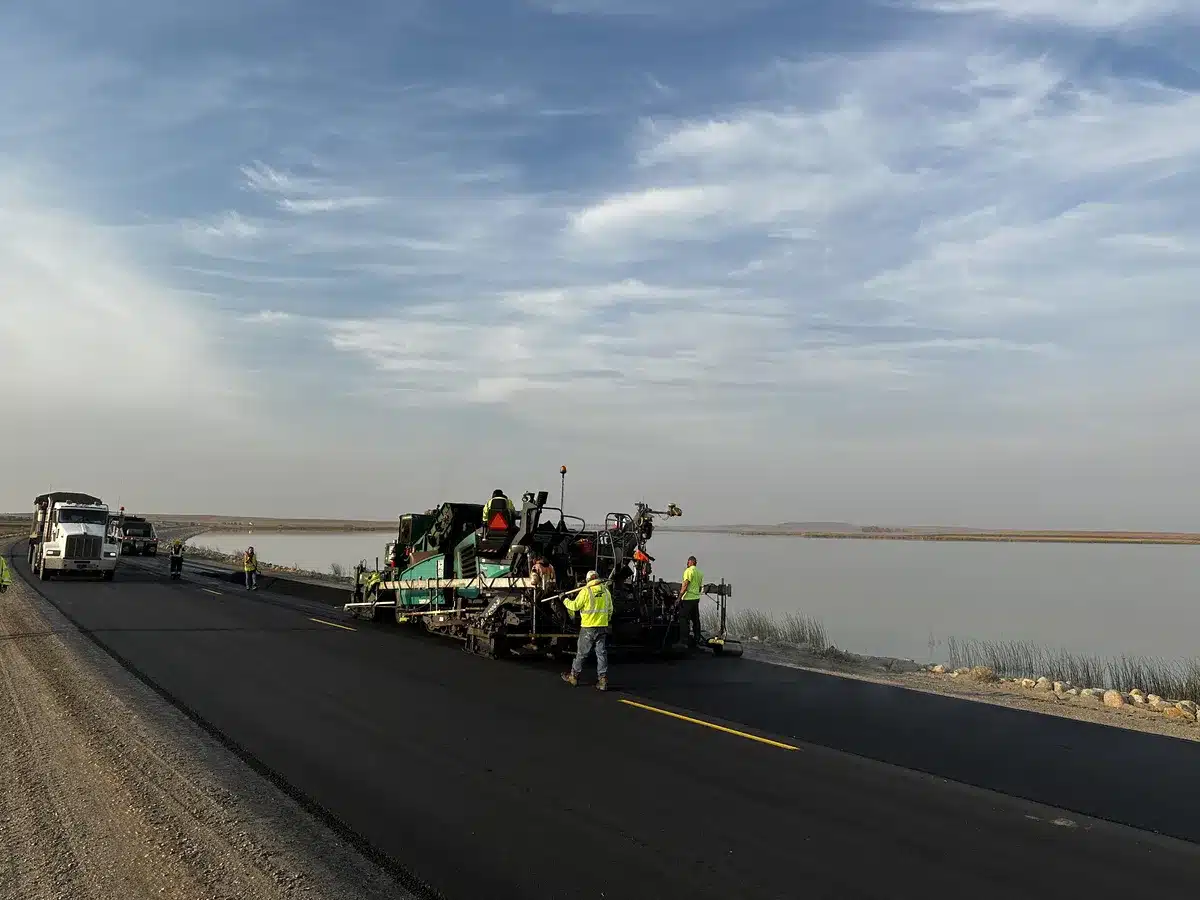
A look at balanced mix design and intelligent systems to minimize human error and increase pavement performance on a North Dakota test project
As introduced in the March/April edition of AsphaltPro Magazine, Job 23273 along Highway 14 in Burleigh County, North Dakota, trialed not only an array of new technologies but also balanced mix design (BMD) in its eight test sections. The North Dakota Department of Transportation (NDDOT) let the job totaling 21.22 miles to test BMD and technologies and to repair the roadway. Jonathan D. Stork, P.E., is a research engineer for NDDOT Materials and Research and he outlined the roadway’s history.
FTF-SS-X-1-014(014)000 was part of the Feb. 16, 2024, bid letting. The roadway had originally been built in 1963 and saw an average daily traffic of 630 vehicles at the time of the most recent project design (2022).
“The existing pavement system had most recently received a 2-inch overlay in 2009, and a chip seal in 2013,” Stork shared. “The roadway was originally paved in 1963, with varying treatments throughout its lifetime. The overall IRI for the roadway before construction was near 90 inch/mile before improving to 40 inch/mile after project completion. The prior distress score for this roadway was categorized as fair (88), with main distresses being various cracking and patching.”
In 2022, it was time to address the underlying distress.
“Like many roadways constructed at its time, the original base course was somewhat lacking for today’s traffic counts. Because of the scope of work, the decision was made to build these test sections on a uniform, stabilized base to create a proper platform for many future years of service.”
“Part of this project was to find the ‘limits’ of these balanced mix design ranges, and that comes with both good and bad test results, which is crucial for validating this research.”—Jonathan D. Stork
The scope of work took a team to decide upon. As Pavewise’s Bryce Wuori commented, the job came together similarly to a design-build project. Stakeholders met and brainstormed the best way to use technologies to achieve the end goal.
“This is the first time I’ve participated in a process where a state highway in need of repairs was transformed into an 8-section test area without causing significant disruptions to the construction process,” Wuori shared. “The collaboration between the DOT, the contractor, and other stakeholders truly reminded me of a well-executed design-build project.”
Tyler Wollmuth, PE, assistant M&R engineer, NDDOT Materials & Research Division, explained, “The stakeholder group was instrumental in helping phase the work and set up the parameters of the test section construction. The remainder of the project was designed by the NDDOT and was mostly complete when the stakeholders started having meetings.”
“During the conceptual phase of the project planning, NDDOT formed a BMD working group comprised of various stakeholders including many of our local contractor partners and suppliers, Federal Highway representatives, university partners, and industry experts,” Stork explained. (See Sidebar) “From this working group, we were able to design and bid this project in a manner that was both reasonable and effective. This was important for all parties involved, as we wanted to balance agency and contractor risk while still obtaining the testing result spread that we needed to validate different performance levels.”
One example of modifying the parameters to facilitate the project’s execution was that of addressing certain volumetrics requirements in the field.
“We required our standard specifications for compaction incentive/disincentive, which can vary depending on substrate, mainline or joint placement,” Stork said. “We waived certain volumetrics (AC content, percent air voids) during the construction of the test sections, as was laid out in the plans after feedback during the BMD stakeholder meetings. These requirements were waived to avoid penalizing the contractor for supplying the project with the DOT requested mix that falls outside our typical construction limits. Part of this project was to find the ‘limits’ of these balanced mix design ranges, and that comes with both good and bad test results, which is crucial for validating this research.”
Wollmuth explained it would’ve been unfair to penalize the Border States team for achieving a result the DOT requested, even if that result was outside the typical construction limits Stork mentioned. “Waiving the requirements for some volumetric properties was necessary to protect the contractor from falling into the disincentive range on air voids and asphalt content,” Wollmuth shared. “Our specifications require they stay within an acceptance band for each property, but because of the way we were varying the asphalt content in the mix, that would not have been possible. We didn’t want to penalize the contractor for doing exactly what we asked them to do.”
“The roadway was originally paved in 1963, with varying treatments throughout its lifetime. The overall IRI for the roadway before construction was near 90 inch/mile before improving to 40 inch/mile after project completion.”—Jonathan D. Stork
The contractor also set up innovative solutions to protect the environment during construction. A section of the roadway passes through the Rice Lake Wildlife Management Area, which all parties wanted to protect. “Floating silt curtain was installed before work began in the Rice Lake Area, and was maintained throughout the duration of the construction,” Stork said.
From protecting the environment to executing a successful pavement maintenance project, all stakeholders embraced best practices and new technologies to bring everything together. Each step along the way had some new or exciting element that promised to elevate success.
“For me, it’s not the use of a single technology but the use of many different technologies working together to form a comprehensive look at the overall operation,” Stork shared. “Using IC for compaction control uniformity, thermal profiling to limit material segregation, density profiling to ensure quality pavement assessment, and E-ticketing to keep everything organized. This is truly exciting as it gives us information that, just a few years ago, was simply not feasible to ask for. Now, we can look at any aspect of the operation, address and learn from mistakes, and continue to improve the operation to make paving safer, more efficient, and produce a much longer lasting pavement.”
To prove the two mix designs—the virgin aggregate with 5.6% optimum AC and the RAP mix with 4.7% AC plus 0.93 for a 5.63% AC content—Border States Paving of Fargo, North Dakota, provided 100 pounds of each of the eight test-section mixes to NDDOT. The two grades of AC used were 58S-28 and 58H-34 polymer modified. The sections and their nuances are outlined in Table 1 below.

Table 1. The HMA Test Sections on Hwy. 14 | Border States Paving constructed eight HMA test sections from RP 0.5 to RP 8.5 on the top 2-inch lift. The test sections were part of a BMD validation study for a NDDOT research project. Data provided by Pavewise LLC
While the balanced mix design (BMD) component of the project was top of mind for the DOT, other aspects of the project made this one of national importance. Stork explained some of the overarching milestones the agency wished to achieve.
“The ultimate goal of selecting this project was to validate the performance thresholds for our future potential shift to balanced mix design,” Stork shared. “In doing this, we aim to link the test section performance to their various testing results and determine the path forward for setting requirements.
“When we have a project such as this, with multiple mix designs in a relatively small span of both time and quantity, we want to assess variability and ensure uniformity of both the materials and the operation,” he continued. “To achieve this, we relied on technology to help set up, monitor and assess the quality of the operations. In doing so, we feel we were able to limit the risk and ensure that the test results and conclusions are valid.”
The quantity to which Stork referred was just over 96,000 total tons of hot-mix asphalt (HMA). The time was roughly 180 days from start to finish, which involved milling, widening, pipe replacement and extensions, HMA and cement-treated base (CTB), and full depth reclamation (FDR) in all of the eight sections. Wollmuth confirmed work started on the project on April 15, 2024, and was completed on Oct. 19, 2024, with the BMD test sections completed during the second half of September.
Testing BMD Leads to Success
According to a presentation from Zane Hartzog at the National Center for Asphalt Technology (NCAT), the four lab tests used to determine mix performance were the indirect tensile asphalt cracking test (IDEAL-CT), indirect tensile rutting test (IDEAL-RT), the disk-shaped compact tension (DCT) and Hamburg wheel track test (HWTT). Let’s break those down as they relate to the design phase of the Hwy. 14 project. All tests were performed by the NDDOT Bituminous lab, the NCAT mobile asphalt lab and the NCAT lab in Auburn, Alabama. Wollmuth stated NDDOT Bituminous lab did most of the testing referenced herein; NCAT lab results were very similar.

Bob Usher of NDDOT runs the IDEAL-CT in the NDDOT Bituminous Lab. Photo courtesy of NDDOT
IDEAL-CT
ASTM International defines the level of cracking resistance of a pavement as its cracking tolerance, or CTindex. The higher a mix’s CTindex, the better its resistance to cracking. This test is ASTM D8225. For the Hwy. 14 project design, lab techs prepared asphalt samples in the gyratory compactor and cured them for two hours at 77°F (25°C) before placing them in the IDEAL-CT device. Wollmuth shared: “IDEAL-CT results showed crack resistance results ranging from a CTindex of 49 to 220.”
IDEAL-RT
ASTM International defines the level of rutting resistance at high temperatures as its rutting tolerance, or RTindex. The higher a mix’s RTindex, the better its resistance to rutting and the shallower ruts in the final pavement should be. The lower its number, the more resistant it is to cracking. This test is ASTM D8360. For the Hwy. 14 project design, lab techs prepared asphalt samples in the gyratory compactor and cured them for one hour at 115°F (46°C) before the peak load was applied. Wollmuth shared: “IDEAL-RT results showed rutting resistance results ranging from a RTindex of 70 to 145.”
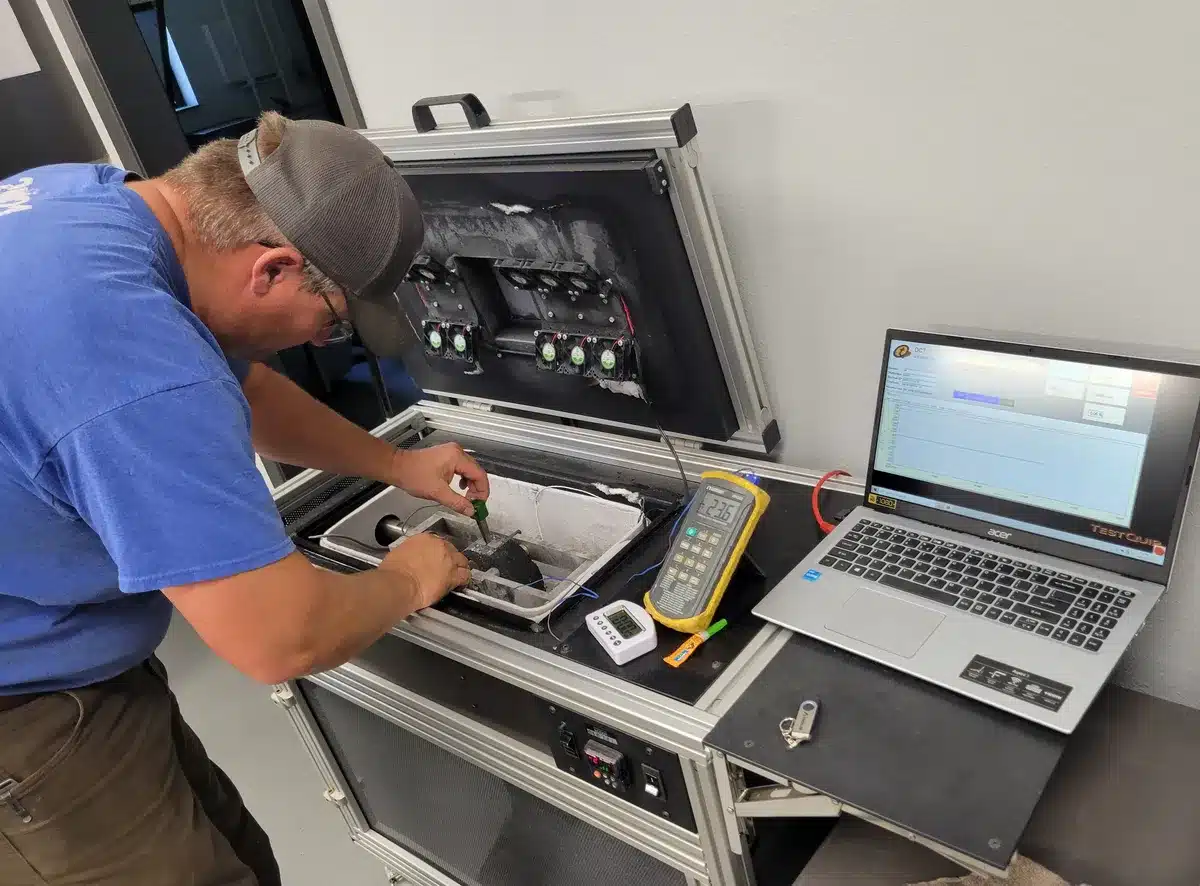
Justin Rogstad of NDDOT runs the DCT in the NDDOT Bituminous Lab. Photo courtesy of NDDOT
DCT
The DCT (ASTM D7313) is a thermal cracking test. The higher a mix’s number, the better its resistance to cracking. For the Hwy. 14 project design, lab techs prepared asphalt samples in the gyratory compactor and cured them for two hours at –11°F (-24°C) before applying the energy to pull them apart until cracking occurred. Wollmuth shared: “DCT results showing thermal cracking resistance results ranging from an index of 331 to 492.”
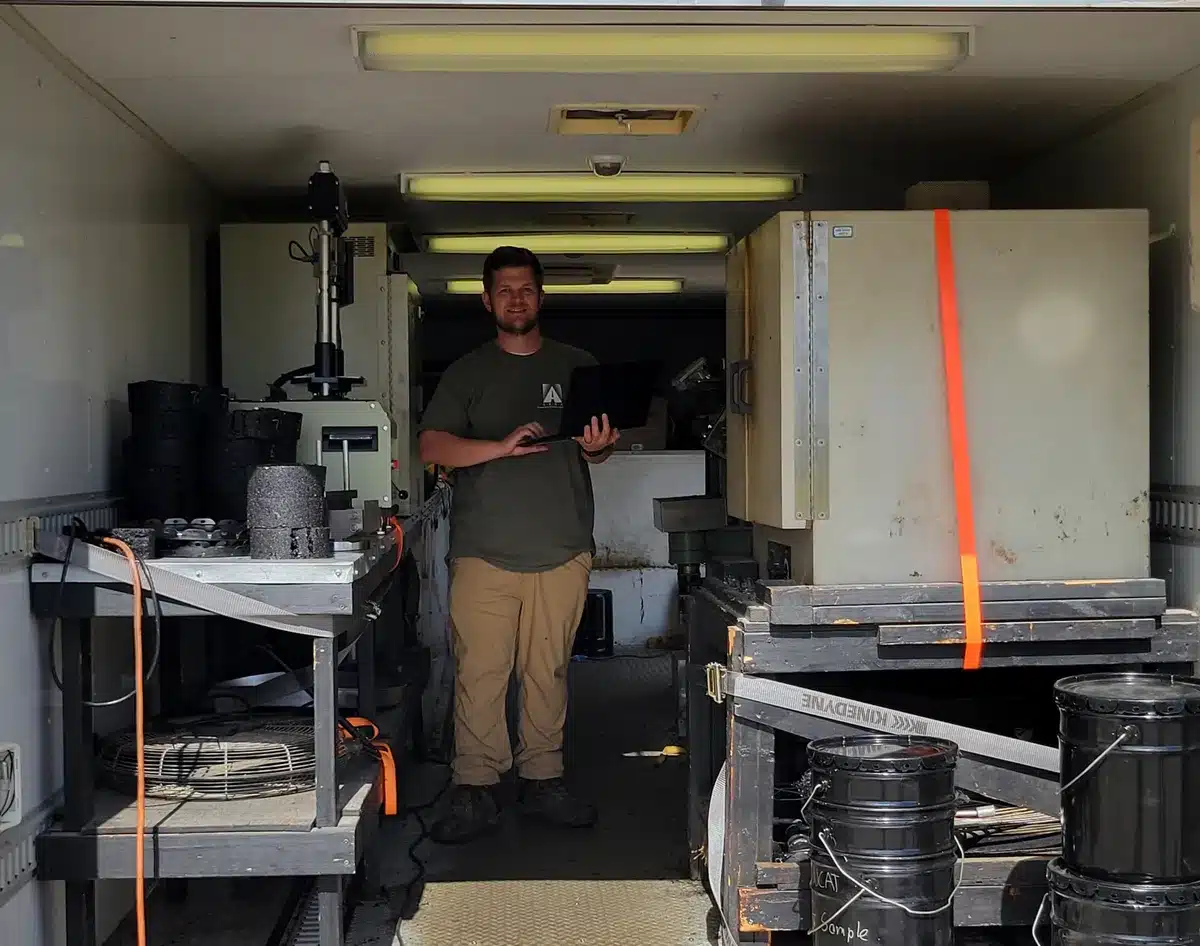
Zane Hartzog of NCAT runs tests and gathers data in the NCAT mobile asphalt lab. Photo courtesy of NDDOT
HWTT
The cyclic loading of the HWTT tests the rutting, stripping and aggregate breakdown of the sample. For the Hwy. 14 project design, lab techs prepared asphalt samples in the gyratory compactor and performed the test in water at 115°F (46°C). Wollmuth shared: “HWTT results showing rutting values that ranged from best 2.87 mm of rutting in 20,000 passes to the worst 12.5 mm of rutting in 9291 passes.”
With robust testing and planning on the front end and continuous monitoring and quality control throughout, the various members of the Hwy. 14 project team delivered a high-quality pavement to end users while providing a high-level trial project for DOT and industry to evaluate.
“This project had many unique features associated with it and came with additional complexity and effort,” Stork shared. “To employ so many technologies and new innovations takes lots of additional time and expertise, and we appreciate our involved partner’s willingness to further the research efforts. Overall, the contractor received performance bonus for both compaction and smoothness, and we consider this project as a success.”
The final installment of our Hwy. 14 series will dive into additional data points and final numbers and will take a look at how Border States earned bonuses with technology and technique.
The BMD stakeholder team for the Hwy. 14 project:
- Knife River Materials
- Mayo Construction
- Border States Paving
- Northern Improvement
- Sundre Sand & Gravel
- Terracon
- Aaron Swan Labs
- NDDOT
- NCAT
- FHWA