
Adding Liquid Capacity Increases Flexibility for R.K. Hall
BY Sandy Lender

R.K. Hall and BROCK partner on enhancing performance for the plant
Editor’s Note: The new Focus on Performance series from AsphaltPro Magazine allows OEMs and service providers in the industry to highlight asphalt professionals who have improved efficiencies and the bottom line through best practices and performance. This month’s installment, featuring R.K. Hall, Paris, Texas, dives specifically into efficiencies gained through adding liquid asphalt capacity.
During 2024, R.K. Hall, a division of Summit Materials at press time, headquartered in Paris, Texas, increased capacity at two of its 11 asphalt plants by adding larger, vertical liquid asphalt cement (AC) tanks from BROCK LLC, Chattanooga. With more mix designs and projects on the horizon, the company will update additional sites with similar tanks over the winter and Manager-Asphalt Plants Richard Yates shared how this strategic plan benefits the producer.
“We use a lot more grades of asphalt than we used to, so some of this is a storage requirement.”—Richard Yates

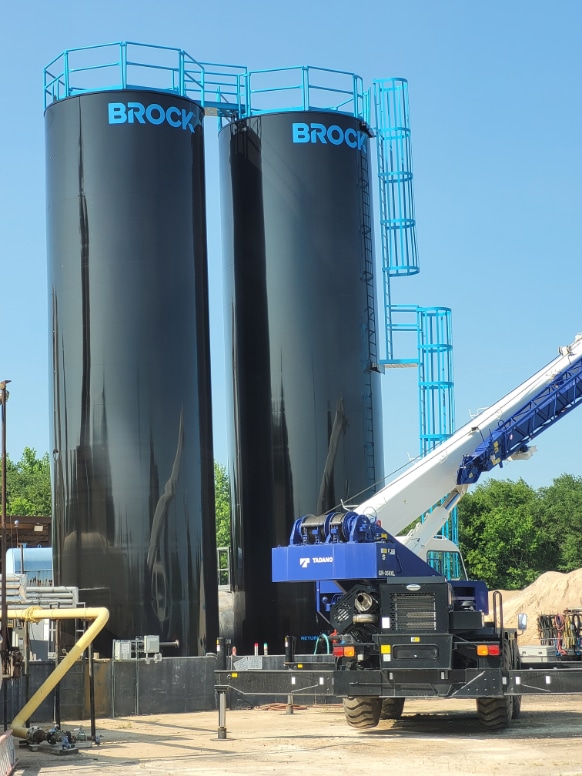
In June 2024, R.K. Hall and BROCK worked together to install a new, 30,000-gallon, vertical AC tank at the Mt. Pleasant plant to increase liquid storage and give the site more flexibility. All photos courtesy of BROCK
Logistics
The two sites we’re discussing in this article are located in Mt. Pleasant and Denison, Texas. Both are facilities R.K. Hall acquired in 1992 and 2010 respectively and has been updating and upgrading as time allows.
The Mt. Pleasant site is about an hour and a half to two hours from the nearest refinery from which they draw liquid; the Denison site is about three hours away from the nearest refinery. While there are other refineries to draw from, those are the closest and require careful scheduling of material use and delivery when the site only has two or three storage tanks. The company is giving personnel like Justin Mulino, plant manager at Mt. Pleasant, some breathing room by setting up more tanks at a facility.
“We needed more storage,” Yates said. “Some of our facilities are relatively close to refineries and some are not. Having four, five, six tanks simplifies our lives. We use a lot more grades of asphalt than we used to, so some of this is a storage requirement.”
Performance grade (PG) 64 is a base grade used for many Texas Department of Transportation (TexDOT) projects, so it’s natural for R.K. Hall to have that on hand, but the company has found itself needing to stock a variety of other grades and products to meet a growing demand for its own crews and customers.

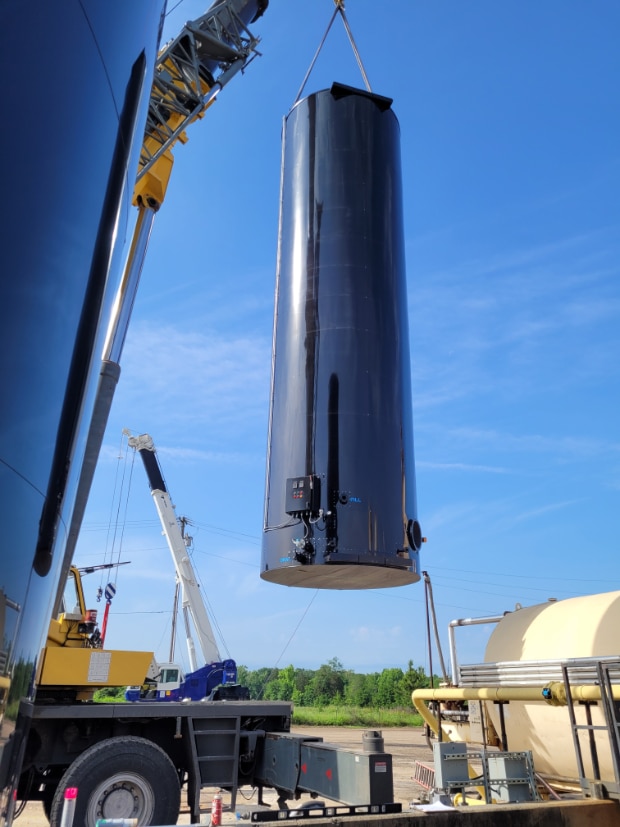
In these two images, you can see the delivery of a new 30,000-gallon liquid AC tank and its hoisting via crane at the Denison plant site. BROCK’s Lance Clark shared, “The entire R.K. Hall team is very professional, highly intelligent, and passionate about our industry.”
Pleasant
As of press time, the Mt. Pleasant site had five AC tanks—including the two 30,000-gallon vertical tanks they added from BROCK in June 2024—and was about to receive a sixth.
“It’s kind of an unusual marketplace,” Yates said. “We reach into Arkansas and sell to a lot of counties and cities that buy cold mix, so we have one tank dedicated to cold mix AC 1.5. We also do a lot of FOB sales to contractors doing TexDOT work needing different grades of oil. And if we’re doing a big project, we might need two tanks for that alone.”
That makes for a lot of moving pieces for Mulino to track, but Yates spoke confidently of the plant manager’s skills.
“It’s price-driven where we pull the oil from, and it might be three or four hours away. We average five transports a day coming in [with AC deliveries].” Add to that 30 to 40% of haul trucks for R.K. Hall and 60 to 70% for outside sales, and Mulino’s keeping it all coordinated.

“Justin started out as a ground man and has been an operator there at least five years now. He’s one of the more level-headed people I know. He can keep everything on an even keel. He’s calm, cool and collected most of the time. He’s calm in the face of the storm and when you’re running four or five jobs out of there, it can get pretty hectic. He’s able to manage it all.”
Lance Clark of BROCK also spoke of the team’s efficiency and partnership. “R.K. Hall has been instrumental in the growth of BROCK over the past four years,” Clark shared. “I have had the privilege of managing their account from day one. R.K. Hall provides constructive feedback on equipment designs, which we implement as design standards, to make products better for our customers. The entire R.K. Hall team is very professional, highly intelligent, and passionate about our industry.”

Denison and Beyond
The Denison site came with two 20,000-gallon horizontal tanks, to which the company added a 30,000-gallon vertical from BROCK in April 2024.
“We don’t buy anything but 30,000 anymore,” Yates said. “There’s very little difference in the heating cost; you’re going to use the same size coils. Most of the heating and elements in the top and bottom are not very different from a 20 to a 30.”
“BROCK tanks are designed with finned tube coil bundles,” Clark explained. “Utilizing finned tube bundles mitigates the need of multiple layers of bare pipe inside each tank. Tanks with multiple layer pipe coil bundles add a higher amount of pressure drop for the heater pump to overcome. BROCK coil bundles are designed for a lower pressure drop and heat transfer in mind. Each BROCK coil bundle has 1,100 square feet of heating surface area for a 30,000-gallon AC tank.”

In these two images, you can see the delivery of a new 30,000-gallon liquid AC tank and its hoisting via crane at the Denison plant site. BROCK’s Lance Clark shared, “The entire R.K. Hall team is very professional, highly intelligent, and passionate about our industry.”
The difference Yates’ team is experiencing between the different sizes of tanks is in production. “It’s doing exactly what we had hoped. We can handle more variety. We’re able to react to customer demands more quickly. Some customers decide the day before what they need and now we can react faster to their needs. It has increased our production capabilities.”
They plan to make that increased performance possible at more sites during the downtime of 2025. “We’re going to do away with some of the hoizontals this winter,” Yates said. “We’ve got a mix-match of plants because we’ve acquired them over the years, and they’ve come with horizontal AC tanks. We’re working with BROCK to switch those out.”
At this time, the plan is to “simplify their lives” at sites in Amarillo, Greenville and Denison, for starters. “We still do business with other manufacturers, but we do a lot of work with BROCK and enjoy that relationship.”