
VFW National Home Gets Mill-and-Fill Revamp Before Centennial
BY Sandy Lender

Quality Asphalt & Maintenance takes the reins for restoring infrastructure at the VFW National Home ahead of centennial
Working on a paving project that serves veterans brings a heightened sense of pride and gravitas to the job. This rang true for Veteran Shane Farlin, owner of Quality Asphalt & Maintenance LLC, Battle Creek, Michigan, when he had the opportunity to take on the street paving project for the VFW National Home in Eaton Rapids, Michigan, in the spring and summer of 2024. The project consisted of replacing drains, curb-and-gutter, parking lots and streets in time for the facility’s centennial celebration.
Farlin engineered the project with his Quality Asphalt company and subcontracted the mill-and-fill work to American Asphalt out of Lansing. By the end of the project, they’d repaved a beautiful community for veterans and their families through a set of history-revealing challenges.
Farlin’s paving project was the last piece of the updating puzzle for the VFW before its centennial celebration, and he considered it an honor to be selected for the job. “Our project was just one [of many]. They wanted to make it beautiful…and we were the ribbon on the facility. They had done landscaping, and we were doing the roads. Doing that for the centennial was an honor.”
During a video interview, Mike Wilson, the executive director of the VFW National Home, explained how Farlin’s company won the project.
“It’s a huge risk, hiring someone to come in and do this extensive work, and you know, expect it to turn out okay,” Wilson said. “But when they heard it was a veteran-run organization that was doing the bidding, and was going to do the work, it made it a lot easier for us to say, yes, let’s get it done.
“We are a nonprofit,” Wilson continued. “We survive solely on donations. Our first actual meeting with Quality Asphalt, Shane was willing to give something back when we hadn’t given anything to him yet.”
Military Vets Could Be the Answer to Your Construction Staffing Challenges
Rick Stiver, National Children’s Home facilities director, shared during that same video interview how the relationship began. “The state of our roads here were terrible, cracked, weathered, uneven, the drainage was next to none…The front area, the entrance was asphalted. Shane volunteered his men and his time, and did that for absolutely zero cost to the National Home.”
Farlin shared, “There were some bandages we could put on or some trauma that we could mitigate, but it was all short-term. It [the entrance] was falling apart. It was raveling. They reached out to me early in this season [2024] and talked to me about the possibility of having the paving project and seeing if we could come in and do it right and get the entire facility fixed up. We partnered up with them and laid out a plan to properly engineer some things, make it so that they can avoid some of the problems and issues that led to the failure of the roadways and the parking lots.”
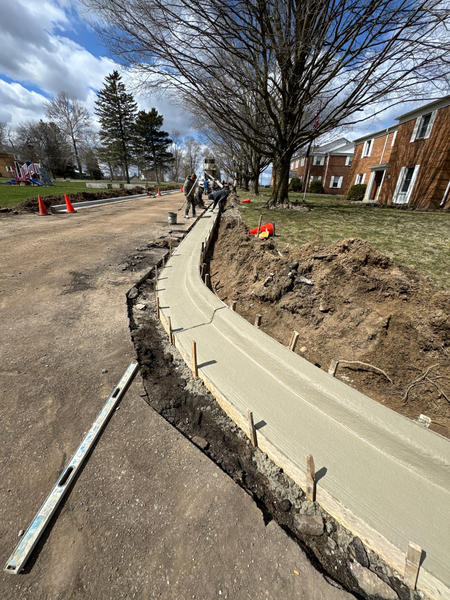
Quality Asphalt & Maintenance took care of curb and gutter for the community as one of the phases of the project.
After re-engineering the entrance, other phases of the project required mill-and-fill. Farlin shared, “Milling depths varied from 4 to 7 inches, depending on thickness of existing asphalt. Production varied on the sections milled and ranged from 1,000 to 1,800 tons per day. Days averaged about 10 hours on the ground.”
While there were plenty of crew members who went above and beyond to complete the project, Brett Blood, the owner of American Asphalt, mentioned a few in particular. “There were multiple mill operators on the job, but Chris did the majority of the phases. He has approximately 40 years’ experience and will push through issues to get the job done.”
They received mix from Rieth-Riley’s Astec double barrel plant in Lansing, about 15 miles from the project. “The mix was very good and consistent,” Blood said, sharing that production temperatures were averaging 315 degrees.
American Asphalt’s team used two pavers—an older Volvo PF4410 and a Carlson PC100 2—to place the mix in two lifts—a 2-inch leveling and a 2-inch wearing course. Again, management was appreciative of the operators. “Two paver operators worked on this project. Tom, an old-timer with 30 years’ experience running a paver and Dylan, a youngster who has been running paver for American Asphalt for just two years now and has taken well to it and is eager to learn.”
They used two breakdown rollers—a HAMM HD14 and CAT 434—and two finish rollers—a HAMM HD12 and HAMM HD10—to achieve the final smooth pavement.
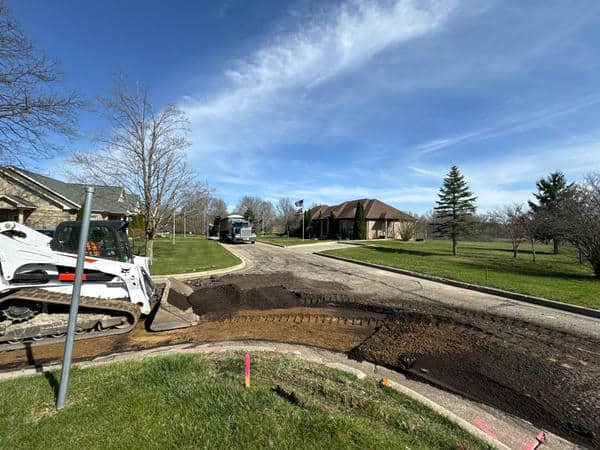
American Asphalt milled varying depths, averaging 4 to 7 inches across the project, depending on the layers they encountered each day. “The mill even broke through in some areas,” Farlin said. “Other areas had 24 inches of asphalt.”
Veterans Have A Heart For Other Veterans
 There’s a reason Farlin’s heart was committed to the VFW project. “I was 14 years old when I left home for military school in Virginia via a VMI/West Point preparatory school because I knew I wanted to be a career soldier and officer,” he said. “I came back, graduated from a military school in Michigan, the MYCA. My junior year, I went straight into the military two days after I turned 17. At the age of 18, I shipped out to Iraq, and shortly after my 19th birthday, on Memorial Weekend in 2004, I was blown up and lost my right eye in support of the Battle of Fallujah. As a veteran who has faced my own tragedy and struggles, when the VFW National Home came to my attention, it was a no-brainer that I could help them restore their roads.”
Farlin shared that any time he can give back to an organization that’s helping kids or veterans, he wants to. “My heart is attached to a place that is a child-centric organization so that’s why we do a lot of volunteering. We’re donating Purple Heart parking with stenciling as well, this year [2025].”
“We have 42 homes where we house veterans that are either transitioning from active duty, or transitioning out of the military, or we have families here that have just, I would like to say, kind of lost their way,” Stiver explained. “And they’re here for a period of time for us to help them get back on their feet, in hopes, when they leave here, they’re better off than when they came.”
With the new streets and pavements complete, the families have a safer and more user-friendly community to enjoy during their stay. “Since the day they were done, I’ve seen roller skates,” Wilson said. “I’ve seen skateboards. Kids out playing…[before they] weren’t able to do that. The streets were in bad shape. They hadn’t been paved in 40 years, very bad shape, and so I think it’ll impact the lives of all the families here, just because it’s a durable, reliable surface that they can go and have fun on and enjoy.”
“It really means a lot to me to be a part of that, be part of something that has a huge impact on people,” Farlin said. “We’re all about partnerships and long-term relationships. We don’t look for the easy paycheck one time in and out. We take every project and figure out and evaluate it from start to finish in the long term. We’re going on three generations running this company now. What that means is that at some point, my son is going to make sure that this is still a viable parking lot.”
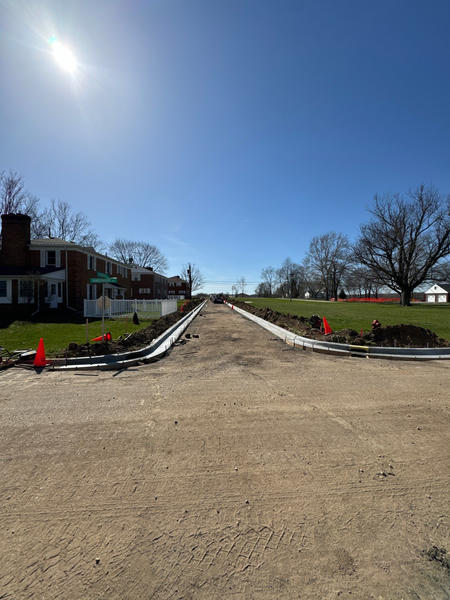
With the subgrade prepared, the crew is ready to place the 2-inch leveling course.
Despite a rainy season and surprising subgrade, the team members working with Quality Asphalt accomplished the phases of the VFW project throughout the spring and summer of 2024 to provide the veterans’ families with a beautiful finished project. The 100th anniversary celebrations continue with the next event scheduled for Aug. 13, 2025, when the VFW Auxiliary hosts a bus trip to visit and tour the community.
The Purple Heart
On Aug. 7, 1782, President George Washington created the Badge of Military Merit. The badge essentially replaced the Fidelity Medallion, which had been bestowed upon three wounded American soldiers in 1780. Prior to the medallion and badge, it was customary to give “awards” to officers who were instrumental in winning battles, so the badges for bravery and injury being limited only to enlisted soldiers was novel.
On Feb. 22, 1932, Army General Douglas MacArthur helped rename and revise the look of the Badge of Military Merit, establishing what we know today as the Purple Heart. From 1932 onward, the Purple Heart was available to both officers and enlisted personnel.
On Dec. 3, 1942, President Franklin D. Roosevelt clarified the qualifications for receiving a Purple Heart with Executive Order 9277. He removed “meritorious service” as a qualification and expanded eligibility to all branches of the military. The medal can be bestowed upon any serviceman or woman who is “wounded or killed in action,” obviously allowing it to be bestowed posthumously.
Each Aug. 7, we recognize National Purple Heart Day as a chance to say “thank you” to the men and women who fought and died for our nation’s freedom, and those who now carry the physical scars with them. To salute these heroes, AsphaltPro Magazine is proud to share at least one story in our pages this August of a Purple Heart recipient, Shane Farlin, who owns and operates Quality Asphalt & Maintenance LLC in Battle Creek, Michigan. His company’s restoration of streets and infrastructure at the VFW National Home is a tribute to our nation’s heroes.