Shut Down the Roller for Winter

Now that it’s time to put the roller away for the down season in most parts of North America, you can plan ahead for spring startup.

Make sure the roller operators and mechanic working on the rollers this winter check for worn coco mats and broken scraper bars. This is the time to replace them. Maybe you need to repair nozzles on the water spray system that lubricates the drums. Adding lights now gives extra nighttime paving safety and visibility to your worker later. Maybe you need to replace the fuel tank cap or something else that’s simple now, but could be a nightmare later.

Whatever the point of concern, now is the time to address it.

Take a good look at the roller’s drums. You’re looking for divots in the surface of the metal. If you see gashes or gouges, you know those will translate into missed areas of compaction in your asphalt mat. Your mechanic probably cannot weld smoothly enough to return the drum to perfect working condition. You will either remove it and send it to the OEM for repair, or, if the gash is deeper than the metal, you may have to order a new drum altogether. When in doubt, check with the OEM about components and flaws.

Have you drained and flushed all the systems? Have you capped or covered nozzles after thoroughly cleaning them and their filters? Make sure you check the owner’s manual for best practices—if you’ve misplaced this vital document, the OEM probably has a copy online.

Don’t forget company policy when putting this machine into storage. Your team may have additional steps to lock up equipment for the next few months.


Subscribe now to receive tips like this directly to your inbox each week!
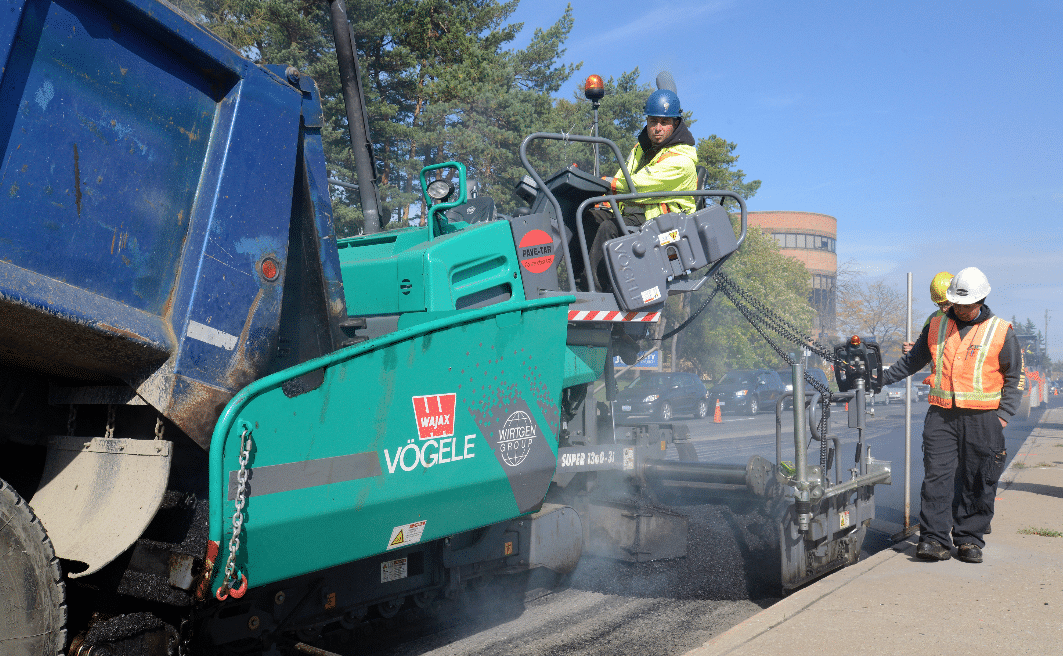
How to Store the Paver for the Winter

One of the most vital machines for your paving operation is, of course, the paver. By taking extra time this winter to clean and shore up the paver, you invest in next paving season’s success. The online training course that we offer gives an in-depth look at paver maintenance, including a downloadable checklist for paver operators and mechanics to use, but let’s look at some points of concern right now.

Make sure the paver operator and mechanic working on the paver this winter check for missing bolts and metal fatigue. This is the ideal time to fix those things. Maybe you need to repair or add conveyor belt rubber to the front of the hopper and hopper wings to improve holding capacity. Adding lights to the hopper wings now gives haul truck drivers clear delineation for backing and dumping later. Maybe you need to repair the conveyors in the hopper floor to more efficiently move material. Maybe the flow gates need attention. Whatever the point of concern, now is the time to address it.

Before you store your paver for the season, there are things you can do to ensure it will have a healthy spring start.

  • You want to start with a thorough cleaning with a biodegradable release agent to get any and all debris and asphalt off all moving parts and extra greasing on chains, sprockets and exposed cylinders.
  • Drain the fuel tank and refill it with a winter blend to prevent the fuel from turning to sludge at cold temperatures. You don’t want to leave the tank empty, as it will be prone to rust. Also drain the fuel/water separator. Drain the spray-down system, mixing system, lines and nozzles of water, and flush them with antifreeze.
  • Next, secure all the panels and lock the hopper in transport mode. You’ll lock the screed “up” off the ground to keep it from rusting.
  • Cover the fume extractor and seats to prevent weathering.
  • Even though you’ve stored the paver for the winter, you want to have a schedule posted to start and move the machine at least monthly. Drain and refill the lines of antifreeze, remove the blocks and uncover the fume extraction system. Starting the machine and moving it a bit will charge the battery, move the fuel and hydraulics through the system, and help prolong the life of the tires or tracks.
  • Don’t forget company policy. Your team may have additional steps to lock up equipment for the next few months.

Have a safe and wonderful Thanksgiving holiday!


Subscribe now to receive tips like this directly to your inbox each week!

Stewards of a Better Environment

I remember the clickety clickety clickety phooooosh of Aqua Net on weekday mornings as I prepared my hair to survive a full day of 1980’s high school. I also remember the guilt trip leveled at me for the increasing hole in the ozone layer, to which my hair style choices contributed.

Fast forward to my adult years and I found myself listing the composition of Earth’s atmosphere for an appendix in my Dragons in Space YA sci-fi series and, lo and behold, there’s more than Nitrogen, Oxygen and Argon in the air we breathe. While Ozone and Nitrogen Dioxide make up an incredibly small percentage of what we’re taking in, they join Methane, Carbon Dioxide and a few others that might surprise the kids being taught to fear anything not being filtered through an N95 mask.

This month’s editor’s column follows the science to mention the various elements and compounds necessary for Earth’s atmosphere for a simple reason. We should acknowledge the small stuff.

Talk to most therapists these days and they’ll remind you to be thankful for the small stuff. Look for and give thanks for the little things in life. Show gratitude for each of the tiny rewards, no matter how insignificant they may feel at first, and don’t be surprised when they snowball into mountains of blessings.

In the asphalt industry, we often need to remind the communities in which we live and work that we contribute positively to the environment, economy, infrastructure and so on. It’s not commonplace for a zoning board to proactively brag about the remediation efforts of the quarry down the road or of the local plant donating RAP to an animal rescue to re-pave its driveways, which we all know leads to more ecologically friendly fuel use.

We must ring those bells ourselves.

The examples of our industry performing in an environmentally friendly and sustainable manner border on endless at this point in history. We are good stewards of the environment at large and have the opportunity to be positive forces when sharing that news.

This month, as hearts and minds turn toward charitable giving and communing with faithful friends who are dear to us, gather near to us positive and hope-filled messaging. On my grown-up Christmas list, I’ve added a desire that we all set aside the uglier language of social media platforms and mainstream news channels and focus instead on sharing our good events in the best way(s) we can. I want to encourage you to share your positive, environmentally friendly stories with us at AsphaltPro so we can work alongside you to broadcast your message across a wider platform. Let us help you share that we are stewards of a better environment.

In the meantime, I wish everyone a safe and beautiful holiday season. Merry Christmas and Happy New Year from the team at AsphaltPro.

Stay Safe,

Sandy Lender


Elements and Compounds in Air

This is the composition of air, in percent by volume, at sea level, at 59°F and 101325 Pa.

  • Nitrogen = 78.084%
  • Oxygen = 20.9476%
  • Argon = 0.934%
  • Carbon Dioxide = 0.04%
  • Neon = 0.001818%
  • Methane = 0.0002%
  • Helium = 0.000524%
  • Krypton = 0.000114%
  • Hydrogen = 0.00005%
  • Xenon = 0.0000087%
  • Ozone = 0.000007%
  • Nitrogen Dioxide = 0.000002%
  • Iodine = 0.000001%
  • Carbon Monoxide = trace
  • Ammonia = trace

Source: https://www.thoughtco.com/chemical-composition-of-air-604288

World of Asphalt, AGG1 Open Registration for 2024 Return to Nashville

Registration is now open for World of Asphalt Show & Conference and the co-located AGG1 Academy & Expo, running March 25-27, 2024, at the Nashville Music City Center in Nashville, Tenn. With more than 400 exhibitors and more than 200,000 square feet of exhibits, the 2024 show is expected to be among the biggest in its history. Attendees who register through December 15 can save 40 percent on admission by using code NEWS40.

“We’re looking forward to returning to Nashville to bring the asphalt and aggregates industries together again to showcase the latest products and innovations all in one place,” said World of Asphalt Show Director Brittany Schmidtke. “Additionally, we are expanding this year’s show to include more networking and educational opportunities than were available at the record-breaking previous show.”

How to register:

  1. For the ultimate World of Asphalt and AGG1 experience, opt for the All-Access badge, granting daily entry to both World of Asphalt and AGG1, along with access to up to 10 concurrent education sessions. Promo code does not apply to the All-Access badge option.
  2. Book yourtravel and accommodations through the official World of Asphalt and AGG1 hotel block that provides access to the show’s rate assurance without the need to pre-pay.
  3. Enroll in education to secure your spot. Education topics include people, plants, paving, pavement preservation and environment, health, safety and sustainability (EHS&S).
  4. Prepare for your visit. With more than 400 exhibitors and just three days to explore everything, attendees are encouraged to organize their schedule for World of Asphalt and AGG1 ahead of their arrival in Nashville. Additionally, remember to plan Nashville experiences for time spent off the show floor.

“The 2024 AGG1 Aggregates Academy & Expo will foster a unique environment of professional networking along with the latest in industry education,” said Michael Johnson, president & CEO of the National Stone, Sand and Gravel Association (NSSGA). “Everyone should have AGG1 on their calendars, since the show creates the largest annual gathering of industry producers and those in the manufacturing and services space.”

Attendees will be able to download the World of Asphalt & AGG1 mobile app in spring of 2024. The app will seamlessly connect with the online show planner, offering show maps and real-time notifications.

“This World of Asphalt is poised to be the most crucial one yet with all the advancements going on in the asphalt pavement industry,” said Dr. Audrey Copeland, President and CEO of the National Asphalt Pavement Association (NAPA), co-owner of the show. “That’s why we’re offering asphalt paving professionals and business owners in the industry more to see and learn than ever before.”

Begin Off-Season Repairs with Cold Weather Machine Care

What are you driving to and from the areas of the plant to be evaluated and upgraded this offseason? What kind of platform will you raise and lower on the reg to execute each task? Those pieces of equipment need love and attention during cold weather to run efficiently.

One of the most obvious tips for keeping auxiliary equipment at the ready is using a block heater to raise the temperature of the engine and hydraulic fluid. If you want to speed the warming process, you can block the radiator to keep cold air away from the fan.

But take a look at the hydraulic fluids you’re warming. Did you start with the right ones? Before it gets freezing cold out there, make sure you install the right engine oil, hydraulic fluids, and transmission and final drive lubricants for the specific machine and the specific temperature range you’ll be working in during plant maintenance and upgrading. The operator’s manual will guide you there.

Take a look at the hydraulic hoses while you’re in that area, too. Hose outer wrapping could use a nice rubbing of arctic hydraulic oil during the winter so it doesn’t get brittle enough to crack.

You looked at the engine and fluids, but don’t forget the drain that cold weather effects on the battery. That thing has to generate almost twice as many “cranking amps” to get going when it’s cold outside. (You may want to store it indoors in between workdays.)

Don’t forget your best practices for storing diesel exhaust fluid involve temperature. DEF will freeze if left exposed to temperatures of 12 degrees F or lower. Then, after it has expanded, it can bust out of its container during thawing. This means you want to store it properly, in a proper container, at temperatures you can monitor.

Whichever steps are most efficient for your team to get equipment started in the cold weather, don’t get in a hurry. Make sure you let the engine reach its operating temperature before you “take off” to work. Intake and exhaust valves can gum up, among other problems, if you don’t take the time to let engines warm up properly.

Here’s a caution tip for you. If you elect to use starting fluids to help get equipment running, remember that they are highly flammable. They’re also toxic. Make sure you store starting fluids properly in the mechanic’s garage.


Subscribe now to receive tips like this directly to your inbox each week!

Registration Now Open for 2024 WofA Mentorship Program 

Women of Asphalt (WofA) has opened registration for its 2024 WofA Mentorship Program. Registration ends December 1, 2023.

According to WofA, one of the organization’s primary goals is to foster and promote networking and mentoring opportunities, and its mentorship program is designed to be a resource for women in the industry and encourage success.

To participate in the mentorship program, both mentees and mentors must be registered WofA members. The mentorship is a 12-month commitment, and requires participation in at least one mentorship meeting per month and other training or events when possible.

Those interested in becoming a mentor, or those who would like to be paired with a mentor, should complete the WofA Mentorship Registration Form. This includes current participants in the program (there will be instructions specific to current members within the form).

For those who are new to mentorship programs, WofA provides plenty of resources to help guide the experience, including a WofA Mentorship Guidebook and online training for mentors and mentees.

For more information, click here for an overview of the program or email WofA at info@womenofasphalt.org.