OMI Industries Adds to 1300 Series

OMI Industries (OMI), Palatine, Illinois, has added a new series of products to its industrial asphalt mix. The latest 1300 series is designed to provide manufacturers and contractors with an improved response to strong odors associated with operations.

Over the last five years, the Ecosorb 1300 series has undergone extensive testing on asphalt cement blends. It is through research and development that OMI identified new asphalt mix odor profile trends and crafted this latest line of products to offer a broader spectrum of odor control in the asphalt and petrochemical industries.

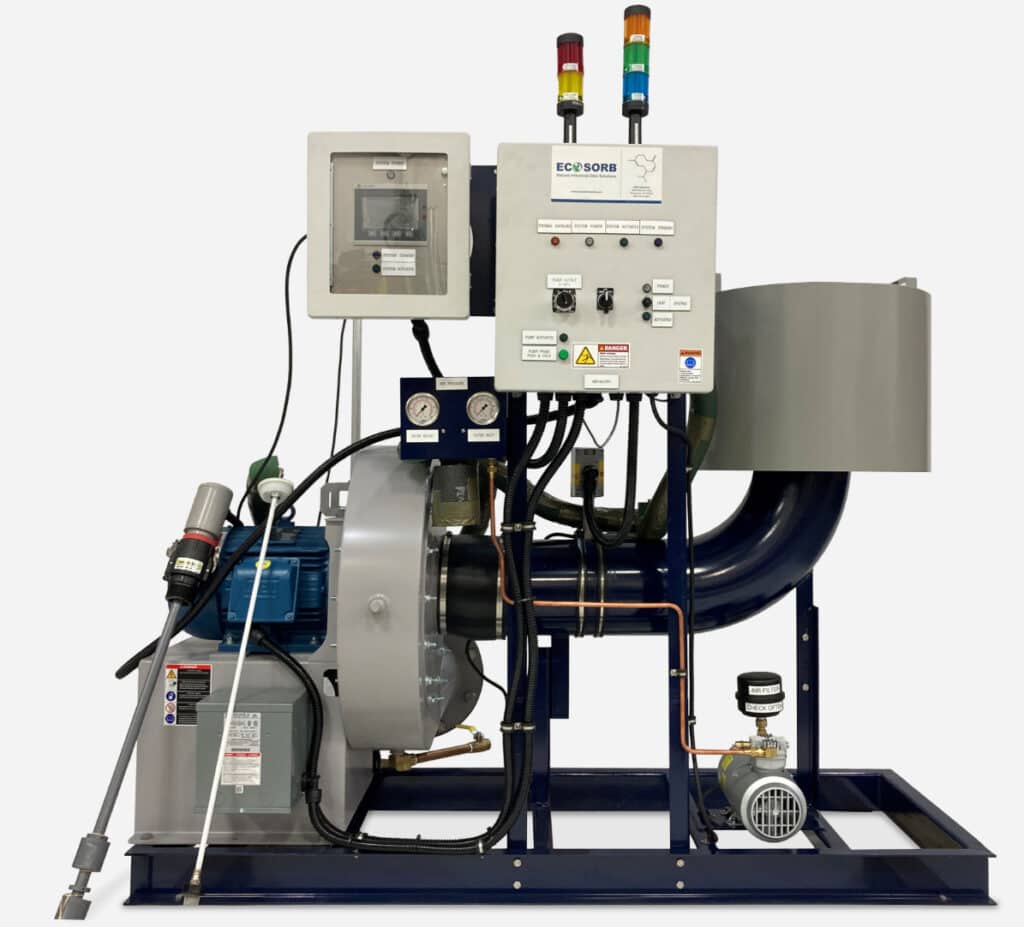
The 1300 series distinguishes itself by incorporating plant oils to address hundreds of odor-generating compounds such as hydrogen sulfide and mercaptans. The new formulations are blended into hot mixes or distributed in the air vapor phase systems to neutralize airborne chemical compounds that cause offensive odors.

The 1300 series offers two primary use formats:

  • Oil-based additive—1300A is directly added to oil-based substances. Incorporating plant oils and a scavenger to reduce sulfur containing compounds to influence odor control in both liquid and vapor phases. At 20C, it has a specific gravity of about 0.94 and a colorless to amber appearance.
  • Water-based additive—1306 is tailored for use in Ecosorb vapor and atomization systems to manage airborne odors. It can be strategically applied in exhausts or through ducting where unpleasant odors are escaping. At 20C, it has a specific gravity of about 1.00 and a milky white appearance with a pH of 4.0-8.5.

To treat asphalt cement additive, oils and their derivatives with the oil-based 1300A, add 100-1,000 ppm (which is ½ to 5 gallons per 20 tons of asphalt cement) of Ecosorb additive during a transfer process such as terminal storage tank to truck or truck to hot-mix asphalt plant tank. This addition can be done via in-line dosing with the Ecosorb additive injection system or by adding the Ecosorb additive to the transfer hose before beginning the transfer.

For airborne treatment using the water-based 1306, you can use the VPS equipment. Connect the drum or tote to your Ecosorb VPS machine and set the gallon/day rate at the value directed by your Ecosorb salesperson or start at ½ of the capacity of your system. After treating for two hours, review your odor situation and adjust the set-point as needed. Alternatively, you could use the air atomization method. Dilute or set dilution of the 1306 between 25:1 and 100:1 with water. After treating for two hours, check the odor condition and adjust your dilution accordingly.

Store the product in a well-ventilated, cool area, away from direct sunlight, heat sources, strong acids and oxidizing agents at temperatures between 40-85F.

Increase RAP with Astec ReMix CCPR System

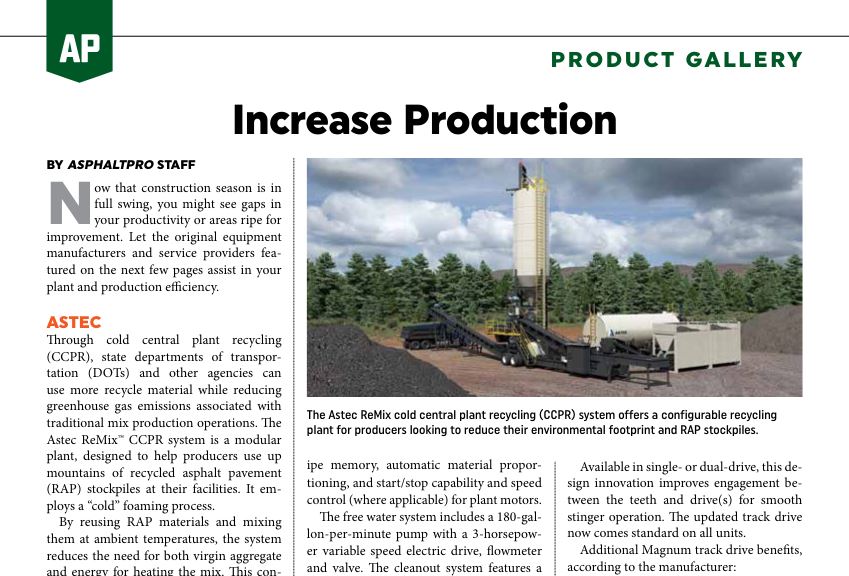
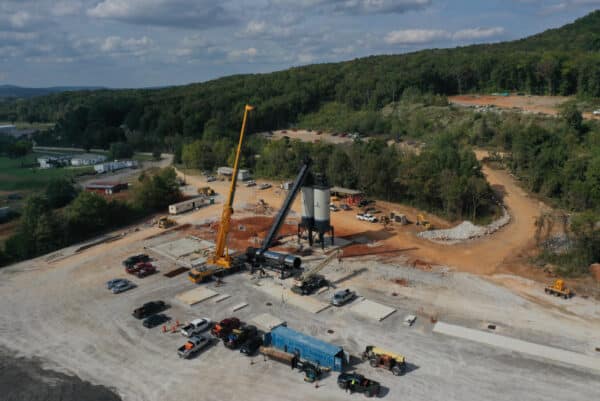
Through cold central plant recycling (CCPR), state departments of transportation (DOTs) and other agencies can use more recycle material while reducing greenhouse gas emissions associated with traditional mix production operations. The Astec ReMix™ CCPR system is a modular plant, designed to help producers use up mountains of recycled asphalt pavement (RAP) stockpiles at their facilities. It employs a “cold” foaming process.

By reusing RAP materials and mixing them at ambient temperatures, the system reduces the need for both virgin aggregate and energy for heating the mix. This conserves both natural resources and lowers carbon emissions.

The Astec ReMix system has a nominal production rate of 300 tons per hour production. It offers a range of modular configurations. From highly portable setups to maximum production configurations capable of handling large-scale road construction, the Astec ReMix CCPR provides producers with options.

The system comprises the following components:

  • A core load with a trailer chassis;
  • 300 TPH pugmill;
  • Feed conveyor;
  • Controls system;
  • Water line connection;
  • Shore power connection;
  • Water pump and metering system; and
  • Either a foamed asphalt injection system or an asphalt emulsion injection system.

The system features an intuitive user interface to enhance productivity and reduce the learning curve for operators. The touchscreen and controls are located on a panel at ground level and offer real-time trending and diagnostics. The controls include recipe memory, automatic material proportioning, and start/stop capability and speed control (where applicable) for plant motors.

The free water system includes a 180-gallon-per-minute pump with a 3-horsepower variable speed electric drive, flowmeter and valve. The cleanout system features a 2-gallon-per-minute cleaner pump, 10-gallon spray bar recirculating cleaner system and 5-gallon water line cleaner system. The pugmill is a twin-shaft design mixing box with AR steel liners featuring an electric motor with v-belt driven gear reducer.

The first two units are in testing with producers and the design is available for purchase.

For more information, visit astecindustries.com.

How to Be the Plant Everyone Buys From

Editor’s Note: For 2024, AsphaltPro Magazine allows experts in the industry to share how to expand your operations to the next phase of business. Are you ready to start making your own hot-mix asphalt? Let’s turn to some professionals who have equipment, services, software and tenure to help you expand to mix design, production, hauling and more. This month’s installment looks at the best practices you can employ with the storage silo to offer customers quick, quality asphalt mix for their paving projects.

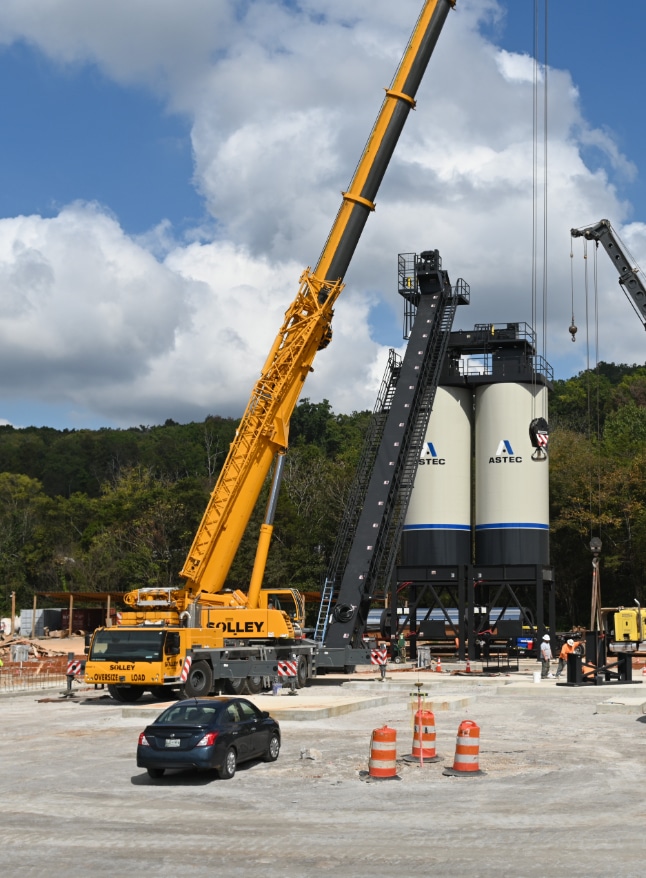
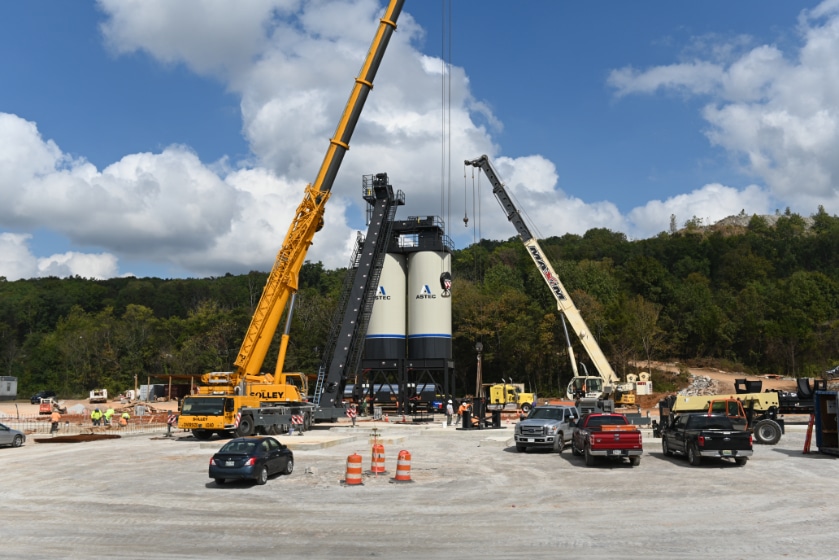
If you’re in the hot-mix asphalt (HMA) industry, you know one of the game-changing inventions of last century was the storage silo. During his “Asphalt Plant Efficiency” presentation during a World of Asphalt People, Plants and Paving session in Nashville in March 2024, Greg Renegar, the vice president of customer success for Astec Industries, Chattanooga, discussed the benefits of planning ahead with your storage silos in mind.

If your “why” is to provide mix for both customer and in-house crews, you’ll want to plan ahead for overnight storage of appropriate mixes as you build your new plant. During his presentation to the World of Asphalt audience in March, Astec’s Greg Renegar reminded attendees the plant that can start loading out customers first thing in the morning will be the plant everyone flocks to.

As he explained, even if you have older components you’ve been unable to update the past few years, you can operate efficiently if you maintain those parts, tighten up your environmental footprint, and follow best practices, such as optimizing the use of storage silos.

Notice that’s “optimizing” the use of storage silos. Not every mix design is ideal for the suggestions to come, and we’ll talk about those.

“If you are using very low absorption aggregates, it may lead to a high film thickness and the mix is more prone to drain down.”—Steve Jackson

Solve Asphalt Plant Odor Issues

Store It for Fast Startup

Renegar’s presentation included a side-by-side comparison of operations you might be able to share with your production team to showcase what’s optimal and what’s not.

Amazing Producer ABC

Using old technology

  • Starts loading out of prefilled silos at 6 a.m.
  • Starts up the plant at 8:30 a.m.
  • Runs two to three mixes on various jobs, with enough trucks for the day
  • Runs all day with changeovers but no mid-streams
  • Fills the silos at the end of the day for tomorrow’s early customers

Expand into Production: Plant Ticketing Software Basics

Struggling Producer XYZ

Using new technology

  • Starts making mix at 6 a.m.
  • Runs two to three mixes on various jobs, short of trucks
  • Mid-streams at 8:30 for 45 minutes
  • Runs another 300 tons and finishes for the day!
  • Cleans out
  • Gets a call at 10:15 a.m. for a 150-ton parking lot job
  • Fires back up at 11 a.m., runs 147 tons, then mid-streams while paving foreman figures the last bit needed

One of the two producers in our examples is using new technology for its efficiency and sustainability but isn’t using best planning strategies. Renegar shared plants that start and stop more than three times per shift use up to 20-35% more fuel than they do when they run steadily. These percentages are published in the National Asphalt Pavement Association (NAPA) publication QIP-132.

You can probably monitor the effect of starting and stopping on your own fuel use. By using the storage silo to take up the slack and prevent starts and stops, you keep a steady, even production. Renegar stated Astec’s most successful customers are the ones who use long-term storage capabilities to become more profitable.

Think about it.

Because 95% of breakdowns occur at startup, you have a leg up on the day even if unplanned downtime hits you at first light. You also have a leg up on your competition on the other side of the county if your plant already has mix in the silo while Producer XYZ is still getting fired up.

Renegar explained it this way: “Storage in multiple silos plus planning allows FOB customers to get in and out quickly in the morning. Serving the FOB customers better than your competition will result in more business.”

Expand Into Production: Navigate the Permit Process

Design Your Storage

This isn’t rocket science. But it does require forethought. Renegar cautioned producers on some reasons you might not want to store mix overnight. For example, lack of planning from your customers could result in wasted mix. There’s no point in producing a hundred tons of state mix at 300 degrees if your top five customers will show up wanting a less-pricy mix produced at 340 degrees.

If you don’t have proper heating systems in place, you run the risk of losing mix temperature. There are companies making electric heating elements that can be placed in silo cone packages to take the fear out of overnight storage. These entities might not make the silo itself, but are experts in the manufacture of electric heating components and provide these to OEMs like CWMF Corp., Waite Park, Minnesota, who then assemble the complete silo.

Even with the concern of temperature under control, you want to consider the mix design you’ll store. Renegar listed the “fear of storing polymer” as one of the reasons producers shy away from filling up the silo overnight or over a weekend. Folks in the field echo his concern when it comes to open-graded mixes due to a phenomenon known as drain down. This is when gravity pulls the liquid asphalt cement (AC) away from the aggregate and down toward the silo cone.

Steve Jackson, the vice president of plant operations and sustainability for NB West Contracting, Pacific, Missouri, spoke of this phenomenon in stone matrix asphalt (SMA) mixes. “The worst mix that I have seen for drain down is SMA,” Jackson shared. “That is why some agencies are reluctant to remove the cellulose fibers even when you add ground tire rubber or reduce the mix temperature.”

He gave an example. “I remember an SMA project where we filled a silo, and that was all the mix that we made for the night. The first sample, from the bottom of the silo, had high AC and 1.5% air voids. The second sample, toward the top of the silo, had low AC and 7% air voids. We made the mix extra hot because it was going to spend a long time in the silo.” The expensive lesson he shared was having to mill out that tonnage and replace it.

How to Become Your Own Hot-Mix Supplier

“SMA, open-graded friction course and other gap-graded mixes are the worst for this phenomenon,” Jackson continued. “They also usually have specified minimum asphalt contents. If you are using very low absorption aggregates, it may lead to a high film thickness and the mix is more prone to drain down. When Joe Schroer (NB West’s construction materials engineer) worked at MoDOT, he evaluated some of those mixes, and started calculating the volume effective binder, and approved some of the SMA mixes with less than the minimum spec requirement AC content of 6.0%.”

In other words, there’s hope for “fixing” the gap-graded mix so it can be stored overnight for quick loadout in the morning, if you’re willing to work with it.

Malcolm Swanson, industry consultant and president of e5Engineers LLC, Chickamauga, Georgia, shared his thoughts. “Coarse graded mixes, SMAs, any mix with little surface area will tend to drain down. That is a major reason for adding fiber to a mix. Fiber adds surface area without changing gradation. The added surface gives the AC a place to hang on.”

“If the state allows the contractor to design their own non-gap-graded mixes, then the mix has the absolute minimum asphalt content, so they are less likely to drain down,” Jackson said. “If there are mixes that specify a minimum asphalt content, then I would be careful. Take a look at the aggregate absorption as well. We typically use aggregates with 1% or lower water absorptions in our high type mixes, these are mixes that we try to drop the mix temperature as low as possible to prevent drain down.”

For producers looking to optimize the use of the storage silos, it’s possible to adjust the mix design and temperature to ensure you have exactly what your customers are looking for first thing in the morning. It might take a little forethought and planning, but the producer who plans ahead is the producer who can optimize all the components for a tight environmental footprint, an efficient operation and a plant that all the customers flock to.

Solve Asphalt Plant Odor Issues

Editor’s Note: For 2024, AsphaltPro Magazine allows experts in the industry to share how to expand your operations to the next phase of business. Are you ready to start making your own hot-mix asphalt? Let’s turn to some professionals who have equipment, services, software and tenure to help you expand to mix design, production, hauling and more. This month’s installment from Ecosorb takes a look at the permit line-item of odor control at the plant to ensure your community relations, sustainability initiatives and production efficiency are working hand-in-hand.

In the asphalt industry, maintaining neighborly relations and curtailing odor complaints before they arise is just as important as maximizing production for every company’s long-term business continuity.

Asphalt binders are complex mixtures of organic compounds produced as a byproduct of petroleum refining. With constantly changing feedstocks, staying on top of blends is critical to controlling odors. In recent years, “opportunity crudes” have become more prevalent industrywide, and it has become necessary to balance the lower cost of these crudes with extra processing and off-gas scrubbing requirements. Another factor to consider is increased equipment maintenance and premature failure because of accelerated corrosion caused by hydrogen sulfide in lower grade crudes.

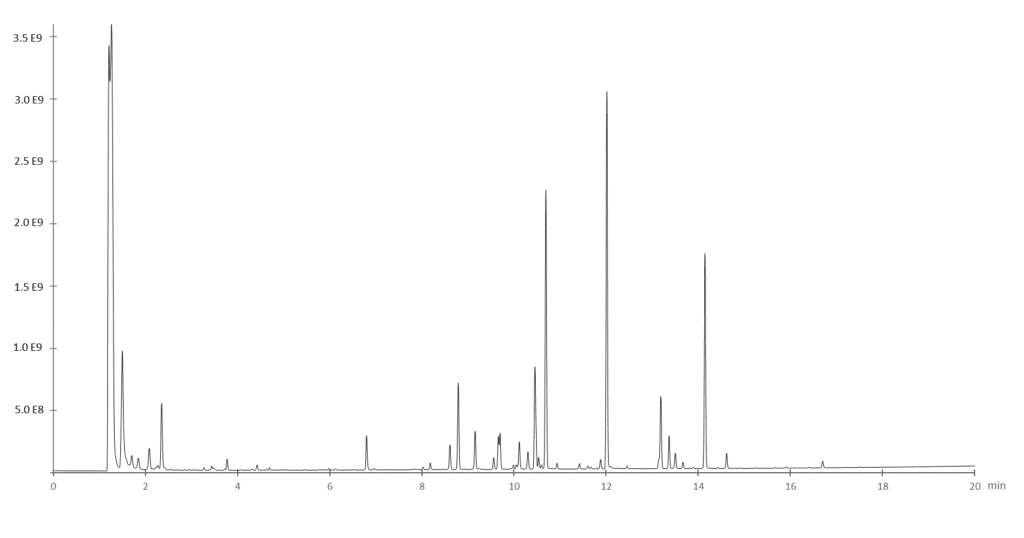
Each peak in a GC chromatogram represents the presence of a compound, identified and quantified on the x- and y-axes respectively.

During heating, mixing, transfer and application of asphalt binders, odors are often produced from volatile organic compound (VOC) emissions, which can lead to concerns from neighbors and passersby smelling the off-gas. If left unaddressed, concerns can become complaints, which can ultimately pave the way to regulation and operational restrictions.

Odor abatement is a historically difficult undertaking in the asphalt industry because of the complex makeup of bindings and numerous petrol products used in each hot mix. However, plants can now enlist the help of top suppliers with the knowledge and advanced laboratory technologies needed to chemically neutralize odor-causing components. These experts address this issue by identifying the problematic compounds, and by then creating and providing additives specially formulated to neutralize odors from various asphalt mixes.

Neutralization challenges with evolving mixes

Occupying a lower tier on the crude refining food chain, asphalt blends will always vary much more than higher-tier products, such as aviation fuels. Mixes can vary significantly from one season to the next—particularly with opportunity crudes—depending on the oil sources available and how they are processed. As a result, odor neutralization formulations must also adapt to the changing constituents of each season’s asphalt mixes.

Manufacturers, therefore, cannot always rely on the same odor-mitigating additives from one season to the next, even when producing the same end product. Additionally, since crude sources and refining processes vary by region and supplier, the nature and intensity of odors can differ even between batches of asphalt binders. Other factors for odor mitigation assessment include the temperature at which the plant is operated, geographical attributes—such as hills and valleys—humidity, temperature, wind speed and direction, and proximity of neighbors.

OMI Industries Introduces Ecosorb 1300

There are many potential VOC emission sources during the processes of refining the feedstock, manufacturing the mix, and storing the finished product. This is especially notable during the storage of bulk asphalt in a heated tank, in addition to stack emissions during production. Loading asphalt from one vessel to another—such as from the silos into trucks, and from trucks into a paver hopper—is another frequent odorous phase.

VOC concentrations increase significantly at higher temperatures. Below 150°C, few detectable VOCs are produced, but above this point, emissions increase. VOC prevalence is also dependent on the surface area of asphalt exposed to air over asphalt-coated aggregates. VOCs also increase substantially when these asphalt-coated aggregates are agitated.

Ecosorb’s vapor phase delivery system is useful for mitigating odors in airborne particulate matter at a baghouse.

Research-driven and plant-based solutions

Asphalt production variability spawns the need for adaptive and sometimes customized blends. Although there is no one-size-fits-all solution, there are general formulations that bolster odor mitigation efforts for a variety of asphalt mixes. These general formulations are added to the mixes to neutralize several odor-causing constituents, like hydrogen sulfide, mercaptans and general hydrocarbons. Specialty suppliers update their additives from year to year based on aggregate samples taken at asphalt plants to maintain effectiveness.

Although general formulations are efficacious for many mixes, some plants require custom blends, and expert suppliers can help with these needs as well. In these situations, asphalt samples are taken from the plant during multiple stages of production. These samples are then studied in a lab using gas chromatography mass spectrometry (GC-MS) to determine the precise molecular makeup of odors, even those present in minute amounts.

A GC chromatogram is a visual output of the data recorded by the detector, and it is presented as a plot of detector response along the y-axis, versus retention time along the x-axis (See the graph in this article).

Blue Smoke Control Introduces X-VOCS™ to Eradicate Odor-Causing Emissions

Each compound detected appears as a single peak on the graph, with the corresponding retention time value used for identification. Once the odor-causing compounds are identified, scientists develop a formulation using plant oils to molecularly neutralize the odors when the additive is combined with the mix.

This results in versatile and cost-efficient solutions—specially crafted for maximum effectiveness in each application—with each solution leveraging customized concentrations of plant oils, biobased surfactants and water to eliminate odors. These additives are designed to be safe, non-toxic and biodegradable, and to be applied during any phase of the asphalt lifecycle: manufacturing, storage, transportation and use. When used in refineries, hot mix plants, transportation systems and paving operations, they are blended directly into the asphalt mix (Figure 3).

These additives are also useful for mitigating odors and blue smoke when dispersed via vapor phase during the capture of particulate matter in a baghouse.

Airborne vapor phase dispersion is also commonly deployed to control odors at storage terminals, where asphalt is kept prior to delivery.

Multi-mix odor neutralization with a single additive

One longtime Ecosorb end-user customer—a new and reclaimed asphalt pavement plant producing 1,500-2,000 tons of hot mix asphalt each day for contractors and construction firms—relied on a basic odor-mitigating additive for years. However, recent asphalt mix variability spurred the need for a specially targeted formulation. The different mix sources and grades began producing pungent odors in the areas surrounding the plant, and the standard additive was no longer effective.

Spring Startup: Keep an Eye out for Blue Smoke and Odors Before Your Neighbors Do!

The plant shipped samples of three different asphalt mixes to Ecosorb’s lab to assess the levels of hydrogen sulfide, mercaptans and general hydrocarbons in each. The data from one asphalt mix, before and after treatment at 150°C is shown in Table 1.

Although the levels were different in each mix, the team of scientists formulated a single blend to neutralize odors in all three mixes, eliminating the burden of correctly matching different additives with a specific mix. The plant added this single blend to all its mixes, which reduced airborne sulfurous release by over 90%.

Ecosorb uses GC-MS instrumentation to identify odor-causing substances in asphalt mixes, and then develops custom plant-based formulas to neutralize odors.

Effective eco-products enhance odor abatement

By adding plant-based odor removers to asphalt mixes, manufacturers can effectively mitigate odors using safe, environmentally friendly and cost-efficient methods. These custom formulations do not mask smells, but instead mitigate them by breaking down and neutralizing odor-causing molecules in the mixes.

These mitigation techniques empower asphalt manufacturers to redirect their time from odor control and complaint handling, to maximizing production and overcoming the steady stream of challenges posed by evolving feedstocks.

Laura Haupert, Ph.D., is the chief scientific officer for Ecosorb, where she leads research and development, regulatory, safety and quality control. She earned her B.S. in chemistry from Manchester College and Ph.D. in physical chemistry at Purdue University, working with bond energies of solvated clusters. Haupert also completed her post-doctoral research at Purdue.

Relieve These Top 8 Pain Points When Laying Out Your New Plant

Editor’s Note: For 2024, AsphaltPro Magazine allows experts in the industry to share how to expand your operations to the next phase of business. Are you ready to start making your own hot-mix asphalt? Let’s turn to some professionals who have equipment, services, software and tenure to help you expand to mix design, production, hauling and more. This month’s installment from CWMF takes an overarching look at the plant footprint.

If you’re considering or planning on building a hot-mix asphalt (HMA) plant or expanding on your existing operation, you likely have a question or two. Or maybe a couple hundred. That’s because it’s complex and highly specialized. And not everyone who recognizes the marketplace opportunities of asphalt and paving is necessarily already an expert in what it takes to build an efficient asphalt production facility. Getting this massive undertaking right requires vast experience and deep expertise. Here are a few things to consider when you start planning your new asphalt plant.

1. Stationary or Portable and Tons per Hour (TPH).

The choice between a portable and stationary asphalt plant depends on various factors, including project size, duration, location, environmental regulations and mobility requirements. Stationary plants are best suited for large, long-term projects, while portable plants offer flexibility and mobility for shorter-term, varied, or remote projects. You will also need to determine how many tons per hour your market requires. Bigger isn’t always better when considering the overall investment.

Expand into Production: Plant Ticketing Software Basics

2. Equipment Placement.

Determine the optimal arrangement of key equipment within the plant. When designing an asphalt plant, two crucial factors demand careful consideration.

Available Real Estate for Stockpiles

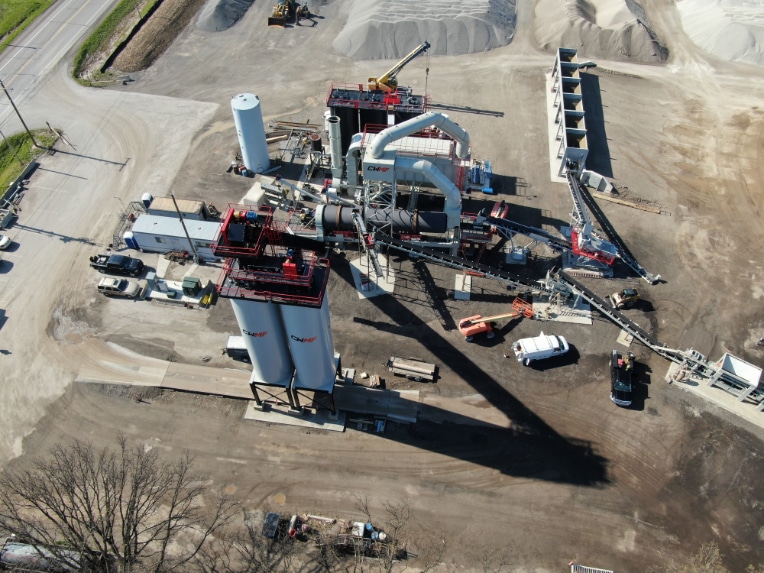
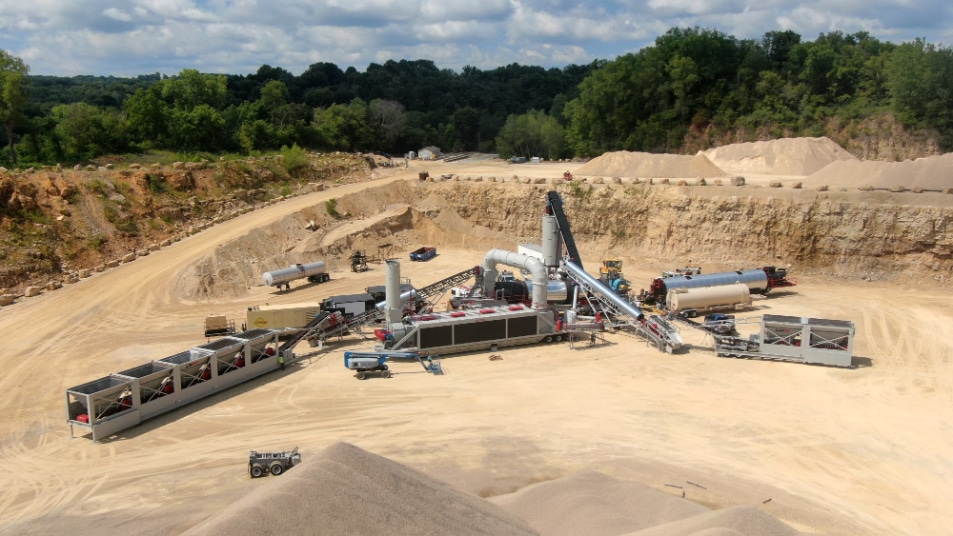
The extent of available property plays a pivotal role in determining the layout of the plant. To optimize both cost and efficiency, it is essential to focus on key features such as minimizing the distance and ducting required between the drum and the baghouse. Additionally, when positioning the asphalt cement (AC) tank package, minimizing the amount of piping that needs heating is paramount for enhanced efficiency.

Truck Traffic Flow in the Yard

Determine the optimal arrangement of key equipment within the plant. The goal is to minimize the distance virgin and recycled materials must travel through the plant and ensure efficient material flow.

When planning for current and future cold feed and recycled asphalt pavement (RAP) bins, it is imperative to be mindful of the traffic flow. The available real estate will dictate the optimal angle and configuration for the plant.

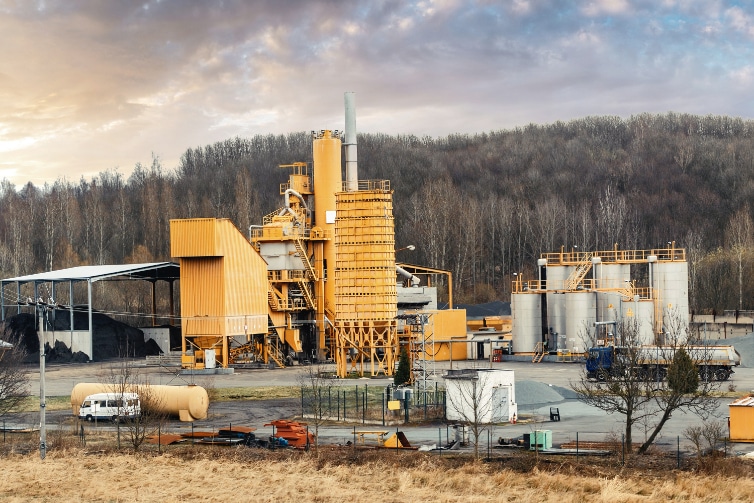
Even if you have plenty of real estate to spread out plant components for optimum visibility and multiple stockpiles of on-spec material, you want to focus on such things as minimizing the distance and ducting required between the drum and the baghouse. Keep these efficiencies in mind when designing your layout. Photos courtesy of CWMF Corp.

3. Control Room.

Design a control room with a clear view of the entire plant operation. This allows operators to monitor equipment, adjust parameters and respond to issues. CWMF offers integrated industrial automation and control solutions for asphalt plant equipment. We can provide the engineering, manufacturing, installation, start-up, and training to get you up and running at peak efficiency.

4. Install Electric and Plumbing.

Establishing the required equipment for your plant is one thing, but defining your needs to get it up and running is an entirely separate process that requires significant planning and preparation. Be sure to team up with an equipment manufacturer that can walk you through each step of the process.

Plan Ahead! Implement safety measures, such as clear traffic patterns, proper signage and emergency response plans. Getting the right signage in the right places is part of your successful plant layout plan, not only for traffic flow and proper stockpile management, but also for emergency preparedness.

5. Environmental Impact Assessment.

Evaluating the potential environmental impact of your new asphalt plant is critical. You’ll need to make sure you are following the local environmental regulations and obtaining the necessary permits. Consider implementing a pulse jet or reverse flow baghouse, such as CWMF’s Dust-Eater.

The baghouse dust collector is considered the “lungs” of a plant. When the plant cannot breathe effectively, it negatively affects production. This is an essential part of asphalt plant operations, along with the dust control system employed upstream to help retain and return usable dust particles back into the drum mixer rather than putting them immediately into the exhaust airstream.

Expand Into Production: Navigate the Permit Process

6. Zoning, Land Use Regulations and Permitting.

Understanding the local zoning laws, land use regulations, and permitting that govern where industrial facilities like asphalt plants can be located is incredibly important.

7. Safety and Emergency Preparedness.

Prioritize safety for both employees and the surrounding community. Implement safety measures, such as clear traffic patterns, proper signage and emergency response plans. Ensure that fire protection systems, hazardous material handling, lockout/tagout, and confined space entry procedures are in place.

How to Become Your Own Hot-Mix Supplier

8. Replacement Parts.

Once your plant is up and running, are you prepared for untimely breakdowns? Team up with a company you can trust to get you the replacement parts you need ASAP. The CWMF sales and service teams are ready to work through determining what you need to get your plant up and running, whether for the first time, during scheduled maintenance, or after unplanned downtime. Never underestimate the importance of the parts that make up the whole or the value of the professionals who go the extra mile to keep your plant online.

CWMF has been a trusted company in the stationary and portable asphalt industry for decades. As a full-service manufacturing company, we engineer all our products to order, allowing us to serve as a full-service, end-to-end provider of asphalt plant solutions. We have the machinery and equipment you need, and a confident team working together to make this happen. This provides an exceptional experience for our customers, and for the dedicated team standing behind their products. We work hard not only to retain our reputation but to stay current on the latest industry trends and technologies.

Wally Olson is CWMF Corporation’s sales manager. For more information, contact him at (320) 251-1306 or visit cwmfcorp.com.

Expand Into Production: Navigate the Permit Process

Editor’s Note: For 2024, AsphaltPro Magazine allows experts in the industry to share how to expand your operations to the next phase of business. Are you ready to take the plunge and start making your own mix? Let’s turn to some professionals who have equipment, services, software and tenure to help you expand to mix design, production, hauling and more. This month’s installment from Astec Industries Inc., Chattanooga, takes an overarching look at the permitting process.

There are a few important steps to keep in mind when seeking a permit for a hot-mix asphalt (HMA) facility. Please remember that regulations can vary quite a bit, so the tips we’re providing here are of a general nature. The actual procedures might differ in your area. If you’re ever unsure about how to move forward, it’s a good idea to reach out to a local consultant who has experience with permitting industrial facilities like HMA plants. This guide is meant to offer helpful suggestions, but it’s not a strict rulebook you must follow to the letter.

Site and Zoning

Site selection is an important consideration when contemplating installation of an HMA facility. It’s wise to prepare a thorough site analysis before proceeding further. Several areas need to be addressed at this stage of the project:

  • Are other plants already servicing the area? If so, research them thoroughly.
  • Is there an adequate customer base for my product? How much will the plant produce annually?
  • How much truck traffic will the plant generate? Consider the movement of both raw materials and finished product.
  • Is there easy access to community arteries from my plant site that can handle the additional traffic?
  • Is there a nearby source of raw materials?
  • What utilities services are needed and available?
  • Are there geological features (i.e., wetlands) at the site that must be considered?
  • Are there nearby neighbors that may potentially be impacted by the facility?
  • What impact to the environment will there be from the facility?

Another consideration is the zoning classification of the intended site. Though not a necessity, it’s preferable to select property already zoned for industrial use. Rezoning parcels or obtaining waivers to use the site for an industrial facility can be difficult.

Review all local ordinances to determine operating restrictions on parameters such as hours of operation, permissible sound levels, maximum structure height and exterior lighting to name a few. It’s important to verify whether different standards apply for day versus night operations. Facilities are often held to tighter standards during night operations, particularly for properties located adjacent to parcels with different zoning classifications.

Next, determine the applicable environmental requirements. Some municipalities have local agencies that issue operating permits within their specific jurisdiction. Local regulations take precedent as they must be at least as stringent (but are typically more stringent) as the state-level regulations. It is often helpful to speak personally to a permit engineer in the industrial sources division. Reviewing the operational requirements will allow you to select plant components to comply with applicable environmental regulations. You will need equipment information for dealing with the local authorities for site approval.

Once a site has been selected, contact the local planning board to schedule an in-person meeting. The intent is to determine if the proposed facility is compatible with the long-term land use plans for the community. Compatibility often depends on zoning classification of adjacent parcels. Communities typically cluster industrial sources and try to locate them away from commercial, institutional and residential land uses. The planning board should be able to indicate whether your facility will be a welcome addition to the community at the preferred site. They can also indicate what permits will be required for installation.

Enhance EPDs with Burner Tech

Engage the Community

Many contractors mistakenly try to keep their intentions a secret. Secrecy often leads to problems further along in the process, even if done for competitive reasons. This is especially problematic for sites near residences. Homeowners are naturally concerned with industrial facilities that may affect their quality of life. They often feel the contractor is trying to “sneak” into the community. Affected neighbors, by law, have the right to make comments during all public hearings. Public opinion can greatly sway approval decisions by elected officials, even when all operating criteria are met.

Fear causes objections by many people. The public is concerned about their health, property values, truck traffic, odors and obtrusive noise. Contractors should personally contact businesses and homeowners within a reasonable distance of the intended site. Plan to visit the homeowners in person if there are only a few houses. For larger neighborhoods, mail a letter to residents and schedule an in-person visit with community representatives. The letter should contain a summary of your proposed project. Include your contact information so residents can respond with concerns. The purpose is to determine the specific concerns of those potentially affected by your facility. You can better respond to, and hopefully allay, their fears, by addressing their specific concerns.

The key to obtaining community approval is education. Great ways to educate the community include hosting an informational meeting for the community and, if possible, organizing a tour of a nearby facility (ideally from the same manufacturer of the proposed equipment). Limit trips to facilities that are well maintained so it will be a positive experience for the visitors.

Mix-and-Match Asphalt Plants

Informal gatherings allow the contractor an opportunity to address neighbors’ concerns without the constraints of a formal hearing. In fact, holding an informational meeting may eliminate opposition if a hearing is required.

At the meeting:

  • Present a short explanation of your project.
  • Address any aspects of the opposition’s position that may have been publicly voiced.
  • Display pictures or models of equipment similar, if not identical, to what is proposed for the plant site.
  • Respond to each concern voiced during the meeting individually to avoid fueling concerns over a separate issue that has no merit or would not have been otherwise considered.
  • Never evade a question or respond rudely to the person asking it, even if the question seems silly. If you aren’t sure of the answer, indicate that you don’t know (they will appreciate your honesty and you will gain credibility) but will find out for them. Take their name and contact information so you can respond as soon as you have the answer. It’s important to follow through with supplying the requested information. Engage industry experts as necessary to properly answer the enquiry.

Remember, many people may not want to listen to facts that differ from their opinions and there will be people whose minds you will never be able to change. Arguing with such people can have a negative effect on others in attendance.

How to Become Your Own Hot-Mix Supplier

Emphasize the benefits to the community. Outline the tax revenue to be generated by the facility. It’s typically best not to over-emphasize job creation, as there are often few actual plant employees. Discuss the economic benefits of competition if there are other nearby facilities. Explain that minimizing haul distance can lower costs to the community for road construction projects because trucking costs are a significant factor in the price of hot mix. If replacing an older plant, note the positive benefits of replacing old equipment with new state-of-the art components, including lower emissions and quieter equipment operation.

To build good will, many contractors participate in community endeavors, such as Little League team sponsorship. Outline how your company intends to positively contribute to the community.

Plan to discuss all aspects of truck travel in and around your plant site. Trucking can have a huge effect on special land use permits and property re-zoning. Commission a traffic study for a greenfield site at the onset of the project. The study should involve determining the composition of traffic currently using the roadways that will be traversed by vehicles entering and departing your property. Pay particular attention to nearby land uses. Schools, hospitals and emergency vehicle stations are problematic as they each have traffic flow issues of their own. Plan your truck routes so that they are directed away from such entities, if possible.

Truck routes should also be planned to minimize impact on the community. Make realistic estimates of all truck flow in and out of the plant site. Account for the delivery trucks bringing in raw materials as well as haul trucks heading to the job site. Include both directions of travel in your traffic estimate, keeping in mind that trucks may enter or depart from the site empty.

Be prepared to address how your facility will minimize odorous impacts to surrounding land. The overwhelming response from the community is that they don’t want to smell asphalt fumes. This largely stems from the assumption that the odors must be harmful. However, that is not the case. Most compounds present in HMA facilities have low odor detection thresholds, meaning they can be smelled at concentrations far below exposure limits designed to protect against adverse health responses. Odors are typically regulated at the local level via zoning ordinance. Some states are beginning to implement odor limits within their air pollution regulations.
Sound and Emission Compliance

The emission regulations pertaining to the intended site will influence the plant components necessary for compliance. Facilities will have to install a baghouse filter collector to meet federal particulate standards. Several states are now requiring dispersion modeling for plant emissions to determine pollutant concentrations at the property line and possibly nearby receptors. Modeling results can reveal the need for taller stacks, additional emission controls, and equipment arrangement on the site.

Emphasize that your project will fully comply with all environmental regulations. Local planning or zoning boards have no authority to regulate air emissions. However, they can require implementation of certain mitigation methods as a special use permit condition.

Plant configuration and layout can affect the sound output during operation. When a strict sound ordinance is in effect, conduct modeling to predict the anticipated sound levels. The proposed equipment may have to be amended during this stage. Sound contours for the facility can show how the plant should be oriented on the site, placement of material stockpiles, and whether silencers are required. It is best to abate sound levels through strategic placement of plant components and stockpiles.

How to Start Up Your HMA Plant

Conclusion

Obtaining permits for asphalt mixing plants is crucial for environmental compliance and community harmony. Each step, from site selection to zoning, environmental requirements and community engagement, helps ensure a productive and successful process. Following the steps suggested here fosters trust from the community, benefitting both the HMA operation and its surroundings.

Begin preparing the various permit applications as soon as the project has been deemed feasible. Obtaining required permits can take a great deal of time, so start this step as early in the process as possible. Keep in mind that it is usually easier to make amendments to a permit than to obtain one in the first place. While it is better to have already selected specific equipment, it is sometimes possible to make changes once the permit is issued. It is best to check with the permit authority over your project concerning its policy. Required permits may include a special land use permit, building permit, air permit and a storm water permit.


Catherine Sutton-Choate is the IPS Director of Product Documentation & Environmental Compliance for Astec Industries, Chattanooga, Tennessee. For more information, visit AstecIndustries.com.