PFAS Update

ATL offers guidance for potential PFAS contamination from airport millings out of New York

The subject matter experts at Atlantic Testing Laboratories (ATL), headquartered in New York, have examined the issue of per- and polyfluoroalkyl substances (PFAS) occurring in the pavements milled during pavement maintenance activities at airfields. As discussed in the January 2024 issue at this link, PFAS are a group of man-made chemicals, including perfluorooctanesulfonic acid (PFOS) and perfluorooctanoic acid (PFOA). The PFAS from firefighting foam is the specific concern for the asphalt maintenance and preservation industry that we’ll focus on here because the foam has been used in training operations at airfields and other locations where contractors now mill and overlay.

Cheyenne J. Dashnaw, P.E., is a senior engineer at ATL and wrote recently of the hazards contractors may encounter when milling at airports and other locations with a history of using firefighting foam. Contractors collecting contaminated recycled asphalt pavement (RAP) and/or recycled concrete aggregate (RCA) need to be aware of potential environmental and legal consequences.

“If contaminated RAP or RCA are relocated to a different site, the contractor could be considered a potential generator and transporter of hazardous materials,” Dashnaw wrote. He explained to AsphaltPro readers how the contractor could be seen as a “generator” in this circumstance.

“If you have a project that may require sampling for PFAS or any other environmental analyte, ATL, a WBE certified company, has experienced environmental professionals located throughout New York State to perform sampling and coordinate applicable analysis.”

“The definition for generator is ‘any person, by site, whose act or process produces hazardous waste…or whose act first causes a hazardous waste to become subject to regulation.’” In these cases, the United States Environmental Protection Agency (USEPA) and the New York State Department of Environmental Conservation (NYSDEC) “would generally view the site owner as generators for most hazardous wastes, but could consider site owner and contractor as co-generators of certain hazardous wastes, especially for the scenario of a material being relocated to a different site without yet knowing it is a hazardous waste,” Dashnaw shared. “Additionally, if the materials are used as fill or an ingredient in new pavements, there is a risk of contaminating multiple other sites.”

In Defense of Segregation

The New York State Department of Transportation (NYSDOT) allows up to 30% RAP in its mix designs, according to Materials Method 5.16. Of course, the RAP material must meet spec. The NYSDOT Standard Specifications section 703-09 states:

“The aggregate component of the RAP shall meet the requirements of section 703, Aggregates. The bitumen component of the RAP shall be asphalt cement and shall be free of significant contents of solvents, tars, or other contaminating substances that will make the RAP unacceptable for recycling as determined by the Department.”

Dashnaw shared that in January 2021, NYSDEC Division of Environmental Remediation (DER) released a technical guidance document titled, “Sampling, Analysis, and Assessment of Per and Polyfluoroalkyl Substances (PFAS),” requiring sampling and analysis of environmental media for PFAS as part of remedial programs under 6 NYCRR Part 375. This guidance document has since been updated, with the current version dated April 2023.

Currently, NYSDEC DER requires the use of EPA Method 1633 for analysis of PFAS in all environmental media (not including drinking water), Dashnaw wrote. The background on EPA Method 1633 and PFAS cleanup is found at this link.

“Guidance values for limits in soil have been developed for sites in New York State, but soil cleanup objectives (SCO) are not planned to be established until at least a proposal and approval in a future revision to 6 NYCRR Part 375-6. The current guidance gives limit values for PFOA and PFOS based on the anticipated site use for soil and groundwater. While regulations are in progress, it is important to rely on knowledgeable environmental scientists and engineers to ensure that sampling and analysis are completed reliably and in accordance with the most recent and updated regulatory standards.”

Only the Paranoid Survive

Dashnaw clarified: “While the guidelines include soil cleanup objectives based on site use conditions, these are not yet established as regulatory standards and future regulatory standards may differ. If millings are known to be contaminated with PFAS, disposal at a permitted facility should be considered to err on the side of caution. At the very least, I would recommend deferring to the guidance value for Unrestricted Use, which is 0.66 ppb for PFOA and 0.88 ppb for PFOS. If you have samples exceeding these concentrations, disposal should be strongly considered.

“It is important to note that there is a risk that SCO could end up being lower than the current guidance values (and SCO could be developed for additional PFAS compounds other than PFOA and PFOS), but should at least work within the bounds of existing guidance.”

If a contractor suspects PFAS contamination, it’s wise to keep those incoming materials in their own stockpile. “Being able to separate materials is always beneficial, albeit not always obvious or practical,” Dashnaw said. “If a material does end up being discovered as contaminated, and it was managed separately, it is more efficient to track and less costly for subsequent removal and disposal.”

For more information, contact Cheyenne Dashnaw at (315) 386-4578 or info@atlantictesting.com.

Remote Technology Teleo Solves Ajax Plant Pain Points

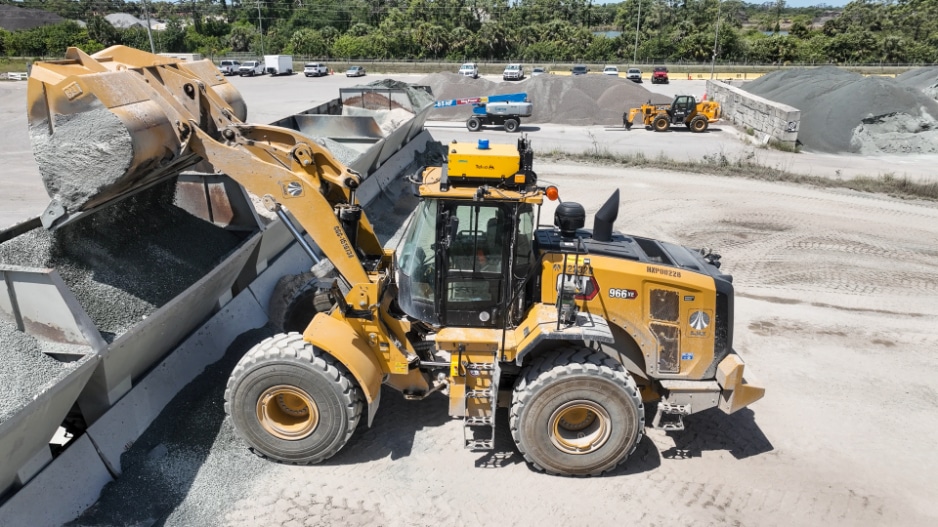
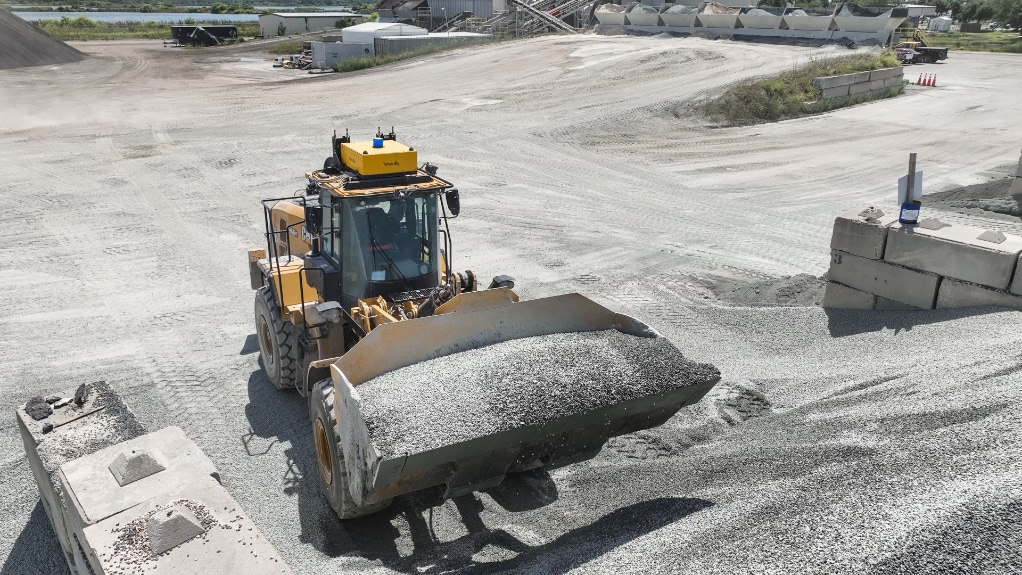
Teleo outfitted a new Caterpillar 966XE wheel loader with Teleo Supervised Autonomy, the technology that enables remote and autonomous operations of machines from a command center, for Ajax Paving of Florida. Now Ajax will have the option of running the machine, located at its Venice facility, even if the available worker for the day is clocked in at a command center 80 miles away. Here’s how Teleo is helping the asphalt industry attract workers who can keep production up and running.

Right now, Ajax’s plant in Venice, Florida has its first command center and the Teleo-equipped loader. The locations for the second wheel loader and the other two command centers will be determined by Ajax at press time.

Readers know asphalt production is a time-sensitive business. When customers need asphalt, it’s needed right away. Ajax Paving, which operates eight asphalt manufacturing plants across the state of Florida and has paved thousands of miles of roadways, needs to ensure they have enough operators to run the machines that feed their asphalt plants with reliability. The just-in-time nature of the business is hampered, however, by an ongoing labor shortage that has made heavy equipment operator roles tough to fill. According to the Associated General Contractors of America, 91% of construction firms are having a hard time finding workers to hire.

Ajax Paving turned to Teleo for help. The Teleo-enabled heavy equipment will provide a practical solution to help alleviate Ajax Paving’s staffing challenges. The loaders are to be stationed at two of the company’s asphalt manufacturing plants, which are roughly 80 miles apart. This means that once the second wheel loader is outfitted with Teleo’s technology, a single Ajax operator will be able to work across two job sites, simultaneously, from one of three of Ajax’s command centers.

Ajax Paving is also the industry’s first company to use remote operations to load an asphalt plant.

Vinay Shet, co-founder and CEO of Teleo, explained that the technology mixes remote and autonomous operations, and is designed to let a single operator control multiple machines. “When the machine is running in autonomous mode and it can’t handle a specific task, it stops and waits for the operator to take over to control the machine remotely,” Shet explained.

Ajax Materials Corporation Manages New Plant Build

“For example, Tomahawk Construction integrated our technology into their operations and currently has a single operator in Ft. Myers, Florida, operating up to three articulated dump trucks 40 miles away in Naples, Florida.

“Ajax Paving has integrated Teleo Supervised Autonomy and will soon utilize the capabilities so that one operator can control Ajax’s two machines at once. The operator will have the ability to remotely operate one machine while the other is tramming, or autonomously hauling materials from one point to another, and the operator can switch back and forth between the machines and modes.

“Ajax will have three command centers in different locations from which the two machines can be operated. This provides for maximum operator flexibility: an operator in any of these command center locations can control any Teleo-equipped machine in their fleet.”

The Teleo-equipped Caterpillar wheel loader operates in the midst of other operations across the Ajax Paving asphalt plant in Venice, Florida.

Andy DeCraene, the executive vice president of operations at Ajax Paving, shared their vision. “We’ll be using Teleo at two of our asphalt facilities to remote-operate the loader which feeds the plant. This is going to allow us to not only staff the facility with just local folks, but we can do remote working from other places around the state.”

Having one operator able to control machines across multiple sites has many advantages for Ajax Paving. If an operator isn’t available on one site—due to a general staffing shortage or an operator calling out sick—another operator at a different site can step in and operate the machine.

Safety Matters

The safety aspects of operating multiple machines at once is handled through the machines’ pauses, as alluded to above. Shet explained, “Teleo’s central command center can control any type of machine and with Teleo Supervised Autonomy, one operator can safely control multiple machine types at once. It’s up to the customer and the operator’s comfort level whether they want to or need to switch between the different types of machines. If an operator knows how to operate multiple types of machines, they should have no issue doing so using Teleo’s technology. Alternatively, an operator with no experience operating heavy machines, can learn to do so from the Teleo central command center.”

Shet continued, sharing the Ajax model specifically. “At Ajax Paving, an operator can remotely switch between Teleo-enabled machines, but they are only remote operating one machine at a time. This means the operator’s full attention is on the machine and they have a complete view around the vehicle thanks to the many on-board cameras. Currently, they’re remotely operating a wheel loader and then parking the machine and switching to remotely operate another machine.”

Safety is enhanced by stacked technology that detects obstacles, as well as internal backups for shutting down if necessary.

Spot-On Performance Connects Plant, Paving Crews

“Our state-of-the-art tech stack is the same as what you’d find in self-driving cars,” Shet explained. “The perception stack detects obstacles such as people, vehicles, other construction machines, and when in autonomous mode, it will stop if something gets in its way. Further, there are multiple redundancies built into the system, so if there’s a network glitch or network loss, the vehicle comes to a safe, complete stop.

“Additionally, the onboard camera systems provide for a wide field of view when an operator is controlling a Teleo-equipped machine from the command center. They have better visibility from the command center than when they’re sitting in the machine because there are no blind spots.”

The perception system, which identifies objects around the machine using cameras, is always running and obstacles around the machine are detected when the Teleo system is on. In remote-operations mode, the operator is alerted by the visual—a big red box around the person or object—to draw the operator’s attention so they can react accordingly. If the machine is operating autonomously, the machine will stop if it detects any object without any need for oversight from the operator.

This Caterpillar 966XE wheel loader, equipped with Teleo Supervised Autonomy, pulls aggregate from the stockpile and delivers it to the appropriate cold feed bin at an Ajax Paving asphalt plant.

“Having the perception system running at all times provides the additional benefit of identifying potential hazards that can’t be easily seen by the naked eye, such as if a person or object is very far away or it is dark.”

Shet outlined the safety multi-layer concept in the Teleo technology:

  • Layer one: the system always self-diagnoses, and if any subsystem is not running perfectly the machine will safely stop.
  • Layer two: full visibility. The operator is fully immersed in the world around the machine and the environment in which it’s being operated.
  • Layer three: the full autonomy perception stack is running at all times.

“Further, all data is recorded and provided back to foremen and other worksite leaders so they can review and observe operations and use the information to help further train their operators.”

A Woman of Asphalt: Meet Ajax’s Jessica S. Kiesel

Focus on Health

While it may seem that younger, tech-native operators—those who are more familiar with gaming and technology—would be the only ones who adapt to this new technology, that hasn’t been the case. “Even some of the older generation operators have picked it up within 20-25 minutes,” DeCraene noted.

Shet explained that the ideal candidate for remote-operating equipment is anyone. “Remote operations make the operator role more attractive and accessible. Teleo eliminates physically demanding aspects of operating heavy machinery, like harsh vibrations or sitting inside the vehicle for long periods of time, making the machines easier to operate. We expect remote operations to help Ajax attract a more diverse applicant pool to include people who are typically under-represented in this industry including women, people living with disabilities, veterans and more.”

And workers don’t have to feel anxiety over learning the system.

“We provided three weeks of training for everyone in Ajax’s organization who needed to be trained to become proficient operators, including both the veteran and younger operators,” Shet said.

Stress is, in fact, one of the factors the remote operation is alleviating for workers. The technology addresses physical wellbeing and mental health by bringing workers to a central location.

Repaving North Port in the Sunshine State

The job of a heavy equipment operator can be extremely stressful, both physically and mentally, because of heavy machine vibrations, secluded job sites and more. Ajax Paving President Vince Hafeli is an advocate for mental health in the construction industry and he quickly recognized how Teleo could help both the business and its operators.

“One of the perks of integrating Teleo’s technology is that it takes operators out of the cab, making their lives easier,” Hafeli said. “By removing the physical aspects of doing this job, the mental demand automatically decreases. It’s a welcome benefit of the technology.”

Teleo provides a solution that will help Ajax Paving broaden its hiring pool, allows operators to control machines in more than one location simultaneously, reduces maintenance costs, and provides meaningful mental health benefits that are a priority for the company. According to Hafeli, “We say that the future is riding on Ajax. Well, the future is now at Ajax!”

Risk-based Quality Management System (QMS) for Construction Materials Testing Laboratories

Good business leaders understand that higher quality generally equates to lower overall risk to the company—lower risk for defective products, associated lawsuits, and the resulting loss of reputation and sales. Let’s look at building a risk-based quality management system (QMS) in your testing lab to meet or exceed a variety of accrediting agency standards, such as the American Association of State Highway and Transportation Officials (AASHTO), ASTM International (ASTM) and International Organization for Standardization/International Electrotechnical Commission (ISO/IEC).

QMS is Required

Construction materials testing (CMT) labs that provide testing services on publicly funded projects are required to have an approved QMS to meet the quality requirements of AASHTO R18, ASTM D3666, ASTM C1077, ASTM D3740, ASTM C1093 or ASTM E329. This requirement is typically contract or specification driven and will depend on the scope of work for the project. While most CMT labs pursue these standards as a framework for developing their QMS, many go above and beyond.

Many labs follow a more robust outline to deploy their QMS to showcase their lab competence and uphold higher standards. Many quality experts consider the ISO/IEC 17025 standard “General Requirements for the Competence of Testing and Calibration Laboratories” one of the most reliable standards for developing a QMS.

Deploying a risk-based QMS that conforms with AASHTO, ASTM, and ISO/IEC quality standards is a rigorous task.

When a QMS is developed to meet regulatory requirements or exceed minimum expectations, lab managers often need help to define the scope and extent of policies, procedures, processes, etc. Their challenge is exacerbated by the industry’s continuing evolution and lessening room for error. QMS is always a work in progress.

RMAEC Offers Certification for Process Control/Owners’ Acceptance Testing

Consider Risk

Risks, and their associated tolerance, are critical components for any lab operation, but they’re hard to identify. Some are harder to quantify. When risks creep into a QMS, they weaken the system, making it unreliable and prone to manipulation. At the very least, a risk assessment should include risk probability, severity and existing mitigation techniques.

The current version of the ISO/IEC 17025 standard, released in 2017, applies risk-based thinking to developing a QMS. It doesn’t provide any prescriptive solutions to manage risks. Instead, the standard requires the lab to perform a risk assessment and develop a management plan based on the risk’s influence on performance.

The standard gives sufficient discretion to lab managers to assess and manage the risks as they see appropriate. We’ll examine two sections of the ISO/IEC 17025 standard from the risk assessment and management perspective as it applies to CMT labs to demonstrate the risk-based approach to developing a QMS framework. The risk severity and probability for any given section in the ISO/IEC 17025 document will likely differ for different labs; Therefore, consider how the risk assessment and management plan discussed in this article could meet your organization’s needs.

Section 4.1: Impartiality. Risks from perceived bias have always been around, but with the current ISO/IEC 17025 standard, they need to be addressed by assessing and suitably managing them. These risks can range from innocuous to detrimental to any lab’s operation. For example, a personal relationship between a lab staff member and a customer can cause any reasonable person to question the impartiality of the lab finding. If management considers an issue like this harmful to its business, it is in the lab’s interest to establish policy guardrails to curb such problems. To manage the risk described above, the lab can have a policy that says if the customer and a lab member have a personal relationship, that lab member shall work on the customer’s project under the direct supervision of another lab personnel.

Section 8.7: Corrective action. Nonconformities are inevitable in any lab testing operation. But not all nonconformities rise to the level of requiring a risk-based corrective action. Some are isolated incidents that require a one-time corrective action. If the issues start recurring and become severe, there may be a good case for planning to manage that risk. However, it’s challenging for labs to assess the reason(s) for nonconformities and implement timely and effective corrective action. Let’s look at an example. A lab technician repeatedly failing to follow correct sampling procedures certainly could rise to the level of risk assessment. Managing this risk may include, among other things, retraining the technician to perform their task per the relevant standard methods.

Bluegrass Testing Laboratory Focuses on Asphalt Mix Designs, Binder and Aggregate Testing

PDCA

The lab should always consider the severity and probability of risks when planning the scope and extent of how to manage them. When planning risk management steps, a good formula is to use the PDCA rule: plan, do, check and act. To elaborate, plan what you will do when there is a risk, do what you planned, check if you accomplished what you wanted, and act on the gap between the plan and accomplishment. The other big part of resolving any issue is to keep all parties in the loop if needed. This will go a long way toward resolving problems and gaining stakeholder credibility.

A QMS is like a musical ensemble, if you will. In a musical ensemble, a group of well-rehearsed musicians plays a piece together in accord. It rarely happens that a change made somewhere or a lack of harmony among musical notes goes unnoticed in the final production. Like a musical ensemble, all it takes is one element of the QMS not to meet its quality objective, potentially reducing its overall effectiveness. Therefore, the lab staff should ensure that all aspects of the QMS are performing optimally. Deploying a risk-based QMS that conforms with AASHTO, ASTM, and ISO/IEC quality standards is a rigorous task. It is common to feel that the QMS is a burdensome requirement for companies to comply with. However, not having a functioning, structured, risk-based QMS could lead to failure for any lab. A reputation for inconsistent or unreliable results does the very opposite of driving sales, especially in the built environment.


Jayanth Kumar Rayapeddi Kumar, PE, ENV SP, currently serves as the quality control engineer for Jas. W. Glover Ltd. in Hawaii, and on the ASTM D04 committee on Road and Paving Materials and the ASTM E36 committee on Accreditation and Certification. Reach him at jayanthk@gloverltd.com.

Dave Savage is the director of accreditation for CMEC Inc. and serves on ASTM Executive Committees E36, Accreditation and Certification, and D04, Road and Paving Materials. Reach him at davesavage@cmec.org.

Paul Matera currently leads the Inspection Body program for the ANSI National Accreditation Board (ANAB). Before joining the ANAB staff as a senior accreditation manager, he provided assessment services to different accreditation bodies and industry groups. Reach him at pmatera@anab.org.

Common Mistakes to Avoid During an OSHA Inspection

Undergoing an inspection from the Occupational Safety and Health Administration can be a stressful and intimidating experience. However, going into the process informed can not only help you reduce stress, but can also reduce the chances of making one of the following mistakes.

During his 33 years in the occupational safety and health field and 25 years as an OSHA compliance safety and health officer, Matthew Humphreyville has seen it all. Now a senior industrial hygienist and safety consultant at Universal Engineering Sciences (UES) following his retirement, Humphreyville shares some of the mistakes he’s seen during OSHA inspections.

Mistake #1: Not having a safe, OSHA-compliant job site in the first place

This one may be obvious, but the biggest mistake a company can make is not having a safe job site in the first place.

“We all understand a solid safety and health plan is important,” Humphreyville said. For example, he added, “When the compliance officer is on the job is the wrong time to be thinking about fall protections.”

“Preparing an inspection plan helps you avoid penalty fees and abatement costs into the thousands of dollars,” Humphreyville said. In the example of fall protection, the gear, the procedures, and training should be purchased, discussed and implemented long before OSHA shows up. “The capital costs can be high getting these things figured out up front, but in the long term, you’re going to save yourself money,” he added.

Use OSHA’s NEP to Keep Workers from Overheating

Mistake #2: Not understanding what prompts an OSHA inspection

“A lot of people believe an inspector can just drive down the road, pick out a site, drive in there and do an inspection,” Humphreyville said. “But that’s not legal. If [an inspector] does that, you need to call their department on it.”

Reasons for an OSHA inspection include catastrophes, fatalities, complaints, referrals from other government agencies and program inspections for construction.

Under the plain view doctrine, a compliance officer can also cite any imminent dangers he or she may see. For example, if an officer is driving down the street and sees a 20-foot trench with type C soil with water in the bottom, spalling off the side, the spoil pile right on the side and three guys inside, Humphreyville said the officer can stop and inspect the site. “The plain view doctrine means that if I see a hazard not related to my inspection, I can start investigating that hazard,” he said.

Mistake #3: Not resolving citations by pre-inspection, when possible

When OSHA receives a report of a lower risk hazard, Humphreyville said OSHA may not send out an inspector. Instead, they might call, fax or email the employer to let them know they’ve received a complaint.

“They give [the employer] five working days to look into the issue and reply with a written response,” Humphreyville said. Some of the information that may be helpful in resolving a complaint without an inspection include photographs showing resolution of the issue, safety product purchases and invoices, or conducting employee training.

“If [your response] satisfies the OSHA office, they’ll normally close that [complaint] out,” Humphreyville said. “If you don’t respond, or they have additional questions, they’ll call you. Sometimes, they may actually perform an inspection.”

Mistake #4: Not notifying OSHA yourself in the event of a qualifying incident

“In the event of a fatality on your job site, you have eight hours to call OSHA,” Humphreyville said. “You have 24 hours for loss of an eye, amputation or an inpatient hospitalization other than for observation.” Humphreyville notes that if a person is hospitalized overnight for observation, it may be recordable, but it’s not reportable.

“A lot of times, what happens is the employer thinks the worker’s compensation company is going to report it [to OSHA],” Humphreyville said. Although some districts may be okay with the report coming from other organizations, such as workers compensation or the police department, others want the report to come directly from the contractor. Ultimately, filing that report in the proper time frame is the contractor’s responsibility.

Mistake #5: Not establishing a point of contact within your company to work with OSHA

“You should always have a point of contact with the company to deal with OSHA,” Humphreyville said. “I don’t know how many times I walked onto a site, introduced myself to the foreman, and they didn’t know who to call.”

When that would happen, he would usually suggest calling the person’s direct boss. “But instead of me walking that person through what I think is best, the company should have that process in place.”

The OSHA contact point should have information on the company’s safety program, injury/illness prevention program, the company’s safety manual, hazardous assessments, PPE requirements, logs, equipment records, daily inspection reports and the like. “You don’t have to give all this to the compliance officer right off the bat, but you should have them ready in case they ask for it,” Humphreyville said.
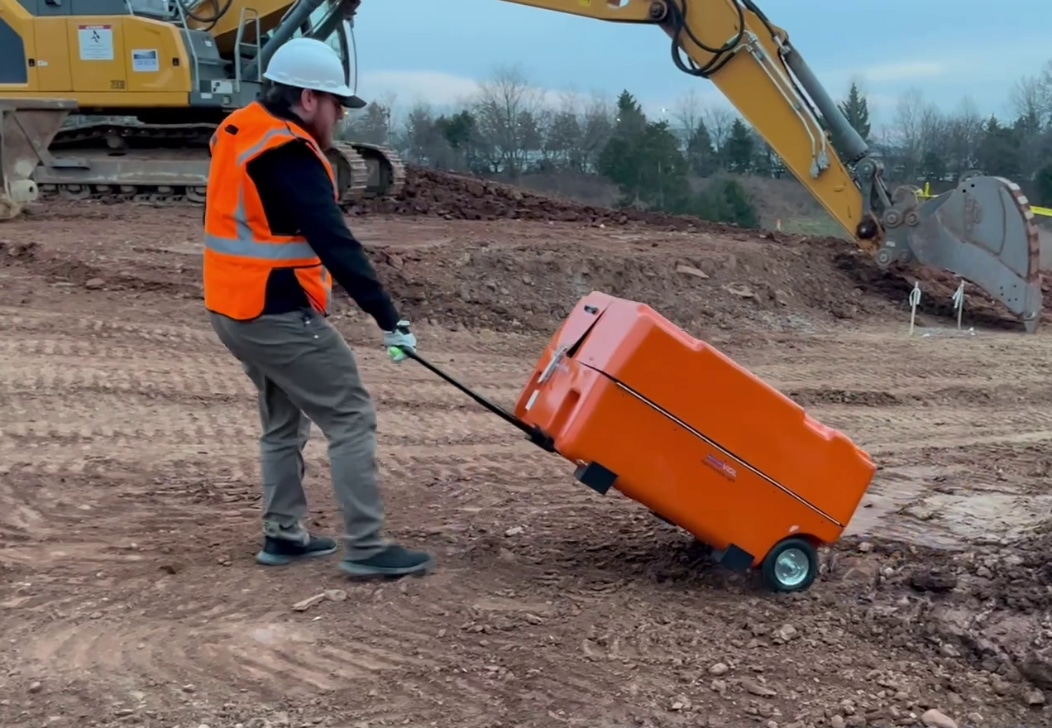
Each ALED unit is 75 pounds, so it can be transported in a pickup truck bed and rolled like a suitcase to where it’s needed.

Mistake #6: Not knowing your rights when OSHA shows up at your job site

“The first thing [an OSHA compliance officer] is supposed to do when they show up to your site is show you their credentials,” Humphreyville said. “They should also be able to tell you why they’re there. Always ask the reason for the visit.”

Humphreyville also recommends checking the officer’s paperwork during the opening conference to ensure the address listed is actually your address. It’s not unheard of for officers to show up at the wrong address; if you don’t check, you may undergo an unnecessary inspection. “It’s incumbent on you to ask those questions, to verify these things when they get there, to know your rights,” Humphreyville said. “They aren’t going to get mad at you; they expect you to ask questions.”

During the opening conference, the officer should provide you with a copy of any complaints and review the employer’s rights, including the right to refuse entry. Although Humphreyville was only refused entry once in his career, it is the employer’s right. In that event, he said OSHA must be granted a warrant before returning for the inspection, which can take anywhere from a few days to a few weeks.

“I don’t recommend this because, in the inspector’s mind, they’ll wonder why you’re refusing them,” Humphreyville said. Although officers aren’t supposed to treat a company differently, he said refusing entry could cast suspicion in the officer’s mind. “They might look a little closer than they normally would.”

During the opening conference, the officer will ask basic questions about the company, including number of employees, management structure, contact information and similar details. “They may ask if there’s a union representation, because the union has a right to be a part of [the inspection], either in the same opening conference or in a separate opening conference,” Humphreyville said.

Mistake #7: Being a jerk to the compliance officer

“Be respectful and courteous,” Humphreyville said. “Even if they’re a nitwit or act like a cop who wants to flex their muscles, just be professional. If you have a problem with a compliance officer, you can always take it up with the area office.”

Calculate the Cost of Occupational Injuries & Illnesses with OSHA’s Safety Pays

Mistake #8: Not following proper safety procedures during the inspection walk-around

Humphreyville said the officer may conduct a walk-around, if necessary. During the walk-around, be sure to wear the appropriate PPE and ensure the OSHA representative also has the appropriate PPE. “You want to show some initiative here,” he said.

If the compliance officer sees something during the walk-around, Humphreyville recommends taking some kind of immediate corrective action if possible. For example, taking the machine in question out of service.

Mistake #9: Not taking your own photos and notes during the inspection

“As the walk around occurs, if the [compliance officer] takes a picture, I recommend you take the same picture,” Humphreyville said. If they write down an issue, you should write it down, too, he continued.

Mistake #10: Giving the compliance officer more information than requested

“Don’t offer information unless the compliance officer requests it,” Humphreyville said. “Don’t be evasive and don’t lie, but don’t roll out the red carpet and start throwing information at them.”

Although it’s an obvious mistake to lie during an OSHA inspection, Humphreyville said the types of actions that are most likely to result in a criminal review include mail fraud, lying to investigators or sending false documents. “Those are the types of cases that tend to get picked up by the Department of Justice,” Humphreyville said.

There’s also some information you aren’t required to supply. For example, a copy of your incident report. Although this was something Humphreyville always asked for, he added that “the investigator is supposed to investigate that on his own. The reason I asked for it was I wanted to see what internal processes [a company] has in place to investigate these events for future improvement.”

Furthermore, Humphreyville stressed the importance of providing the officer with copies of any documentation you supply. “Don’t ever give them your original.”

Keep OSHA Away with Less Dusty Pavement Repair

Mistake #11: Not understanding your employees’ rights

According to Humphreyville, OSHA now performs employee interviews at almost every inspection. During these interviews, the officer will ask employees questions, write down his or her answers, and request that the worker sign his or her statement.

“Employees have the right to talk to the [compliance officer],” Humphreyville said. “They can request to talk to them and the employer cannot refuse the employee’s request.” If an employee cannot speak English but wants to speak to the officer, OSHA will get an interpreter.

If an employee brings up issues beyond the scope of the investigation, Humphreyville added, the officer is supposed to focus on the specific inspection. However, any additional information provided may be featured in the report or may instigate a separate complaint.

On the other hand, employees also have the right to refuse to talk to OSHA. They also don’t have to sign their statement if they don’t want to. Humphreyville said he’s seen some employers’ lawyers advise them never to sign a statement or even read it. “[These attorneys] look at [the statement] as if it’s notes on the conversation,” he said.

Humphreyville said it’s also relatively common for employers to try to oversee employee interviews. Although some employees may agree to this, he adds that the employee has the right to talk to OSHA by themselves or have their own designated representative with them.

“When you cross the line into management personnel, then you can have a company representative in there,” Humphreyville said.

Mistake #12: Not asking questions during the closing conference

After the inspection is concluded, the compliance officer is supposed to hold a closing conference. Humphreyville said this is an ideal time to ask any questions and request an abbreviated version of what they’ve found.

“I’d also ask if they think they’ll need to come back for more interviews, more walk-arounds, etc.” Humphreyville said, to get an idea of what’s to come. He said this also provides a time to review citations and even to request that serious citations be reduced to other than serious. “Sometimes that’s a way to settle [disputes],” Humphreyville said.

Mistake #13: Not following proper procedure in the event of a citation

“When you get a citation, you’re supposed to post that for employees to view,” he said, for three days or until the hazard is abated.

“Failure to abate is when you don’t abate a violation; a violation repeat is when you fix the violation but it reoccurs,” Humphreyville said, adding that OSHA can cite you for a repeat on a different standard so long as it’s closely related to the original citation.

New Online Portal Simplifies Application Process for OSHA’s Voluntary Protection Programs

Mistake #14: Promising corrective measures you can’t deliver on

In the event of OSHA proposing corrective measures, Humphreyville said it’s acceptable to request more time to research potential solutions “so long as it’s in good faith.”

“Take the time to look into solutions, to research them, to see if that’s really something you’re going to be able to do,” Humphreyville said. “You don’t want to tell OSHA something and then have to backtrack.”

Mistake #15: Not going above and beyond OSHA’s standards when necessary to maximize employees’ safety

“Remember, OSHA standards are minimal safety standards,” Humphreyville reminds us. There may be safety best practices above and beyond OSHA’s requirements, including state or local standards or even requirements from the general contractor on the job.

“OSHA can’t cite you for [breaking] an employer’s rule,” he said. For example, if a GC requires hardhats on a site where OSHA doesn’t require them and a subcontractor doesn’t follow the GC’s rule, that is not an OSHA issue. But, it may still be necessary to improve safety on that particular job site.

And we should all be doing our best to maximize employee safety—not only to avoid OSHA citations, but because it is the right thing to do.

How to Handle Asphalt Burns

No matter how many hours of safety training the asphalt tank farm manager, sealcoat laborer, or other paving professional undergoes, accidents can happen in an industry where materials are stored and applied at high temperatures.

Rick Stone, the business development manager for Maxwell Products Inc. has been in the pavement maintenance market for over four decades and has found evidence that most asphalt burns happen to workers who have less than a year of experience or more than 10 years of experience. The first category of worker is new to the job and prone to mistakes. The second category of worker grows complacent in the day-to-day routine. While the industry can learn from these statistics and beef up safety training for all, we can also look at what to do when someone is burned by hot material.

Eyewash Safety Station and Emergency Shower Solutions

How to Avoid the Burn

First and foremost, recognize that hot-mix asphalt (HMA) is just that—hot. That sounds simplistic but it’s easy to become complacent when you work with the material day in and day out.

Workers coming into the industry must be told what temperatures and materials they’re working with. You can’t expect that they’re reading the safety data sheets pinned to the bulletin board where they clock in or in the break room. They must be told that hot liquid asphalt cement (AC) has the potential to explode when other substances are introduced to it. If you stop and think about it, we foam liquid asphalt with water to create specific pavement mixes, but we do this in a controlled manner within a contained apparatus. If you allow water to splash into heated asphalt, it could bubble up and explode to dangerous effect.

Teach this to new workers; remind veteran workers.

In its “Asphalt Worker Safety” series of safety manuals, the Occupational Safety and Health Administration (OSHA), spells out a number of back to basics, common sense practices for avoiding burns during asphalt work. What we have to remember is these are only “back to basics” for veterans of the industry. It’s all new to a worker who’s never been introduced to something that has a flashpoint above water’s boiling point.

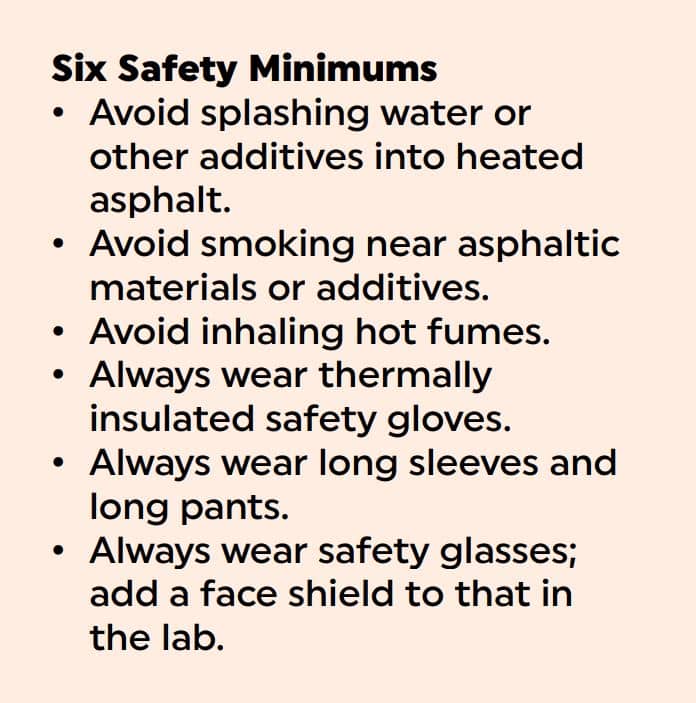
The personal protective equipment (PPE)—such as thermally insulated safety gloves and a plexiglass face shield—you give the new worker represents common-sense protective measures against burns but feels foreign to him at first. He needs to hear; these gloves keep 300-degree liquid from burning your hands and harsh solvents from soaking into your skin. This face shield keeps 300-degree asphalt from splashing onto your face, sticking there, and scarring you for life.

How to Treat the Burn

Once an accident happens, you must take fast action. We’re not talking about reacting to an explosion. We’re talking about a burn on the skin. If what you have is a 375-degree drop of sealer the size of a dime that has dripped onto your hand or forearm, “it’s still going to hurt like hell,” Stone said. But that single drip is not necessarily going to stop production.

Paving Consultant John Ball has seen workers get a splash of hot tack on their wrist or hand and the steps to help them are immediate. He said, “We shove their arm in the ice container right off to kill the pain.”

Calculate the Cost of Occupational Injuries & Illnesses with OSHA’s Safety Pays

If the area was small enough, those workers wrapped the wound in gauze—which OSHA does not recommend—and went back to work the rest of the shift. For more severe burns or those that cover more area, the worker needs to be treated in an emergency room. Ball recommended the crew have a discussion during the pre-construction meeting that includes:

  • What is the closest hospital?
  • What’s that hospital’s phone number?
  • Who is the designated driver in the event of an emergency?
  • Where is this information written on the day’s job report?

N.B. West’s Steve Jackson reminded readers that you need to include the site’s emergency address. For example, the address you give to the haul truck driver to come pick up mix may not be the address emergency personnel would use to find your team if a worker is down with a chemical burn. Know what address you are to give to the 911 dispatcher whether you’re out on a highway project, at a commercial lot, or at the asphalt plant.

At the paving site, each morning’s toolbox talk should include a “this is where we are today” moment when the foreman points out the cross streets or nearest mile marker. Have workers repeat the name of the street or the mile marker so you know they can say it to a dispatcher on a 911 call. Few dispatchers will be able to direct emergency responders efficiently to “the back of the tack truck in that work zone out on I-95.” Do all EMTs know what a tack truck looks like? Maybe not. It’s best if your personnel can say, clearly, “We’re at mile marker 79 Southbound on I-95.”

Comply with NEP: Tips to Keep Workers Cool, Safe and Your Company in Compliance

Don’t forget that an emergency will put the human mind and body into fight/flight/freeze/focus mode. That means the members of the crew witnessing a colleague screaming in pain may not react as they are supposed to. Even though they know they need to plunge the injured person’s arm into a bucket of ice water and call the emergency number for help, their prefrontal cortex has transferred “action” to the lizard brain. When this happens, you want their instinct to be the right actions. You want them to be so well trained in the right steps to take that they have no choice but to help their co-worker properly. That means you need to practice emergency safety training.

Ball suggested practicing to help a burned co-worker during a rainy day, at the tailgate talk, or during annual safety day seminars. Or at all three. By practicing what to do in the event of an emergency, your team is more likely to respond to the emergency properly.

Check out the poster from Asphalt Institute—available for purchase through the National Asphalt Pavement Assocation (NAPA) online store—titled: “First Aid for Asphalt Burns Poster.” The NAPA store also features “First Aid for Asphalt Burns Wallet Cards.” Both of these properties have an area where the purchaser (you) writes in the appropriate emergency number in your immediate region/county to call for help. Both of these properties stress the importance of immediate cooling care for the burn victim at the scene, but address the need to ensure the victim is breathing clearly.

Step 1. Immediately assess the victim’s breathing and circulation.

Step 2. Immediately begin the cooling process. Run cool water over the affected area. If water isn’t immediately available, you “can” place an ice pack or a cold pack on the area while someone brings water to the site.

Step 3. Let others know what’s happening. Get help. Don’t try to do this alone.

Step 4. Call for emergency help, whether that’s 911 or the local emergency number.

Notice these steps do not include covering the affected area with gauze or a bandage or any other wrapping. All current sources indicate you must leave the burn uncovered. Get the victim to help instead.

Mitigate Pyrophoric Material in AC Tanks

Notice these steps do not include trying to remove the asphalt from the skin. All sources indicate this step is for medical personnel in an emergency room or other medical setting to undertake; even those sources are divided on best substances for asphalt removal from skin to prevent irritation, infection and potential poisoning from the substance being used. Let a medical professional handle that task. Get the victim to help instead.

In fact, if the victim wears contact lenses and has liquid AC in his eyes, it is recommended that trained emergency personnel be the ones to remove the lenses. You will flush the eyes with cool water for at least 20 minutes, but a trained medical professional should handle the difficult task of saving the victim’s sight.

Common sense dictates burns that incorporate the eyes, face or other sensitive area will require more immediate emergency care than a burn to an arm or leg, but all burns should be treated with immediate, cooling care. But the best way to treat an asphalt burn is to avoid it. Train your workers how to respond to an accident, but above all, train them how to avoid the accident in the first place. Show them how and why to use PPE and how to be safe around hot materials.


Reminder from Robert Redford

While smoking cigarettes has its own health risks, doing so near asphalt or flammable additives can cause an explosion. You might not see vapors, but they could be around the ember of your cigarette, about to catch fire.

Members of this audience might be familiar with the 1975 Robert Redford movie “The Great Waldo Pepper,” in which a World War I non-fighter pilot sought fame and fortune on the state fair airshow circuit. In that film, one of Pepper’s fellow stunt pilots crashed in front of an excitable crowd of looky-loos who rushed onto the scene with their cigarettes hanging from their lips and fingers. Of course, their ashes caught the leaking fuel vapors afire, and Pepper’s friend died a horrible death

Let that scene burn into your memory and the next time you need a smoke break, take that break far from the asphalt action.

Eyewash Safety Station and Emergency Shower Solutions

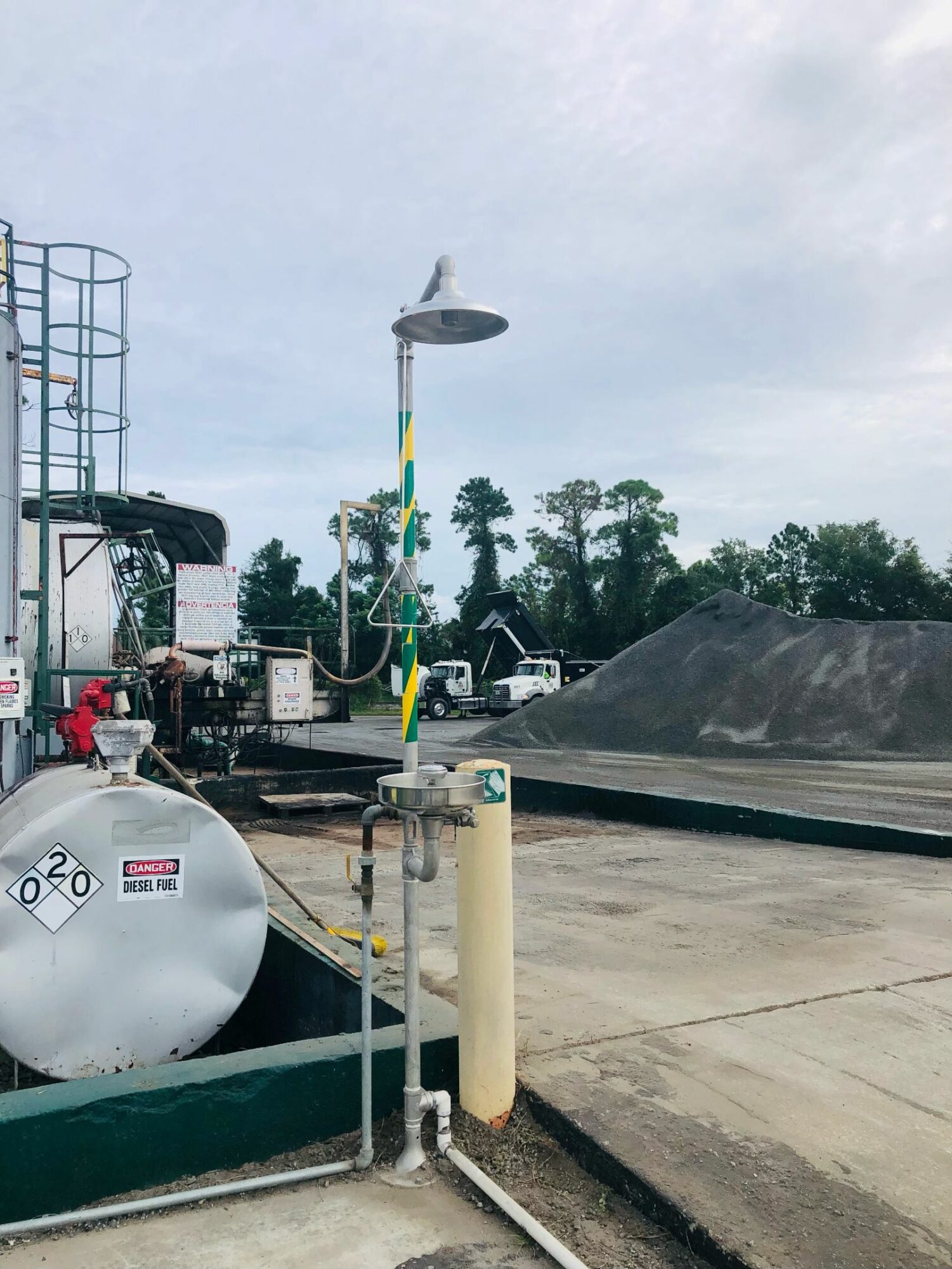
The Occupational Safety and Health Administration (OSHA) requires the availability of eyewash stations and emergency showers within the work area for immediate emergency use in all facilities “where the eyes or body of any person may be exposed to injurious corrosive materials,” states regulation 29 CFR 1910.151(c).

At the asphalt plant, eyewash stations and emergency showers are commonly located near the lab, tank farm and control house.

However, OSHA’s regulations don’t specify requirements for product selection, installation, operation or maintenance, instead referring employers to ANSI/ISEA Z358.1, a national consensus standard established in 1981 and last revised in 2014.

ANSI Standard Specifics

The standard calls for eyewash stations and emergency showers to be located within 10 seconds of any hazards, which translates to approximately 55 feet; on the same level as the hazard; clearly visible and well-lit; with an obstruction-free path of travel; and provisions should be made to prevent unauthorized shut off.

Both stations and showers should deliver tepid flushing water, which is considered between 60 and 100 degrees Fahrenheit. Additionally, both stations and showers should be activated once a week to verify operation. Self-contained eyewash units and showers should also be checked weekly to ensure sufficient flushing fluid. Stations and showers should also be inspected annually to ensure they meet all ANSI/ISEA Z358.1 performance requirements.

The standard also instructs companies to ensure all employees are aware of the location of eyewash stations and showers, and have been trained on their proper use.

Eyewash Station Specifics

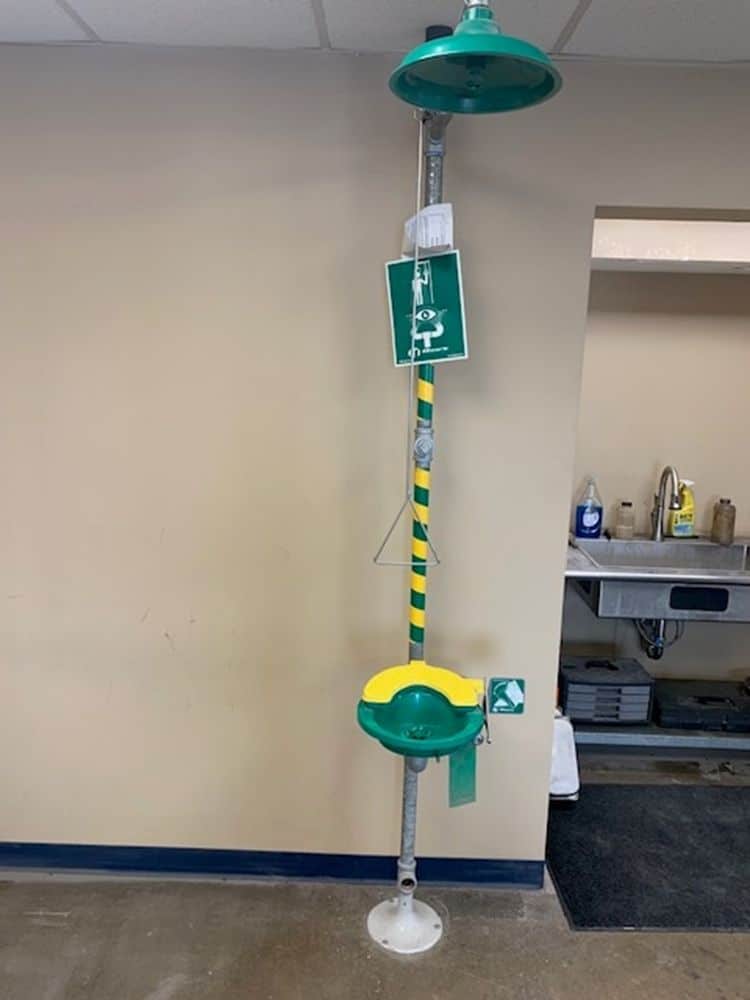
Eyewash stations may include plumbed stations, where an eyewash unit is permanently connected to a water source, or self-contained stations, where the device contains its own flushing fluid. There are also personal eyewash stations, which include bottles that can be mounted to walls or carried in a toolbox, however, these are not a substitute for required eyewash stations.

Eyewash station control valves should be simple to operate, go from off to on in one second or less, and the spray head should be protected from possible contaminants (for example, the cover is removed when the water flows out).

The water flow should be between 33 and 53 inches from the surface upon which the user stands and 6 inches away from any obstructions. The unit should be able to wash out both eyes simultaneously.

The water flow velocity of eyewash stations shouldn’t injure the user, but is high enough that the user can hold their eyes open while rinsing.

Milestone Contractors, Indianapolis, conducts its eyewash training during its first aid/CPR training. Photo courtesy of Milestone Contractors

Emergency Shower Specifics

There are two types of emergency showers. Plumbed showers are permanently connected to an appropriate water source, while self-contained showers are stand-alone devices that contain their own flushing fluid.

Regardless of the type of shower, emergency showers should have a hands-free valve that activates within one second that is easily located and no more than 69 inches above the surface on which the user stands. The shower head should be between 82 and 96 inches above the standing surface.

At 60 inches above the standing surface, the water pattern should have a minimum diameter of 20 inches. The center of the water pattern should be at least 16 inches from any obstructions, and if the shower is enclosed, the enclosure must be at least 34 inches in diameter.

Both types of showers should be able to deliver 20 gallons of water per minute for 15 minutes in the required pattern, with plumbed showers at a pressure of 30 pounds per square inch.