Meet a Woman of Asphalt: Iron Horse Asphalt’s Alisha Hatch
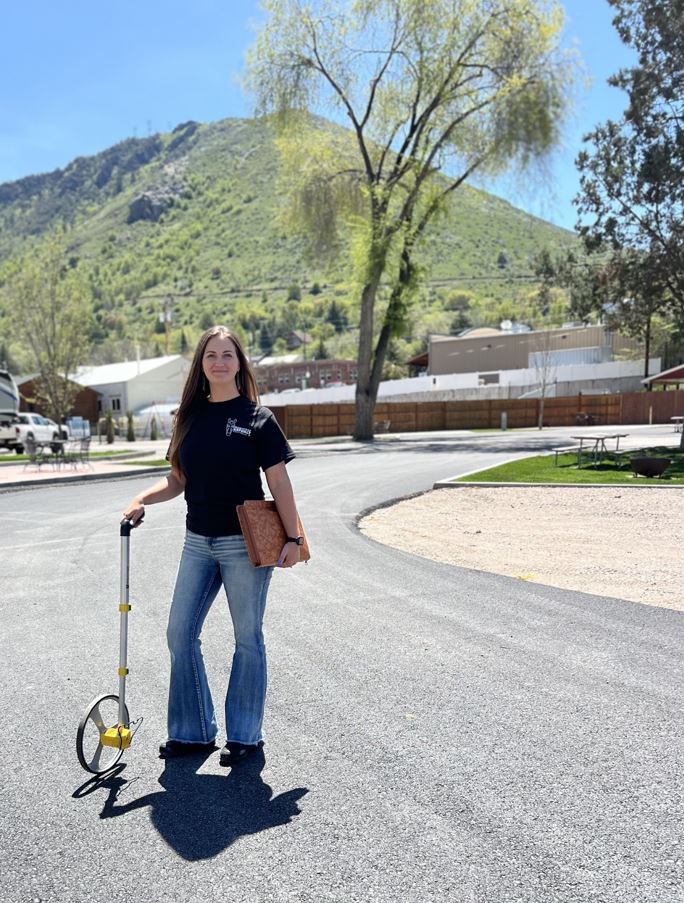
Incorporating family and career offers a satisfying work-life balance for this paving contractor woman of asphalt.

What do you do when you’re juggling a full-time job with raising a family and expanding an asphalt business? If you’re a woman of asphalt, you go all in! For Alisha Hatch, she’d been working at the Federal Bureau of Investigations (FBI) when she and her husband, Tyson Hatch, purchased Pocatello Sweeping in 2009. She left the office job to join the asphalt industry full-time in May 2017.

“We had three children at the time,” Hatch said. “The next year we had our twins, making five. Their ages now: Rex 11, Willow 9, Wynn 7, Otto 5, Wilder 5.”

When it became obvious the company was ready to expand into paving, she became majority owner of Iron Horse Asphalt. On the day we spoke, she shared that she’s technically the owner and office manager, but the day prior, she was a full-time estimator. We’re fortunate she could take some time to share her story and show how a woman of asphalt gets the job done.

AsphaltPro: You shared that you worked full-time at the FBI prior to deciding to become a majority owner in the asphalt business. Could you share with the readers what the deciding factor was to jump in with both feet?

Alisha Hatch: We wanted to take our business to the next level, and we knew we couldn’t do that juggling children between us and me not able to help fill time. The year I joined Tyson we increased sales by 33% and the following year we increased by almost 60%.

AsphaltPro: What appealed most to you about the construction business and asphalt in particular?

Alisha Hatch: Our business was already going towards asphalt and working with Tyson was where I wanted to be. Asphalt and construction is not a woman’s world and the challenge was appealing. Learning more about asphalt and being able to help our company move forward is exciting.

AsphaltPro: It’s no secret many women take on the caregiver role in families and our industry has been working to find ways to provide childcare options and family-leave options for family members who need flexible schedules or time off to care for aging parents, etc. What solution did Iron Horse Asphalt find for your schedule (or for the schedule of other women you have in your employ)?

Alisha Hatch: As business owners we work around the clock it seems. Our children are very involved and usually come with me to do estimates. We arranged the on-site estimating to once or twice a week so we’re not driving around all the time. I use lunch time and afternoon to write up the estimates and the kids help take care of each other. There are usually TV shows involved at that point, too!

AsphaltPro: You mentioned that the business is allowing you and your husband to work together toward a common goal. Could you share with the readers your philosophy on how the Iron Horse Asphalt business is allowing you to build this enterprise together?

Alisha Hatch: Tyson and I work very closely. I do the office work and estimating, and he does the groundwork. Working together has its ups and downs. We have to listen and respect each other’s needs and trust the work we are each contributing.

AsphaltPro: When do you find time for yourself and how have you found a work/life balance amid building a business you’re both a part of? (Are there any tips you’d offer to another woman of asphalt considering partnering in business with her spouse?)

Alisha Hatch: The balance is a work in progress. As our kids are getting older, we have been able to set aside time for date nights but that didn’t happen in the earlier years. Finding a babysitter was hard for five kids (two being infant twins). Vacations turn into taking work calls and kids’ school activities are sometimes missed by one of us. We know that what we have is made possible by God and our hard work and we’re grateful for it. We love having our kids involved and taking claim to building and working towards this with us. Our kids helped do some asphalt work at their school and thought it was pretty awesome. It gave them a sense of pride.

My tips for others working with their spouses is patience, look forward to set goals and look back at goals accomplished. We set a few five-year goals when we started and met all of them except one: me being able to quit my full-time job. We added it again to our next five-year goals and we were able to make it happen. Sometimes when we’re down or frustrated with each other or the business it helps to reminisce how far we’ve come and what major milestones we have made together.

AsphaltPro: Iron Horse Asphalt isn’t a large corporate paving company. Could you describe the atmosphere you’ve built and what about the structure is most comfortable/pleasing to you?

Alisha Hatch: We have a family-oriented approach to our company. All that are working with us, we feel are family and take that to heart when making any company decisions.

Through the busy season we’re usually 8-10 people. The atmosphere is casual and joking. Everyone gets along and no one is lost. Everyone is crucial to our success and our employees take pride in the work and care about the outcome and quality of the job.

AsphaltPro: Besides the sweeper, are there other pieces of equipment you’ve operated in the field? Which is your favorite?

Alisha Hatch: I operated the paver when someone needed the day off and I’ve operated the skid-steers. Up until two years ago we also offered snow removal; I drove plow trucks quite a bit. One particular storm was very intense and my job called off work for the day. I went straight to work in a plow still wearing my skirt, blouse and high heels!

Operating the paver is stressful and hard. I made a few mistakes, and I am very grateful we have qualified people to do that and not me. I enjoy the sweeper, probably because I did it the most in earlier years.

AsphaltPro: Which of your roles in the company is the most rewarding to you and what is it about the role that you find most appealing or satisfying?

Alisha Hatch: One of the most rewarding roles is following an estimate all the way through a job. I like meeting customers and when our crew provides a great end product, it’s very fulling.

AsphaltPro: As a contractor that performs commercial and residential installs, Iron Horse Asphalt must get to work with a variety of project owners/property managers. What is your favorite type of project to work on and what makes that intriguing to you?

Alisha Hatch: I like working with and developing relationships with long term customers the best. Homeowners are good to work with and the plus side to that is we get to meet a lot in our community.

AsphaltPro: Could you share with the readers what your role as the office manager of an asphalt company, specifically, requires of you, in general and day-to-day? What are some “soft skills” you would recommend other women in the industry hone if they wished to step into an office manager role?

Alisha Hatch: Multi-tasking! I take calls from the customers, write up estimates and follow up on their needs. I manage the schedule and coordinate with Tyson and the crew to make sure I’ve provided enough time for work. And when a job changes and all the work needs to be juggled around, I make a new schedule. Once the work is completed, I send out the invoices and also follow up on accounts receivable. Each day has a bit of everything mixed in.

But on a regular day, we get the younger kids to school. I home school our oldest son, so I spend time between him and office work until we pick up our youngest twins. I finish up as much as I can before the rest of the kids get home.

I recommend honing in on customer service, project prioritization and allowing yourself grace when things get busy.

AsphaltPro: I don’t want us to ignore your early career in the FBI. Could you tell the readers what you found most valuable about that job and what skills you see yourself transferring from that career to your current career?

Alisha Hatch: I wouldn’t be able to do what I do without my experiences and growth at my previous job. I worked at the FBI for 10 years. I had many opportunities to work with a variety of people and learn quality control techniques and presentation skills. I managed several different teams and learned from others on how to and how not to manage people.

AsphaltPro: What do you think is the most important skill you’ve brought to your position as first a sweeper operator and then as a company owner and project estimator in the asphalt industry? (And how would you encourage other women entering the industry to hone a similar skill to be any kind of construction professional they want to become?)

Alisha Hatch: Being part of all different aspects of the business has allowed Tyson and I to understand the demands of each position. This gives us the opportunity to know what each employee can and should be able to handle and also the limits of each position. Empathy is something women can bring to the construction industry. Construction can be rough around the edges and women can bring a lighter, more organized approach to employees and scheduling.

AsphaltPro: What would you say has been the most challenging “obstacle” you, as a female in the construction industry, had to overcome in the past 15 years, and how DID you overcome that obstacle?

Alisha Hatch: One of the biggest challenges is customers not accepting me as a knowledgeable professional that can give educated answers to their questions and provide an accurate, quality estimate.

AsphaltPro: How do you think other women in the industry can incorporate that skill or habit into their workdays?

Alisha Hatch: I want to be a resource for our company and help where it’s needed. In order to do this, I ask a lot of questions, help fix the equipment on nights and weekends, and visit the job sites. I also travel to trade shows with Tyson to see what is going on in the industry and bring the knowledge back to our market.

AsphaltPro: Let’s talk about Teamwork. What is the most challenging project Iron Horse Asphalt has been a part of and how did you and your crew overcome the challenge?

Alisha Hatch: Our crew pulled off a big job without a full crew. We had a deadline for an install on campground. The job needed to get done so the area could be reopened for the weekend. On the morning of the project everyone was given their responsibilities knowing they’d have to pull extra weight and extra tasks to make it happen on time and be done well. Trucks started running behind and one truck blew a tire. Despite being shorthanded and having slow trucks, they were able to put down all the asphalt and have a high-quality product for the customer. While loading up the equipment, everyone was able to take a breath and really admire what they accomplished. Each member of the crew felt a sense of pride knowing what they had overcome.

AsphaltPro: Let’s talk about Perceptions. It’s a fact that asphalt paving can be hot and dusty. How do you respond to people who say it’s a “dirty job?” And how can we re-educate young people about to encourage more women to consider a career in the asphalt business?

Alisha Hatch: It is a dirty job! It’s real, honest work. Sometimes dirty jobs and asphalt work is looked down upon as a lower-class career.

There’s so much behind the scenes and on the job site that women can help with. We’ve had great women sweeper operators, because they have more of an eye for cleanliness. We’ve had women roller operators; they do great in that capacity because of attention to detail. Something I would tell a young lady to encourage her in this industry? There’s a lot of manly men in the world of construction! There are so many opportunities for growth and development that haven’t been tapped into yet for women. A new perspective on a mostly male run industry can use a feminine touch.

AsphaltPro: What is the most rewarding aspect for you of being in the asphalt business?

Alisha Hatch: The most rewarding has been bringing a fresh outlook to asphalt to our community. Sometimes dirty jobs and asphalt work is looked down upon as a lower class or low caliber career. We are trying to change that perception. We hire men and women who are respectable and hard working with a quality mind set. It is so rewarding to watch a customer be pleasantly surprised when we show up on a job site clean cut, respectful and with a desire to give the best product. When the job is complete, we have made one more person in our community think differently about the dirty work of asphalt.

AsphaltPro: Will you tell us about a person who served as a mentor for you and how this person encouraged you? Is there a piece of advice from this person that you would share with other women in the industry/other operators?

Alisha Hatch: My husband Tyson is my biggest mentor and cheerleader. When I get discouraged about people in the industry thinking less of me as underrated woman of asphalt, he always jokes that if they only knew who ran this company! He teaches and pushes me to overcome these stigmatisms and show our community how a woman can do this too. You CAN be a big part of the industry, you can get your hands a little dirty and we can become more well-rounded women because of it.

Get Full Pay on Any Job

Increasing quality for your customers starts with well-maintained equipment that can function the way it’s meant to

As Eric Swan pointed out in his preventive maintenance article on page xx, performing in any sector of the asphalt industry requires all the moving parts be in sync—right down to a well-oiled engine. If the broom you intended to use behind your cold planer suddenly seizes, you can’t get the fine millings up, thus the tack isn’t going to stick properly, thus the asphalt isn’t going to adhere uniformly. If this takes place on a parking lot job, you might not see an immediate financial hit from an inspector docking dollars from the project, but you might have an angry customer calling you to come back and repair potholes in a couple months.

If the striping equipment arrives at 4 a.m. to prepare the lot for the day’s traffic, but someone didn’t tuck it away correctly last night and you must replace clogged nozzles before you get started, guess whose customer is about to get mad at a delay.

If you allow material to build up on the paver’s tires, the tractor will have a bumpy ride. This means you’re not paving a smooth mat, and you could risk cooled, caked material falling from other areas onto your new mat, resulting in non-compactible areas that turn into potholes later. Photo courtesy of John Ball

What Swan said holds true: paving is a high-stakes performance of people, equipment, traffic, schedules and materials. You need your equipment to be well-maintained. That takes training of invested workers who understand the importance of clean, working machines. John Ball, the proprietor of Top Quality Paving, Manchester, New Hampshire, has preached this gospel for years. When consulting from week to week, he sees asphalt professionals of all skill levels, and he commented on what he sees in the newcomers to the industry.

“These guys out there on the crew aren’t regimented,” Ball said. “There’s a certain procedure for cleaning and maintaining the equipment, but these guys aren’t following a procedure. They’ve got to learn to care. That attitude has to be homegrown. They’ve got to be taught so they know why they’re taking time at the end of the shift to clean the paver.”

Members of this paving crew get to work with putty knives, screwdrivers and release agent to remove built up material from different sensitive areas of the endgate to ensure it can function properly during the day’s shift. Without a smoothly moving endgate, you can’t expect to have a smooth mat. Photo courtesy of John Ball

When the distributor truck driver sprays disappointing strings of tack on the surface to be paved, someone must care enough to speak up. As seen in the image above, the operator didn’t have the right pressure dialed in and had clogged nozzles on the right side of the spray bar. “You can’t have spaghetti strands,” Ball reminded readers. (See the article titled “Prevent Callbacks for Pavement Slippage” for best practices in tack applications.) But someone has to train the operator on this, and the crew—or mechanic—must know how to solve the problem.

The most important machine to check over is the paver.

No matter the size of machine you’re working with—whether that’s a sidewalk paver for a last-minute walking trail, a commercial paver handling a parking lot mill-and-fill or a highway class paver taking care of 1,200 tons on the mainline today—that machine is your lifeblood on the paving project. Its care and maintenance is the difference between achieving a quality job that gets full pay from the customer and a problematic job that gets a costly call-back to fix something later.

This distributor truck driver needs help from the mechanic to get the spray bar leveled and the nozzles cleaned properly. A member of the crew needs to be empowered to call an audible to have this area re-sprayed or the tack isn’t going to do its job. Photo courtesy of John Ball

“The paver is your bread and butter,” Ball said. “If the endgates aren’t flush with the screed, you can’t pave a good joint. If you wrap your tires with asphalt, the tractor’s ride is going to be bumpy and the screed, which is your hot iron, won’t be able to smooth it out. Good cleaning and routine maintenance of the paver will make or break you.”

Due to the importance of this topic for a contractor’s pay, we’ll return to it soon. Use the tips offered with these pictures to guide your cleaning and maintenance routine and watch for upcoming articles on this topic from Ball.

Prepare for Playoffs to Start Next Season Strong

It’s September and the plants are packed, the days are getting shorter, and we’re all up against the weather to end the season with a win. Welcome to the playoffs!

That’s what we at American Pavement Specialists call the busy months from September through December as we try to wrap up all our commitments for the year. By the time fall rolls around, clients of all kinds are ready to wrap up outstanding projects, from driveways to highways. The pressure is on. This is what we’ve been building toward all season long.

Just like any sport, playoffs can make or break you. If the team doesn’t win, fairweather fans could leave you with empty seats in the stadium come spring. If the paving crew doesn’t win, there are going to be empty slots in the schedule come spring.

Here are a few tips for ending the paving season with a win.

Prepping for playoffs? Check out Raised on Blacktop’s Playoff Collection this fall. “I usually give my whole crew something [from the collection],” said Matt Stanley. “They look forward to it every fall.”

Come September, Bill Stanley and the crew at American Pavement Specialists launch into ‘playoffs’ as they strive to complete every project before winter weather rolls in and plants shut down.

Prepare Your Team

By the time a team reaches the playoffs, they’ve had all season to prepare. Paving playoffs is no different. The nature of our trade means our crews have had months to get warmed up by the time September rolls around. As the coach, I’ve got each player in the right position and they’ve had enough time in that role that they’re ready to take their game to the next level.

How to Get New Workers to Stick With It

Because of this, I can do more in one day in September than in one week in April. Those first few weeks each spring, it’s like everyone forgot how to pave, forgot how to get to the shop, etc. No one knows where the jumper cables are. It takes an hour to leave the shop in the morning. By September, the team knows the drill. We meet at the shop at 6:15 a.m. and leave by 6:22. We’re paving at maximum efficiency. Every step in the process feels like muscle memory by now. Everyone is in the zone.

Although APS strives to pave in ideal paving conditions, sometimes customers’ timelines and the weather will dictate that paving must be done in sub-optimal conditions. This is when Bill’s 50 years of paving experience play a pivotal role in achieving quality results.

Prepare Your Gear

No equipment maintenance is done during playoffs. That roller leaking hydraulic fluid better be fixed. The supplies better be in. All equipment has to be ready for battle. Period. We’re also up against bad weather, shorter days, and impatient customers. Why would we ever want to start that game with a cracked bat?

Know Your Worth to Get Paid Your Worth

Each night, we do as much as we can to prepare our equipment for the next day. As the weather gets colder, this includes preventing the water systems of our machines from freezing overnight. If the inside of that mill freezes, we might be looking at $5000 in damage and days of maintenance we just don’t have time for. Before it gets dark at the end of the day, we run antifreeze in the lines and drain them. All equipment gets loaded into our garage each night so we aren’t dealing with frozen lines, dead batteries or frost, snow and ice. Chipping ice off your car is bad enough, but if you have to chip ice off a roller even once, you won’t make that mistake twice.

Come fall, the APS crew is ready to start each day strong. “We meet at the shop at 6:15 a.m. and leave by 6:22,” Stanley said. “We’re paving at maximum efficiency.”

Prepare to Call an Audible

A manager doesn’t go into the first game of the World Series thinking about game seven. He focuses on one game at a time. By the time September rolls around, we’re often scheduling our crew one day at a time. We might be working in New York one day and Connecticut the next. It’s not unusual for us to complete 30 one-day projects in 30 days. Walmart on Monday, CVS on Tuesday, a private driveway on Wednesday, a road for this township on Thursday, another private driveway on Friday.

We might have Customer A booked, but Customer B calls with an urgent need. Often in this industry, other peoples’ emergencies fall into our laps. As much as I’d like to tell them their lack of planning doesn’t constitute an emergency for me…we want their business. We want their repeat business. I might call my guys on the way to the shop to tell them the day’s job has changed. Everyone has to be able to shift gears as needed. And sometimes we have to handle whoever is screaming the loudest.

APS Makes Winter Work Work

Other times, we have to prioritize our long standing customers who pay on time over customers who are new or are slow to pay. It’s a strategy, but it’s also a necessity. Every October, I find myself wondering how we’re going to finish every job by the end of the season. We always try to get to everyone before the end of the season—and thankfully we have a history of meeting all our commitments—but it’s not easy.

Of course, we have contracts that dictate that if the customer isn’t ready by a certain date that we may not be able to serve them. But that doesn’t sit well with me. If we don’t get to a customer by the end of the season, he’ll find a paving company that can. And he’ll use that paving company next year and the year after that. When spring hits and we’re having a slower start, we don’t want to have lost customers because we couldn’t get to them—no matter whose fault it is.

“No equipment maintenance is done during playoffs,” Stanley said. All equipment must be ready for minimal downtime during playoffs.

Prepare for Rain Delays

The nature of our trade is that we’re the last ones in on any construction project. So, if construction is delayed on a building at the corner of Main and South street as the end of paving season approaches, they still need to get their asphalt—rain or shine—because they’re not going to get their certificate of occupancy until that blacktop is down.

We always strive for quality. We try to avoid paving in poor weather conditions. We never want our pavements to fail. But sometimes, we have to do what the customer needs us to do. Sometimes we have to pave over mud just to get their asphalt down before winter, even if it means we’ll be back for repairs come spring. That said, I tell our customers what quality they can expect based on the conditions we’re facing. Whether or not they’re willing to sign off on those risks in exchange for having a paved lot all winter is their call.

During the fall, we use lighter rollers because the heavy rollers bring up more moisture. We also warn our customers to wait until the moisture is out before letting trucks on the asphalt, sometimes up to a week.

Even when we’re paving in adverse conditions, we apply best practices for that situation. If it’s a cold day and the wind is blowing, our rollers are right up behind the paver. If it’s raining and the slope of the parking lot goes left to right, we’re paving it left to right so we aren’t paving into puddles. If the ground is wet, we’re only paving the base course and will pave the top course come spring.

American Pavement Paves the Way for Amazon

If we have a three-day job in the fall, we may need to pave it differently than we would in the summer. We might have to pave it backwards in case it snows tomorrow and the plant closes the next day. We might have to do the entrance and handicap stalls first so the owner at least has something to get him through the winter until we can pave the rest of the lot. Because it’s not up to us. It’s up to God and the asphalt plants. If they say they’re done making blacktop, that’s it. Season’s over, folks. Come again next year.

The Squeeze Play

When these are the conditions we’re working in, how can we please our customers despite extreme weather, keep employees going despite the pressure, and round out the year with enough profit?

My final answer is preparation. Preparation, preparation, preparation. That’s what coaches do. Prepare. Playoffs are a hard time of year. Preparation and experience will get you through it. If your crew performs well during playoffs, this can be a profitable time of year that sets you up to enjoy the fruits of your labor during the slower winter months and prepares your company for bigger crowds come spring.

Let the games begin!


Bill Stanley owns American Pavement Specialists, Danbury, Connecticut, with his wife, Colleen. Stanley has more than 50 years of experience in the asphalt industry.

Blaw-Knox: New 7000C Series Tracked Paver

The new Blaw-Knox 7000C series tracked paver was featured at the 2024 World of Asphalt show in Nashville. The all new PF-7000C (and PF-5000C) series highway class paver features a new Cummins performance series engine, and all-new telematics.

The all new “C” series pavers will boast a new Cummins Tier 4F / Stage 5-compliant engine as well as a MOBA automatic grade and slope control option, which is also available for the 5000 and 4410 series pavers.

For more information, visit www.blawknox.com.

Ammann Group Acquires ABG Paving Product Line

Readers may be aware that Ammann Group, Langenthal, Switzerland, manufactures pavers and compaction equipment in addition to asphalt mix production facilities. This summer, the group announced it had finalized its acquisition of the ABG paving product line from Volvo Construction Equipment.

“ABG is a strong brand that we’re proud to welcome to Ammann,” said Hans-Christian Schneider, CEO of Ammann. “We will continue to build on ABG’s exceptional product line and reputation and provide complete roadbuilding solutions for the industry.”

This is an international move. The transaction includes the transfer of Volvo CE’s paving businesses in Linyi, China, and Bangalore, India, as well as Volvo CE’s ABG facility in Hameln, Germany. ABG pavers and screeds will continue to be produced at the facility in Hameln. The production facilities in Mehsana, India, and Suzhou, China, will also be a source soon. ABG in Hameln will become the center for paving operations within the Group, according to a recent press release.

The Ammann ABG fixed screeds feature electric heating and offer paving widths ranging from 8 to 42.6 feet (2.5 to 13 m).

Initially established as a construction equipment repair shop in 1945, ABG in Hameln has evolved into one of the most recognized paving brands globally. Demonstrating its ongoing innovation, ABG recently introduced a new electric paver at INTERMAT 2024 in Paris.

Ammann will retain the respected ABG name. “The ABG brand is synonymous with quality in the industry and aligns perfectly with Ammann’s history in asphalt compaction,” said Bernd Holz, executive vice president at Ammann.

The range of paving products offered includes the compact Ammann ABG 2820 tracked paver, with a basic screed width of 4.9 feet (1.5 meters). On the other end of the spectrum, the Ammann ABG 8820 tracked paver boasts a 42.6-foot (13-m) paving width, large hopper and powerful engine for challenging production jobsites such as airports and highways.

“In addition to our smallest and largest pavers, we have several other models to meet the unique needs of every customer,” Holz said.

For more information, visit www.ammann.com

Race to Resurface F1 Track

Sunland Asphalt performs mill and fill on Miami Formula 1 track with echelon paving ahead of successful Grand Prix

In the Formula 1 world, millimeters matter in both racing and paving. Management at Sunland Asphalt & Construction, Littleton, Colorado, knew they would need their A team on hand to handle the 2023 resurfacing project at the Miami International Autodrome, home of the Formula 1 Miami Grand Prix. They mobilized 75 internal employees, 15 technical specialists and 40 pieces of heavy equipment from around the country on 35 separate transport loads.

The project’s scope consisted of milling 2 inches of the existing track and repaving it with a highly specialized asphalt mix designed to Formula 1 standards. Crews were to repave the track at 2 inches thick for a total of 9,500 tons over an eight-day period.

Construction scheduling for the 3.36-mile anticlockwise circuit, which winds around the Hard Rock Stadium in Miami Gardens, had to be choreographed around the stadium’s other events, including the end of the National Football League season, a jazz music festival and the Miami Open tennis tournament. The International Automobile Federation also required Sunland to have the mix put down 60 days before its big event for the material to properly cure.

Needless to say, it took a lot of coordination for Sunland to make this happen and the Wirtgen Group was just one of the many partners in place to help.

Sunland crews used three pavers working in echelon to prevent cold joints along the 50-foot-wide track, paving at a very efficient pace of only 6 fpm.

Step 1. Mill. The crew from Sunland Asphalt & Construction, Littleton, Colorado, used three milling machines to precisely remove 2 inches from the existing track.

The Need for Speed—and Grip

In 2022, Miami held its first Grand Prix event on the track. When drivers expressed concerns with the grip on the pavement, track owners decided to lay fresh asphalt ahead of the 2023 race. The track management hired Tilke Engineers & Architects, headquartered in Aachen, Germany, to oversee track resurfacing, which they said would ultimately improve the “spectacle” of the 2023 race.

Sunland was hired to complete the mill-and-resurface of the track and began work to remove the existing surface in the early spring of 2023.

Sunland Asphalt trucked all their equipment in to ensure crews were familiar and comfortable with their equipment and processes. They used three pavers working in echelon to prevent cold joints along the 50-foot-wide track. The pavers were also moving at a very efficient pace of only 6 fpm to ensure paving smoothness.

The mix design for the track included 60% US-mined granite from Georgia with the remainder of the aggregates being locally sourced lime rock from Southern Florida. These aggregates ensured the grip needed on the course.

Step 2. Fill. Three pavers worked in echelon at a steady pace of 6 feet per minute to ensure no cold joints interrupted a smooth mat. Here you can see a Weiler material transfer vehicle feeding the hopper insert of one of two Vogele Super 2000-3i pavers to assist in smooth, constant material control.

Technology Meets Tight Tolerances

In addition to the three Wirtgen mills, Sunland used three HAMM HD+ 80i rollers and two VOGELE Super 2000-3i asphalt pavers. The Wirtgen Group technology on these machines is “plug and play,” which allowed the team at Sunland to get up and running with these machines easily.

“The plug and play feature on all these machines has been a huge advantage to us as a Topcon provider, making the installs quick and easy,” Tony Carden, intelligent paving product manager at RDO Equipment said. “We’re also able to provide serviceability for them both on the dealer side and from the manufacturer side. It’s a win-win.”

The project’s scope consisted of milling 2 inches of the existing track, then repaving 2 inches thick with a highly specialized asphalt mix designed to Formula 1 standards, for a total of 9,500 tons over an eight-day period.

Thermal Imaging

The pavers on the job were equipped with a temperature monitoring system. Thermal cameras were mounted to the pavers and used to find any temperature differences that could indicate potential segregation in the mat as it was being laid.

“The thermal profiling that we’re using on the pavers gives a rundown of where the pavers were, where they’re going, at what speed they are running and at what temperature,” Greg Hughes, project engineer at Sunland said. “If one isn’t getting to a high enough temperature, we can go back and look at it and see what happened and fix it and that’s a great tool for us.”

To address racecar drivers’ concerns about pavement grip, the Miami International Autodrome’s Formula 1 Miami Grand Prix track was milled and resurfaced ahead of the 2023 big event. All photos courtesy of C2C Visuals

To address racecar drivers’ concerns about pavement grip, the Miami International Autodrome’s Formula 1 Miami Grand Prix track was milled and resurfaced ahead of the 2023 big event. All photos courtesy of C2C Visuals

Intelligent Compaction

“The intelligent compaction on all the rollers shows us our roller patterns throughout the day,” Hughes said. “It provides us real-time documentation of the areas we are hitting and if we’re hitting any areas more than we should. We’re also able to know if we should be vibrating more or less as well.”

With the HAMM Intelligent Compaction system, users can set a designated number of passes ahead of paving. The system shows the operator, on the in-cab display, how many passes have been completed.

Sunland management says they also use the intelligent compaction system as a training tool. “We sit with our roller operators, and we can show them where we might be able to improve on future jobs.”—Greg Hughes

Step 3. Compact. The compaction team set a rolling pattern behind the pavers to achieve optimum densities and a smooth driving surface incorporating three HAMM HD+ 80i rollers.

Sunland management says they also use the intelligent compaction system as a training tool.

“We use it in the office to see where we could be more effective,” Hughes said. “We sit with our roller operators, and we can show them where we might be able to improve on future jobs.”

The crews finished paving the 19 turns of the course on the Autodrome’s schedule, and the 2023 Miami Grand Prix was a success thanks to the hard work and dedication of the people behind the machines.