Autonomous Equipment Joins the Job Site
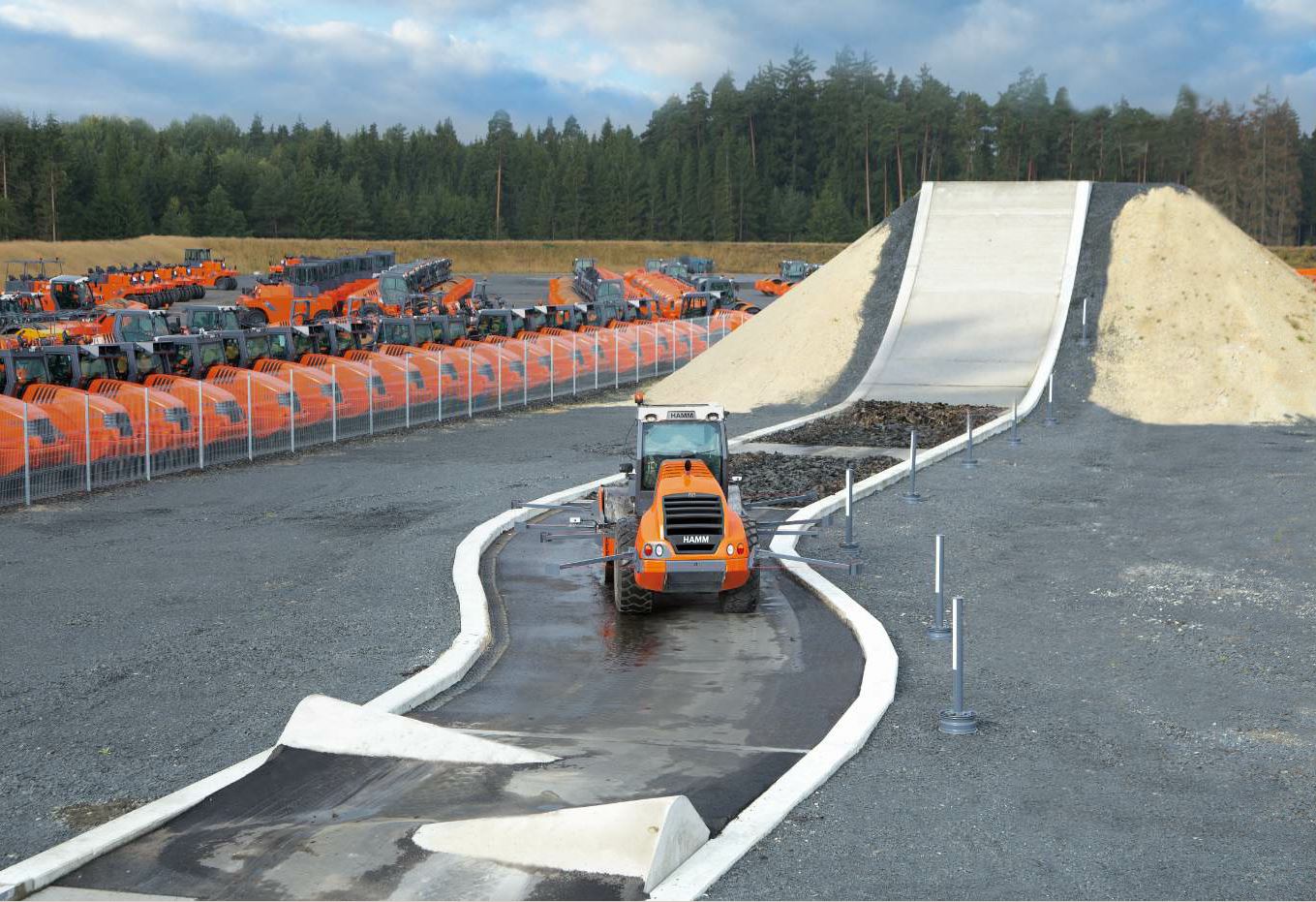
You may already be aware of autonomous equipment use in mining operations in the form of Volvo CE’s HX2 autonomous, battery-electric load carriers or Caterpillar’s autonomous mine trucks.
What you may not know is that this autonomous technology is also making its way into asphalt paving jobs. Autonomous equipment can make a job site safer and save fuel consumption and operations costs, as well as free up skilled employees for other tasks and help address the workforce shortage the construction industry is currently experiencing.
“[In the mining sector], highly standardized work is carried out in closed systems; there are few points of contact with the outside world and few unforeseeable influences on the process,” said Dr. Stefan Klumpp, Chief Technology Officer of Hamm, Tirschenreuth, Germany, in a 2017 announcement from Hamm. “In road construction, by comparison, the processes are far less clear-cut and less easy to structure. Every construction site is a little different. There is also much more contact with the surroundings (and thus more potential hazard), and user behavior is not uniform.”
Despite the challenges, companies like Hamm and Caterpillar, among others, are moving forward for a safer, more efficient tomorrow.
Autonomous Equipment in Action
Despite obvious differences between mining and paving, many of the first autonomous machines to be headed for the paving train are also material transport vehicles.
Last October, Built Robotics announced its Autonomous Track Loader (ATL), which is a compact track loader that can perform excavation, grading, pad prep, compaction and other tasks without an operator. This is made possible by the ATL’s LiDAR, which are essentially the machine’s eyes on the jobsite, and its GPS sensors to assist with navigation and precision tasks.
Also last fall, United Rentals, which provides more than 3300 equipment and tool classes for industrial and construction sites in the U.S. and Canada, deployed its first autonomous machine on the job site, a Bobcat skid steer moving materials around the job site.
Another autonomous machine of interest to paving contractors is the autonomous impact attenuator truck from Royal Truck and Equipment, Coopersburg, Pennsylvania.
The company’s first fully autonomous attenuator truck was deployed in Colorado last year. Autonomous attenuator trucks have already been tested in Florida, but this is the first time one has been deployed without a safety rider.
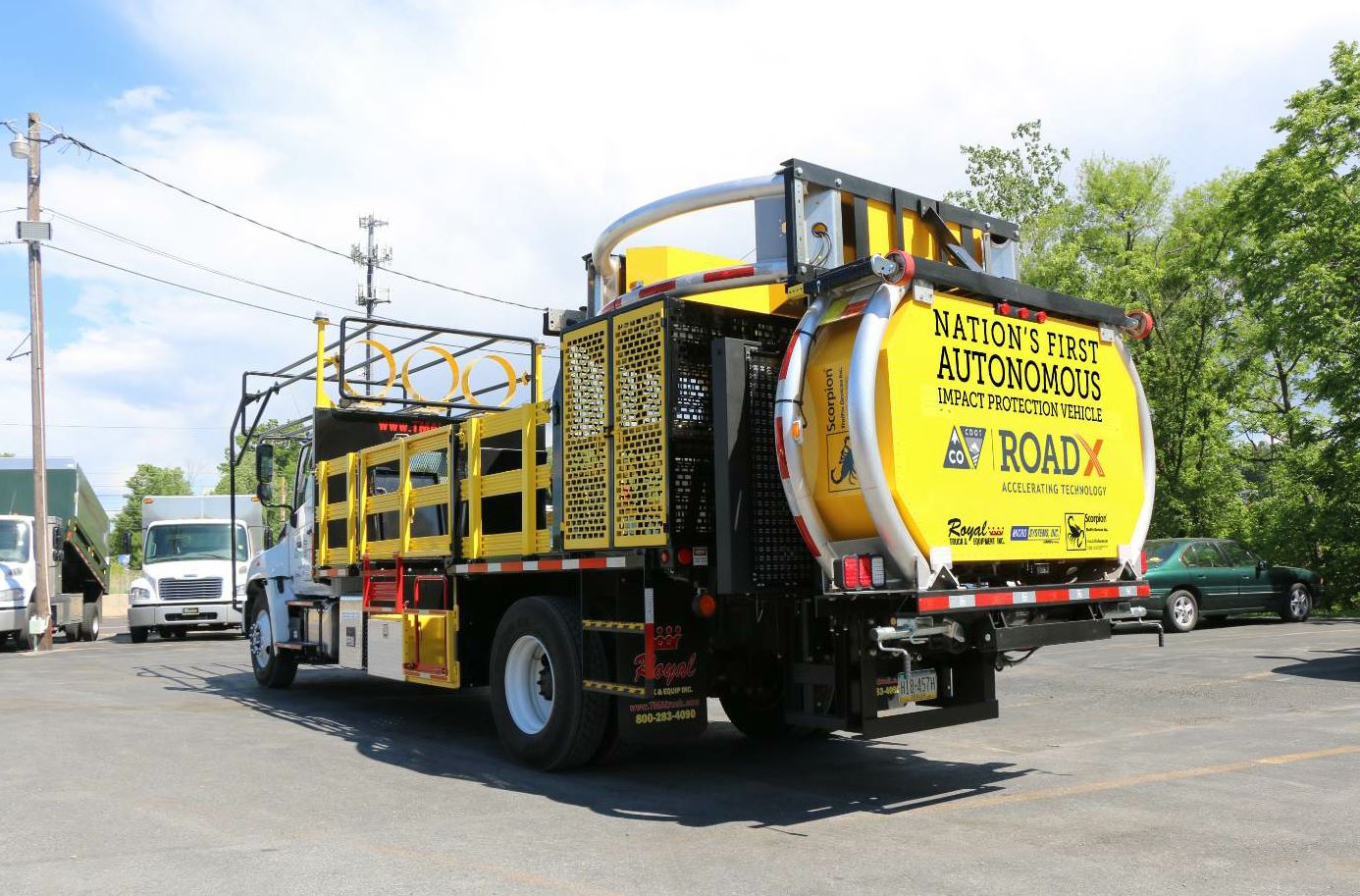
CDOT’s Autonomous Impact Protection truck is demonstrated on a Colorado highway.
The Colorado DOT had purchased the driverless attenuator truck to be the shadow vehicle behind a human-driven line painting truck.
“That operation moved at around 5 to 7 miles per hour,” said Royal’s Government Account Manager Fred Bergstresser. “Until now, there needed to be a driver in the ATMA protecting that line painting truck.”
However, by equipping the lead vehicle with a highly precise GPS system, it could transmit the information the attenuator truck needed to safely follow behind while avoiding obstacles.
After the success of this initial test, the autonomous TMAs are now approved for full use in Colorado’s district 4 by both the Colorado legislature and the Colorado State Police. The Colorado DOT will be adding more driverless attenuators to their fleet by the end of 2018, with a goal to get an autonomous TMA behind every mobile maintenance operation in the state, Bergstresser said.
“CDOT has also initiated a pooled funding study with the Federal Highway Administration that around 10 other state DOTs have joined, Bergstresser said. “They’re pooling funds to do additional studies on autonomous TMAs for further use cases, like behind sweeper trucks and mowing operations.”
Royal also has a driverless attenuator in action in London, being used behind a cone setting truck during a 10-week live trial with international road construction company, Colas, and Highways England.
One of our barriers now is that a number of states don’t have legislation allowing for the use of autonomous TMAs,” Bergstresser said. On September 26, 2018, the Pennsylvania Senate unanimously passed SB 1096, which allows the use of highly automated work zone vehicles in Pennsylvania. A companion bill, House Bill 1958, also passed unanimously in the House. “It is our hope that they both will now be sent back to the House and Senate respectively for final passage and then to the Governor for signature.”
Autonomy on the Paving Train
When it comes to autonomous equipment operating within the paving train, both Hamm and Caterpillar are working to develop self-driving compaction equipment.
“Compactors are a good place to start because they utilize processes with a high level of repetition, which can lead to operators losing concentration and performing inconsistently,” said Bryan Downing, Global Sales Consultant of Caterpillar Paving Products. Downing also said that autonomous compaction equipment can improve uniformity and consistency.
“Poor layer durability often can be attributed to inconsistencies in processes, such as rolling pattern variations (poor pass coverage, improper vibratory system on/off variation or incorrect use of amplitude or frequency),” Downing said. “With the use of autonomous systems and semi-autonomous (operator assist) systems, the roller processes will be more consistent and precisely executed.”
Hamm also sees the potential for a self-driving compactors, a concept the company first announced it was working on in 2017.
“Rollers for asphalt and soil compaction will be among the first vehicles in which such systems will widely establish themselves,” Klumpp said. “This is because, in many respects, they are closer to cars than many other types of machine are. This is why we have been dealing with this subject for some time at HAMM.”
The first step, Klumpp said, is to ensure the machines’ sensors can appropriately measure stiffness to accurately decide frequency and amplitude. According to Klumpp, “the automation of the working process of the machine has to be optimized and further developed. As a result, the driver can concentrate on driving.”
The following piece of the puzzle is to allow the machine to make passes autonomously, with a operator on board just in case. The final step is to have sensors successfully monitoring the machine’s surroundings so it can begin to operate fully autonomously.
Klumpp said the two main reasons to automate this process are to improve quality and solve the labor force shortage.
“When we shared the article about our efforts in 2017, immediately we got calls from several companies asking when they could buy it because they cannot find enough labor force to realize their projects,” Klumpp said. “But we still have to concentrate the knowledge of the driver into rules that a machine can follow.”
In the 2017 announcement from Hamm, the company also outlined how fully autonomous compaction equipment could offer other benefits, such as significantly larger drum diameters, bigger water tanks and more space for the batteries of electrically powered rollers.
Where To Next?
Although OEMs continue to invest in the possibility of autonomous equipment on the paving train, most commercially available self-driving equipment is still a long ways off.
Klumpp estimates it will be at least another 10 years before a fully autonomous roller will be commercially available.
Automating other equipment on the paving train is even further afield.
“The asphalt paver will be one of the most difficult machines to make autonomous on the paving train because of its interface with trucks or material transfer vehicles and its connection to the floating screed,” Downing said. “This is a convergence of a lot of processes and variability.”
“We’ve built a roadmap and we are constantly working on this mission,” Klumpp said. “This will not happen tomorrow, but the path to get there is clear.”