
Dec 12, 2025
Season’s Greenings
BY Sandy Lender
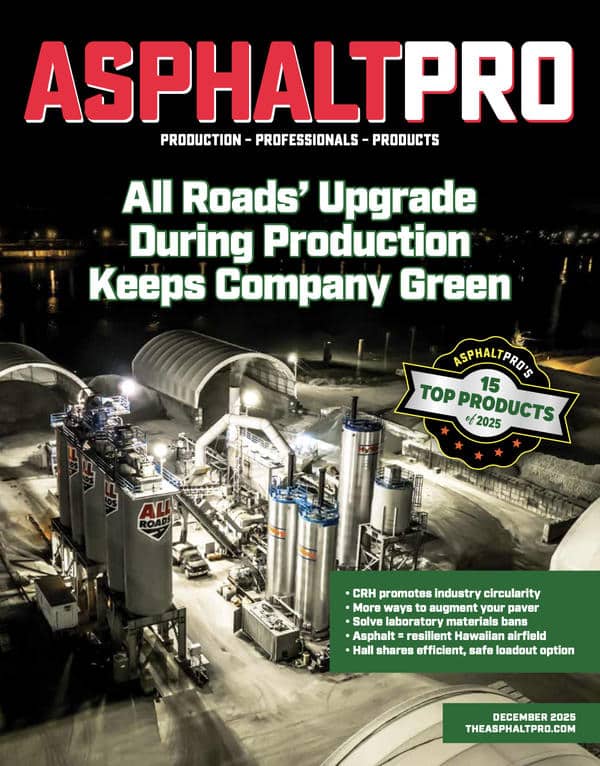
As we do each December, we offer a look at sustainable practices throughout the asphalt industry in this issue. I’d like to take the opportunity to discuss consumerism this season, too. Let’s face it, there’s money to be made when greening up the environment, whether with monitoring devices or electrified equipment.
Polaris Market Research reports that the air quality monitoring system market is projected to be worth USD 11.62 billion by 2034; up from USD 5.73 billion in 2024. The research firm states: “An air quality monitoring system is an instrument or collection of instruments…that helps identify impurities such as carbon monoxide, nitrogen dioxide, ozone, particulate matter (PM2.5 and PM10), and volatile organic compounds (VOCs).”
The systems are designed to provide real-time data, which guides environmental management of pollution control measures and so on. Asphalt professionals may be familiar with these devices as a recurring element that citizen environmentalists “quote” at town hall meetings. One of the problems with average citizens erecting such stations to gather ammunition against the local asphalt plant is the average citizen’s lack of science methodology practice. Not every soccer mom understands the impact of Canadian wildfires, the dust plume from the Saharan Air Layer, or twice-daily traffic jams less than a mile from the station on readings. Not every soccer dad is ethical enough to care.
I don’t want to paint a negative picture of our neighbors. I’m sure there are people who want to shut down an established asphalt plant who would not dream of idling a rusted out 1994 Dodge Ram 2500 next to an air quality monitoring station to influence its readings.
Of course, a person would have to look hard to find such a truck. In July and August 2009, the U.S. government distributed about $3 billion in funds for the Car Allowance Rebate System (CARS). This program involved a straightforward voucher given to an individual trading in a not-so-fuel-efficient vehicle to buy a new, efficient one.
Folks in the construction industry can apply that concept to their fleets today with this decade’s incentive programs. Many of the current programs are directed at fleets, operators or businesses, rather than individual consumers. These incentive programs often focus on zero-emission technology rather than just purchasing a more fuel-efficient machine.
For example, the California Air Resources Board launched a voucher program for off-road heavy equipment called the Clean Off‑Road Equipment Voucher Incentive Project. This initiative encourages the purchase or lease of zero-emission off-road equipment like loaders, excavators, mobile power units, etc. In New York State, the Truck Voucher Incentive Program, which has expanded to include non-road equipment such as construction, agricultural, etc., offers incentives up to 45% of the base cost when you replace and scrap the gas/diesel equipment.
On the federal level, we have the Clean Heavy‑Duty Vehicles Grant Program, overseen by the Environmental Protection Agency (EPA). This isn’t a trade-in voucher program for off-road heavy construction machines like CARS was for consumer vehicles, but a grant program to which businesses can apply, to accelerate replacing internal-combustion heavy-duty vehicles (Classes 6-7) with zero-emission vehicles and their associated infrastructure.
Personally, I drive a 2006 Chevy Cobalt with manual door locks and crank windows. Does it have some rust spots? Sure. I broke the turn signal handle earlier this year because plastic gets brittle over time. I pay a mechanic to keep it running because you’ll have to pry that vehicle out of my cold, dead hands.
Call me all the generational names, but the last thing I want is a car that “conveniently” unlocks the doors for me when I put it in park…in downtown Detroit. Or that shuts off while traveling 55 mph on a remote highway because it detects a pinhole leak in the radiator. I have enough anxiety without adding “range” to it, thank you.
The problem is that the car is old and will need to be replaced, but, thanks to CARS of 2009, simple cars are few, far between, and priced like something out of a science fiction movie.
Is this the direction our construction industry is headed? Will we look back at the mid-2020s when we were trading in tried-and-true machines for 45% off a newfangled electric or hybrid model and wish we hadn’t?
It looks like Michigan DOT has their answer. MDOT conducted research for Fleet Electrification Strategies and recently released Research Report Number SPR-1739 wherein they state: “MDOT was provided with a number of considerations for transitioning its fleet [of 5,000 units] to low- or no-emissions alternatives. These include conducting pilot projects to test electric or hybrid models of a specific unit and evaluate how well they actually perform compared to MDOT’s current gas- or diesel-powered model….Electric-powered versions of these units are available and have been determined to meet MDOT’s operational requirements.” Read the full report online.
No matter how many units from your fleet you feel comfortable replacing to effect cleaner air, this is the edition where we share the sustainability initiatives your peers are also considering and implementing. As we dive into December and the festive green season, the staff at AsphaltPro wishes you and yours a blessed, peaceful, Merry Christmas!
Stay Safe,
Sandy Lender