
D.E. Gemmill Deploys Robotic Tracking for Pavement Marking
BY The Asphalt Pro Staff
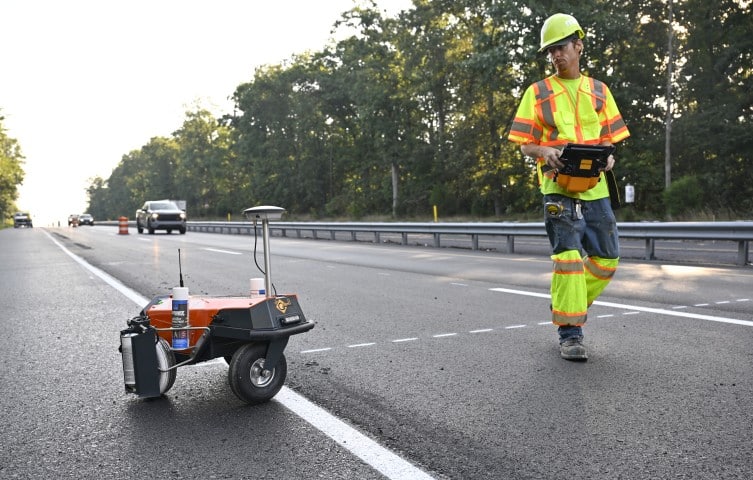
Incorporating the Tyker Robot Plotter in its pavement marking plan, a Northeast contractor becomes the first in the United States to deploy the tech for transverse-joint layout
Finding and marking transverse joints for sawcut and seal becomes more precise and efficient when D.E. Gemmill, Inc., Red Lion, Pennsylvania, combines LiDAR mapping and robotic layout technology. The pavement marking contractor and sign manufacturer has provided Pennsylvania, Maryland and Delaware with marking and maintenance services for 40 years, and now is the first U.S. company to deploy robotic plotter technology for transverse-joint layout.
INSET:
Since 1986, D.E. Gemmill, Inc., has provided professional, high-quality marking and maintenance services to clients throughout the Mid-Atlantic region. The company specializes in a range of services, including providing pavement marking and maintenance, hydro blasting and marking removal, Auto Layout with LiDAR technology, robotic layout, in-house traffic sign manufacturing, sign installation, and roadway safety services.
END OF INSET
D.E. Gemmill recently added the Tyker Robot Plotter, which combines LiDAR mapping with automated robotic layout, making it one of only 10 companies nationwide currently using this autonomous layout technology. D.E. Gemmill put the equipment to work in September 2026 on US15 in Adams County, Pennsylvania, giving its team the opportunity to evaluate the technology in an active roadway environment.
David Gemmill, owner of D.E. Gemmill Contracting, shared with The Asphalt Pro some particulars of the project. “This was a Penn DOT project however we were performing the work for the prime contractor, The JVI Group. The project was approximately 4.1 miles long and encompassed the two southbound lanes of a four-lane highway. Each lane required a closure of one shift to perform the layout marking for the transverse joints.”
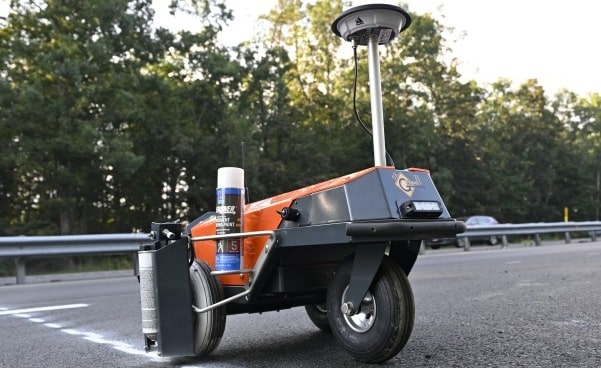
The addition of the Tyker Robot Plotter is part of D.E. Gemmill’s continued investment in technology and automation designed to improve roadway safety and field operations for the company.
Here’s how the process works.
Step 1. A milling subcontractor removes the existing pavement to expose the underlying concrete roadway.
Step 2. D.E. Gemmill uses its Auto Layout truck with LiDAR technology to scan the exposed concrete. This captures the locations of joints and saw joints of the concrete repairs. This information is processed into precise positioning data, and the data is uploaded to the robotic plotter.
Step 3. The primes contractor paves the roadway.
Step 4. D.E. Gemmill uses the robotic plotter to travel the new pavement surface and mark the transverse joint locations.
Step 5. A subcontractor saw cuts and seals the joints.
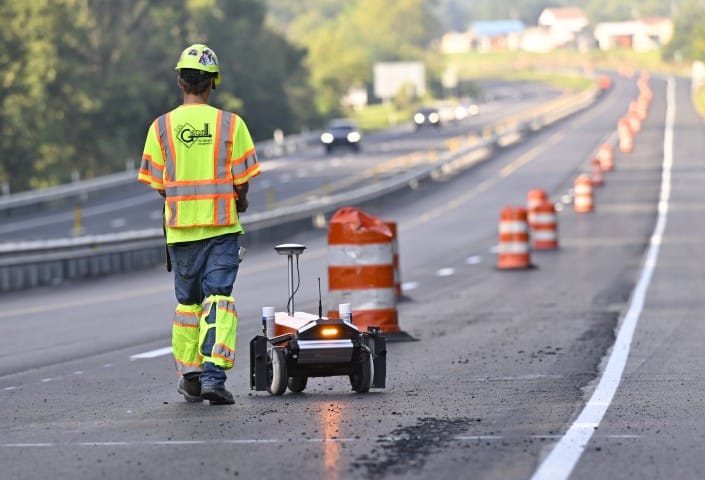
After the prime contractor has paved over the concrete, D.E. Gemmill uses the robotic plotter to travel the new pavement surface and mark the transverse joint locations.
The result is a more automated approach to a process that traditionally requires considerable time and physical labor on the roadway.
“The reason for sawing and sealing the joints is for the expansion and contraction during the freeze and thaw cycles in cold weather climates,” Gemmill shared. “Without the joint for expansion and contraction, asphalt placed over concrete road bases can cause the concrete to buckle or crack. This is a process that PennDOT has as part of its construction process.”
Now D.E. Gemmill has the Tyker Robot Plotter to facilitate automation. Company management first learned about the technology at the American Traffic Safety Services Association’s annual Convention & Traffic Expo in early 2026. Seeing an opportunity to reduce employees’ roadway exposure while making the layout process more efficient, the company added the system to its pavement marking division for field use.
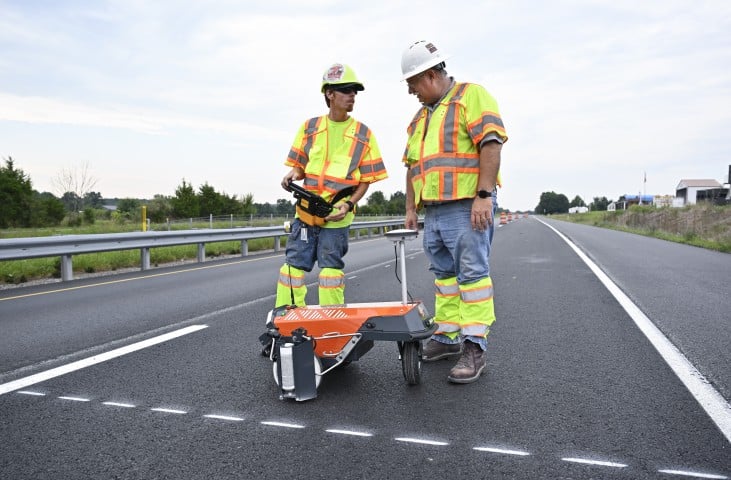
David Gemmill (at right) discusses incorporating the Tyker Robot Plotter technology for transverse-joint layout.
“Over our 40 years in business, we’ve seen our industry change significantly and continue to move toward new technology and automation,” Gemmill said. “We believe it’s important to embrace the technologies that can position us for the future, especially when they can improve safety for our employees…These investments also give us the opportunity to expand our capabilities and provide services that may not currently be widely available throughout our service area.
“D.E. Gemmill Inc. is a pavement marking contractor that is utilizing equipment that is used for pavement marking capture and layout, by expanding into another area of the construction process,” he continued. “It is just another form of marking that needs to be performed in the highway construction process.”
The addition is part of D.E. Gemmill’s continued investment in technology and automation designed to improve roadway safety and field operations as the company completes pavement marking projects throughout Pennsylvania, Maryland and Delaware.