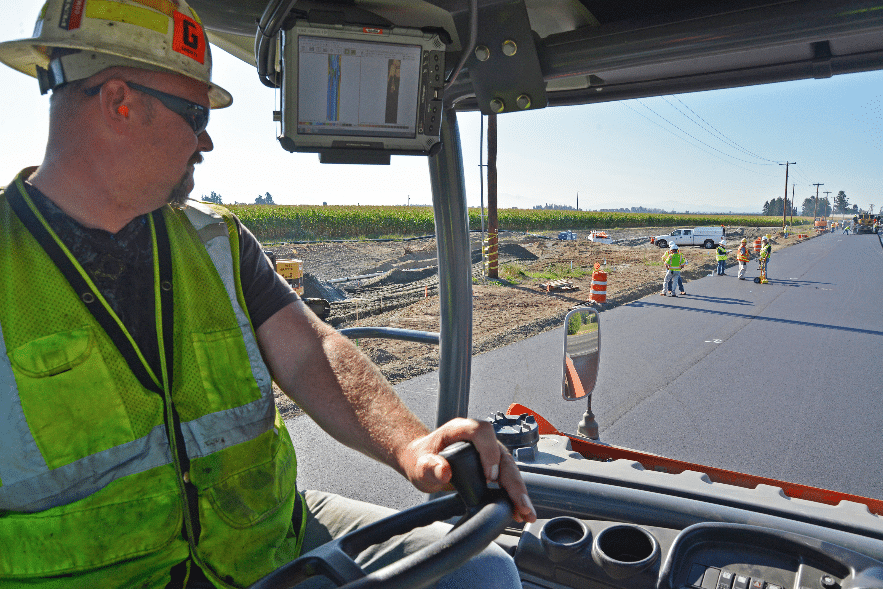
Striping Tip for Skip Lines

When you’re striping with a walk-behind—or self-propelled—machine, you put a lot of faith in the settings and automation. Once you’ve locked in the measurements and started moving forward, there’s no looking back. Or is there?

If you notice alteration or “wobble” in your skip lines, stop and reset.

You don’t have to live with unevenly spaced markings that may or may not get full pay from the client or prime contractor. Look at your control panel’s screen and ensure your measurements are on target. ​

If everything reads the way it’s supposed to, your next troubleshooting step is to check tire pressure. Both back tires of your striping machine need to be within 1-2 pounds of each other. (Basically, if you have 58 psi on the rear tires, you want both to read 57-59.) If one is “flatter” than the other, your calibration is off. Take the time to fix it. ​

Inflate the problem tire and recalibrate the machine. Now you’re ready to get back to making money.

Extra Tip: Keep an eye on your tire tread, too. You’d be surprised how problematic a rock in the tread can be for painting straight, evenly spaced lines. And if you’ve been letting paint dry on your tread, those layers are changing the tire’s circumference. Make sure you’re keeping the tires nicely maintained.


Get tips like this delivered directly to your inbox each week when you sign up for Toolbox Tips.

Paving Yield Log App Tracks Yield in Real Time

IOS Developer Daniel Schroeder, Bielefeld, Germany, launched a new iPhone app in May 2026. The Paving Yield Log is designed to keep track of each truckload as it is placed on the mat and report a running yield percentage per load and across the shift. The app is intended to notice yield drift early. If a load is running thick at load three, the foreman sees it at load three rather than at the end of the shift.

For every truckload, Paving Yield Log records tonnage, stationing, mat width, lift thickness, and mat temperature. The app uses a spread rate of 110 pounds per square inch as the default density baseline, and lets the user override it with the lab-measured value from the mix design report. The app can generate a per-shift PDF modeled after the Wisconsin DOT yield check sheet and a CSV export for quality control.

It runs completely offline with no account and supports US-customary and metric units. Paving Yield Log is a one-time purchase for iPhone, available in the Apple App Store.

Cummins Expands Mobile Power Line with 12kW Generator

Cummins Inc., displayed its 12kW Tier 4 Final mobile generator set during CONEXPO-CON/AGG in March. This model includes a heavy-duty trailer for use in a variety of industries that require mobile power. Manufactured in the United States and built for the North American market, the offering expands Cummins Power Generation Tier 4 Final Certified rental product portfolio, ranging from 12kW to 1MW of power. It includes a sound-attenuated enclosure for quiet operation.

Monitor Rolling Temperature—Paving Details Matter

It’s still plenty hot out there in North American paving zones and that ambient temperature affects your mat and your rolling zone. With WMA designs in play, the idea of getting off the mat when it has cooled to the 160 to 180 degrees F range isn’t always valid. Depending on stone structure, mix design, WMA additives, and so on, you may be able to roll in static mode when the mat temperature is cooling below 160.

Know your mix. Know your temperature. Know the fancy intelligent compaction system you’re working with and plug in all the parameters that can help you get a bonus-worthy mat.

Above all, create a test strip and have the QC/QA tech double-check your numbers. The tech helps you set up the perfect rolling train, complete with the temperature range to watch, when you place a test strip.


Get tips like this delivered to your inbox each week when you subscribe to Toolbox Tips.

Cojali Celebrates 35 Years of Commercial Vehicle Innovation

Cojali, Campo de Criptana, is a Spanish multinational that specializes in the manufacture and development of technological solutions for commercial vehicles, agricultural equipment and machinery, and the company celebrates its 35th anniversary this year. Since its foundation in 1991, the company has maintained a constant evolution, positioning itself as a major player in fields such as electronics, advanced diagnostics, connectivity and data analysis. Founded in Campo de Criptana as a company initially focused on the repair of components, Cojali has evolved and developed a comprehensive ecosystem of solutions aimed at optimising efficiency and competitiveness, with brands such as Cojali Parts, Jaltest Diagnostics, Jaltest Telematics or Jaltest Tools, internationally recognised and currently present in more than 100 countries.

Cat Introduces Collision Mitigation System for Compactors

CAT announced in early March the Cat Detect—Collision Mitigation System, a technology designed to enhance situational awareness when operating the compactor. It features an integrated, intelligent sensor array to provide forward and reverse collision warnings, people detection, motion inhibit and automatic braking. Visible in real-time and recorded for future analysis, critical zone detection events transmitted to VisionLink™ enable organizations to proactively mitigate potential hazards, enhance operational safety and identify opportunities for improvement.

The Collision Warning radar system targets collision potentials in front of and behind the compactor using audible and visual alerts that allow the operator to see, manage and mitigate hazards that may otherwise go undetected. Leveraging smart cameras, People Detection alerts the operator when on-site personnel are detected to the front and rear of the compactor, providing alert levels that dynamically adjust travel speed based on the person’s proximity to the machine. With manual override capability, Motion Inhibit prevents compactor movement when the machine is stationary for at least two seconds and the detection system identifies a collision potential. When the compactor is in motion and critical zone detection occurs, Automatic Emergency Braking activates if the operator fails to act. When the critical zone detection clears, compactor control returns to the operator.