Autonomy Action

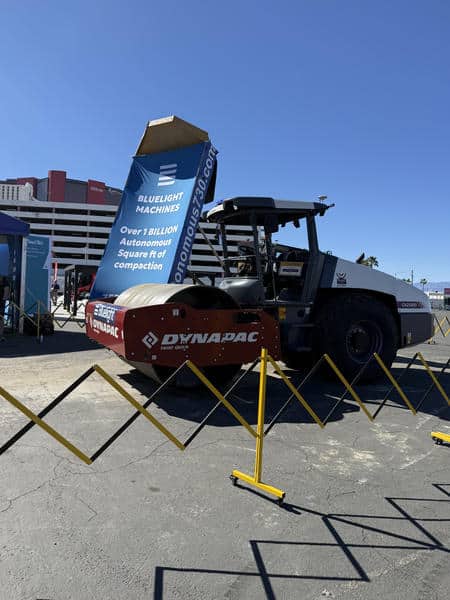
Dynapac North America and Bluelight Machines announced in February a strategic collaboration to showcase autonomous compaction solutions to contractors across North America. The technology was demonstrated at CONEXPO 2026, where Dynapac’s 84-inch, 11-ton CA2500D Seismic Soil Roller operated in Bluelight Machines’ live autonomous equipment demonstration.

The demonstration showed how Bluelight’s autonomy platform integrates with Dynapac compaction equipment in a real-world job site environment. Dick Zhang, the president of Bluelight Machines and software co-developer, said, “By combining Bluelight’s go-to-market-ready autonomy platform with Dynapac’s proven compaction equipment, we’re delivering a practical, scalable solution that is already performing on active job sites today.”

Bluelight Machines’ autonomy platform is currently deployed on active job sites across the United States and internationally, with approximately 75% of installations operating in compaction applications. The company offers retrofit kit options for compaction equipment and haul trucks, supported by a growing distribution network.

“Having Bluelight autonomy available for Dynapac rollers is a major step forward for our customers,” said Jennifer Bishop. She’s the director of product marketing and customer experience for Dynapac North America. “By combining Bluelight’s autonomy platform with Dynapac’s Seismic technology, contractors gain a fully integrated, market-ready autonomous compaction solution that delivers exceptional precision, consistency and performance. Backed by our Dyn@link telematics platform, we’re seeing engaged contractors improve utilization on soil rollers and realize efficiency gains and increased production.”

Compact FDR Before Moving Forward

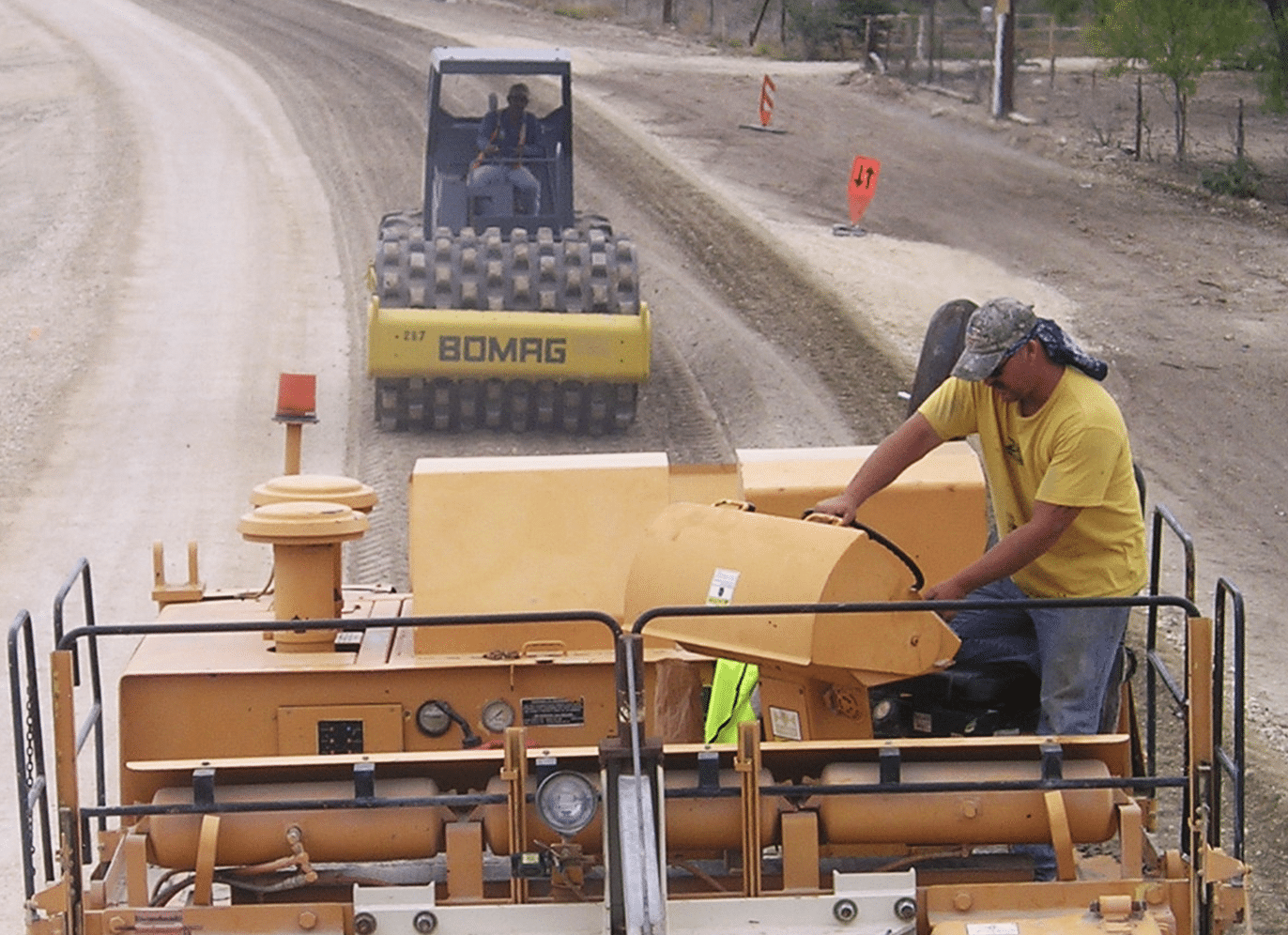
Before the July “Compaction Action” issue of The Asphalt Pro hits your inbox later this week, let’s apply some quality control to a sometimes-overlooked area of pavement preservation. During a full-depth reclamation (FDR) treatment, you’ll add crushed aggregate prior to the procedure of reclaiming and remixing in-place. You must compact that layer properly.

We’ll oversimplify this to make it a quick tip: Additives work as stabilizing agents and play a role in the reclaiming and remixing stage of FDR. Those agents set up. They bond things together. This offers the reclaimed layer as a base for an overlay.

To get proper compaction of that base layer, you’ve got to get your compaction train mobilized efficiently. You want to achieve final compaction of the reclaimed layer within two hours of reclamation (that’s an average; it depends on ambient temperatures) to achieve manipulation of the elements. You want the rollers on the base layer before the stabilizing agents set up and refuse to allow further manipulation.

With your base layer’s optimum compaction achieved, you’re ready to overlay and give the taxpayers a long-lasting asphalt roadway.


Subscribe now to receive tips like this directly to your inbox!

Interstate System’s 70th Anniversary Highlights Need for Long-Term Federal Investment

As the nation marks the 70th anniversary of the Interstate Highway System on June 29, transportation and construction industry organizations are using the milestone to call on Congress to pass a new multi-year surface transportation reauthorization before current federal programs expire Sept. 30, 2026.

The Transportation Construction Coalition (TCC) and the National Stone, Sand & Gravel Association (NSSGA) both issued statements recognizing the anniversary while emphasizing the importance of continued federal investment to maintain and modernize the nation’s interstate network.

The Interstate Highway System spans nearly 49,000 miles and remains a critical component of the nation’s transportation infrastructure, supporting the movement of people and freight across the country. According to the TCC, continued investment is necessary as the system ages and transportation demands continue to increase.

“From supporting supply chains to connecting communities, America’s Interstate Highway System has powered economic growth and opportunity in every region of the country for decades,” the coalition said. “As this system ages and demand continues to grow, sustained federal investment through a new surface transportation reauthorization is essential to ensure it remains safe, reliable, and efficient for the millions of Americans who depend on it every day.”

The coalition noted that the current federal surface transportation authorization expires Sept. 30, 2026, and said a long-term bill would provide states and local communities with the certainty needed to plan and deliver infrastructure projects.

“Congress must pass the next surface transportation reauthorization and reinforce the federal commitment that created the interstate system by investing in key initiatives such as major bridge improvements, freight movement projects, and road and workzone safety programs,” the coalition continued. “Advancing a new surface transportation reauthorization bill by September 30 will support continued economic growth for communities nationwide and keep America moving.”

The TCC also highlighted several interstate corridors as examples of how continued federal investment supports mobility, freight movement and economic growth. Among them are Interstate 10 along the Gulf Coast, including the Calcasieu River Bridge; Interstate 70, a major east-west freight corridor connecting the Rocky Mountains and the Midwest; and Interstate 90 in New York, including the Castleton-on-Hudson Bridge.

NSSGA President and CEO Michele Stanley also reflected on the significance of the anniversary and the role aggregates producers continue to play in building and maintaining the nation’s highways.

“Today marks the 70th anniversary of the Interstate Highway System and the passage of the National Interstate and Defense Highways Act, which was signed into law by President Dwight D. Eisenhower. This historic investment in our nation’s highways transformed our country, connected communities and powered commerce, laying the foundation for the prosperous nation we are today. NSSGA members proudly play an essential role in building and maintaining over 47,000 miles of interstate by supplying the 38,000 tons of aggregates material required to construct every mile of four-lane highway. Their work helps ensure safe, durable roads that support the nation’s transportation and economic needs.

“Now we must look to the future to modernize and strengthen this system. This milestone anniversary, along with America’s 250th Birthday, serves as a reminder of the critical need to pass a multi-year surface transportation reauthorization bill this year. We urge the House of Representatives to consider and pass the BUILD America 250 Act, and the Senate to also take up legislation, to secure the future of our interstate legacy.”

Both organizations pointed to the Interstate System’s legacy as a foundation for economic growth while stressing that continued federal investment will be essential to preserve and strengthen the network for future generations.

Volvo Partnership Supports Electric Off-Highway Equipment Leasing

Volvo Penta and Volvo Financial Services have partnered on a finance solution for end customers designed to help support the transition to electric off-highway vehicles. DFDS, one of Northern Europe’s largest shipping and logistics companies, is the first customer to benefit from the partnership with its order of six MOL RME225 RoRo tractors, which are powered by Volvo Penta electric drivelines. DFDS and VFS are entering into a seven-year lease agreement on the 4×4 tractors.

The goal of the partnership is to support DFDS as it transitions a portion of its 280 diesel-powered terminal tractors to electric off-highway vehicles. The initial agreement sees the Volvo Penta electric drivelines supported by Volvo Penta service contracts for preventive maintenance and VFS insurance coverage.

“Leasing electric equipment is an attractive option for end customers while the technology evolves rapidly and the upfront investment remains higher than for traditional combustion engine equipment,” said Jeroen Overelde, area sales manager, Volvo Penta Industrial. “Now that we have developed this financial solution, we will bring this approach to other segments, markets, OEMs and customers.”

Topcon Expands SmoothRide Digital Paving Workflow

Topcon offers a digital workflow for paving with its SmoothRide. During CONEXPO-CON/AGG 2026, the company displayed a variety of intelligent paving offerings in the SmoothRide ecosystem, including the RD-M scanner. This data-collection aspect of the paving process lets the quality control and planning teams work with an abundance of real-world data. With a downward-facing LiDAR scanner attached to the back of a standard work truck, an inspector or other employee drives along the relevant roadway. The RD-M scanner then collects a constant stream of data as the worker drives.

The system includes an integrated HiPer VR GNSS receiver and Inertial Measurement Unit (IMU) to capture point data while cruising at moderate speed. The data is automatically timestamped and stored for management and point cloud generation.

Benefits include:

  • All major satellite systems: GPS, GLONASS, Galileo & BeiDou
  • Speed scanning without lane closures
  • Scan rates up to 100 times per second
  • Graphical software for intuitive processing

FleetWatcher Expands Real-Time Trucking Visibility Tools

FleetWatcher’s Materials Management solution, an AlignOps product, leverages telematics technology to give real-time visibility into trucking operations, whether those are your own or third-party provider fleets. At CONEXPO-CON/AGG 2026, the company debuted its industrial-grade, dual-facing cameras. The cameras aren’t just for recording video; they’re leveraging a real-time artificial intelligence (AI) that detects fatigue, speeding, and seatbelt use, then tying that safety data directly to the vehicle’s operational KPIs.

Also during the show, President Adam Harshman spoke to AsphaltPro about the system, explaining specifically how FleetWatcher’s Load Cycle Analysis can show in real time where bottlenecks could be occurring at the asphalt plant. The Load Cycle Analysis feature also helps users correct issues in real time and enables users to schedule, manage,and pay material haulers. Director of Sales Tyler Hackman said, “Essentially what we’re working on is connecting the dots between where material is produced and where it’s processed at the job site, getting everybody on the same page, really turning the lights on so…everybody is working with the same understanding of what’s actually going on, so you can identify problems in real time.”

Other facets of the system include being able to set KPI benchmarks such as start times, tons per hour, cycle times, paving speed, cost per ton, wait times, plant production, etc.; dispatching; quick truck pay; an e-ticketing solution; virtual shift tickets; and integrations with OEM software, ERPs, and more.

For more information, visit the AlignOps site.