Keep the Drones Safe from Thanksgiving Turkeys (and Other Wildlife)

Do you have your final stockpile inventory for the season? It’s time to tuck the drone(s) away for safe keeping. Do you know how to store its battery?

Start with the drone manufacturer’s battery storage recommendations. Some OEMs prefer you completely discharge the battery. Some have you fully charge the battery and store it with a “drip” current, draining power down to no lower than 70% over time. Some say discharge the battery to between 40 and 65%. The level of power also depends on the length of storage time, so you’ll want to follow your particular OEM’s guidance.

Then store the battery, unplugged, in a fireproof container, in a cool, dry room. A Lipo-bag is one type of container you can use.

This doesn’t mean you’re done for the winter! Check on those hibernating batteries every two to three weeks. You’ll double-check the battery levels and look for any signs of corrosion or swelling.

You can share your drone-storage tips on our Facebook page discussion.

The staff at AsphaltPro wishes you a happy and safe Thanksgiving this week with family and friends.


Get tips like this to your inbox each week when you subscribe to our Toolbox Tips emails.

Caterpillar Launches Next-Gen Articulated Trucks with Advanced Features

Caterpillar introduced its latest articulated truck design with built-in automatic features for the next generation Cat® 725, 730, 730 EJ and 735 models. The upgraded interior puts control at the operator’s fingertips, with all functions accessible through a touchscreen or a smooth, responsive keypad. The touchscreen can be navigated using the integrated jog dial. New push-to-start with operator ID stores up to 50 operator IDs to quickly get to work and safeguard against unauthorized use.

The new Cat C13 engine powers the next generation of trucks with ratings from 257 to 316 kW (345 to 424 hp), depending on the model. Designed to meet global emission standards—including U.S. EPA Tier 4 Final, EU Stage V, Japan 2014, and Korea Stage V—the C13 features a compact, lightweight design with no need for exhaust gas recirculation. The machine is available in configurations suitable for all regions worldwide, according to the manufacturer.

The Cat 725, 730 and 735 models feature a redesigned dump body that features a rerouted exhaust heat system that helps minimize material carryback. Improved payload technology allows operators to view real-time load weights on the integrated display, and the system has updated software and sensors. External payload indicator lights alert the loading operator when approaching rated payload and when payload is reached.

An onboard, optional interactive training tool, Operator Coaching, measures and reports on individual operator behaviors that impact efficiency, safety and machine health. Operator Coaching identifies opportunities to improve operating behavior for inexperienced and experienced operators alike by monitoring 14 activities. Tips can be viewed on a summary page on the main touchscreen display, while animated video tutorials provide operator instructions. For fleet managers, the GPS function includes maps to show the location of where tips are triggered on the work cycle. Among the 14 coaching tips are:

  • Hoisting without articulation
  • Hoisting with transmission in neutral
  • Hoisting on level ground
  • Reducing cornering speed
  • Using lower gear when retarding
  • Reducing speed in rough conditions
  • Approaching grade in lower gear

Production of the new next generation Cat Articulated Trucks, starting with the 730 model, is scheduled for January 2026.

For more information, visit your local cat dealer.

Sripath Launches ButaPhalt® to Advance PMB Performance

Sripath Technologies® LLC, Mahwah, New Jersey, has launched its innovative crosslinking additive, ButaPhalt®. In May 2025, Sripath acquired the “Buta Business” consisting of the assets of ButaPhalt Products LLC, ButaChem LLC, ButaMix LLC, and related businesses and activities.

ButaPhalt is the first product of the Buta Business being offered under the Sripath banner. ButaPhalt is an innovative crosslinking additive that is specially engineered to improve the performance of polymer-modified bitumen (PMB). It allows sulfur to more effectively crosslink with the polymer during PMB production, according to the manufacturer, which may help reduce the amount of polymer needed in a PMB mix to deliver desired performance. ButaPhalt is formulated from a proprietary blend of sulfur powder, accelerators, scavengers, surfactants, absorbing agents and specialty oils. The result is a product the manufacturer states is a more effective crosslinking additive as well as highly dosage efficient.

The company states: “ButaPhalt is available as both a free-flowing, dust-free power and as a pumpable liquid suspension for easy handling. ButaPhalt powder also helps reduce waste and backhaul charges. ButaPhalt typically improves productivity, reduces processing time, and lowers operational costs. ButaPhalt is an operations-friendly product that is easy to use and safe to handle. It can reduce hydrogen sulfide (H2S) emissions and odor typically associated with PMB production. It helps improve working conditions while mitigating potential environmental impacts. ButaPhalt improves the thermal stability of a PMB. It easily delivers desired PMB performance.”

“We’re incredibly proud to add ButaPhalt to Sripath’s product portfolio,” said Dr. Krishna Srinivasan, president of Sripath Technologies. “We believe it fills a need in the industry for high-performing crosslinkers that improve polymer modified bitumen performance and grade more effectively than traditional solutions.”

“From a technical perspective, ButaPhalt has been and continues to be a significant step forward in crosslinker technology,” said Dennis Krivohlavek, business development specialist for Sripath Technologies. “Its proprietary formulation delivers greater stability, consistent performance, and enhanced ease of handling for producers. We’ve designed it to integrate seamlessly into PMB production, helping our customers optimize their processes while meeting stringent performance specifications.”

For more information, visit www.sripath.com.

Continental Launches Thunderbolt SilentSync Composite Sprockets

Continental, Fairlawn, Ohio, announced in September that its group sector ContiTech has launched its Thunderbolt SilentSync® composite sprockets for the power transmission industry. They are designed to help customers optimize drive performance and reduce system costs. Engineered from a patented high-strength material (U.S. Patents 10865868, 10989293, 11015694), Thunderbolt SilentSync® composite sprockets offer up to 80% weight reduction compared to steel counterparts, according to the manufacturer.

Thunderbolt sprockets, developed and produced by ContiTech in the Americas region and specifically for this region, are currently available in a Helical Offset Tooth (H.O.T.) construction. Future developments include straight tooth profiles as well as large-diameter Thunderbolt sprockets designed for Air Cooled Heat Exchanger (ACHE) applications.

Help the Newer Roller Operator Through His First Cold-Weather Balancing Act 

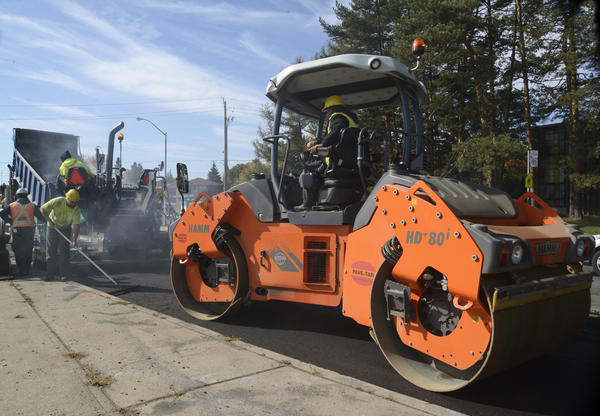
Veteran roller operators know the drill, but any newer crew members or folks who’ve joined the industry this season might not be ready for cold-weather paving. Or cold-weather compaction. Let’s talk about keeping roller marks out of the equation as well.  ​

If your roller operators wish to warm the drums (or tires) by staying on the hottest part of the mat, they could be jeopardizing density. It’s a balancing act to get perfect density without overcompacting on a normal day; add lower ambient temperatures or cool autumn breezes and you have all new calculations. Here are some tips to protect the mat from divots and indents.

  • Never stop the roller on the hottest part of the mat. (This goes for any time of year.)
  • When stopping to change direction, do so slowly and at a diagonal so the resulting “shove” of material is slight and easier to roll out on subsequent passes. If your automatic system doesn’t do this for you, remember to turn off vibration one roller length prior to stopping.
  • When you must park the roller, stop on the cooler part of the mat where the machine is less likely to “sink,” and stop at a diagonal. For cool-weather paving, rather than parking the roller, turn off vibration/oscillation and roll slowly in static mode on warm parts of the mat. Again, it will be a balancing act to remain in motion to keep drums on a warm mat while remaining in proper rolling zones. Work with the QC tech to determine how to accomplish this without breaking aggregate in the layers (overcompacting).
  • Monitor fuel and water use. You’ll give drums or tires too much time to cool if you have an unplanned stop far from the paving train to refill. It’s better to be aware when fuel or water is running low so you can have the general laborers help you before it’s a crisis. Stop the roller at a diagonal on a cool part of the mat, refill efficiently, and get back to best rolling practices.

Subscribe now to receive tips like this to your inbox each week!

ProStack Launches TW 36-150 Telescopic Conveyor

ProStack®, a Terex company, has launched the TW 36-150, a 150-foot radial telescopic conveyor, which will be manufactured at the Terex facility in Mt. Vernon, Missouri. The conveyor is designed specifically for the North American market and delivers stockpile capacity with tool-free deployment. To meet the demands of the North American market, the TW 36-150 is fully road towable across the region and comes with a tow hitch as standard, according to the manufacturer.

The TW 36-150 has been engineered for multiple stockpiling applications including quarrying and mining, with features designed to maximize efficiency and ease of use. With a 150-foot telescopic reach and radial capability, it delivers stockpile capacity that exceeds 48 feet, 10 inches in height and accommodating up to 102,696 cubic yards of material, according to the manufacturer.