Blue Diamond Launches Series 2 Cold Planers for Road Milling

Blue Diamond® Attachments, Knoxville, Tennessee, announced in February its new line of self-leveling Extreme Duty Series 2 cold planers, designed for road surface milling, concrete scarification and asphalt removal applications. The line includes eight models ranging from 14 inches to 48 inches in milling width, compatible with skid steer and compact track loaders, and the attachments are available in both low and high flow.

The new cold planer line features design elements to enhance performance and precision:

  • A patented self-leveling system for constant milling depth regardless of ground contour or machine position
  • Independent right and left depth adjustment capability, available in both mechanical and hydraulic configurations, for surface matching and side-by-side passes
  • Standard hydraulic side shift functionality for flush milling against walls and other obstacles
  • Multiple drum options with different widths and teeth layouts

The cold planers feature milling depths from 4.3 inches to 6.7 inches, depending on model, and working speeds of up to 16.4 feet per minute. All models have an optional dust suppression spray system and clear depth indicators for precise control.

For more information, visit the Blue Diamond website.


Neutralize Asphalt Plant Odors with Plant-Based Solutions

Asphalt production and paving are essential foundations for modern infrastructure. However, despite its indispensable role, the production of asphalt can generate pungent odors that negatively affect nearby communities and potentially disrupt plant operations.

This issue has become increasingly widespread, driven by the global demand for asphalt and the growth of urban development surrounding production facilities. As a result, effective odor control is now a critical component of responsible asphalt manufacturing.

Traditional masking agents fall short when it comes to tackling this challenge. Instead, leading suppliers with application expertise are delivering both standardized and customized odor control solutions tailored to each manufacturer’s specific needs.

One highly effective approach involves applying plant-based odor neutralizers directly at the stack and baghouse. Unlike masking agents, these environmentally friendly and cost-efficient formulations don’t simply cover up odors. They work by breaking down and neutralizing the odor-causing volatile organic compounds (VOCs) present in the offgas emissions.

By using these advanced solutions, asphalt producers can take a proactive stance in managing odor challenges. This not only helps ensure regulatory compliance but also strengthens community relationships and allows producers to concentrate on their core business operations without the distraction of odor-related complaints.

Editor’s Note: This content originally appeared in the article Neutralize Odors at Your Asphalt Plant’s Stack and Baghouse by Glenn B. Crisler II.

CWMF Unveils Dust Pilot Baghouse for High-Capacity Asphalt Plants

While WOA attendees could see the Honey Badger and Tremor Shaker from CWMF Corp., Waite Park, Minnesota, on display, they also had the chance to pick up information on CWMF’s newly branded Dust Pilot reverse-flow baghouse. Designed for high-capacity operations, the Dust Pilot is engineered to deliver peak performance with fewer moving parts. Features include precision airflow control, an advanced inertial separator and CWMF’s unique indexing wheel mechanism.

Its standard features include 3/16-inch shell construction; portable and stationary configurations; and 68,000 or 93,000 or 120,000 CFM. Additional sizes can be built as well.

For more information, visit www.cwmfcorp.com

Eagle Crusher Launches Next Gen 1200-CC Portable Crushing Plant at WOA

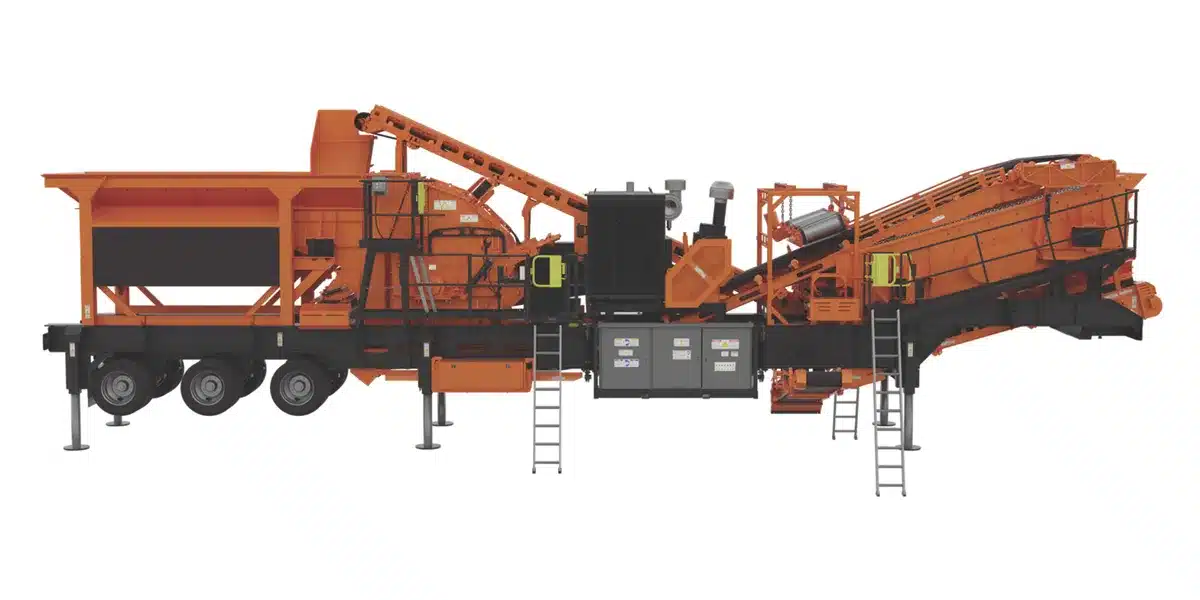
Eagle Crusher, Galion, Ohio, introduced its next generation 1200-CC portable crushing and screening plant during WOA/AGG1 in St. Louis. The 1200-CC’s new features include a redesigned return conveyor; a new fully hydraulic side discharge conveyor, a self-lowering control panel, and an available onboard cross-belt permanent magnet that stays on for transport.

The next generation 1200-CC from Eagle Crusher offers new features to make the aggregate and recycle producer’s job easier. Photo courtesy of Eagle Crusher

The redesigned return conveyor allows quicker setup without having to attach parts after extension. The new, fully hydraulic side discharge conveyor makes setup and teardown easier. The self-lowering control panel no longer requires additional equipment to remove from the plant.

Partnering with producers worldwide, Eagle Crusher Co. manufactures a complete line of heavy-duty impact crushers, portable crushing and screening plants, jaw crushers, and hammermills—made in the U.S.A.—and manufactured for the recycled concrete, asphalt, aggregate, and sand and gravel markets.

For more information, visit https://eaglecrusher.com/

Asphalt Industry Applauds Passage of Pro-Growth Legislation

Asphalt professionals across the country are taking note of the U.S. House of Representatives’ recent passage of the “One Big Beautiful Bill Act,” a comprehensive budget reconciliation package praised for its strong support of infrastructure investment and pro-growth tax policies.

The National Stone, Sand & Gravel Association (NSSGA) and Associated Equipment Distributors (AED)—two key organizations representing sectors vital to the asphalt industry—welcomed the bill’s passage, citing provisions that promise to bolster the industry’s economic stability and long-term growth.

“We thank House members for their swift passage of the One Big Beautiful Bill Act,” said Michele Stanley, Interim CEO of NSSGA. “It includes many aggregates provisions to strengthen the industry and the American economy.”

Among the most relevant elements for asphalt professionals are extensions and enhancements to tax measures that directly affect equipment purchases and small business operations. Both NSSGA and AED highlighted the reinstatement of 100% bonus depreciation and the increase in Section 179 expensing levels—measures that allow paving contractors to more effectively invest in the heavy equipment and machinery essential to their work.

AED President & CEO Brian P. McGuire noted, “This legislation delivers pro-growth tax policies, streamlines energy project approvals, and strengthens surface transportation infrastructure investments.”

The act also preserves the 199A qualified business income deduction and maintains the current corporate tax rate, delivering fiscal certainty to asphalt producers and contractors alike. Provisions enhancing estate and gift tax exemptions and protecting percentage depletion will particularly benefit family-owned and multigenerational firms.

Infrastructure-specific measures in the bill are equally significant. The legislation includes a national user fee for electric and hybrid vehicle registrations, earmarked to support the Highway Trust Fund—a long-sought revenue source that ensures all road users contribute to infrastructure upkeep. “Though this will not completely address the shortfall in funding, it is a positive step forward,” Stanley added.

Additionally, expedited permitting for energy infrastructure projects is expected to smooth the path for operations related to asphalt production and paving projects, potentially reducing delays and administrative burdens.

With Senate consideration of the bill on the horizon, both NSSGA and AED are urging swift action to secure final passage. For asphalt professionals, the stakes are clear: tax certainty, stronger infrastructure investment, and a regulatory environment more conducive to growth.

As the industry awaits further legislative developments, the House’s action marks a significant step forward for those who build and maintain the nation’s roads.

The National Asphalt Pavement Association (NAPA) also stated: “Our nation’s people and economy rely on modern roads to get from here to there. Historically, this vital work relies on user fees. For three decades, the value of those fees collected in the Highway Trust Fund (HTF) have declined, leading to uncertainty for our roads and the local businesses across our nation that build and maintain them. The National Asphalt Pavement Association (NAPA) proudly supports fair and equitable funding of the HTF by all users, including hybrid and electric vehicles. We applaud the House for including this measure, along with tax policies that support small businesses – like Section 199A reform, facilitating greater bonus deprecation [sic] and extending research and development tax credits – in its approval of the One Big Beautiful Bill Act. We now call upon the Senate to embrace these victories for American businesses and families by advancing the package swiftly to President Trump’s desk.”

Stay the Course

A conversation during the recent World of Asphalt (WOA) trade show March 25-27, combined with the release of researchers from the National Institute for Occupational Safety and Health (NIOSH) the week after, convinced me to update this note.

Federal and non-elected agencies are undergoing audits and checks-and-balances in this early part of 2025. Redundancies and inefficiencies—to be kind about it—are being reduced or eliminated. Without getting into the weeds, I’ll acknowledge that temporary funding “holds” versus full-stop cuts have left the public bouncing between news sites that report with whatever bias their overlords tell them to use. For our purposes, I want to encourage asphalt professionals to stay the course.

Ours is an industry of doers.

We get the job done. We build escalators into long-term projects, when allowed, and we know how to plan for short-term materials price spikes until in-country manufacturing levels out. Savvy businessmen and women in our industry can see three and four moves ahead and can adjust for those moves.

What I found of interest from my private conversation during WOA, and from a public statement bemoaning the loss of researchers from NIOSH, is the lack of confidence some entities have in our industry’s willingness to do the right thing without regulation. I can understand from where this stems. The Apostle Paul wrote 2,000 years ago, “For I know that good itself does not dwell in me, that is, in my sinful nature. For I have the desire to do what is good, but I cannot carry it out. For I do not do the good I want to do, but the evil I do not want to do—this I keep on doing.” (KJV, Romans 7:18-19)

Of course, Paul was struggling with sin, not with paying a fair wage to legal workers, installing emissions control devices around an asphalt plant or terminal, sharing environmental product declaration (EPD) data for the betterment of his region’s EPD collection, or offering a mental health wellness app within his company’s larger safety program. These modern-day aspects of running an asphalt company take—among other key indicators—monetary investment. If I listened to the naysayers, I would believe the CEOs among us won’t do the right thing unless forced to do so.

But I have faith in our industry to do good, even when good isn’t mandated by a non-elected agency demanding we staple money to the clouds. I have faith in our industry to do the right thing, even when the right thing is difficult or takes an investment of time, energy, personnel and so on.

Call me naive if you like, but I know human beings in the asphalt industry who place people ahead of profits. It works out in the long run because a healthy, happy, well-cared-for workforce in a healthy, sustainably sound environment can’t help but prosper.

Investing in the workforce as well as the environment is something the asphalt industry has been doing since I started reporting on it in 1998. I’ve seen success stories that make me proud to be part of the asphalt family. Let me be self-serving for just a moment to say I’ve shared a couple of those stories in an inspirational and motivational business book titled “Capture Your Dream: Stack Real-World Goals, Develop Your Dragons, Thrive Beyond the 9-5,” which is available wherever print books are sold online. It’s my twenty-first book, but first under the category of business. I humbly invite you to check it out. And I humbly encourage you to stay the course, investing in our good industry.

Stay Safe,

Sandy Lender