Product Gallery: Staar Lubricants Introduces Eco-Friendly Trick Shot Asphalt Release Agent

Staar Lubricants LLC, Reynoldsville, Pennsylvania, has launched its asphalt release agent and solvent titled Trick Shot® for the industry. Available in sizes conducive to pre-treating hand tools and components, the liquid also comes in totes for use at the asphalt plant or wherever you pre-treat the asphalt haul truck bed.

The company states the bio-based Trick Shot “sustainable products asphalt solvent and cleaner has been specifically developed as an EPA allowed alternative for the asphalt production, paving and maintenance industries.” Also labeled Trick Shot Asphalt Solvent & Cleaner (TSAS&C®), the product is formulated to dissolve bitumen, tar, oil and tack from paving equipment without harsh chemicals. The manufacturer states, “It does not release harmful fumes, is non-flammable, safe for contact with skin, and is even registered NSF-H1 food safe.”

Product Gallery: Rotochopper Expands R&D Innovation Center with New 12,000-Square-Foot Facility

Rotochopper, St. Martin, Minnesota, held its ribbon-cutting ceremony in August in celebration of its newly expanded research and development innovation center. This 12,000-square-foot expansion includes a state-of-the-art production space, significantly increasing the company’s manufacturing capabilities, along with an office area to enhance collaboration and efficiency. Additionally, the new facility features a dedicated space for research and development. This space will allow Rotochopper’s engineering and R&D teams to continue driving innovation.

Product Gallery: Eagle Crusher Hosts AEM Manufacturing Express to Celebrate American Manufacturing

Eagle Crusher Co., Galion, Ohio, hosted the Association of Equipment Manufacturers (AEM) Manufacturing Express on Sept. 13, 2024, at its Bucyrus manufacturing facility as the tour’s 55th stop, celebrating company employees and highlighting the critical role that Eagle Crusher plays in advancing American manufacturing and its contribution to the local economy. Eagle Crusher employees and their families, AEM, and members of the local Bucyrus and Galion communities, including local officials and policymakers, gathered to recognize Eagle Crusher as an industry pioneer for its contributions to U.S. manufacturing and witness firsthand the high-quality crushing and screening equipment for which Eagle Crusher is known.

Through Eagle Crusher Co.’s investment in the local workforce, the company plays a key role in maintaining the economic vitality of the area. Mike Tinkey, president, Eagle Crusher, thanked all who attended and contributed to making the event a success.

Kip Eideberg, senior vice president, Association of Equipment Manufacturers, stated, “The AEM Manufacturing Express traveled to Ohio to celebrate the grit, determination, and can-do spirit of the people who build things in America and to remind everyone that when the equipment manufacturing industry is strong, communities like Bucyrus are also strong.”

For more information, visit https://eaglecrusher.com

AI Loadout Technology

Many of our advertising partners have asphalt plant control systems that allow the plant operator to prevent the silo gate from opening until the haul truck driver has positioned the body correctly on the scale. Back in 2007, when AsphaltPro Magazine was preparing to make its debut, a conversation with Richard Young of B&S Light Industries, Claremore, Oklahoma, revealed the need for a publication that would discuss the importance of this safety technology.

Seventeen years later, software providers as well as asphalt plant original equipment manufacturers (OEMs) make loadout controls a focal point of plant control for good reason. Not only is this an area where safety is of utmost concern, but it is also an area where quality control and bean counting can derail if all parties aren’t paying attention to details—or letting new technology assist.

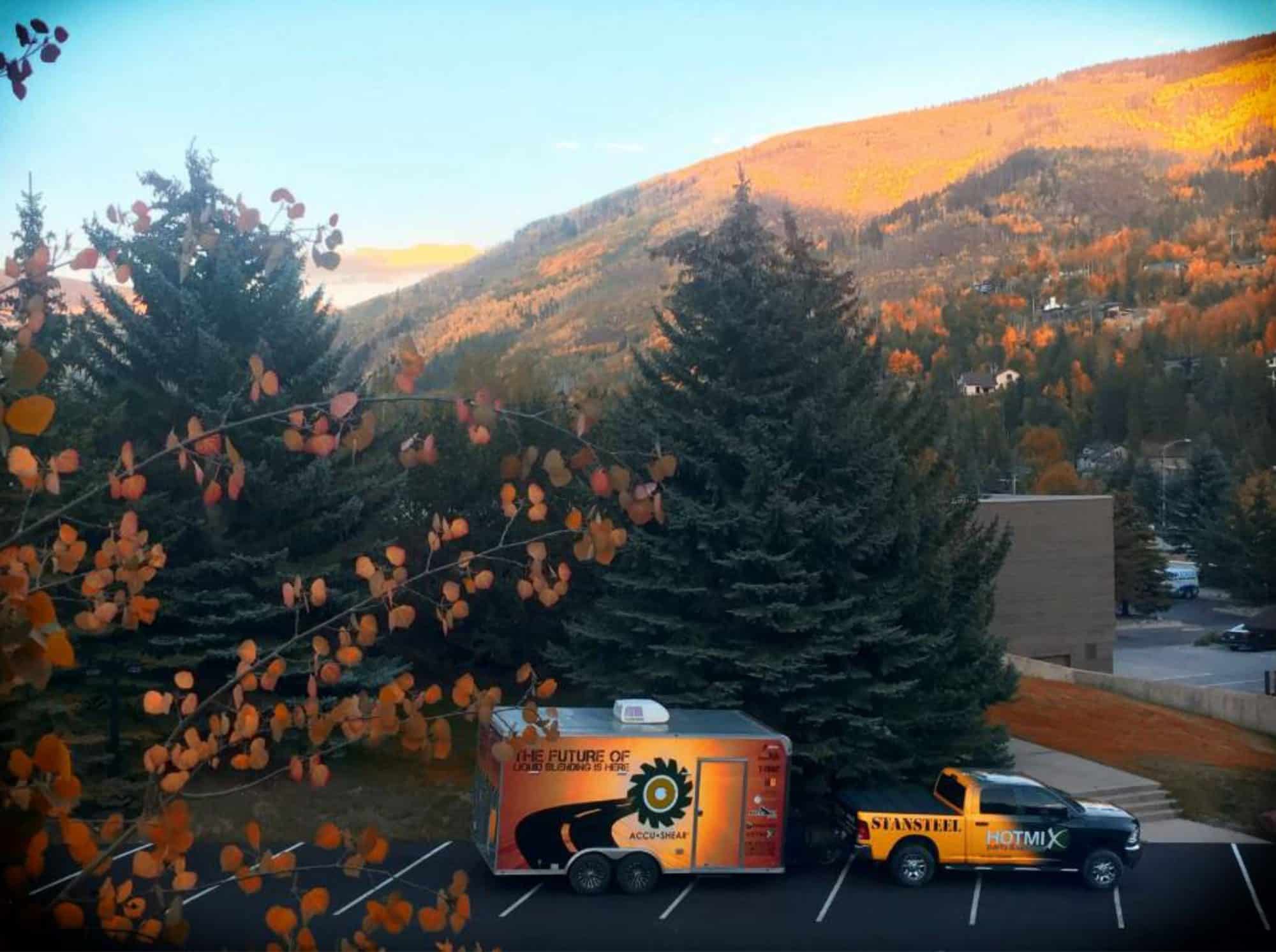
Let’s focus specifically on the Look, Lock ’N Load system by Stansteel/Hotmix Parts & Service, Louisville, Kentucky. The system uses artificial intelligence (AI) to “learn” about incoming trucks and to load them accordingly.

As a truck approaches the loadout area, the Look, Lock ’N Load system digitally scans it and is designed to differentiate the cab area from the loadout bed. The control display shows the operator a red zone for the cab and a green zone for the loading bed. It recognizes the truck’s position and links that to the silo loadout system to confirm when a specific truck is in the loading zone, approving the silo gates to open. The console allows manual override and an optional keylock to prevent bypass loadouts, if the plant manager wants that.

In the end, the system is mathematically using images to teach its neural network about the trucks that frequent your plant and learning how to load them safely. The Stansteel AI-based scanning and visual identification technology is similar to that used by Amazon and United Parcel Service for rapid, high-volume package sorting, according to the manufacturer.

It would take multiple pages to share all the robust and innovative programs OEMs and software providers have implemented to enhance the safety and efficiency of HMA loadout. Instead, asphalt producers are encouraged to peruse the ad index for plant components and controls providers as well as plant manufacturers. These companies, as well as consultants in our industry, are available to discuss upgrades and enhancements to make loadout safe and efficient at your operation.

Product Gallery: Meeker Equipment Introduces Advanced Baghouses for Enhanced Dust Management

Meeker Equipment’s line of baghouses includes the Freedom Series reverse air baghouse and jet pulse baghouses. Our reverse air baghouse is designed to pulse an entire turret one revolution or half a revolution; and pulse in selectable sequence instead of one after the other.

The manufacturer states: “We use cuff bottomed bags so cages don’t ‘squeeze’ up over time. Our reverse air and jet pulse baghouses are insulated, which saves start up time and heating costs. Tube sheets are epoxy coated or available in stainless steel for difficult applications.”

The OEM offers baghouses up to 120,000 CFM, knockout boxes, ductwork and screw conveyor systems for a complete dust handling solution.

For more information, call (888) 333-0323 or visit https://www.meekerequipment.com/productDetails-57.

Warm Paving Projects for the Rescue

While snow is already flying in some parts of North America, ambient temperatures are still right for paving and finishing up the season in other parts. There are some mix temperatures you’ll want to attain, and some you’ll want to avoid, to get a bonus-worthy mat. Of course, each temperature you consider depends on a host of variables. In the old days, contractors were advised to lay asphalt when ambient temperatures were 48 degrees Fahrenheit and rising. With the advent of warm-mix asphalt (WMA) designs, cooler ambient temperatures are not as detrimental to success as they once were. So let’s look at the constants.

When you heat the screed at the beginning of the shift, savvy consultants want you to get it to 300 degrees F to match the arriving mix temperature. Use a temperature gun to check many points (at least three) across the full width of the screed plates so you know the screed is heating evenly and none of the elements are malfunctioning.

Here’s a moving constant for you. The temperature of the mix coming from the plant should not vary more than 20 or 25 degrees from truck to truck. Use a stick thermometer to determine exact temperature of the delivered mix. The best hole in the truck bed to use for this is the one that is two-thirds of the way from the back. If the second truck to the job measures 300 degrees F, then you want to see each truckload after that measuring no less than 275 degrees F. (Remember that the first truck on the job might be delivering mix that was waiting in the silo cone, and it may be 10 to 20 degrees lower than the temperatures you’ll expect from the subsequent trucks.)

If there’s a sudden difference beyond 20 to 25 degrees, find out what that specific truck driver did differently during his route. If the truth is “nothing different,” then call the plant operator to find out what’s going on.

Another “constant range” that is no longer set in stone is the temperature of rolling zones. Now that we have WMA designs to consider, the idea of getting off the mat when it has cooled to the 160 to 180 degree F range is not always valid. Depending on stone structure, mix design, and additives/compaction aids, you may be able to roll in static mode when the mat temperature is cooling below 160 degrees F. That’s where creating a test strip and having a QC/QA tech with a density gauge double-check your intelligent compaction numbers is a valuable system to have in place. The tech helps you set up the perfect rolling train, complete with the temperatures to watch, when you place a test strip at headquarters.


Subscribe to get tips like this delivered to your inbox each Monday.