Huron Capital’s Platform Sunland Asphalt Acquires Georgia Paving

Leading middle-market private equity firm Huron Capital (“Huron”) announced today that its portfolio company, Sunland Asphalt (“Sunland” or the “Company”), has acquired Georgia Paving, LLC (“Georgia Paving”). Headquartered in the greater Atlanta area, Georgia Paving began operations in 1996 and has established itself as one of the premier asphalt maintenance and paving companies in the region. Georgia Paving provides asphalt paving and maintenance, striping, seal coating, concrete, and other ancillary services for customers in the metro-Atlanta area and surrounding region.

“Sunland is excited to partner with the Georgia Paving team to continue our growth as a super-regional provider of asphalt paving and maintenance services throughout the broader U.S. sunbelt,” said Bryan Kalbfleisch, CEO of Sunland. “Georgia Paving has developed a strong brand presence in Georgia through its history of exceptional service, safety, and quality of work that offers strong alignment with Sunland’s capabilities and reputation.”

Race to Resurface F1 Track

Georgia Paving represents Sunland’s third acquisition following the foundational investment in Sunland in 2021. The acquisition of Georgia Paving expands the platform’s presence into a highly attractive, new geography. Following the acquisition, the Sunland platform now operates across five states throughout the Southwest and Southeast regions of the United States.

“Sunland is a recognized and respected leader in the asphalt paving industry,” said Georgia Paving Owner, Eddie Livingston. “Sunland’s customer-centric culture aligns perfectly with our values. Joining forces with Sunland means that we can learn from best practices, benefit from being a part of a larger organization, and serve as a platform for additional growth in the Southeast region.”

“Sunland’s partnership with Georgia Paving is a key milestone for Sunland’s growth with our expansion into the Southeast geography,” said Jim Mahoney, Managing Partner at Huron. Cale Kaczmarek, Principal at Huron, continued, “We are thrilled to partner with Eddie and the rest of the Georgia Paving team for future growth and to assist in building on their legacy as a premier provider of asphalt paving and maintenance services.”

Honigman LLP served as legal advisor and Moss Adams LLP served as financial diligence advisor to Sunland and Huron
Casting Material Across the Mat Leads to Segregation

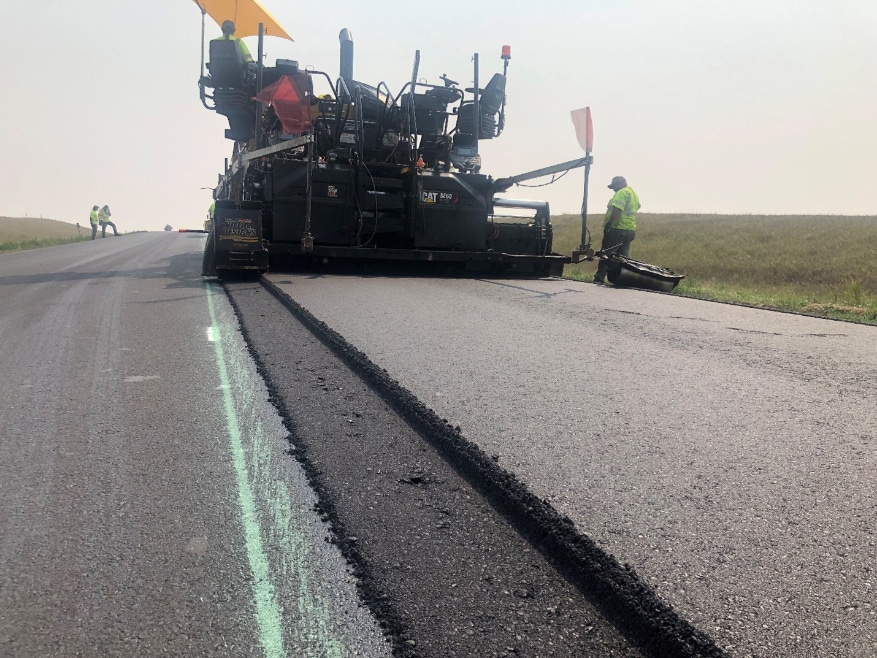
We all know that casting material from an overfed longitudinal joint across the fresh mat leads to segregation and poor density, so why are laborers still doing it? Train them to stop that.

Now, as we’re deep into the 2024 paving season, take the morning tailgate talk to remind laborers that breaking down the joint with manipulation by lutes and rakes that spread cooling dribbles of mix across a smooth mat on which the screed has already achieved 80% or more compaction is a poor paving practice.

If you see a co-worker casting mix across the mat today, speak kindly to suggest he stop that practice and perform a different activity to assist the team in getting a smooth, compactible surface.


Subscribe now to receive tips like this to your inbox each week. 

Missouri Leaders Share Infrastructure Investment Impacts at Emery Sapp & Sons Asphalt Plant Event

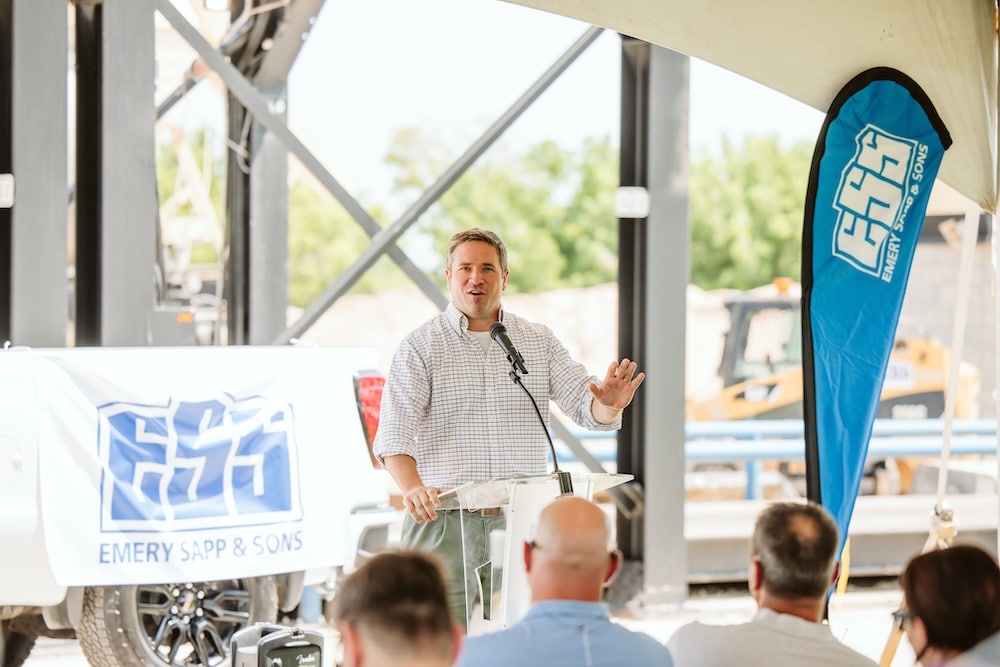
Missouri government leaders gave insight into Missouri’s infrastructure plans on Monday, July 15 at the Emery Sapp & Sons (ESS) asphalt plant industry event in Springfield. Missouri Lieutenant Governor Mike Kehoe, State Senator Lincoln Hough, Missouri Attorney General Andrew Bailey, State Auditor Scott Fitzpatrick and ESS executive leadership shared remarks promoting Missouri’s dedication to the development of transportation systems.

“The large investments Missouri is making in our community will have an immediate positive economic impact including job creation and further development,” said Brandon Finn, executive vice president of asphalt operations at ESS. “We are very fortunate that here in Missouri we have strong leaders that understand the importance of responsible government and infrastructure investment.”

Lt. Governor Mike Kehoe focused on the return on investment through job creation. “Every billion dollars spent in infrastructure creates about 20,000 jobs…The highway program we have now is close to a 5-billion dollar program, which is 100,000 jobs created across the state.”

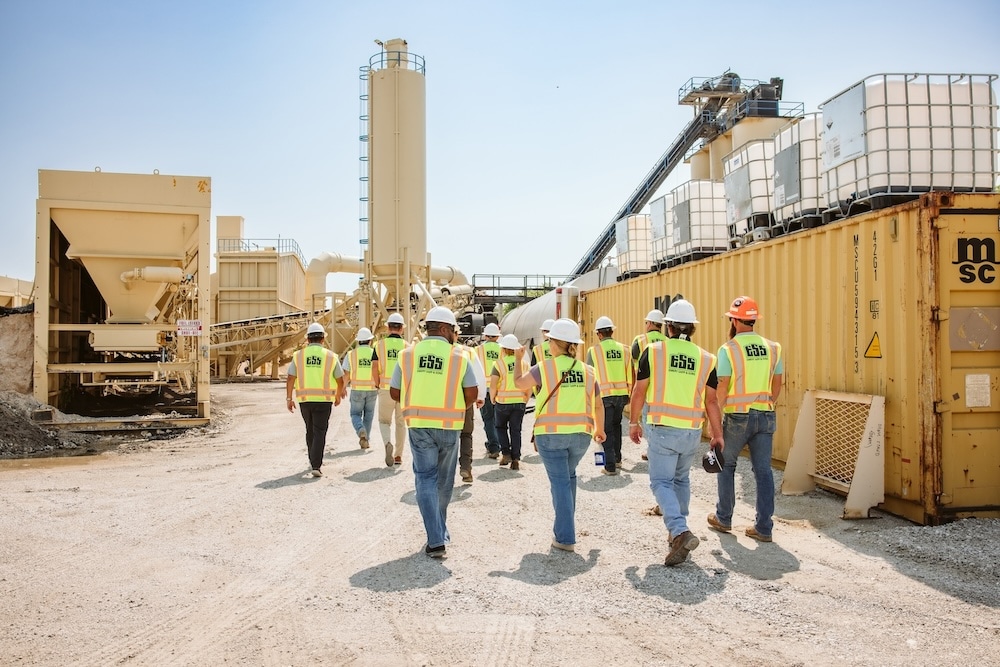
The event provided valuable insights into the asphalt process and the impacts of infrastructure on the community. Attendees gained firsthand knowledge of the capabilities at one of Emery Sapp & Sons’ nine asphalt plants in the Midwest. Remarks from elected officials reasserted Missouri’s position on the industry.

“When we do things like the [Improve I-70 project], those are generational investments,” said Sen. Lincoln Hough. “The state ought to be figuring out ways to rebuild the structures we have all over our communities so that the next generations have every opportunity.”

Significant transportation projects in Missouri include the I-70 improvements, the I-44 corridor and $100 million rural road enhancements. By funding these projects, Missouri is committing to building safer roads ready for the future.

Teach New Workers How to Use the Depth Crank

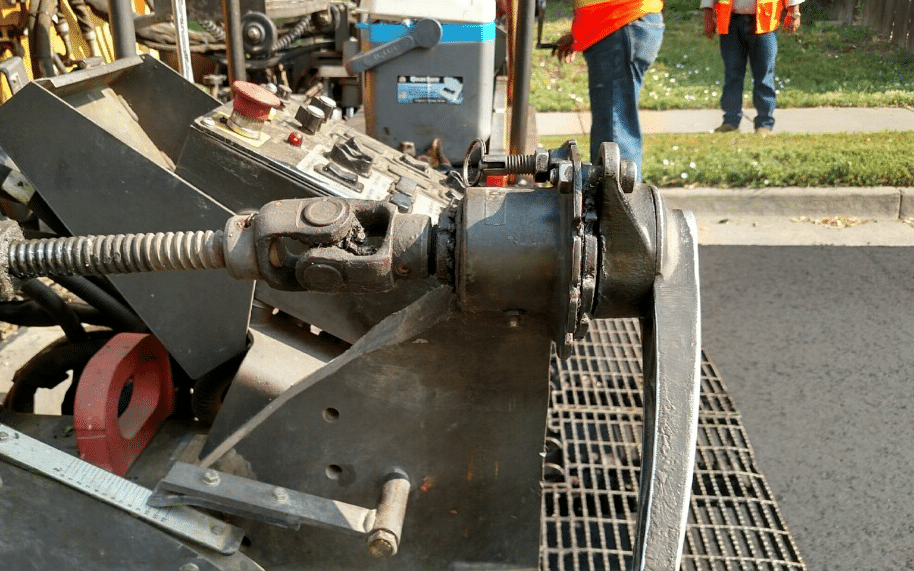
On the back of the paver, at the left and right of the main screed, the screed operator will encounter a depth crank. This vertical pole with a handle on top raises and lowers the screed in small increments, and the new screed operator must be taught to adjust it minimally.

Look at the top of the depth crank like it’s the face of a clock. The top is 12 o’clock. The far right is 3 o’clock. And so on. One whole turn around the clock will cause the screed to rise (or lower, depending on the manufacturer) about an eighth of an inch, and it will take a full length of the paver moving forward before you “see” the result of that change in the mat.

Teach the screed operator not to turn the depth crank two or three (or more) revolutions around the “clock” at once. If he rocks around the clock too many times, he’s causing significant change to the mat, which will result in hills and valleys for the state inspector to find.

Instead, train the screed operator to give mild adjustments and half-turns of the depth crank. Teach him to be patient watching for the slight and gentle change in the mat. And remind him to check the indicator on the depth crank to see whether “clockwise” takes you up or down.


Subscribe now to receive tips like this to your inbox each week. 

NSSGA Receives EPA Grant to Advance Aggregates Sustainability

The National Stone, Sand & Gravel Association (NSSGA) is proud to announce it has been awarded a five-year, $9.65 million grant by the Environmental Protection Agency (EPA). With the EPA grant funding and support, NSSGA aims to provide the aggregates industry with essential resources to: robustly produce and release Environmental Product Declarations (EPDs); establish guidelines on best management practices for reducing CO2 emissions; and enhance the industry’s capacity to sequester CO2.

“Thank you to the EPA and their staff for this important funding. We look forward to working together to enhance the transparency and availability of environmental impact data within the aggregates industry,” said Michael Johnson, president and CEO of NSSGA. “The unwavering support from our members, industry partners and 23 state associations has been instrumental in securing this grant and will be crucial, as we move forward to accomplish the initiatives. This builds on our industry’s robust efforts to be a leader in the carbon solution, as we continually protect the environment and sustainably produce critically needed materials.”

Over the next five years, NSSGA will engage its partners to create, train and promote resources, as the industry continues to be a beacon of sustainability. Key initiatives will include:

  1.  NSSGA to Become Program Operator for Aggregates Industry PCR and EPD: NSSGA will have full-time staff to administer the program, facilitating more robust updates and ensuring comprehensive oversight.
  2. Access to Digital Tools and Solutions: Providing the aggregates industry with robust tools to transparently report the environmental impacts of their products.
  3. Comprehensive Training Programs: In collaboration with state associations, universities, and other partners, equipping industry professionals with the knowledge and skills needed to implement sustainable practices, perform life cycle assessments and produce EPDs.
  4. Best Management Practices for CO2 Reduction and Sequestration: Establishing and promoting guidelines that help the industry reduce its carbon footprint and also enhance its ability to sequester CO2 effectively.

The production of aggregates is an inherently low-carbon process, and member operations utilize various measures to reduce their energy use and carbon footprint. This grant initiative follows the successful application submitted by NSSGA. With this opportunity, NSSGA continues to lead the way in promoting sustainability within the aggregate industry. For more information about the grant funding and initiatives, please contact the NSSGA GARA team.

NAPA to Receive $10 Million for Continued Low-Embodied Carbon Study

During a press conference held at Superior Paving’s asphalt facility in Chantilly, Virginia, the Environmental Protection Agency (EPA) Deputy Administrator Janet McCabe announced $160 million in grant selections for low-embodied carbon construction materials, including $10 million for the National Asphalt Pavement Association (NAPA) to continue its work with environmental product declarations (EPDs) for the industry.

Speakers explained low-embodied carbon materials are anticipated to become the norm and EPA is accelerating the research and development around these products. The grants will support the Biden-Harris Administration’s Federal Buy Clean Initiative, which leverages the U.S. government’s sway as the largest purchaser on Earth to catalyze demand for clean construction materials used in federal buildings, highways and infrastructure projects. The grants will be awarded to businesses, universities and non-profit organizations serving all 50 states and will help disclose the environmental impacts associated with manufacturing concrete, asphalt, glass, steel, wood and other materials.

A reported 105 applications for grants were received; 38 grants are being awarded with work expected to begin later this year and projects to be completed by 2029.

NAPA President Audrey Copeland, P.E., shared in her remarks that during the first few years after 2017, when NAPA rolled out its Emerald Eco-Label tool, 18 hot-mix asphalt (HMA) plants participated in publishing 44 EPDs. Now the asphalt industry has around 300 HMA plants participating and more than 2,500 EPDs published. The grant, Copeland explained, will allow the association:

  • To further improve asphalt EPDs. This will include removing barriers such as cost while highlighting such energy-saving and emissions-reduction measures as increased warm-mix asphalt implementation and better stockpile management for reduced fuel use in aggregate drying, and more.
  • To help owners consider the whole life cycle impact.
  • To empower the workforce to better understand life cycle analysis and EPDs and how these are interrelated.

Other asphalt-related entities receiving grant awards include Holcim U.S., Inc., and Oldcastle Infrastructure Inc.

Learn more about EPA’s Grant Program for Reducing Embodied Greenhouse Gases in Construction Materials and Products.