
Episode 5: Build a Caring Culture | Cal Byers Shares Strategies to Approach Employee Substance Abuse with Care


This podcast is sponsored by Dynapac.

Listen to the audio-only version of this podcast on our Suicide Prevention page, and take a moment to sign the Suicide in Construction Awareness Proclamation while you’re there.

Sandy: Welcome to part two of the AsphaltPro magazine podcast miniseries for mental health wellness and suicide prevention. I’m magazine editor Sandy Lender, your host for this miniseries. In this three-part podcast, we’ll explore ideas for incorporating a mental health wellness component into your safety program. 

Sandy: AsphaltPro is honored to expand the conversation around this important topic and to bring Holmes Murphy’s Cal Byers to the podcast for that purpose. Cal Byers has over 30 years of safety, risk management, and insurance experience. He has expertise in a host of emotional intelligence programs such as mental health, suicide prevention, employee well-being, safety culture development, and transformation, wellness program design, implementation and evaluation, Employee Assistance programs, and more. He is the vice president of workforce risk and worker wellbeing at Holmes Murphy and Associates. Let’s get started on our interview.

Sandy: So, let’s begin part two of this three-part podcast talking about how we create a caring culture where we help workers avoid opioid dependency or get away from opioid dependency without taking on financial risk and liability. One of the topics that comes up in the mental health wellness conversation is that of employer responsibility and liability. 

Get Cal’s white paper, Building a Caring Culture: Addressing Mental Health in the Workplace.

Sandy: I’d like to have you walk us through some fact and fiction to hopefully set employers’ minds at ease. We’re wanting to reframe some discussions in work environments. It seems a common theme for HR and management to work alongside employees who are struggling with a mental health issue, and that’s kind of what I’m looking for here. I want to talk about how we reframe some of these discussions and what different employees are allowed to do when reframing these conversations.

Cal: This is what I love, this idea of reframing. I’ve been involved in this topic for many years, as you know, before there was data. So I’m going back post 9/11 but pre-Hurricane Katrina. It was after Hurricane Katrina where I was reframing the idea around workplace mental health and including suicide prevention. I called it the next frontier in safety because there was no standard, there was really no basis for doing it because there really wasn’t data. But we recognized the challenges in industries that were predominantly male-oriented. So construction, mining, extraction, agriculture, forestry, commercial fishing, to name a few. 

Cal: The data we had was from veterans and first responders. And so, I postulated based on my past work in public entities working with police, fire, and emergency medical services post 9/11. They had employee assistance programs, they had chaplains, some had peer support. Construction had none. So when we asked contractors post 9/11 how are their people, we got answers like “we’re fine, we’re tough, we’re construction, don’t baby us.” So I started working on this idea of critical incident response to address the emotional needs of employees in the aftermath of a traumatic injury. And that critical incident response took about seven to 10 years to get to a tipping point because it’s not what we’d always done. [There’s this mentality of] “We gotta get back to work, we don’t want to have workers dwell and think about what has happened, we want them to focus on getting the job done. That would be the best therapy.” And in time, we learned that the better outcomes were teaching people how to take care of themselves after a traumatic experience. So that was positive.

Cal: The second part was that no one wanted responsibility. HR was hearing from legal counsel, “This is a slippery slope, don’t talk about mental health, don’t talk about these tough issues, do drug testing.” But when someone doesn’t pass a drug test, it’s their responsibility. So we would have clear and concise policies. The downside was everyone thought someone else was taking care of the rehabilitation. We kicked a lot of good people to the curb. So when we talked about this idea of caring cultures, it was to have this be the next frontier in safety. There was no standard, but we were going to teach people how to prevent injuries, how to focus on getting people back to work, and reducing stigma, shining light, offering people more support by talking about this. 

Cal: I would say that reframing [this] as the next frontier of safety worked until about 2014 when I went to work for a contractor. And then I reframed it yet again. We were reading a book that I had introduced to the contractor, it was called “Safety 24/7”. It had nothing to do with mental health, it talked about a company’s journey toward exceptional safety performance. And we reframed “Safety 24/7” [to mean], “It’s not enough to get people home safe at the end of a workshift. If we really were going to be effective, we had to focus on getting people back to work safe from home.” So reframing has always been a part of this. That’s what’s powerful, and that became a tipping point much like safety as the next frontier. 

Cal: I would say we learned some things during the pandemic. We were able to educate employers and leaders. Before the pandemic, our industry struggled with mental health, substance misuse, even suicide risk. And the powerful part is, it took the pandemic for us to really address substance misuse. You wrote one of those early articles that both Dr. Sally Spencer-Thomas and I wrote in AsphaltPro back in like 2017. It took us until 2020 before editors would really let us write about substance misuse. So the education now is reframing that addiction isn’t only people making bad lifestyle choices. In part one, we talked about three leading gateways to new persistent opioid use, and if we don’t address those three initial causes, we’re going to have more people with addiction. And so one thing we’re seeing companies do today is put Narcan or a drug called Naloxone on job sites, and many leaders are like, “I can’t believe we’ve gotten to this point, how did it get so bad?” But when you think about the totality of the opioid crisis, in the most recent reporting year, [there were roughly] 48,000 suicides and 108,000 overdose deaths. So this need for reframing is really important. And what I would say is Narcan alone is not enough, just like previously drug testing alone wasn’t enough. 

Cal: We truly need to teach people, we need to share resources for those individuals with a substance use disorder that they can find AA meetings and share literature, normalize the conversation, offer things called recovery first aid training, not waiting for people to put their hand up and come and seek help, but to make it available to everyone. That would destigmatize it. 

Cal: Another thing that I think is really important is teaching people not to wait until someone hits rock bottom. If we wait for people to hit rock bottom, we’re destroying human capital in the process. They’re breaking all their relationships, they’re damaging the potential for salvaging a marriage or keeping shared custody with children, they lose their job, they lose their insurance, the spiral continues. They might lose their home. Those items are called human recovery capital, and you need certain capital to be able to recover from substance use disorder. And if we wait for people to hit rock bottom, they’ve lost everything. And then people who feel helpless often feel hopeless, and when people are concerned that they’re a burden on others, they think about taking their life. 

Cal: So this idea of reframing, there’s a lot that we need to relearn, just like we had to learn on suicide prevention. If you talk about suicide, if you ask someone directly, “Are you considering suicide?” it does not put the idea in their head. Research has shown that. And I want everyone who’s listening to really realize, I learned years ago that there was research that showed a 9-minute scenario from the time someone thinks about an ideation of suicide to when they would make an intentional act. We have 10 minutes for each other to be part of this solution, to stay connected, to offer that person hope, help, and a chance at recovery. It is very powerful in reaching out to that person.

Sandy: When a worker is going through something, even if it’s not obvious yet but you have a suspicion, how can we give leaders the permission to ask a worker what they’re struggling with? How can we give leaders permission to reach out to a worker, an employee, or a colleague?

Cal: Sandy, I believe in leaders at every level. So I think that’s what’s really important, this idea of shared leadership in this regard. You might be talking about formal leaders, not informal leaders. So the formal leaders need to understand, like, this is our responsibility and it is an opportunity to build a tighter relationship with the workforce. The workers today are seeing signs of stress in their families; 65 to 80% of American families are feeling more pressure today than before the pandemic. Stress, anxiety, ideas of burnout, substance misuse increased, obviously grief during the pandemic, more families have increased responsibility for caregiving. Building a caring culture becomes a safety net. It keeps people from slipping through the cracks. So everyone [needs to think], “I have a role to play in worker safety, health, and wellness.”

Cal: Well-being is the intersection between physical and mental health. And if we focus on well-being, I’m going to be there for my employees, we’re going to talk about a caring culture, we’re going to share resources. And the workers will respond if the leader leads. I’ve always believed in the three Vs of leaders: being visible, vocal, and vulnerable. Leaders who are visible and vocal will have an easier time being vulnerable. Vulnerability is sharing our struggles, too. [For example], I use mental health services, I’ve used the employee assistance program and it helped us, or I wish I had used it but I didn’t know about it. 

Cal: When those three Vs are present, employees feel psychologically safe and feel more comfortable that the company authentically cares about them. They’re more likely to have a fourth V emerge, and that is vertical—up and down the organization chart. People start sharing because they know it’s okay to not be okay. The leader that is visible, vocal, and vulnerable is modeling the right type of behavior. And where that psychological safety occurs, other people are going to follow that modeling. People fundamentally seek connection, they want support, and we need to make three aspects of help very pronounced. It’s offering help, it’s accepting help, and it’s seeking help. Those three are different and we need to teach people how to accept help when someone offers. Number two, we need to teach people how to offer help. So that’s using things like wallet cards to teach people 988, the crisis text line, the warning signs of suicide, do role playing, role modeling to teach people how to share that information with their families and their coworkers. Those are some of the examples people can use.

Sandy: So let me ask about the fitness for duty examination. I want to ask when this is allowed, and when this is not allowed. Does the employer have the right to say “I think you’re under the influence of a narcotic and that could put our entire company at risk”? And is there a point at which the employer would be liable for the employee causing an accident while under the influence of an opioid or should that even factor in? Should the employer just be able to walk up to his employee and say, “I believe that you have a substance use disorder. I’m worried about you”?

Cal: As a risk management and safety professional, there’s established protocols. Many companies now are doing drug testing as a standard of business. For 20 consecutive years, Quest Diagnostics, which is a national testing laboratory, has shown positive drug test results have increased. So you are going to be liable as a business for the actions or inactions of your employees, that’s the reality. So being proactive, you want to have pre-placement drug testing, you want to have protocols in place to teach supervisors reasonable suspicion, have post-incident, even return to work, for people who have tested positive who go and get recovery or rehabilitation or just work with a substance abuse professional. 

Cal: It’s hard to say that there’s one pathway [because] there unfortunately are different rules. Marijuana has become legal in more jurisdictions, that should be a separate podcast by itself. That alone, without a legal counsel, wouldn’t even be an appropriate topic. It’d be too hard to keep current on all the state laws. What I said earlier in podcast one, drug testing alone is not enough because there are different gateways to different medications. One thing employers should be aware of is every year the Bureau of Labor Statistics, which is part of OSHA, has an annual census of fatal occupational injuries, and nine years in a row, there’s been an increase in job site-related fatalities due to ingestion of substances. In the most recent reporting period, that was 8% of all job site fatalities. 

Cal: So this is a workplace issue. You cannot bury your head in the sand. It would be hard to confront an employee directly when you have other methods. So it would be hard for me to give one answer, Sandy. A majority of medium and large-sized companies do have comprehensive drug testing programs. The testing results will give you an opportunity. Doing that recovery first aid training is a way for people to seek help. There are programs being built into employee benefits that are helping people find a pathway. The National Safety Council says 19% of construction workers have a substance use disorder. There’s data from Gallup that shows between 25 and 40% of individuals go home from work to a person with addiction. Alcohol-related deaths increased by 25% in the year immediately after the pandemic. So people are increasingly aware that doing nothing isn’t going to solve the problem. 

Cal: So, [let’s talk about] recovery first aid. I was taught that by a gentleman named Hamilton Bon and Rich Jones. They’re with a company called U-Turn Health. I serve on their Advisory Board in an uncompensated role. It was a radical reframing. Instead of saying “Hey, we’ve got the EAP here today, they’re in Jane’s office. If you want to talk to them, go see Jane.” No one does. [With recovery first aid], you offer every employee the opportunity to learn about substance use disorder, substance misuse, treatment options, recovery capital. More people are likely to seek help in that situation than any other way I’ve seen. 

Sandy: It’s been a pleasure talking with Cal today. I hope everyone listening in has picked up something they can use in their companies to expand the conversation around mental health wellness and reducing opioid use in their workforce. I want to encourage you to follow Cal on LinkedIn. You can find the Holmes Murphy and Associates Insurance Brokerage online at www.holmesmurphy.com. If you or a colleague needs immediate help, the Suicide and Crisis Lifeline has licensed counselors standing by at all times to speak with you. Please call or text 988. Thank you for tuning in, and thank you for your willingness to share this podcast and conversation with others.
Nine Children of Fallen Transportation Construction Workers to Receive Financial Assistance

Nine children of highway workers who were killed or permanently disabled on the job will receive post-high school financial assistance for the 2024-25 school year thanks to the American Road & Transportation Builders Association (ARTBA) Foundation’s “Lanford Family Transportation Construction Worker Memorial Scholarship.”

The program was established with a gift from two Roanoke, Va. highway contractors and their companies—Stan Lanford (1999 ARTBA chairman) of Lanford Brothers, and Jack Lanford (1991 ARTBA chairman) of Adams Construction Company. Scholarships have a value of up to $10,000 annually.

More than 200 scholarships have been awarded to worthy students from 33 states to pursue undergraduate and graduate courses, as well as technical training. The program was expanded in 2023 to include additional sectors of the transportation construction industry.

The 2024 class includes:

Amy McNeil, Lumberton, Texas

Amy’s father, Jeffrey McNeil, was killed in 2005 while working for the Texas Department of Transportation. Amy is a graduate student pursuing her master’s degree in nursing from the University of Texas, Arlington.

Jenna Jares, West, Texas

Jenna’s father, Gregory Jares, was killed in 2001 while working for the Texas Department of Transportation special crews. Jenna is a graduate student studying occupational therapy at the University of Mary Hardin-Baylor in Belton.

Breana Jones, Gaston, S.C.

Breana’s father, Standra “Stan” Jones, Sr., died in 2007 after being struck by a vehicle while at work for the South Carolina Department of Transportation. Breana will be entering her junior year at Winthrop University studying graphic design.

Katie & Christopher Hutt, Cleveland, Tenn.

Katie’s father, Chris, was struck and killed in 2006 while installing signage for United Rentals in a highway work zone. Katie will be a senior studying architecture at the University of Tennessee (UT), Knoxville. Chris’ son, Christopher, will be a freshman studying chemical engineering also at UT Knoxville. 

LaToya Hood, Houston, Texas

LaToya’s father, Paris Hood Jr., was killed on a roadway project while working for the Texas Department of Transportation in 1998. LaToya will be returning to Texas Southern University as a junior to complete her degree in healthcare administration.

Zoe Watts, Marshall, Ark.

Zoe’s father, James “Kirk” Watts, was killed by overturned equipment while working for the Arkansas Department of Transportation in 2018. Zoe will be a freshman studying nursing at the University of Central Arkansas.

Christopher “Tyler” Montgomery, Greenville, Miss.

Tyler’s father, Christopher Montgomery, was also killed by overturned equipment while working on a bridge project for Austin Bridge & Road in 2011. Tyler will be a freshman studying physical education at Arkansas State University.

Bethany Rains, Memphis, Ark.

Bethany’s father, James “Bubba” Rains, died in 2013 while working for APAC in Tennessee. Bethany will be pursuing an undergraduate certificate in Nursing Assistance (CNA) at Arkansas State University, Mid-South.

Episode 4: Reduce Musculoskeletal Injury, Reduce Opioid Addiction | Cal Byers shares injury prevention strategies

This podcast is sponsored by Dynapac.

Listen to the audio-only version of this podcast on our Suicide Prevention page, and take a moment to sign the Suicide in Construction Awareness Proclamation while you’re there.

Sandy: Welcome to the AsphaltPro Magazine podcast miniseries for mental health wellness and suicide prevention. I’m magazine editor Sandy Lender and your host for this mini series. In this three-part podcast, we’ll explore ideas for incorporating a mental health wellness component into your safety program. 

Sandy: AsphaltPro is honored to expand the conversation around this important topic and to bring Holmes Murphy’s Cal Byers to the podcast for that purpose. Cal Byers has over 30 years of safety risk management and insurance experience. He has expertise in a host of emotional intelligence programs such as mental health, suicide prevention, employee well-being, safety culture development, transformation, wellness program design, implementation, and evaluation, as well as employee assistance programs and more. He is the vice president of workforce risk and worker wellbeing at Holmes Murphy and Associates. 

Sandy: Let’s begin part one of this three-part podcast getting a feel for the opioid crisis exacerbating mental health suffering in the construction industry. Cal, could you start us off with some stats about how many of our construction workers or what percentage of our construction workers are being prescribed opioids and why should that number concern us?

Cal: This is really frustrating. Public health data can be really hard to come across. At this point, there is no national database that shows the frequency or the severity of the opioid crisis impacting construction. I’m aware of three jurisdictions that have data. So it’s very similar to what we had with suicide in construction. We suspected for years before the data [was available] in July of 2016, that construction would have a high-risk population. The same is true with opioids. The three jurisdictions where data exists, construction is in the top three. So that’s been the state of Massachusetts, Toronto in Canada, and King County in Washington state, where Seattle is based. Okay, so the data shows construction does have a high risk for opioid prescriptions. Nationally, the number of prescriptions for opioids, both for primary care and for emergency room visits, continues to decline. Pharmacists and data scientists would tell you there still are examples of overprescribing, but there are other gateways to new persistent opioid use that people need to be aware of. So that includes prescriptions for on and off-the-job injuries and surgery, and then diversion of the almost three billion pills left over every year. So diversion is [when] 90% of people don’t discard leftover opioids, and then people in our homes—pre-teens, teenagers, young adults, and other guests in our homes—divert those pills and use them for personal use or to share with others. Those are three leading gateways. The data will show for construction workers, 55% of the time for musculoskeletal injuries, construction workers were receiving prescriptions. And when we received prescriptions, they were 20% stronger doses and 20% stronger or longer duration.

Sandy: Okay, right. And that duration is something I wanted to ask about. I’ve seen stats from CPWR that show the likelihood of becoming dependent on an opioid spikes at around day five of a prescription. Have you seen similar data to that? Is that something we should be watching out for when a worker has been prescribed something? How do we help educate employees and their families?

Cal: Okay, letting them know that non-opioid pain medication exists and that its efficacy is very strong. In fact, there’s data that will show the efficacy for multimodal pain relief is three times stronger than opioids, especially when it comes to surgery. So non-opioids pain medication does exist. And then secondly, the data from various sources will show day five is the magic point to have someone off opioids. However, you could have a person with a predisposition to an opioid addiction where a one-day dose could be enough to change the dopamine cycle in their brain. I’m not an expert on that. That’s a clinical topic. But as a risk management and safety professional, I’ve learned enough to be able to educate people. So the data will show if the initial episode of opioids is eight days or longer, [that results in] a 13.5% likelihood of persistent opioid use. If that initial episode of use exceeds 31 days, [there’s] a 29.5% chance of persistent opioid. So digging through the data, the scientists and the pharmacists would say day five because if your initial episode was a single day, you would have a 6% likelihood. Okay. So the goal is to [use] opioids sparingly or find opioid alternatives for pain management. 

Sandy: And then, you know, you mentioned education. But other than education, I mean, how do we implement programs that can prevent injury? I mean, obviously, people are being prescribed these opioids or even a non-opioid because they’re in pain, they’ve had an injury. How do we implement some programs to prevent injuries in the first place?

Cal: First and foremost, I’m a safety and risk management professional. When people tell me what’s the most effective first dose prevention strategy for opioids, it’s reducing the frequency and severity of musculoskeletal injuries. The CPWR says 34% of construction workers have at least a single musculoskeletal injury. And repetition of musculoskeletal injuries might be known as a repetitive stress disorder or a musculoskeletal disorder, MSD. So there’s both. If we can eliminate those, and there’s many ways that you could do that, it would be imposing weight restrictions, it would be two-person lifts, it would be job rotation, it would be material handling equipment. In the construction industry, we don’t like the word ergonomics, but that’s the basis of human factors engineering. And so the more we can adapt the load to the worker rather than the worker to the load, the better off we’ll be at preventing those injuries. And the more you have those musculoskeletal injuries, the higher the likelihood of having repeated and longer durations of those opioid pain medications.

Sandy: One of the questions I want to ask you, along the lines of those injuries, is, are we bringing workers back to work too soon after injuries? I know that’s kind of broad. Every worker is different. But in our construction industry right now, we have a dearth of workers in the workforce—are we trying to get workers back too quickly?

Cal: In many ways, workers already have that inclination. If they’re not at work, there’s concern about not being paid or there’s concern about impacting the contractor’s workers comp, or they’re worried about having their crew run short, creating overtime, increasing costs, imposing a burden on co-workers. So that is the factor. The challenge has been what is the best and most effective way to return people to the workplace? So you can have return-to-work programs. It’s better to have employees stay involved in work, being able to do what they’re able to do. So that challenge is re-aggravating an existing injury, which could compound a worker’s compensation claim. The challenge is, I’m old enough to remember when people were sent home and they were recuperating on their couch. It was at that point called the soap and suds phenomenon. And the soap was watching soap operas on TV, and the suds were drinking a beer. Then, more proactive companies began to aggressively manage their injuries and especially the recovery of return-to-work duration. 

Cal: If you can find modified duties that keep the worker engaged, the contractor gets to continue building that relationship, demonstrate care, have empathy for that person, and the person knows that people care about them. Getting employees to stay within the restrictions is sometimes hard, so it puts a burden on the foreman, the superintendent, and project managers to really manage those limitations and restrictions. Many doctors will allow workers to work with restrictions, but if the employee says I’m getting pressured or I’m doing more than I’m supposed to be doing, frequently that will curtail that modified duty. But it’s ideal to maintain contact with that injured employee and the better you’re able to spend time, [the better] you’re able to see what their capabilities and restrictions are. But make this a win-win and have the employee recover doing what they’re able to do. And a lot of times, those modified duties will be alternate productive work. I’m not a big believer in having people put caps on screws sitting in an office. Put them to use doing something productive so the employee knows this is a contribution or it creates resentment by other workers, it creates pressure to get that employee back to work. The goal needs to be “Let’s focus on your healing, we’re taking care of you, we believe in proper workplace safety.” So claim management is a really important part of this as well.

Sandy: Now, I don’t know how to ask this question, but you’re bringing up a thought of in the smaller company where a worker who’s integral to the paving crew has gone out on a workers’ comp issue. I would imagine it’s more difficult to bring that worker back in on modified duty, having him do something that’s not integral to the paving team when the contractor needs everyone on board. And I would think that the pressure would be on the worker who’s been injured. It would be on the contractor. It would be on everyone on that team. How do we work with that safety culture? How do we work with that safety director, if they even have a safety director in such a small company? How do we work with these folks to help the contractor and to help that worker so that he’s not feeling that pressure? 

Cal: For many years, I’ve partnered with small and medium-sized enterprises, not just worked with large. That is one of the big challenges. So having that contractor really do a strong orientation with new hires, there’s very pronounced data that the frequency of injuries for new hires within their first 30, 60, 90 days, and even the first year of employment is going to run high. So, for small and medium contractors to recognize what your historic leading types of loss have been and then build in job and task-specific training so you can focus on preventing those soft tissue injuries. That’s to me where the magic lies. But it’s hard because these companies not only might not have a safety director, they’re not likely to have a full-time HR director. And you just have fewer people managing the safety and the workers’ compensation claim. But I would encourage people to tap the resources from your broker, tap the resources from your insurance carrier. View them as friends and allies. Ask for their support, ask for their help. See if you can get support in providing training. I’m finding more employees are open to the safety message today than at any time in the past. People are recognizing they want to have their whole body when they retire to be in better shape.

Sandy: It’s been a pleasure talking with Cal today. I hope everyone listening in has picked up something they can use in their companies to expand the conversation around mental health wellness and reducing opioid use in their workforce. I want to encourage you to follow Cal on LinkedIn. You can find the Holmes Murphy and Associates Insurance Brokerage online at www.holmesmurphy.com. If you or a colleague needs immediate help, the Suicide and Crisis Lifeline has licensed counselors standing by at all times to speak with you. Please call or text 988. Thank you for tuning in and thank you for your willingness to share this podcast and conversation with others.

Prepare the Surface for Repairs to Stick

With spring rain and random weather events taking place as I prepare this toolbox tip, I’m reminded that crews don’t always have a choice when it comes to the timing of pavement repairs. If a recent tornado put a giant birdbath in the middle of Main Street, you gotta do what you gotta do. But you must prepare the area first.

During today’s pre-shift tailgate talk, remind crewmembers that preparing the surface for a simple repair is vital. If the existing area is speckled with mud, leaves or pools of rain, not a lot will stick to it. You’ll be back in the summer to refill potholes or reseal cracks if you don’t train crewmembers to clean areas prior to repairing them today.

In the online training course we’ve prepared with paving consultant John Ball, we stress the back-to-basics principles that take more time on Day 1 of your project. They’re the best practices that can pay dividends in reduced call-backs, increased customer referrals and the like, when your crewmembers watch the videos and take them to heart.

Then when your team gets to any pavement repair job, have them take the time to clean, dry, prep and tack. The cleaning step may be your most time-intensive step, but that will reduce the chances of your crew returning to that project for “free” later this summer.


Subscribe now to receive tips like this to your inbox each week. 

Episode 3: Eliminate the Stigma | Vince Hafeli Talks About the Role of the Provider-Protector Mindset in Mental Health

This podcast is sponsored by Dynapac.

Listen to the audio-only version of this podcast on our Suicide Prevention page, and take a moment to sign the Suicide in Construction Awareness Proclamation while you’re there. 

Sandy: Welcome to the AsphaltPro Magazine Podcast Mini Series for Mental Health Wellness and Suicide Prevention. I’m magazine editor Sandy Lender and your host for this mini series. In this three-part podcast, we’ll explore ideas for incorporating a mental health wellness component into your safety program. AsphaltPro is honored to expand the conversation around this important topic and to bring Ajax Paving’s Vince Hafeli onto the podcast for that purpose.

Sandy: Vince Hafeli has over 38 years in the highway construction industry. He’s been leading a team of nearly 500 employees as president of Ajax Paving Industries of Florida for the past four years. Although his diverse background includes positions like field quality control and inspection and project manager, at the time of this recording, he’s working toward his Doctorate of Business Administration degree to further his research and training skills related to suicide in the construction industry. As a consultant and speaker advocate, he works with individuals and organizations to create open discussions around Suicide Prevention and mental health. I encourage you to follow him on LinkedIn because Vince has new information, speaking engagements, and updates on Mental Health Wellness information posted on his page frequently.

Sandy: Let’s begin part three of this three-part podcast looking at how we talk to our colleagues who may be struggling. It’s no secret we’re in a male-dominated industry; still, 89 to 90% of the workforce is male. Let’s talk about the provider-protector mindset of the traditional construction worker and how that mindset is valuable to the concept of helping a coworker. Maybe tell us a little bit about how taking those conversations into the field and letting coworkers come forward to be a supporter and to be a provider of help has manifested itself at Ajax.

Vince: We did a toolbox talk around an employee we lost to suicide in 2015. We didn’t make the talk to honor him because there’s no honor in what he did, but we wanted to share what struggles he went through. The first crew we went to that morning wanted to talk about an alcohol intervention they had done two weeks earlier, and they were proud of it. The second crew we went to, a gentleman there, a new employee with the company, wanted to share the story of his father who took his life 10 years earlier. He walks in a suicide walk every year with a picture of his dad on his back. The next crew we went to, a gentleman wanted to show us where he had tried to take his life. By creating a culture of teamwork, these guys now support one another in the field. They ask each other, “How are you doing? Is everything going okay?” It doesn’t have to come from me or the safety director. It’s kind of the same as the buddy system you referred to in the physical sense. It’s just now putting the mental aspect in line with the physical because, again, I think the mental has an impact on the physical.

Sandy: Most companies have a buddy system in place out there in the work zone where they can look out for each other for that physical safety. But do you think we’re coming to a place yet where we can have a buddy system where you watch out for the fellow on the team who looks like he’s distracted, where you can walk up to him and say, “Hey, looks like you’re not present today. What’s up? What’s going on?” Are we there yet?

Vince: No, I don’t think we’re there yet because most companies aren’t doing anything about it. They’re not even having conversations. And I would tell you that in our company, even as much progress as we’ve made in the last 15 months, we’re probably there on some crews and not there on other crews. I think the mental health first aid training we’re doing teaches these individuals what signs to look for. So, the more of those people that we get, the better. Until we do some training on the signs to look out for, if you don’t know what to look out for, right? So, no, I don’t think we’re there yet.

Sandy: You were a guest on the Dirty and Driven podcast back in February, where you made a great distinction for the audience. You said, “Mental health does not mean mental illness.” Could you talk a little bit about that concept or how safety directors and managers can view that idea to reduce reservations about discussions and then help workers?

Vince: Well, let’s begin with the easy one. If we were going to talk about my physical health, would you immediately think that I was about ready to die? Would you immediately think that I needed surgery if I told you that I injured my shoulder two years ago and I went to see a surgeon and the surgeon said, “You don’t need surgery; you need a physical therapist”? Most people, when that happens to me, they say, “Well, good for you. You don’t have to get surgery. That’s great that you’re going to see the physical therapist.” Yet when I told people that, “Hey, one of the professors at USF told me, “I’ll help you through the dissertation, but I want you to go see a therapist to talk to.” When I told that to people, it was gasp, it was awe, it was shock. “Well, I didn’t know anything was wrong with you.” So, mental health is the same as physical health. Mental health is the umbrella over mental illness. For some people that may be struggling with mental illness, it may be a day or two where they just need someone to talk to. And again, someone to talk to may be a supervisor; it may be a wife; it may be a child; it may be whomever. And at the other end of the spectrum, there are people that need medication. They’re on the other end of the spectrum of mental illness. So, we need to remove the negative condemnation that goes with the words “mental health” because mental health needs to be viewed as a positive topic. 

Vince: We want mentally healthy employees on the job. Yet, in my interviews that I do with these executives, one of the questions I asked them is, if I say the words “mental health” to you, what comes to mind? The first thing they say is nothing. It’s a pause because they don’t know what to say. Then they say, “Well, it’s typically someone that’s going through depression or someone that’s got some anxiety or maybe they’re bipolar.” So, I let them answer it, and then when we get done and we turn the recording off, I say, “Okay, now I want to go back to what you said about mental health. When I asked you what mental health means to you, you immediately went to something negative. Yet, if I want to talk to you about someone that’s physically healthy, you might think of a professional football player or you might think of a gymnast or you might think of a marathon runner. You don’t immediately think of the man that’s in the hospital waiting to get a heart transplant. Yet when I tell you the words ‘mental health,’ you immediately go to the person that needs to be in the hospital and medicated.” So, mental illness is just a piece [of] mental health. So, we just have to educate people that mental health is a good topic. We want mentally healthy people. It’s not a topic to be run away from; it’s a topic to run to.

Sandy: Another topic that I’ve heard you mention is that of transformational change. Could you kind of give your definition of this transformational change and what you hope to see in the asphalt industry specifically when it comes to a transformational change in our culture of care?

Vince: I think if you go to the broad, big definition of transformational change, it actually talks about changing an organization. I’ve done some reflection on that this week. There are probably a lot of companies in our industry that really need to do a transformational change. But I think there’s a lot of companies in our industry that just need to tweak the transformation. I think the larger companies that have full safety programs, safety directives, etc. already have a good safety culture. The smaller entities in our asphalt industry that really don’t have a safety program per se, they probably need to look at some type of transformational change. I don’t know if it’s 50/50 or if it’s 80/90, but those companies that already have a robust safety program in place, this is just another piece you’re adding to it. It’s not that difficult. So, yeah, start by talking about it, do a toolbox talk, then empower some of your foremen to begin having more talks about it with the crew. Encourage your foremen to maybe ask once a week, “Hey, how’s everybody doing? Is everybody here with me today? Is there anything going on?” And I know you may not want to talk about it in front of the group, and that’s fine; eventually, they will. So, it’s about getting the conversation going and creating the culture. It really isn’t that difficult.

Sandy: That’s a good message right there. It’s not that difficult to take the step to say we’re going to talk about this. The toolbox tips that you mentioned, they’re available everywhere. CPWR has some. I think they’re everywhere, right?

Sandy: Now, for the doctorate that you’re working toward, you’ve been interviewing members of the asphalt industry who have implemented mental health wellness in their safety programs. Could you share a couple of examples or ideas that have come from some of these interviews? I mean, something that has stood out to you as just interesting or as groundbreaking? Something that has really stood out to you that you would like to share with the audience?

Vince: I don’t know if there’s a big silver bullet out there of what[they’re] doing. The ones that are doing a good job with it have really just changed the culture of their company to where they’re addressing it. They talk about it at their annual safety day. They have the toolbox talks that they’re doing. Some of them have implemented health days, paid health days, if you need time off. I had a gentleman two weeks ago that said, “Hey, I need some help.” One of my questions in that conversation was, “Do you need some time away?” And, “Oh, by the way, don’t worry about the pay; we’ll take care of your pay while you’re away.” Because for me to pay him to sit at home for a month and try to fix his life is less expensive than me telling him to leave and I’ll find somebody to replace him. [That’s a person] I have to hire. I have to bring them to orientation. I have to get them into our safety culture. And there are numbers all over the board up to $25,000 to hire someone. If you’ve got a good worker that has done a good job for your company, the good companies are helping them, either by giving them days off for mental health or by getting them into an employee assistance program. 

Vince: The answers I got through the early part of my research were these moments of quiet where people don’t know what to do. I’ve now redirected my research, and I begin next week interviewing 10 to 15 companies that have been recommended to me by colleagues. They said, “Here are 15 companies that are really doing it right.” I’ve got interviews set up with them to see if I can find a common theme of what those companies are doing. And then in my dissertation, which is a book, I’m hoping to have a section in there to where people could go and look and say, “Hey, here’s what these 10 great companies did, here’s what they say they would have done differently, here’s what they’re doing, and here’s what the future looks like for them.” I don’t have an answer for you today; stay tuned. It’s coming.

Sandy: It’s been a pleasure talking with Vince Hafeli today. I hope everyone listening in has picked up something they can use in their companies to expand the conversation around Mental Health Wellness and Suicide Prevention. I want to encourage you again to follow Vince on LinkedIn. You can find his company online at www.AjaxPaving.com or on Facebook at Ajax Paving Industries of Florida. Be sure to visit theasphaltpro.com/SuicidePrevention to read and sign his Suicide in Construction Awareness Proclamation. If you or a colleague needs immediate help, the Suicide and Crisis Lifeline has licensed counselors standing by at all times to speak with you. Please call or text 988. Thank you for tuning in, and thank you for your willingness to share this podcast and conversation with others.
How to Roll Your Pavement Repair

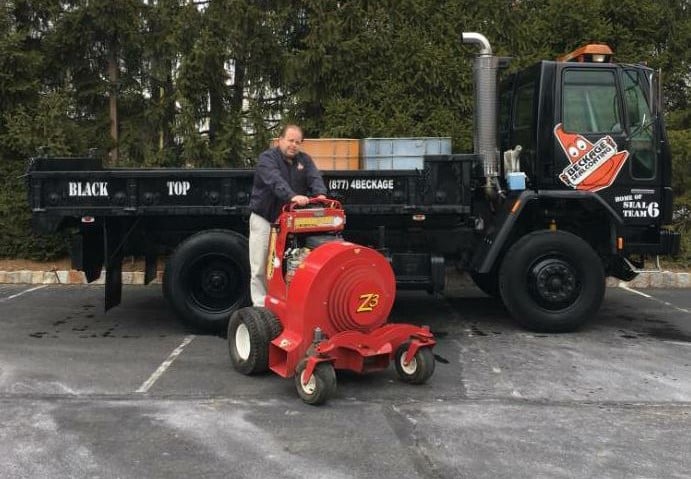
By this point in your career, you probably know how to throw mix into a pothole. If you have an area of excessive alligator cracking, you know how to cut out, clean, tack and fill the area. Utility cuts? You’ve got it. Now who have you put on the small tandem roller or the plate compactor to get the patch sealed properly?

For today’s quick tip, let’s talk about pinching the edges first. If the new guy hops on the tandem and rolls toward the middle of the cut, stop him. He should be taught to roll the edges of the cut—or the edge of the patch—first. Seal the edges and then roll down the center, pressing the hot material into the confined edge.

And don’t forget the use of water on the plate compactor and the roller’s drums. Keep it lubricated to prevent picking up the mix you just laid.


Subscribe now to receive tips like this directly to your inbox each week!