
Let’s Figure How Far That Load of Asphalt Should Go

The last thing you want is to get to the end of the round robin of trucks and discover, oh no, we still have half a lane to pull to finish the parking lot. If it’s 4 p.m. and the plant’s already cleaned out, you know someone’s getting in trouble for asking the plant operator to fire back up and send another load to the job you didn’t manage correctly.

Let’s take a look at how to notice if something’s going wrong earlier in the day. Let’s look at how to figure yield to monitor your progress.

Start with the constants you know—width, depth and tons.

  • Let’s say you’re paving 10 feet wide today.
  • Let’s say the lift you’re placing is 1 inch (about ¾-inch compacted).
  • Let’s say each truck arriving holds 18 tons of homogenous HMA.

You want to figure how much each truck will pave (how far the material will “go”) so you can monitor your progress. Take the number of tons and divide by 0.0567 (1 inch) to get the square yards the material will pave. Multiply that number by 9 (to get square feet) and divide that by your 10 feet of paving width. This gives you the linear feet the material will pave.

In our example with the constants listed above, here’s what we get:

18 ÷ 0.0567 × 9 ÷ 10 = 285 linear feet

If your first pull doesn’t make it all the way to 285 linear feet, this means you’re paving more than 1 inch thickness. You may have birdbaths in the surface or poor quality in the milling that’s causing you to fill in as you go.

While your paving crew can’t help what was done to the surface before your arrival, you can monitor how it’s affecting your progress during the day. You can call the back office to let them know there’s a problem. You can call the plant to let the operator know if you’ll need an extra truck near the end of the shift. Planning ahead could save the costs of standing around waiting on the plant to restart and send another truck at dusk when you’ll also require lighting and possibly a rescheduling of the striping crew.

Figuring and monitoring yield affects more than the pull in front of you. It can affect the outcome of the day. The more members of the crew who understand its importance and how to do it, the better.


Subscribe now to receive tips like this directly to your inbox each week!

Get the Skid Steer Ready for Season Startup

As you prep the paving train for season startup and a successful 2024 paving season, take a look at a piece of equipment that every project needs these days: the skid steer. If you’ve allowed this machine to get caked with material, or if you “forget” to grease vital pinch points, you can bet you’ll have less efficiency on upcoming jobs.

Start with greasing. The general laborer who is assigned to run the skid steer should take responsibility for keeping up with its greasing schedule. Thanks to telematics and a variety of software/tracking programs these days, this worker can have an app “ping” him with the schedule rather than using his brain to remember.

Double-check the machine hour meter also. While some systems make a distinction between on time, working time and idle time, not all of them do. You’ll want to perform specific maintenance tasks based on actual time worked.

On the job, during the morning walk-around, make sure hydraulic fluid is leveled off. Also check to make sure it’s clean. You don’t want metal flakes or dirt gumming up the system. If the fluid is compromised, schedule to have it changed.

Also, during the construction season, stay on top of routine care. Crews need to put time into preventive maintenance. The managers who incentivize good maintenance are the managers who have reliable uptime and consistent production. If the crewmembers take the time to wipe down pinch points and hydraulic cylinders on the skid steer at the end of the shift—whether an app tells them to do it or not—they’re keeping material buildup from hindering efficiency and production tomorrow. Fifteen minutes at the end of the workday saves an hour or two during critical production time tomorrow.

We all understand this concept. You can instill the best practices in your crewmembers by starting with equipment that’s in its best condition going into the 2024 season.


Subscribe now to receive tips like this directly to your inbox each week!

To Prevent Dips and Bumps in the Mat, Keep the Paver Going

Last week, we talked about matching the rolling train’s “speed” to the paver’s speed to the haul truck delivery times. That’s a tough dance to choreograph, but you can do it if you’ve planned everything out nicely and trained your crew to make it happen. One of the steps you want to remember in this “dance” is to keep moving.

You don’t want to stop the paver, if you can help it. Once the haul trucks hit a snag and the hopper runs low, you run the risk of starving the endgates or slowing down. Either of those options is less than ideal but careful planning for the day’s paving should prevent you from stopping the paver on a long pull. Teach your crew that once the paver stops, the heavy screed settles into the hot mat it was in the process of placing. This almost imperceptible settling compacts the material it’s sitting on, too. Once the haul trucks reappear and the crew’s ready to pave forward again, you have a dip in the mat where the screed plate sat. Your roller operator might not be able to “feel” it, but you can bet the state inspector’s instrumentation will pick up on it.

To keep the paver moving, you want to keep the haul trucks arriving in their round robin pattern. You may elect to use a hopper insert to increase the volume the paver can work with. You may elect to have a material transfer vehicle in front of the paver to increase capacity (and for a lot of other reasons) as well. Whatever “good planning” looks like for your crew, keeping the paver moving at a slow and steady speed so it doesn’t stop in between truck deliveries is key.


Subscribe now to receive tips like this directly to your inbox each week!
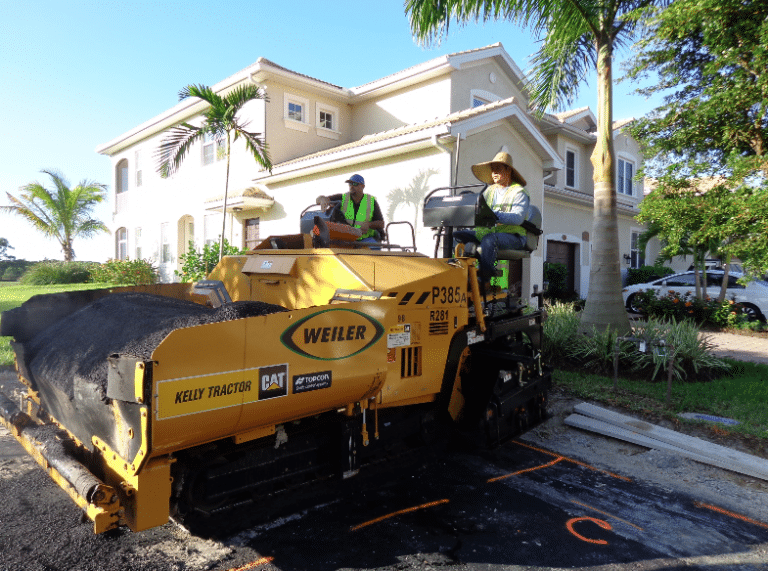
To Prevent Dips and Bumps in the Mat, Match the Rolling Train to the Paver’s Speed

While it makes sense to the seasoned professional on your paving crew, the new team members might not understand why it’s important to set the paver’s speed “slower” on today’s project than yesterday’s. If you paved at 32 feet per minute (fpm) last week, why can’t you stay at that pace this week?

You may need to explain the basics of time and temperature affecting the density you can achieve with the breakdown and intermediate rollers. If you have a mix that needs a little more TLC and a few more passes with the rollers, you don’t want the paver getting too far ahead of the operation.

You also don’t want to adjust the paving speed two hours into the project and affect what you’re demanding from the plant and haul truck drivers. It’s a balancing act out there in the field and the balance ultimately plays into those final density numbers. The final density numbers dictate your pay.

If you can match the rolling train’s perfect speed to the paver’s perfect speed to the haul truck delivery time, you’ve got yourself a lottery-winning type of day. But it’s that type of day you strive for. It’s that type of day you train your new and veteran operators to achieve. Maybe that means today you pave at 22 fpm and keep a density gauge close at hand. Either way, getting the timing right is a tip to share with the new guys on the crew.


Subscribe now to receive tips like this directly to your inbox each week!

Spring Startup: Keep an Eye out for Blue Smoke and Odors Before Your Neighbors Do!

This week’s tip is written by Butler-Justice.

As you’re starting up your plant this spring, keep an eye—and nose—out for blue smoke and VOC emissions. Blue smoke is actually tiny oil droplets that comprise the visible blue haze typically associated with paving and production of hot mix asphalt. It can be found at transfer points, silo-filling areas and truck-loading locations.

Odors from invisible VOCs usually escape from hot asphalt storage tanks.

While it is true that certain areas of the country are seeing an increase in regulatory requirements—including New York and Utah—asphalt plants everywhere are dealing with more and more neighbor opposition. If your eyes and nose are telling you that you might be facing angry calls from your neighbors, you may want to consider adding a blue smoke and/or odor control system to your plant.

The good news is there are several options within the industry today that are highly effective at controlling blue smoke and odor emissions, and they are retrofittable. And, by putting controls into place now, you may be able to proactively stop neighbor complaints before they start.


Subscribe now to receive tips like this directly to your inbox each week!