
Quick Tips to Protect Equipment Used in Pavement Repair

To round out this month when our toolbox tips focus on pavement repair projects such as crackfilling and patching, let’s take a minute to look at the equipment. You can help employees protect equipment—and the project—with a couple quick tips.

  1. When using a spray wand, don’t let the tip drag along the ground. This will wear the tip and/or the elbow, requiring early tip replacement and possibly replacement of the entire wand end.
  2. When spraying sealer, don’t hold the wand above waist level. If the wind is blowing, keep the wand’s tip around knee level at most. This will help keep overspray from coating nearby landscaping, curbs or vehicles.
  3. Use a shield to protect nearby landscaping and curbs. A couple OEMs have come up with shields that attach to the end of the wand without adding too much weight; you might check into those.
  4. Don’t let the hose drag on the ground behind the wand and worker. If the tank can’t be moved to accommodate the space/application, then have an additional worker assist by holding the hose up while the spraying worker moves forward. A dragging hose is a hose you’ll have to repair and replace.

Also consider training each crew member with an online course. You’ve seen us mention this before. AsphaltPro magazine teamed up with industry veteran John Ball of Top Quality Paving & Training to create Asphalt Paving 101. It’s a back-to-basics online course that gives you immediate, lifetime access on any device to train any number of crew members any number of times. You enroll here.


Subscribe now to receive tips like this directly to your inbox each week!

NSSGA Member Highlights Small Business Regulatory Challenges

Ric Suzio, vice president of Suzio York Hill Companies, testified this morning in a House Small Business Committee hearing on the Department of Labor’s burdensome regulations. Representing the National Stone, Sand & Gravel Association (NSSGA), he shared concerns about the effects of new regulatory rules on his family’s small business.

“Small businesses thrive on predictability. Frequent, automatic changes hinder their ability to strategically plan, potentially jeopardizing both their stability and the well-being of their employees,” said Ric Suzio in his testimony. “It is crucial to recognize the disproportionate regulatory burdens placed on small businesses when overarching rules fail to account for their unique challenges.”

This year, in addition to increased inflationary costs, small businesses are having to tackle compliance with regulations that have convoluted standards and excessive red tape. Suzio cites specific issues with OSHA’s tracking workplace injuries and illnesses rule, the change regarding workplace inspections, MSHA’s silica rule, the independent contractor rule, the overtime rule, Davis Bacon Act and the joint-employer definition.

“The financial strain such regulations place on us is substantial, with many of us absorbing these costs,” said Suzio. “Over time, this financial burden risks driving consolidation within the industry, overshadowing the essential role of small businesses.”

NSSGA will continue to voice these industry concerns to maintain a productive business environment for all members. For more news and updates from NSSGA, please visit nssga.org.

Take Steps for Mistake-Free Pavement Repair

In today’s funding arena, cities and local governments watch the bottom line as carefully as you do. When agencies or property managers let a bid for a thin overlay or basic patching job, they want it done right the first time, but they may not be aware of how much extra pressure these small batches put on your crew.

  1. Make sure your crew is watching all the details when you’re on pavement repair jobs, so mistakes don’t creep into the project.
  2. Clean surfaces very well before performing work. A dirty surface won’t let tack or mix adhere properly.
  3. Tack edges, joints and surfaces properly. Too much of a good thing here is just as disastrous as dribbling material sparingly.
  4. Watch mix temperature. Use a temperature gun to monitor what you’re placing. If it’s losing heat, it’s time to re-blend or send it back. If that sounds expensive, consider how costly it’ll be to get called back to the job next spring to replace your failed work for free.
  5. Compact until it’s done. If you over-compact, you’ll break the aggregate, which leaves uncoated rock faces in the mat, among other problems.

This is a quick-n-easy list of basics for the new pavement repair crew. You’ve got to adhere to best practices any day of the week, but best practices are doubly important when working with a thin lift or small amount of material. Mistakes are magnified in these small areas, so make sure you give your pavement repair crew its best chance at mistake-free work with today’s toolbox tip.


Subscribe now to receive tips like this directly to your inbox each week!
Have They Outlawed Common Sense Yet?

We don’t all see the same issues in the same light, but I’d like to think the asphalt paving industry is one that can come together with common sense and best practices to build and maintain infrastructure wisely. We have the opportunity in the United States to lobby our representatives for change—and I bet a few of them still listen.

Even if a majority of the “representatives” north of Richmond have stopped caring what the commoners outside of D.C. want or need, we have communities around us that need our services. And our commonsense ability to get the job done right, safely, in a timely fashion, without the constraint of ungainly mandates works in our favor out here in the trenches. I think there are entities referring to that as the parallel economy and the concept is intriguing.

There’s always that slim chance that one of the contractors available to bid on or perform a local job might cut corners. I’ll keep this anecdote vague to avoid besmirching a specific contractor’s hiring practices (and to avoid litigation), but during the mid 2010s, a pavement maintenance contractor in the southern portion of Florida employed a crew that “saved some time” at the end of a shift by dumping out what was alleged to be a tar-based sealcoating product into a pond rather than returning to headquarters and cleaning out tanks and equipment with proper, safe material handling protocol at the shop.

When fish in the pond died off, an investigation ensued.

It was a bad look for the industry. It left other members of the Southwest Florida pavement maintenance community to assure agencies, regulators and customers alike that not all sealcoat products pose a danger to wildlife. Not all pavement maintenance contractors have workers who take shortcuts—no matter what product they have in their tanks. For a contractor to show disregard for the environment or community is a rare occurrence. (Notice I had to go back to the mid-2010s for the example.) Just look at last month’s editor’s note to see how it’s more common for construction industry employees to jump in to rescue and assist others.

What disheartens me about the climate wherein we do business today is the supposition from lawmakers that business owners won’t do the right thing for workers, neighbors, communities, the environment, the world, and so on. It’s frustrating to look around and see the Angry Keyboard Warrior mentality taking up residence in the humans who are standing before legislators demanding more mandates, more laws, more regulations on an industry that’s already cleaned up the environment. Has no one noticed that the trucking industry alone has, as ATA Director Chris Spear recently pointed out, “eliminated 98.5% of everything that comes out of the tailpipe” in the past couple decades?

Most pavement maintenance, pavement preservation, and paving contractors employ excellent common sense. They don’t need it mandated to them. They need to be allowed to use it for the good of the industry and of the communities they pave and maintain.

Stay Safe,

Sandy Lender

Milling Speed Can Affect Processes at the Plant

As we discussed last week, nearing the end of paving season in parts of North America puts the pressure on to complete jobs before the snow flies. Have you noticed workers speeding through tasks that they might otherwise take time to get the details right on? Take a look at milling and paving speeds not only for quality at the job site, but also for quality at the plant.

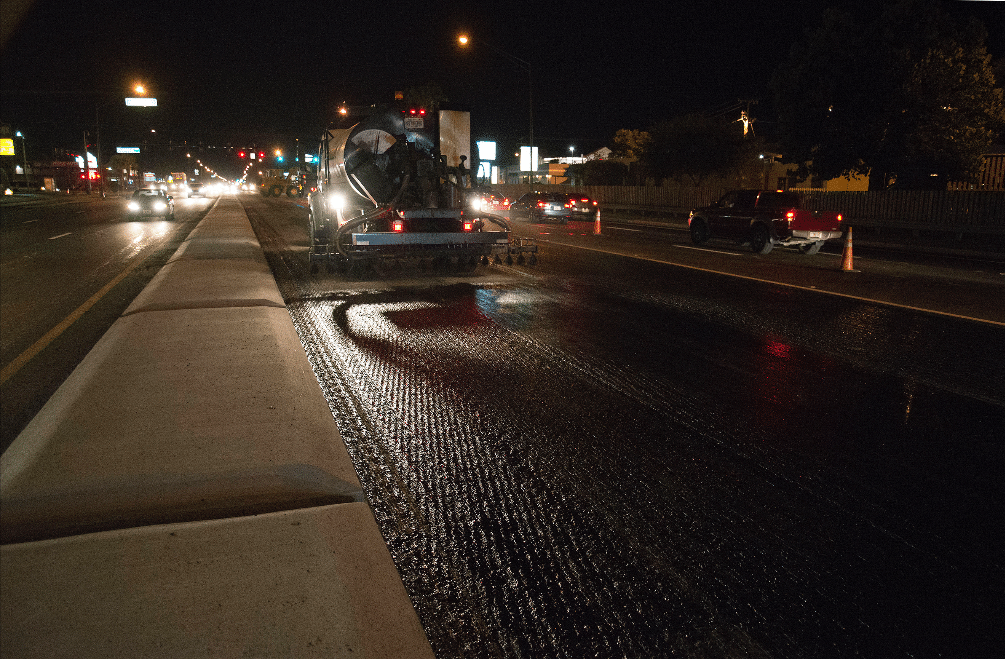
Tom Chastain spoke of the importance of milling speeds to get material sized correctly and to get a tight, consistent pattern behind the machine. Let’s look at another reason you want quality control right at the job site as it affects what’s happening back at the plant.

According to Chastain, a good pattern behind the machine can be achieved when you mill around 30 feet per minute. Milling speeds above 90 fpm can present all manner of trouble on the job, as we discussed last week, but can also create issues with sizing the material.

“We’re trying to use that RAP material,” Chastain said. “The slower feet-per-minute we go, the tighter the pattern, the smaller the RAP material. The faster we go, the more coarse the pattern, the larger the RAP material. We have to screen that RAP, we may even have to crush it, too. So, we’ve added a process simply because we like to mill fast.”

No matter how crunched for time last-minute projects might be this time of year, watch those milling best practices to keep speeds—thus patterns, safety and efficiency—under control.


Subscribe now to receive tips like this directly to your inbox each week!
Control Quality With Milling Speed

As we near the end of paving season in parts of North America, the pressure’s on to complete jobs before the snow flies. Have you noticed workers speeding through tasks that they might otherwise take time to get the details right on?

Take a look at milling and paving speeds. If you rush this process now, you might be back to fix alligator cracking and potholes in the spring.

Wirtgen’s Tom Chastain spoke of the importance of milling speeds to get material sized correctly and to get a tight, consistent pattern behind the machine. Let’s look at the pattern and quality control issue right there on the job site this week.

According to Chastain, a good pattern behind the machine can be achieved when you mill around 30 feet per minute. You can still achieve a good pattern at 60 to 80 fpm, he shared, but you might see the drum no longer pulling the material toward the center of the cut.

“When we get to 85 to 90 feet per minute, we’re starting to get a little coarse and stretching out that pattern,” Chastain said.

Speeds above 90 fpm can present all manner of trouble on the job. Not only does the machine start to walk faster than the drum is turning, but the chunks of coarse material in the inconsistent pattern “could find its way toward live traffic,” he said.

No matter how crunched for time last-minute projects might be this time of year, watch those milling best practices to keep speeds—thus patterns and safety—under control.


Subscribe now to receive tips like this directly to your inbox each week.