Productivity from CONEXPO-CON/AGG

This being the first issue of AsphaltPro Magazine since CONEXPO-CON/AGG 2023 compels me to highlight the industry’s largest tradeshow and conference in some fashion. We provided a quick summary of what stood out from March 14-18 on theasphaltpro.com blog, but we’ll continue coverage by including new products and services seen around the tradeshow floor in the upcoming product gallery departments this summer.

I’m aware that what you want to know is how you can apply any of the information from the show to your operation. While I saw an ungodly amount of battery-operated equipment with promises of robust charging systems to accompany it, I also visited with contractors and original equipment manufacturers (OEMs) who are working in the real world right now with equipment that directly supports the bottom line.

Take Kenco Engineering Inc. of Roseville, California, for example. You probably know Kenco offers wear solutions for equipment and plant components. My visit to their booth gave me a chance to touch different sizes of the tungsten carbide impregnated (TCI) strips used to protect loader buckets, augers, drag floors, impact rotors and a host of wear points around the asphalt plant. By shoring up his wheel loader bucket with TCI wear parts, a contractor not only wear-proofed a component that outlasted the tractor, but he also created a component that required no additional maintenance during the life of the tractor. He removed travel time, downtime and safety issues associated with repairing the loader bucket for years. When the tractor was ready for retirement, the contractor moved the bucket to the next machine.

Take Process Heating Co. of Seattle as another example. While this company has manufactured lo-density, drywell style electric heating for decades to facilitate emissions-free tank heating that discourages coking of material against elements, the industry has begun partnering with them to distribute this technology across a range of products. Readers may remember us reporting on the use of PHCo’s heating tubes in distributor trucks in recent years. The team at Leeboy has seen the wisdom of this and added the PHCo technology to its Maximizer distributor truck. PHCo’s Dan Simpson pointed out this gives the contractor more room for material in the tank. The drywell tubes can be placed lower down in the tank than the flue where a flame used to reside. With the heaters lower in the belly of the tank, the contractor can draw material lower down as well.

Along with efficiencies like these in the field, OEMs talked about subtle efficiencies built into products and designs. One example of that is the Gencor Ultralogiks™ plant controls. Looking at the display screens in the control house set up in the Gencor booth showcased the simplicity of the design. Mousing through screens made sense. Graphics matched components. Information was clear and concise. It was the kind of system either a novice or veteran plant operator could follow efficiently for a day’s production.

And that’s the bottom line.

These are just a handful of examples, but the show was filled with conversations and demonstrations of how to apply some new technology or some new idea to make business more efficient, safer and more productive to enhance the bottom line. We’ll keep sharing as we build upon the tips and ideas we gathered for you.

Stay Safe,

Sandy Lender

The First Step is the Most Difficult When Addressing Mental Health

This week’s toolbox tip is courtesy of information from the president of Ajax Paving Industries of Florida, Vince Hafeli, who is working toward his doctorate in business administration. We share this lengthy, yet important, tailgate talk topic ahead of May’s Mental Health Awareness Month because the asphalt industry has the opportunity and responsibility right now to create a culture of caring for its workforce.

Hafeli shares with the asphalt industry that the Centers for Disease Control and Prevention (CDC) reports construction workers are five times more likely to die by suicide than by a work-related injury. This statistic should encourage us to assist in developing a culture of caring for the colleague on the crew who may be experiencing a degree of mental illness or struggle.

Keep in mind, mental health is a person’s emotional well-being. We all have a baseline for our mental health. Mental illness can encompass many things, varying from mild to severe levels.

Hafeli shared: “None of us should convince ourselves that at some point in our life, we have not or will not experience a degree of mental illness. When you do, there is no shame in saying, ‘I am struggling and need someone to talk to.’ That someone may be a spouse, friend, co-worker or trained therapist. It takes a strong individual to express weakness and ask for help. How strong are you?”

Sometimes, it takes a co-worker or friend to notice someone is struggling. Hafeli has shared this set of warning signs of mental struggles you might see in a co-worker.

  • Anxiety or agitation: You may see or hear your co-worker appear nervous, shaken or worried.
  • Aggressive behavior or uncontrolled anger: You may see or hear your co-worker act overly bitter, hostile or seek revenge. They may get into fistfights or punch holes in walls.
  • Withdrawal: You may see or hear your co-worker stop talking to friends or doing things they used to enjoy.
  • Feeling like a burden: You may see or hear your co-worker feeling like they have let down their co-workers or family and feel worthless.
  • Reckless behavior: You may see or hear your co-worker work dangerously and seem not to care about the consequences.
  • Changes in habit: You may see or hear your co-worker complain of changes in sleep or show significant weight gain or loss.
  • Depression: You may see or hear your co-worker mention feeling very sad or withdrawn with this lasting for more than two weeks.
  • Increased alcohol or drug use: You may see or hear your co-worker begin using alcohol or drugs more than usual.

Here are signs of imminent danger.

  • Feeling desperate: Your co-worker may mention they don’t see their situation changing or a way out; feeling trapped.
  • Tying up loose ends: Your co-worker may give away favorite tools or possessions or put affairs in order.
  • Saying goodbye: Your co-worker may say a final goodbye (subtle or literal) to co-workers, friends and/or family.
  • Talking about suicide or wanting to die: Your co-worker may make statements that are subtle, vague or direct. It could be written or drawn.
  • Seeking access: Your co-worker may start looking around to get the tools they need to complete the act of suicide, such as a weapon, prescription or other means.

If any of the above signs are present in one of your colleagues, please bring it to the attention of your foreman or supervisor. Don’t be afraid to start the conversation with your co-worker about your concerns or refer them to call 988, which is the suicide and crisis lifeline.

If you believe a co-worker is in imminent danger or has already harmed themselves, call 911.


Subscribe now to receive tips like this to your inbox each week.

Put a 2 x 4 on the Work Truck

With paving season starting, you might be restocking the mechanic’s truck, the deck of the paver, and the all-important work truck. As simple as it may seem, be sure you include a four-foot-long 2 x 4 (or two) in the restocking plan.

When the paving crew has an unsupported edge to roll or a new lane to take off from, a set of 2 x 4s could save the day. Make sure you have a couple on hand.

If you have an unsupported edge along a parking area, you can place the board against the uncompacted mat prior to rolling. If you need to roll off the mat for re-fueling or re-filling the water tank(s), put the 2 X 4 on the unsupported edge to keep from destroying the joint you’re building.

The boards you keep on the back of the paver can also serve as starter plates if you don’t have one of those on hand. You want to make sure the board thickness matches the fluff factor you require, place them perpendicular to the transverse joint so they fully support the screed plate when it’s set down, and let them act as the “existing mat” to match—existing mat plus fluff. (Whether you’re using a starter pad or boards, do your math to add the quarter inch per inch compacted to figure the height.)

I bet you have a few other uses for a 2 x 4 on the paving job. Let’s talk about it and brainstorm the ways this simple tool helps your crew get the job done right.

BOMAG Americas Supports Construction Angels Charity Again with CONEXPO/CON-AGG 2023 Campaign

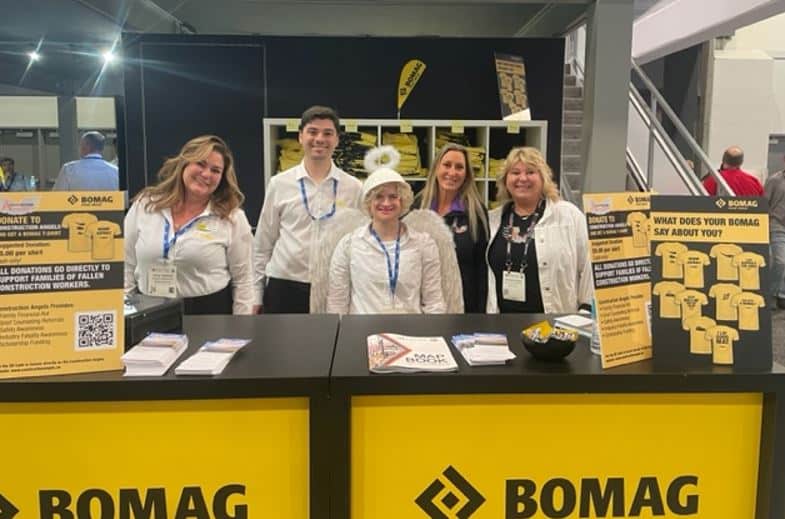
BOMAG Americas raised over $6,400 during the CONEXPO/CON-AGG 2023 show in Las Vegas, Nevada, to support Construction Angels, a 501(C)3 non-profit organization. Construction Angels was founded by Kristi Gibbs and their mission is to provide immediate financial assistance and grief counseling to the children and spouse left behind when a construction worker has a fatality on the job site. Construction Angels offers construction scholarship opportunities to qualified applicants, and additional scholarships to surviving children of fallen workers. The organization also focuses on promoting job site safety awareness.

To support Construction Angels, BOMAG Americas dedicated a portion of their CONEXPO 2023 booth space to run a t-shirt campaign. BOMAG asked attendees to give a minimum five-dollar donation in exchange for a BOMAG-branded t-shirt. There were five different t-shirt styles available, and they all featured the outline of a BOMAG machine or service icon on the front and a fun product- or service-related saying on the back. Some of the sayings were “I Eat Asphalt for Lunch” (Mills), “Keep Rollin’ Rollin’ Rollin’” (Asphalt Rollers) and “Who Needs a Manual?” (Service).

“BOMAG is excited to be partnering again with Construction Angels and looks forward to future campaigns as well. It’s amazing being able to represent such a great foundation on top of collecting over $6,400 in donations to help families of road construction workers who have lost their lives in work-related accidents. It’s a great cause and it reflects BOMAG’s core initiatives promoting jobsite safety awareness,” said Dena Jenkins, BOMAG manager, marketing & communications. BOMAG plans to continue its relationship with Construction Angels so watch for their next campaign to support the cause.

To learn more about the Construction Angels cause, visit the website at www.constructionangels.us. To send a donation on behalf of BOMAG, visit the website and click the “DONATE” tab and scroll down to the BOMAG link.

Reduce Waste at Start-Up

As much as I hate hearing this myself, I’m going to type it right here: You must measure what you’ve got if you’re going to manage it.

Now let’s apply this maddening concept to the asphalt plant at season start-up. You want to define and track waste material at the plant before you can lessen the amount of product you’re wasting. Here’s a 30-second toolbox talk item right here to improve the bottom line when season startup hits.

First, I think we can all agree that the mix you “waste” at the beginning of the run is waste product. It’s the practice load. It gets dumped into the back of a truck and taken directly to the RAP pile. It doesn’t get sold to a customer. It doesn’t go to a project to make a road. It doesn’t add to the bottom line.

Weigh that mix before taking it to the RAP pile. The truck is driving across the scale already; teach plant personnel now to get the actual weight and input the data to the proper field in your software.

Plant personnel must get accurate measurements of what is actually wasted if the bean counters are to account for materials going in, fuel used, utility costs, and so on. You could argue that any mix or material processed or handled at the plant but not sold or used on a project, is “waste material.” What does your company define as waste? Let’s toss around some ideas on the AsphaltPro Magazine Facebook page.


Get tips like this delivered every week to your inbox. Sign up today for AsphaltPro‘s Toolbox Tips newsletter.