Asphalt is an ENERGY STAR Award-Winner

The U.S. Environmental Protection Agency (EPA) and the U.S. Department of Energy (DOE) offer awards each year for entities participating in the energy efficiency system known as ENERGY STAR®. Showcasing the environmental sustainability of the asphalt industry, the National Asphalt Pavement Association (NAPA) attained one of these awards: a 2023 Partner of the Year – Energy Efficiency Program Delivery.

The EPA website states: “NAPA worked in partnership with ENERGY STAR® to develop resources that will enable the industry to better understand their energy performance and decrease greenhouse gas emissions from their facilities.”

These are the accomplishments that EPA listed as key:

  • Promoting the ENERGY STAR partnership among NAPA members, with six becoming ENERGY STAR partners in 2022.
  • Developing an Asphalt Plant Energy Performance Peer Exchange program to share best practices and develop an initial set of resources supporting energy management at asphalt plants. (See this August 2020 article discussing a “treasure hunt” for ideas you might easily implement at your facility.)
  • Publishing The Road Forward, a vision for achieving net-zero carbon emissions for the asphalt pavement industry.
  • Supporting the development of an ENERGY STAR asphalt pavement plant energy performance indicator tool that will assist asphalt producers to measure and benchmark the energy performance of their plants.
  • Including a provision in the Asphalt Mixture Product Category Rule (PCR) that allows Environmental Product Declarations (EPDs) for asphalt mixes to include information about a company’s ENERGY STAR accomplishments.

According to the EPA website, an ENERGY STAR industrial partner:

  • Demonstrates a commitment to energy management;
  • Strengthens its energy program through coaching and mentoring;
  • Learns from leading energy managers and their programs; and
  • Gains access to partner events and meetings.

More than 170 organizations among the 2023 winners are being recognized for their year-over-year commitment to energy efficiency through the program’s highest honor: ENERGY STAR Partner of the Year – Sustained Excellence winner. EPA considers their sustained commitments essential to enabling a transition to a clean energy economy. EPA congratulates them, as well as Partner of the Year, Contractor of the Year, and Excellence award winners for their contributions toward cleaner and healthier products, homes, buildings, schools, and factories. For a complete list of 2023 winners and more information about ENERGY STAR’s awards program, visit EnergyStar.gov/AwardWinners.

EPA reports, since its inception more than 30 years ago, ENERGY STAR and its partners have helped prevent over 4 billion tons of greenhouse gas emissions, while saving consumers and businesses over $500 billion.
Are You Timing Your Chip Seal?

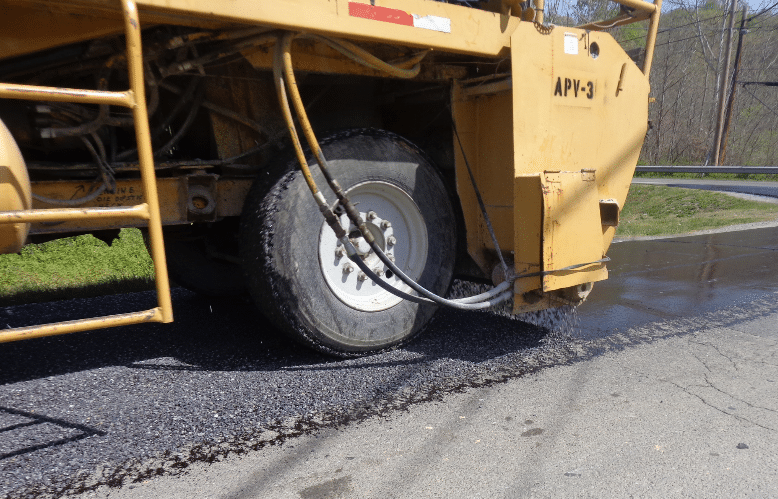
When doing chip seal, the pave-pres team has weather AND temp to monitor to get timing right.

Amid these ambient conditions, the emulsion itself needs to be sprayed at a temperature of 180 degrees F (or higher) to ensure it sprays correctly.

Then, the chip (aggregate) needs to be rolled within two minutes of spreading atop the emulsion. The chips are going down almost immediately, and the roller will come along to knead them into position before the emulsion can set and glue them into positions that might not be ideal. (This may mean you want more than two rollers on the scene, depending on lane width and the “weather” mentioned above.)

The ideal compactor for this operation is the pneumatic-tired roller, moving at about 3 miles per hour, so that it kneads and “smooshes” the chips into place. As a former engineer at Asphalt Institute taught me back in 1998, “Push them into their fat, dumb, happy places.” Whatever it takes to ensure you embed the rock perfectly.

To complete the seal, you’ll broom the new surface, and this takes ambient conditions into consideration again. You want to ensure 85% of the moisture in the emulsion has evaporated before you sweep. You also want to make sure the roller has made at least three passes on the chip. Then broom it to ensure the emulsion has a good hold on the aggregate—you’re ensuring its adhesive strength before turning it over to traffic.

Have you already subscribed to the print magazine in time to receive our May issue? That one includes our PreservationPro supplement with project stories and how-to info for the maintenance and preservation of asphalt pavements. Subscribe for free at this link and forward this email to members of your team who may also benefit from the information!


Get tips like this delivered to your inbox each week. Subscribe to our Toolbox Tips newsletter today!

The EPD Rundown from AsphaltPro Magazine

Help compare apples to apples with this shortened timeline of Environmental Product Declarations (EPDs)

As far back as 2017, asphalt EPDs were on the scene to provide “customers” with the expected environmental impact of an asphalt mix design. The National Asphalt Pavement Association (NAPA), in collaboration with its membership and state pavement associations, designed the Emerald Eco-Label tool not only to track your designs for future use but also to communicate quickly and in a common, standard language what the impact of your specific mix will be.

Here’s an overview from 2017, courtesy of former NAPA Pres. Mike Acott.

In simple terms, the EPD offers the owner/agency a way to quantify the mix to be used. Or…EPDs for dummies.

It takes a product category rule (PCR) to start the process and standardize the EPD, which is one of many reasons state agencies/owners are taught not to compare EPDs of different products. Many facets of a product may make it sustainable, but that doesn’t mean it can be compared directly to another sustainable product. We’re reminded of the adage: Don’t compare apples to oranges.

If one element from the EPD is missing, it’s no longer directly comparable to another EPD where that element is included. We can change the adage just a bit into: Don’t compare red apples to yellow ones.

You may be working with two asphalt mix designs, but the two from the same region, sourcing each and every element they incorporate, will be comparable to one another. They won’t be comparable to a mix from across the country that’s missing data on its fiber additive.

Additive manufacturers have started to standardize their EPDs to close the gap in asphalt mix design EPDs:

Whatever stage you’ve reached in your EPD research, the point is our industry needs more producers on board with detailing and tracking the “footprint” of their mix designs. By including your design in a national database, you participate in the effort to build a more reliable data set without gaps—in other words, getting all the same color apples into the barrel.

As government agencies make project decisions in the future, let’s make sure they’re using complete and accurate information; let’s make sure they’re using local environmental product information based on real, factual data shared by asphalt producers in every sector of our nation.

Watch NAPA’s short video on the Emerald Eco-Label tool here.

The CONEXPO Rundown from AsphaltPro Magazine

CONEXPO-CON/AGG 2023 was electric

Everyone’s shouting their “Top 5 Key Takeaways” from CONEXPO-CON/AGG & IFPE this week. To be honest, I can’t narrow the five days of scheduled appointments down to a “top anything” list without missing something and feeling fussy about it later.

I’ll make you a deal. The plant-related product gallery in the May issue of AsphaltPro and paving-related gallery in the June issue will include some top picks from the tradeshow. Watch the magazine’s pages for feature articles from interviews Digital Editor Sarah Redohl and I conducted during the week. And watch the Monday Morning Toolbox Tips for info we picked up throughout the conference as well.

What I’d like to share with you today is a Quick Capture of two overarching themes from the week of March 14-18, 2023, in Las Vegas.

Electric

I’m going to exaggerate and say every third equipment booth had the word “electric” in it. It seems everyone was advertising “the first electric [insert machine here] in the xx-class range.” You get the idea.

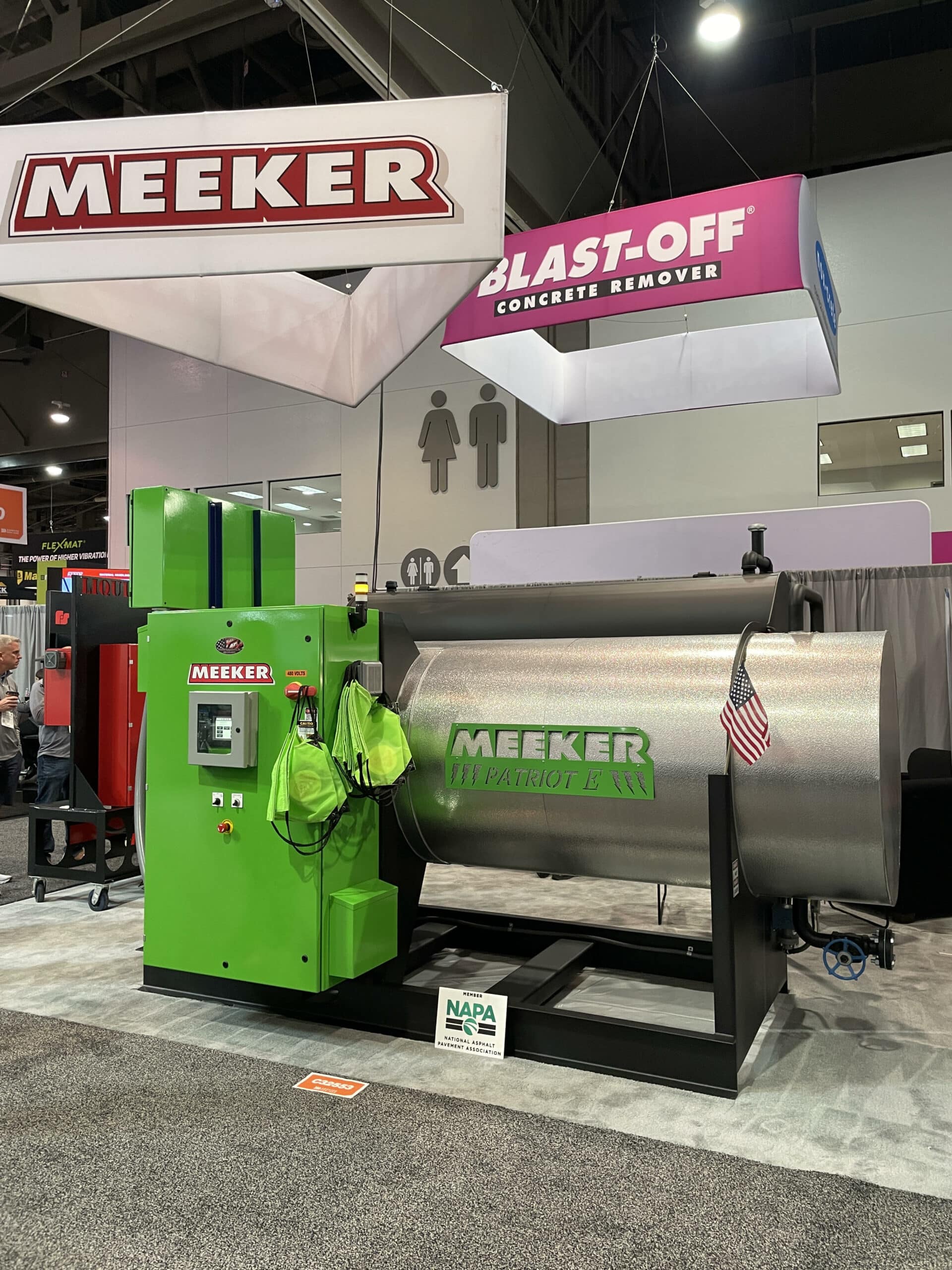
Whether it was a concept machine finished in time to announce at the show—as in the case of LeeBoy’s 8520C paver with its Ultium Charge 360 unit designed with the assistance of General Motors—or a fully operational and ready-to-ship device—as in the case of Meeker Equipment’s Patriot-E hot oil heater for the asphalt plant—original equipment manufacturers (OEMs) were proud to display their electric offerings and talk to attendees about lowering the end user’s carbon footprint.

What you might find interesting is the collaboration between OEMs to get the electric job done. A few years ago, we reported on the use of Process Heating Company’s Lo-Density® rigid tubular drywell tank electric heater elements in the distributor trucks from BearCat. Now you can find PHCo drywell heating elements in Etnyre’s emulsion tanks and tanker trucks, according to PHCo’s Dan Simpson. And you’ll find them in the Electric Max 2 Distributor from LeeBoy. You’ll also find them in the Meeker Patriot-E hot oil heater. It’s a proven technology that makes sense for the asphalt industry.

We’ll have additional electrification information coming up.

Meeker Patriot-E hot oil heater utilizes Process Heating Company’s Lo-Density® rigid tubular drywell tank electric heater elements.

Workforce

The other overarching theme at CONEXPO-CON/AGG was that of workforce development. At the safety and health panel titled “Constructing a Culture of Suicide Prevention” Thursday morning, fellow panelist Aaron Witt told our audience that it’s smart for us to nurture and care for the workforce we already have. It’s our desire to show the incoming workforce that we care about our employees; we have a caring culture. We call our employees our greatest assets; it’s time to show we mean it by developing safety programs for the whole employee, including their mental wellness.

Alongside the whole-person concept, OEMs are still designing operator stations with comfort and ease-of-use in mind to keep workers from experiencing repetitive injury, discomfort and long learning curves. Plant controls manufacturers are finding new and creative ways to design their operating systems for easiest interface with humans. And associations are looking at ways to encourage and “grow” employees. The Associated General Contractors (AGC) California chapter has launched its leadership development program, Project Engage, to develop leaders in the industry.

All that doesn’t mean recruitment was ignored. Conversations around attracting new blood to the industry took place throughout the week, including the Association of Equipment Manufacturers (AEM) press conference rounding off Media Monday March 13.

However we find the workers, we have an aging workforce retiring and a younger workforce “bouncing” shortly after training. It’s time to attract and retain, with ideas percolating everywhere you looked during the show. Check out the Off the Mat department of AsphaltPro for some of those ideas.

Seth Hankowski Accepts the 2023 Board Chair Gavel

During the Annual Membership Meeting at the 2023 Annual Convention, the National Stone, Sand & Gravel Association (NSSGA) outgoing Chair Karen Hubacz, Bond Construction handed off the gavel to fellow Bay Stater, Seth Hankowski, All States Materials Group. A new video introducing Hankowski and showcasing the important work of the industry was also featured.

“Seth Hankowski’s unique background in the aggregates industry and long-time involvement with NSSGA will be a great benefit for the association’s goals and for the continued work of our new strategic plan,” said NSSGA President & CEO Michael Johnson. “I know his knowledge and leadership style will assist in taking the association to the next level.”

During Seth’s remarks, he shared his personal connections to the aggregates industry, growing up in his family business but not thinking it would become his long-term career. He first became involved with NSSGA over 20 years ago, joining as a member of the Young Leaders Program. He eventually rose through the ranks to become the Young Leaders Chair, the Communications Committee Chair and then was elected to an officer position.

The membership meeting with its reworked format also focused on select presentations from industry experts and the formal unveiling of the NSSGA Strategic Plan for 2023-2025 which outlines four major pillars for the association to work on over the next two years. These include: proactively addressing regulatory threats; effectively promoting the industry’s image; focusing on Advocacy as Job #1, which includes the support of ROCKPAC; and reactivating the Rocks Build America Foundation to help fund industry education and branding.

“It’s an exciting time to be in the aggregates industry, as we all know infrastructure funding provides opportunities. On top of that, our association is establishing stronger partnerships and communicating and collaborating in exciting new ways,” said NSSGA 2023 Board Chair Seth Hankowski. “However, we do have multiple challenges on the horizon, and I am ready to tackle these issues and lead the association to create a better, stronger NSSGA and future for our industry.”

Additionally, at the meeting, the full slate of 2023 Officers and Executive Committee Members were announced. NSSGA members’ next full Membership Meeting will be held in Washington D.C. during the Legislative & Policy Forum on September 24-27. For more information on the NSSGA meeting and events please visit www.nssga.org.

Striping Tip for Skip Lines

When you’re striping with a walk-behind—or self-propelled—machine, you put a lot of faith in the settings and automation. Once you’ve locked in the measurements and started moving forward, there’s no looking back. Or is there?

If your skip lines start to “travel” on you, stop.

You don’t have to live with unevenly spaced markings that may or may not get full pay from the client or prime contractor. Look at your control panel’s screen and ensure your measurements are on target.

If everything reads the way it’s supposed to, your next troubleshooting step is to check tire pressure. Both back tires of your striping machine need to be within 1 to 2 pounds of each other. (Basically, if you have 58 psi on the rear tires, you want both to read 57-59.) If one is “squishier” than the other, your calibration is off and it’s time to do some fixing.

Inflate the problem tire and recalibrate the machine. Now you’re ready to get back to making money.

Extra Tip: Keep an eye on your tire tread, too. You’d be surprised how problematic a rock in the tread can be for painting straight, evenly spaced lines. And if you’ve been letting paint dry on your tread, those layers are changing the tire’s circumference. Make sure you’re keeping the tires nicely maintained.

Have you already subscribed to the print magazine in time to receive the May issue? That one includes our PreservationPro supplement with project stories and how-to info related to pavement maintenance. Subscribe for free at this link and forward this email to members of your team who may also benefit from the information!