How to Figure Fluff Factor with a Smooth Screed

We’ve discussed this before, but as paving season heats up, it’s good to remind the crew how to figure fluff factor. This critical paving number is covered in depth in the 8th lesson of the Asphalt Paving 101 online course we’ve put together for your crew, but let’s do the quick tip version right now.

KEEP IN MIND: This tip assumes you’re using a smooth-bottom screed plate. Visit here to read about figuring fluff factor with the OXCLAW patterned screed plate.

Patterned Screed Plate, Smooth Mat

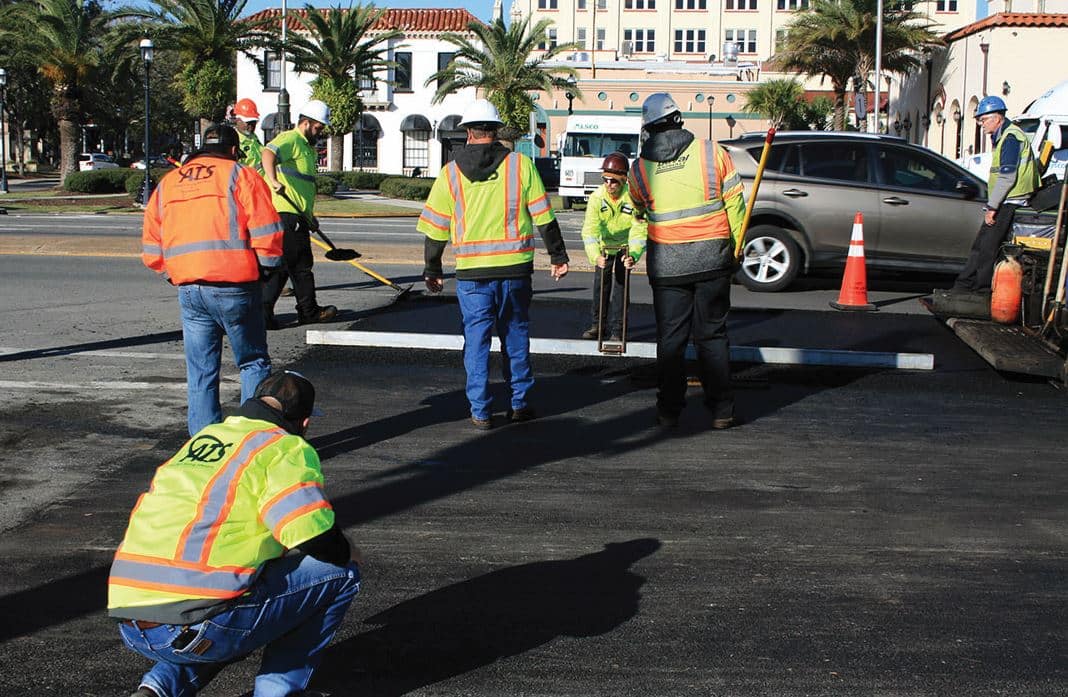
When you pave the asphalt mat with a smooth screed plate, you will place it one quarter of an inch thicker, per inch, than you want the final mat to be. This gives the roller operator room to compact to the final thickness.

Think of it this way: for a 1-inch lift, you’ll actually pave 1.25 inches; for a 2-inch lift, you’ll pave 2.5 inches. That extra height is the fluff factor. The “thicker” number is the actual thickness that the screed will place. The extra height is the amount of mix that will be compacted as the roller operator fills the air voids and achieves density.

There’s a cheat sheet available for free download in the Asphalt Paving 101 online training course that gives you a quick reference for different lift thicknesses and the fluff you need to factor in. Click the green “enroll” button at this link.

Suicide Prevention

The AsphaltPro website now has additional resources for safety directors and managers seeking mental health wellness and suicide prevention materials. Visit this link for information, a library of past articles, and the all-important Suicide in Construction Awareness Proclamation you’ve been hearing about.


To receive tips like this to your inbox each week, sign up for our Toolbox Tips newsletter today!

Will Your Next Chat Move Your Cheese?

Those of you who have been reading my editorials since 1998 know I’m hesitant to adopt new technology without obsessing over it first. I must research and fret before installing an app that uses up precious data on my phone.

There may come a day when artificial intelligence (A.I.) helps me with some portion of my job, but I can make a promise to readers right now: the content of AsphaltPro Magazine is generated, curated and edited by human beings who know, respect and understand the industry. Although I read the same business book from Spencer Johnson that everyone else did in the ’90s, I’m content to sit back and watch how A.I. learns and grows before I log in and play with it for even personal purposes.

You might be wondering how my reluctance to trust a new machine civilization relates to the asphalt industry. Let me see if I can easily reveal the mental gymnastics I performed when applying ChatGPT to telematics.

Buckle up for this one.

Now this conversation applies to more than equipment telematics. Consider the volume of data you traffic in, as a member of the asphalt industry.

From tonnage delivered to a paving site per day to reclaimed asphalt pavement (RAP) fractionated for Pile 0.5-inch versus Pile 0.25-inch, you’re tracking materials. From liquid asphalt cement (AC) graded for FOB customers to the pricier AC with an additive blended at the terminal for a state job your crews will start next week, you’re tracking (and monitoring temperatures for) incoming perishables that have a serious price tag attached.

Depending on your platform-of-choice, all your data could be stored on hard drives that automatically back up on a predefined schedule, a third-party server, the omnipresent cloud, or some combination thereof. If you’re lucky, you’ve got it all going to the same place to be accumulated, evaluated, extrapolated, manipulated, and returned to you in some format that makes it easy for you to see what you have, what you’ve used, how you’ve used it, when it’s time for routine maintenance, when it’s time to order more AC, and what data points line up to make some predictions for next season. If you’re lucky, the entities performing this service for you are worth the cost.

What if an entity similar to ChatGPT’s openai could do it all for free? Has anyone in the construction industry tried feeding all their data to an A.I. platform to let the machine overlords do the work? I’m not suggesting it’ll be easy at first. But then, setting up all those touch points to feed to your current data-gathering mechanism wasn’t easy, either.

Instead of directing your tank temperature gauge, plant alarms, wheel loader’s maintenance schedule and slat conveyor’s wear thickness measurement to a couple different platforms, are we almost at the stage where we direct all those data points to an A.I. that accumulates, evaluates, extrapolates, manipulates and returns projections based on your complete data? For free?

I’m fully aware that the editors at CNET came under fire for using A.I. to generate financial articles that were riddled with basic errors. I’m fully aware that the Stargate A.I. writes scripts that have silly mistakes (such as having characters suggest “resting” when action is required to propel the plot). So, we’re not at a point where handing over all the telematics (and other) construction-related data could reliably offer sound business advice. Or are we? Is the next chat about A.I. changing someone’s business plan?

Stay Safe Out There,

Sandy Lender

Five Equipment Dealership Trends that will Shape 2023

If you have been working around construction equipment you have probably heard of the “Equipment Triangle,” a philosophy that is one of the fundamental tenets of the Association of Equipment Management Professionals (AEMP). The theory behind the equipment triangle is that all transactions between end users, distributors, and OEM/suppliers should be a win-win for all parties. However, with major changes in the construction equipment industry underway, dealerships and manufacturers will need to adapt to keep the Equipment Triangle in balance.

We asked industry thought leaders to share their views of what the future holds:

  1. Online sales and online rentals will increase significantly

In 2021 online sales of automobiles reached 30% of the market, their highest level. In July 2022, Ford announced it would move sales of its electric vehicles online at a fixed price, following Volvo and Tesla. “Whatever happens in the auto industry, is coming to construction equipment dealerships,” says Garry Bartecki, CFO of a Top 100 rental company and former CFO of the Associated Equipment Distributors (AED).

In a 2021 study from McKinsey & Company, sponsored by AED, more than 40 percent of off-highway dealers surveyed think it is very likely or somewhat likely that the OEM(s) they represent will implement a direct-to-consumer model within five years. They expect fully digital sales (including the actual purchase) for new equipment to increase from 7 percent to 29 percent and digital rentals to increase from 7 percent to 33 percent within five years.

“We definitely see things moving in this direction,” says Jefferson Yin, Director of New Business Models and Commercial Intelligence at Volvo Construction Equipment. In 2020, the company began allowing customers to pre-order new electric equipment online, and they recently launched an online configuration tool for those machines, which allows customers to “build and price” their ideal model.

“There will still be transportation, delivery, and service, but it will be much more efficient,” explains Steve Clegg, Managing Director and Owner of Winsby, Inc., a business development firm with many clients in the construction equipment industry.

“Dealers are behind the curve and contractors are ahead of the curve when it comes to utilizing the Internet,” says Ron Slee, Managing Director Learning Without Scars, a training resource for dealers. The shift to e-commerce creates what he calls “the Amazon effect,” which means dealers will have to transition from selling things to selling services.

With brand differentiation waning in the heavy equipment market, Dale Hanna, CEO of Foresight Intelligence, a provider of business systems and telematics software, also believes the battle for customers will be based on customer experience. “Dealers need to adopt more technology to be able to serve more customers with the same amount of people or to attract better people,” he says.

  1. Electrification will disrupt the dealer’s revenue model

Electrification of construction equipment is in its early stages, but Grand View Research reports that the global off-highway electric vehicle market size is expected to reach $42.70 billion by 2030. Growth will be driven by lower operating costs as well as improved battery technology and lower costs for batteries. “You are going to see the whole industry switch to battery-operated or hybrid machines,” says Clegg. “The amount of parts drops by about 90 percent, so if your operating costs for a skid-steer were $20 an hour, that drops to $3 per hour.”

Dealers make their money on parts and services, and a high absorption rate (+85%) is a key focus. This metric is an indication of how well the margin from parts and services covers all the expenses of the dealership.

“Electric machines will cut the maintenance costs, so the dealers will make less money and the OEMS will make less money,” says Bartecki. “It’s a whole new ball game.”

To make up for the difference, dealerships will have to focus on new revenue sources. “Because they have the service expertise, I would recommend they move into supporting and servicing batteries, providing services such as recharging vehicles, tires, wear parts, and repair,” says Clegg. “They can also expand into different lines of equipment.”

According to Lars Arnold, Electromobility Product Manager for Volvo Construction Equipment, the company is working closely with dealers on sales and service training. The company has added electromobility training at its Hayward Training Center and has plans to include it at its new training center at the Shippensburg headquarters.

  1. Connected machines and jobsites will continue to reduce owning and operating costs

Telematics can greatly reduce owning and operating costs. Nearly all new construction equipment machinery is equipped with technology that allows equipment owners and dealers to avoid downtime through preventative maintenance and early detection of mechanical issues. The challenge has been getting equipment owners on board. “Across the industry, adoption of telematics is definitely under 50%, and maybe only 30%,” says Henderson.

“The dealer has the trust of their customer, but they tend to be a single brand, while most customers have mixed fleets,” says Hanna.

Slee believes OEMs have tried to protect their own at the expense of the marketplace, but he’s starting to see some signs of change. “The machines need to be able to talk to each other as they do in other industries,” says Slee.

According to Jim Bretz, Director of Service and Solutions for Volvo Construction Equipment, about 60% of Volvo’s connected machines use the company’s advanced telematics system called ActiveCare Direct. These machines are monitored 24/7/365 for alarms that indicate an issue. Actionable information (an ACD case) is then sent directly to the customer’s equipment manager and the local dealer within minutes. Included is information that will help the customer address the issue without the help of a dealer. In addition, fleet reports are driving a change to the dealer’s business processes. “It gives them a tool to proactively consult with customers and help them evaluate and improve machine operation and maintenance,” says Bretz.

  1. Technology will bring greater efficiency to parts and service

Parts are the bread and butter of a dealership, but for an end-user, buying parts is anything but easy. When a machine is down, the costs are astounding and end-users and rental dealers are likely to pay a premium to get a quality part as quickly as possible. Buyers often need guidance, and that may mean multiple phone calls and texts from multiple sources, including OEM and aftermarket parts dealers. Each part of the distribution chain has its own distribution, logistics, and markup.

According to Slee, OEM dealer market share for parts has dropped to 35-40%, about half of what it once was. Buyers today simply have more options, including Amazon.

Luke Powers, CEO of Gearflow, a web-based platform designed to work within the Equipment Triangle to facilitate the sale of parts, believes dealers will soon be competing directly with Amazon. “MRO supplies are the first entry point of Amazon coming into the industrial markets,” says Powers. “Amazon wants all procurement to be done on its platform regardless of the industry. Private-label brands in the construction equipment industry are the logical next step after adding MRO to their selection.”

Powers wants to take the inefficiencies out of buying OEM and aftermarket heavy equipment parts, and for that he created the Gearflow platform with Co-Founder Ben Preston, to make it easier for suppliers and end-users to work with each other. The platform provides one location for end-users to request parts from their existing suppliers or discover new ones, access their past parts order history paired to their machines, as well as centralize invoicing and reporting across their mixed fleet.

“The No. 1 way dealers lose customers is through miscommunication,” says Powers. A messaging center keeps communications tied to each part’s request and order, in a central location. “We’re trying to automate as much of the process as we can,” he says, “which ultimately will allow end-users and dealers to focus more on productivity and service.

  1. Rental continues to grow, while an Equipment-as-a-Service model draws interest

Rental is expected to continue its upward trajectory fueled by higher prices for construction machinery and rising interest rates. According to the America Rental Association, construction equipment rental revenue is expected to increase 12.5% in 2022 to surpass $41.6 billion, with growth slowing to 7% in 2023, 2% in 2024, 3%in 2025 and 3% in 2026.

The concept of equipment-as-a-service, which would transfer responsibility for equipment to the manufacturer or dealer, allowing customers to focus on their core business, is also gaining interest. Unlike equipment rental, it might involve an entire fleet to be provided for several years with the potential to tie invoicing directly to usage.

Slee believes the concept has potential. “Contractors use the machine to dig a hole. They are only interested in the hole, and they look at the equipment merely as an operating cost,” he says.

Volvo CE is currently exploring the concept. “One of the most positive aspects from a customer perspective is the payment flexibility that this model offers since it’s usually linked to machine utilization,” says Dr. Ray Gallant, Vice President of Product Management and Productivity for Volvo Construction Equipment. This would allow companies with seasonal operations to match equipment expenses with revenues.

“It’s a very customized offer and it requires that the OEM, dealer, and customer are aligned so the fleet performs accordingly and delivers the expected results,” says Gallant.

Change is coming fast

Change typically accelerates in the face of headwinds, whether it is a pandemic, inflation, or high-interest rates. Dealerships that want to succeed moving forward need to prepare for change and that means gearing up with the people, technology, and services the market demands.

Measure Twice Before Paving

You’ve heard this before: measure twice, cut once. This is how you avoid mistakes. This is also why savvy contractors line out their paving jobs and paint the number of tons each pass requires on the existing subbase.

Now here’s a trick question for you.

If you have a state-of-the-art GPS with positioning stations bouncing markers and imaginary stringlines around your paving site, sending depths and slopes to 97 tablets and smartphones that may or may not be owned by people who are integral to this project’s success, will you still take the time to paint numbers around the place? I suggest you do.

Today’s toolbox tip is this: plan ahead. Measure twice. Maybe it’s overkill to paint long lines if you trust your station’s uptime, but the numbers and signs you include in the daily project are markers for each member of the team. Keep everyone on the same page.

Look at other areas you’re measuring, such as the extensions on the screed. Extend that out and measure it. While the marks you’ve painted on the extendible are your guide, you want to pull the tape measure out of your tool belt and make sure you’ve got it right.

Check the depth you’ve set. All the automation and controls are wonderful, excellent tools to help the paving crew get bonus-worthy results in the field, but it’s wise to double-check settings and double-check the metal’s movements. Did the screed plate truly take on a 2 percent slope? Get out the level and straight edge and measure to find out.

If you measure before you start paving, you’ll have more confidence going forward. And you’ll have a better chance at getting a top quality project in the end.


Get tips like this delivered to your inbox each week with our Toolbox Tips newsletter. Subscribe today!

Ensure Your Operator Can Pave in a Straight Line

The paver operator’s first job is to drive the tractor in a straight line. Sure, he has to keep up with the production coming from the asphalt plant, but he must do so without wobbling down the lane. Each pass with the paver has to match to the joint he created with the pass before it. To help him, make sure the paver is in optimum condition, and check the guide bar on the front of the tractor.

Clean the guide bar and straighten it if it’s bent or warped. Some crews will paint the end of the bar to make it more visible.

If you’ll be paving at night, put a light on the end of the guide bar for safety and visibility. It seems a simple device, but it can make the difference for the operator.

Sounds pretty easy, doesn’t it? We all know there’s a lot more for the paver operator to focus on up there, so getting these simple tools in place will help out. Do you have a member of crew you’d like to forward this to? Send it along to them.


Subscribe now to receive tips like this to your inbox each day!

AsphaltPro Teams Up With Ajax Paving’s Vince Hafeli to Curb Construction Industry Suicide Epidemic

Asphalt industry members have a new repository of resources and guidance to assist in spreading awareness of the troubling epidemic of suicide in the construction industry with the newly launched website at https://theasphaltpro.com/suicideprevention/ where they can sign the new “Suicide in Construction Awareness Proclamation.”

Teaming up with Ajax Paving President Vince Hafeli, the asphalt industry’s leading publication, AsphaltPro Magazine, is committed to raising awareness; finding resources for training and creating robust employee assistance programs (EAPs); and helping asphalt companies create a caring culture for all employees. With help from the Construction Industry Alliance for Suicide Prevention (CIASP), Holmes-Murphy, The Center for Construction Research and Training (CPWR) and others, the niche publication staff has gathered materials to a central location—and will continue to gather more.

“We are committed to helping safety directors and managers find ways to approach the topic of mental health wellness and incorporate suicide prevention in their companies’ safety cultures,” AsphaltPro Publisher Chris Harrison said. “We want to encourage those open conversations that help save lives in our industry.”

To advance toward that goal, AsphaltPro is proud to host Hafeli’s “Suicide in Construction Awareness Proclamation” digital living document, which he launched at the Feb. 7 Florida Transportation Builders Association (FTBA) Construction Conference. After a presentation on the topic to a room of nearly 1,900 attendees, Hafeli encouraged officials to sign on the dotted line proclaiming their intent to continue the conversation and work toward having open conversations pertaining to suicide and mental health awareness in our industry.

The physical document will travel with Hafeli from now until December 2024, to a variety of speaking engagements where industry members will have the opportunity to sign their names. The digital document now resides on the AsphaltPro website where anyone can read it and electronically sign, signaling his or her support for expanding the conversation.

Visitors to the site will also see a library of articles from multiple publications and blogs where statistics and tips for assisting workers are outlined.

For more information on the “Suicide in Construction Awareness Proclamation,” please reach out to Vince Hafeli at Ajax Paving at vhafeli@ajaxpaving.com, or read and sign the proclamation today at https://theasphaltpro.com/suicide-proclamation/.