2023-24 Highway Worker Memorial Scholarships Available to Eligible Students

The American Road & Transportation Builders Association’s (ARTBA) Foundation is seeking qualified students for its 2023-2024 Lanford Family Highway Worker Memorial Scholarship program.

Applications are due by Friday, April 14 and are available at www.artbafoundation.org.

Established in 1999, the program provides post-high school financial assistance to the children of highway workers killed or permanently disabled on the job. More than 200 scholarships have been awarded to worthy students from 32 states to pursue undergraduate and graduate courses, as well as technical training. Scholarships have a value of up to $10,000 annually.

For more information, or if you have a lead on a student who might be eligible, contact ARTBA’s Melanie Laird at mlaird@artba.org or 202.683.1029.

Signal Your Recycling Virtue

Back in June 2022, the National Asphalt Pavement Association (NAPA) released a 34-page document titled “GHG Emissions Inventory for Asphalt Mix Production in the United States: Current Industry Practices and Opportunities to Reduce Future Emissions.” Within this report, authors Joseph Shacat, J. Richard Willis and Ben Ciavola shared data that confirms the asphalt pavement production industry within the United States had cradle-to-gate greenhouse gas (GHG) emissions representing a mere 0.3% of the total U.S. GHGs during the year 2019, which is the year of our industry’s highest production of the years studied.

What I’m drawing your attention to is this: During our most productive year of the study, the year representing the most mix we made, we were responsible for 0.3% of the total GHGs in the entire country. That means other industries were causing the other 99.7%.

If you’ve been reading my notes since 1998, you know what I’m about to write next. I’m about to suggest “the government” go after some of those big emitters and leave the 0.3% alone.

But, to beat a dead horse, why not put some more filters on some more equipment and capture some more droplets of smaller microns and spend some more money on some more research to find some more ways to lower the asphalt industry’s numbers some more? I mean, we can print as much research money as we need, right? The government will hand us a grant to study this stuff at this point. Let’s go for it.

Part of me wonders if I could become a multi-millionaire by inventing a stapler that will affix money to the clouds in such a way that it attracts GHGs upward, pulls them through the money’s paper, traps them on the moon’s side of the money’s surface, and keeps the emissions there like a fancy, research-funded net of Earth-saving awesomeness. Anyone who would like to contribute to the development of my Climate Change Stapler (CCS) can have their company logo printed directly on the money and will receive five free tweets to signal your virtue when the money-net is deployed.

To be serious, you can do more than put your logo on a website’s call to help our environment, and as a member of the asphalt industry, you probably already are doing more. I’m not sure how many times we have to say it, but asphalt is the top recycled product. What might be new to shout from the rooftops is a set of impressive stats gleaned by NAPA, in partnership with the Federal Highway Administration (FHWA), through the annual recycled materials and warm-mix usage survey and posted on the association’s website. We, as an industry, recycled 87 million tons of RAP into new mixes in 2020, which spared about 2.3 million metric tons of CO2 equivalent from the atmosphere.

Quick Update: Since press time, NAPA has released the “2021 Recycled Materials and Warm Mix Survey” report, in which the association compiled results from 261 companies with 1,388 plants in 50 U.S. states and the District of Columbia. Of the 101 million tons of recycled asphalt pavement (RAP) reclaimed, contractors reused 84.6 million tons in new asphalt pavements in 2021. This represents a 68.9% increase from the total estimated tons of RAP used in 2009, when the annual survey was first conducted. The survey again evaluated greenhouse gas emissions, and NAPA states it found RAP use saved 2.6 million metric tons of CO2 equivalent, which NAPA reports is the equivalent of removing 570,000 passenger vehicles from the road.

While I see no problem with the responsible and safe movement of virgin asphalt binder for our industry’s use, there is a loudly shrieking minority that thinks we have more rare-earth minerals than fossil fuels right now. And that screaming group should be pleased to know our industry replaced 24 million barrels of virgin asphalt binder with recycled binder from RAP and RAS in 2020. That not only saves costs for the end user, but it also sends a message to the people gluing their hands to pricy paintings in fancy museums. Think of the animals to be saved from the glue/cartilage factories if we let those folks know we’re reducing virgin asphalt binder use in favor of recycled material.

Stay Safe,

Sandy Lender

Prep for Stack Testing: with Good Instruments

Because the Clean Air Act mandates that all permitted emission sources must be stack tested within 180 days of startup, asphalt plants undergo initial tests pretty early on in their lifetimes. But stack testing happens throughout your facility’s life depending on your state’s requirement. Annual testing may mean you want to stay on top of cleaning and watching out for any loosening seals or potential breaches in ductwork and so on.

When it comes to the actual testing, talk with the team or individual who will be performing the testing. You want to make sure you’re running the mix that day with the best opportunity for successful numbers. If it’s going to rain the night before, see if you can reschedule. If you can’t reschedule, you want to pull the driest material you can and monitor the firing rate on the burner. Try to keep track of the dust load on the baghouse so you can see just what affected your numbers.

Beyond the production elements you control, look at the testing equipment. Is it certified? Are you confident it’s been calibrated correctly? You want to watch out for human error, which means you’re looking for the best person you can find to help you get your stack testing handled competently.


Sign up to our Toolbox Tips newsletter to receive tips like this to your inbox each week!

Prep for Stack Testing: with Blue-Smoke Capture

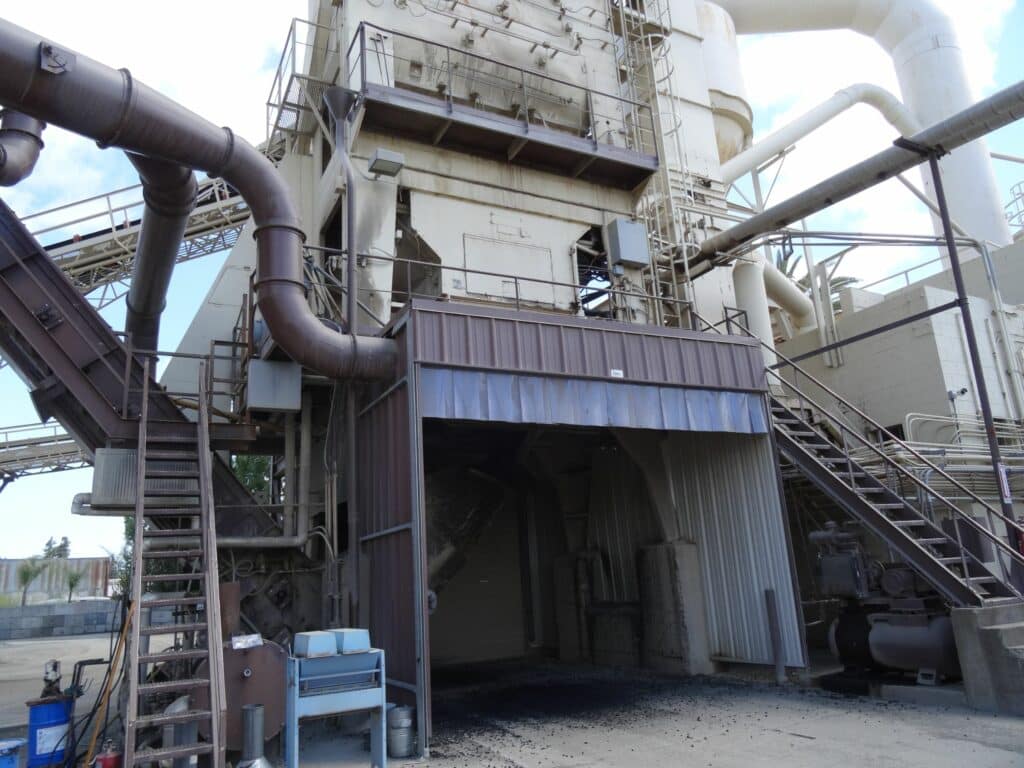
While this may sound elementary to some producers, others may be surprised to learn that you can capture the smoke and/or dust particles emitted around the transfer conveyor atop the silo and feed those elements back into your process. Producers successfully pull smoke from “problem areas” and filter it across or through different media—depending on the manufacturer—to clean the air stream before directing the air one way and the coalesced asphalt cement droplets and fine particulate other ways.

You may have seen pictures of aprons or curtains around loadout areas in combination with walls around the scale, and ductwork atop the silos. Enclosing the loadout area is one way to trap smoke or fume—especially if you still predominantly run hot-mix asphalt (HMA) instead of warm-mix asphalt (WMA).

While no one wants to enclose an asphalt plant and trap heat around workers, enclosing specific “potential emissions points” with structures that can collect and direct particulates toward filtering media is another way to minimize what contributes to your stack emissions numbers. By collecting and reusing particulates—and even microscopic liquid droplets of asphalt gold—you protect the environment, clean your operation, and lower your stack emissions numbers.


Subscribe now to our Toolbox Tips newsletter receive tips like this to your inbox each week.

HAPI Announces 2023 Hall of Fame Inductee Steve Muench

Established in 2021, the Hawaii Asphalt Paving Industry (HAPI) Hall of Fame honors and recognizes those individuals that have:

  • Made significant and lasting contributions to the Asphalt Paving Industry.
  • Unselfishly and generously served HAPI and the industry.
  • Demonstrated a consistent high standard of ethics.
  • Made outstanding contributions of time and or ideas to the industry.
  • Helped mold our industry, reshape, and improve the way the industry operates.

HAPI has announced its 2023 HAPI Hall of Fame inductee, Steve Muench.

Muench grew up in Kailua and has been civil engineering faculty at the University of Washington since 2004. He was introduced to HAPI in 2002 and spent the next decade returning home to give a series of training seminars to over 1,000 attendees. In 2004 Steve produced the first online HAPI Asphalt Pavement Guide, including HAPI-recommended pavement designs. Although he and his family live in Seattle, WA he returns often and will always be a local boy at heart, HAPI said.

ARTBA Joins WOTUS Lawsuit Against EPA

ARTBA Jan. 18 joined a broad coalition of industry groups suing the U.S. Environmental Protection Agency (EPA) in federal court over its recent rule that expands federal jurisdiction over roadside ditches.

ARTBA’s lawsuit states that EPA’s Dec. 30 rule will “result in case-specific, time consuming and inconsistent analyses” which will “substantially increase the costs and burdens” of obtaining regulatory permits for transportation construction. That means delays in delivery of transportation projects, which threatens to nullify the 2021 federal infrastructure law’s benefits.

At issue is how EPA defines bodies of water that qualify as “Waters of the United States” (WOTUS), and therefore subject to federal authority. ARTBA has consistently urged EPA not to consider ditches as protected waterways under WOTUS, noting that they act as an important conduit for draining water from roads under construction– an essential safety feature.

In coming weeks, the U.S. Supreme Court, in Sackett v. EPA, could set limits on EPA’s Clean Water Act jurisdiction and render portions of its new proposed rule invalid.