Top 5 Jump Scares of Pavement Repair for Halloween

While AsphaltPro Magazine supports cautious and safe asphalt paving and pavement maintenance practices at all times, we also recognize that things can go wrong. Not all crews get all the details right all the time. At the bottom of this note, we have a link to a serious article about staging equipment properly, but here’s a “holiday” list of the top five reasons your pavement repair foreman might want to take Halloween off.

Number 5. The tack wagon showed up at ambient temperature. As he suspected, the foreman finds a jiggly gel of material inside, not unlike Slimer from the “Ghostbusters” franchise. “We can fill the holes without it,” a laborer shouts from the back of the hotbox.

Number 4. At the back of the hotbox, a second laborer says, “Not with this chunk.” His buddy says in bewilderment, “How is this possible? The thermostat reads 500 degrees.”

Number 3. A new worker is attempting to clean yesterday’s caked-up shovel with what smells strongly of diesel…while an unmanned plate compactor vibrates past him.

Number 2. The utility mill operator has just backed his own machine off the lowboy, barely missing a vehicle that’ll have to be towed before work can begin, and announces, “Hey, look! Only knocked four teeth off it this time!”

Number 1. The poor foreman returns to his work truck, hoping to start his day over, to find the customer at his driver-side door. “Could you put a couple speed bumps in this other parking lot today? I mean, since you’re already here.”


Sign up for our Toolbox Tips newsletter to get tips like this delivered to your inbox each week!

Count Down to Diesel Drought

The Energy Information Administration (EIA) is a source I trust for reliable numbers on petroleum reserves, crude oil pricing, heating fuel fluctuations, and gas and diesel fuel updates. The news pundits today tend to spin data to fit the narrative-of-the-week, so I went back to the EIA data for this blog post. From what I could surmise, news pundits have finally picked up on the story of diesel supply versus demand that’s been percolating for months.

At this time, it appears on-highway diesel prices may see a spike due to not only a shortage, but due to the United States running out of diesel product in coming days. Without commenting on the causes, some of which you can listen to at this link, I’ll offer a couple of links for more information for those of you finishing up construction projects here at end-of-season.

As a side note to the veracity of the danger of a “diesel drought,” please note that various news pundits have reported since last weekend—the 22nd and 23rd—that the United States has 25 days of diesel supply remaining. Four to five days later, I’m still reading that number, unchanged, in various sources. I see the wisdom in being aware of the uptick in the diesel story coverage, but I urge caution in your doomsday planning.

For pricing and trends, I recommend this website.

For an opinion with “solutions” we may or may not find asinine, check out this Reuters article.

Pave Resiliently

The asphalt industry comprises more than a few exemplary contractors who pave with best practices day in and day out. They train new workers to do the same and they take home bonuses, awards and renewed contracts from satisfied customers for their hard work. The traveling public receives long-lasting pavements as a result of this hard work.

Along comes a bureaucrat who says, “Hey, I think you should pave a different way, so the pavement is resilient.”

I’d argue that the pavement is resilient, but, for argument’s sake, let’s get a definition on that. According to the “New College Edition of The American Heritage Dictionary of The English Language,” resilience, a noun, is, “The ability to recover quickly from illness, change, or misfortune; buoyancy.” It can also be, “The property of a material that enables it to resume its original shape or position after being bent, stretched, or compressed; elasticity.”

Last I checked, the Asphalt Pavement Alliance (APA) was handing out awards for asphalt pavements that have been able to recover quickly from minor misfortunes that don’t require more than 3 inches of structural assistance over their lifetimes of 50 years and longer. Visit driveasphalt.org/awards for more information on that. For this note’s purposes, we’re gonna call that resilient.

Of course, a pavement built before 1972 was designed with an earlier set of standards and codes than the structures we’re engineering today. As an industry, collectively, we’ve advanced in technology and understanding. Even though our pavements are lasting “a long time,” we can—and do—build them even better now, to last even longer under new and more demanding stressors.

Codes and standards change over time as engineers learn more and the materials they work with or have access to advance. I’ll bring up the original Sunshine Skyway Bridge, opened to traffic over the intracoastal waters of Tampa Bay 1954, as an example. On the morning of May 9, 1980, the Summit Venture encountered rough waters and near-zero visibility as it approached the bridge and, tragically, impacted Pier 2S. The west span of the cantilever bridge collapsed and 35 people died in the water below. Did engineers prior to 1954 realize a ship to be commissioned in 1976 would weigh 33,912 tons without cargo and would, at a reduced speed of 6 nautical mph, ram into an ineffective support?

A larger question: should the engineers prior to 1954 have consulted a crystal ball and foreseen the types of vessels and early morning weather conditions 1980 Tampa Bay would collude to present? Could the engineers prior to 1954 have guessed that two vessels would strike the southbound bridge Feb. 5 and the southwest support Feb. 16 of that year, potentially compounding structural weaknesses of the supports?

What I’d like to suggest is engineers, designers, mathematicians, bridge builders and paving contractors in today’s world work with ever-evolving codes and regulations that result in incredibly strong—dare I say resilient—elements of infrastructure.

Sometimes, natural disasters or unforeseen accidents plow through best intentions and the most up-to-date codes. Sometimes, you can’t guess what the future will bring.

What the asphalt industry can do is build long-lasting structures for the future with lower carbon and low-emission materials available today. This edition of AsphaltPro focuses on best paving practices, but it’s sprinkled with environmentally friendly practices as well. Check out Sarah Redohl’s reporting on page 28 where Prairie State Trucking and Bowes Construction raised the grade of I-81 on a 100-year floodplain. Check out Peckham Industries Inc.’s efforts to raise awareness of best practices for cold in-place recycling in the northeast on page 18. Check out the use of a soybean-based additive to fortify reclaimed asphalt pavement (RAP) millings in Iowa on page 34. These are not isolated incidents of our industry’s work toward increasing the life of pavement structures, thus offering enhanced resiliency of roads for anyone who’s paying attention.

Stay Safe,

Sandy Lender

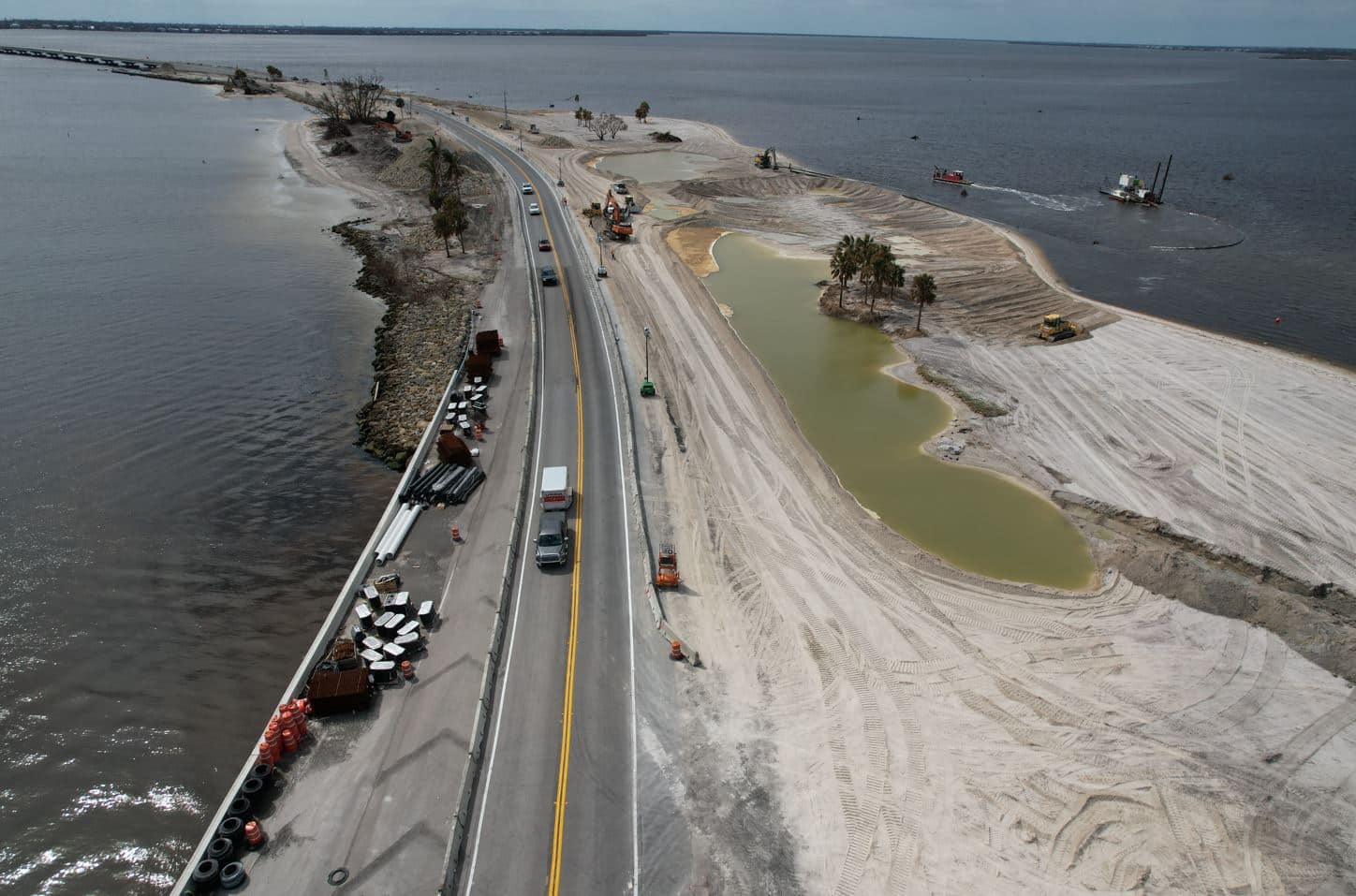
Superior Construction Completes Temporary Repair of Sanibel Causeway

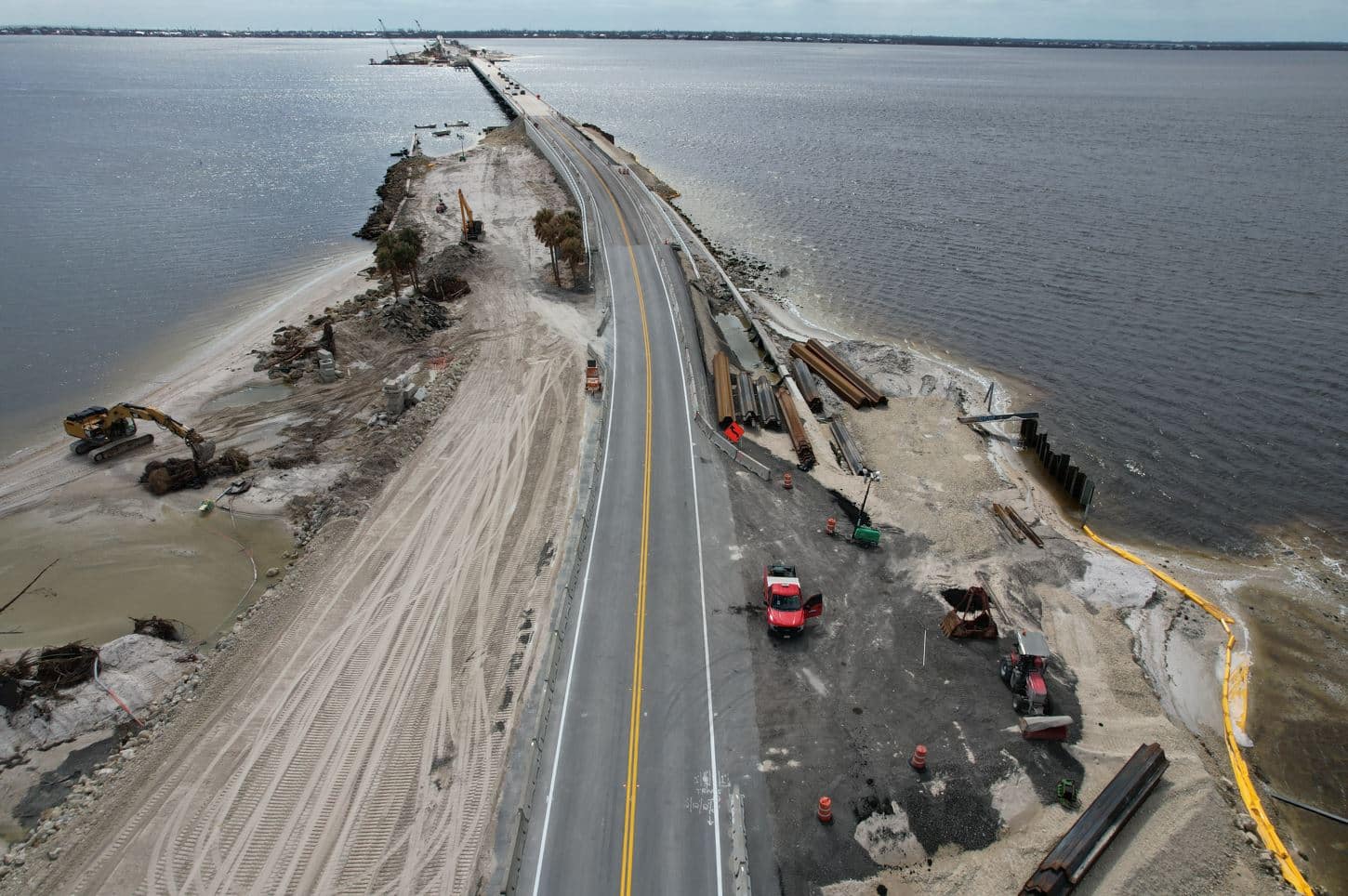
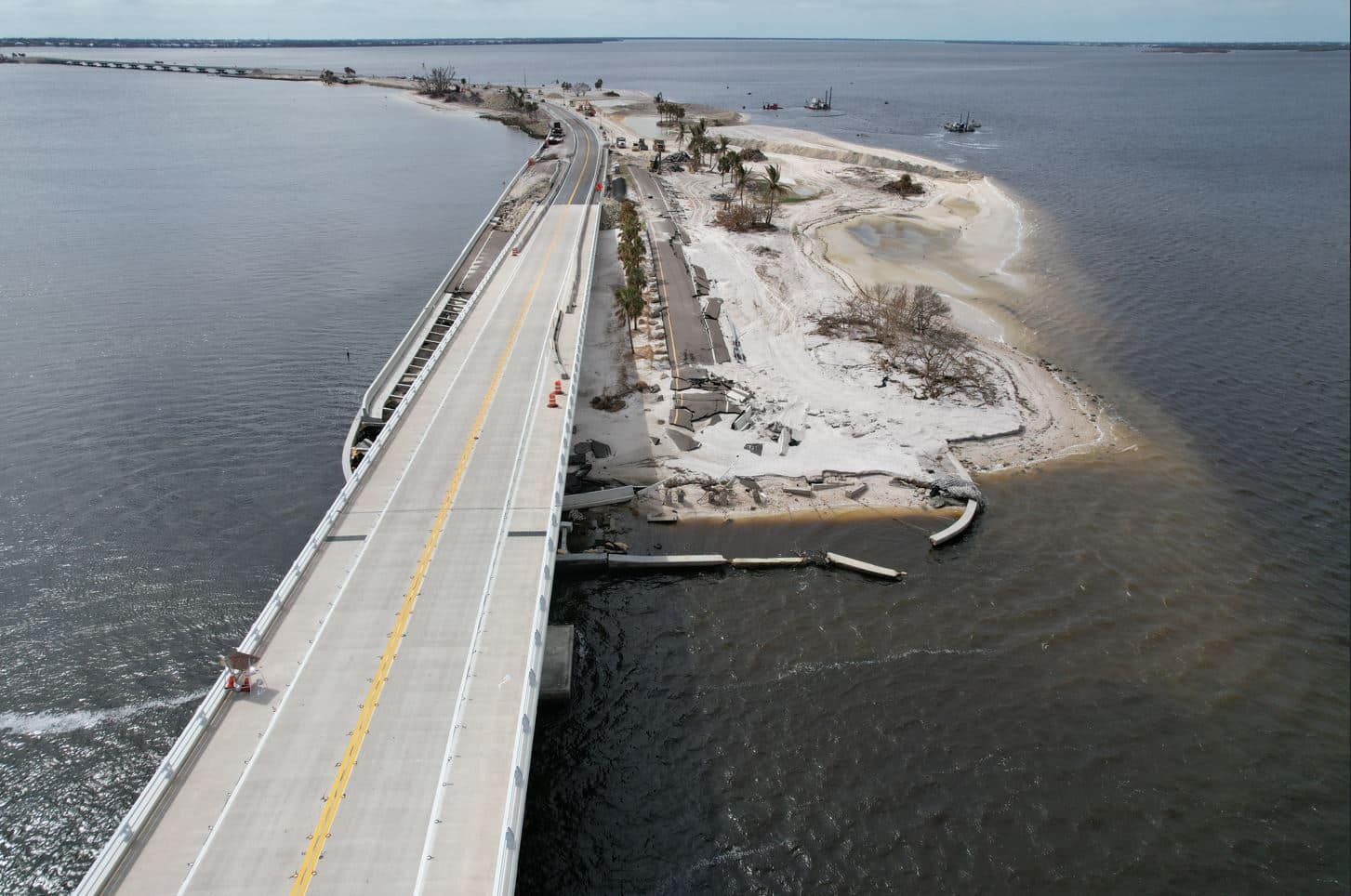
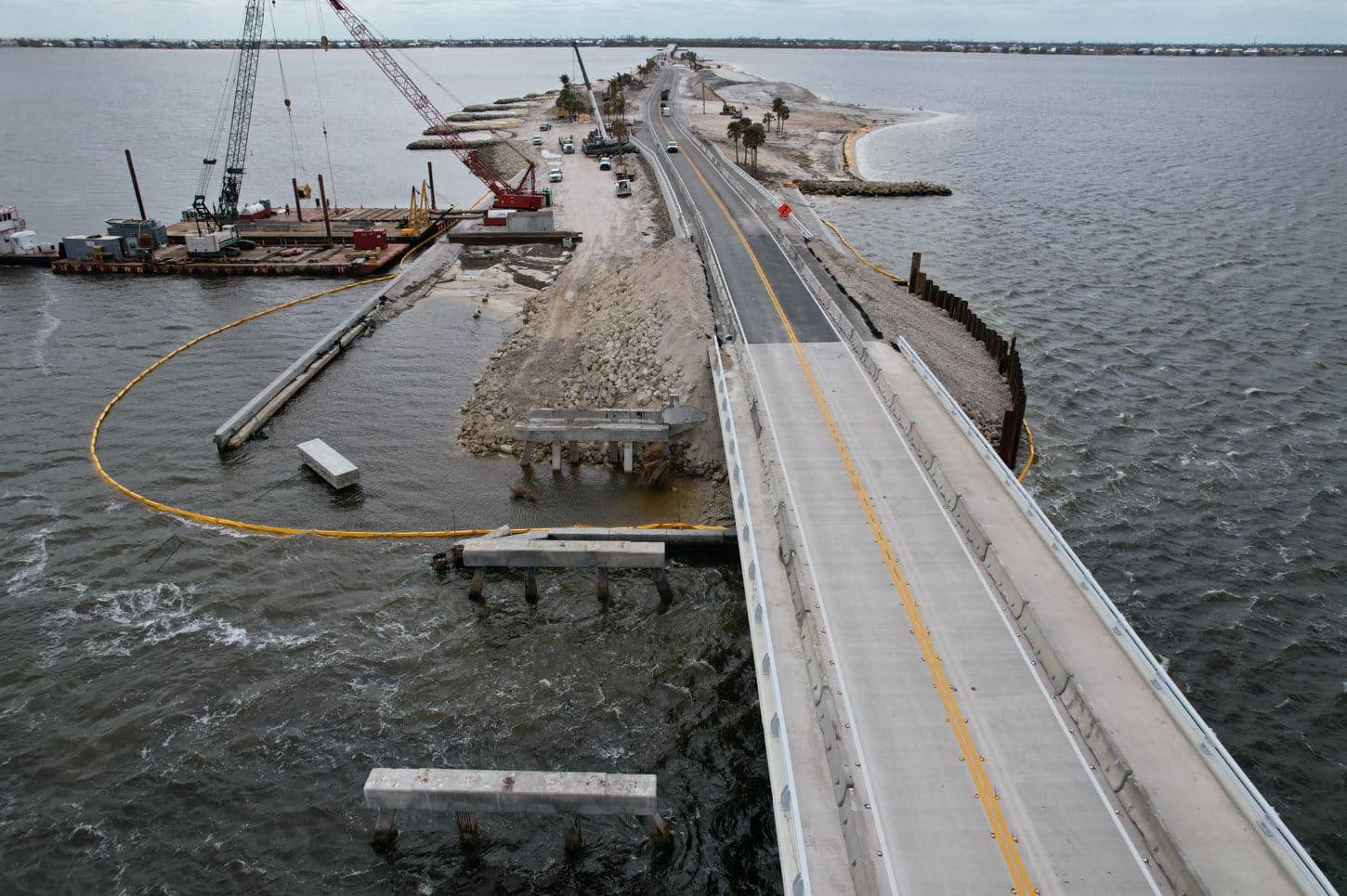
As Florida recovers from Hurricane Ian, crews from Florida-based heavy civil contractor Superior Construction are working around the clock to rebuild the Sanibel Causeway. On Wednesday, October 19, they completed temporary repairs allowing the causeway to be reopened to residents more than a week ahead of schedule.

Superior, in a joint venture with The de Moya Group, has worked collaboratively with Florida Department of Transportation (FDOT) staff to restore this vital infrastructure link. Collectively, the team has worked more than 36,000 workforce hours to bring residents back to Sanibel Island in just 15 days. Now, its crews will shift focus to long-term repairs needed to stabilize the bridge and allow permanent and unlimited access to the island. These repairs are necessary to rebuild the community so local businesses can thrive once more, as the island’s economy heavily relies on tourism.

“Hurricane Ian devastated Lee County, and it’s now our privilege to rebuild a crucial piece of infrastructure for our fellow Floridians and neighbors. It’s not a task we take lightly,” said Superior CEO Nick Largura.

According to FDOT, completing the temporary repairs required:

  • More than a hundred crews
  • 70 pieces of heavy equipment
  • Four barges, five boats and two dredges
  • Seven cranes
  • Dive teams with underwater survey equipment
  • 8,200 loads of fill dirt
  • 2,400 loads of rocks
  • 4,000 tons of asphalt

This work will tie into the permanent repairs Superior will now undertake as it continues long-term efforts to restore the Sanibel Causeway.

Superior Construction is an American family-owned and operated infrastructure contractor dedicated to providing innovative solutions with industry experts and leaders. First established in 1923 as the J Largura Company, the now fourth-generation family business evolved into Superior Construction by 1938. Throughout its history, the company’s foundation has always been building the infrastructure of America, successfully delivering projects across numerous delivery methods, with a specialty in design-build.

Get Smarter About Electric Construction Equipment

Sustainability in the construction industry is being advanced by the public and private sectors. Governments are adopting more clean-air regulations at local and regional levels and companies are adopting sustainability policies and asking partners to help them meet their targets.

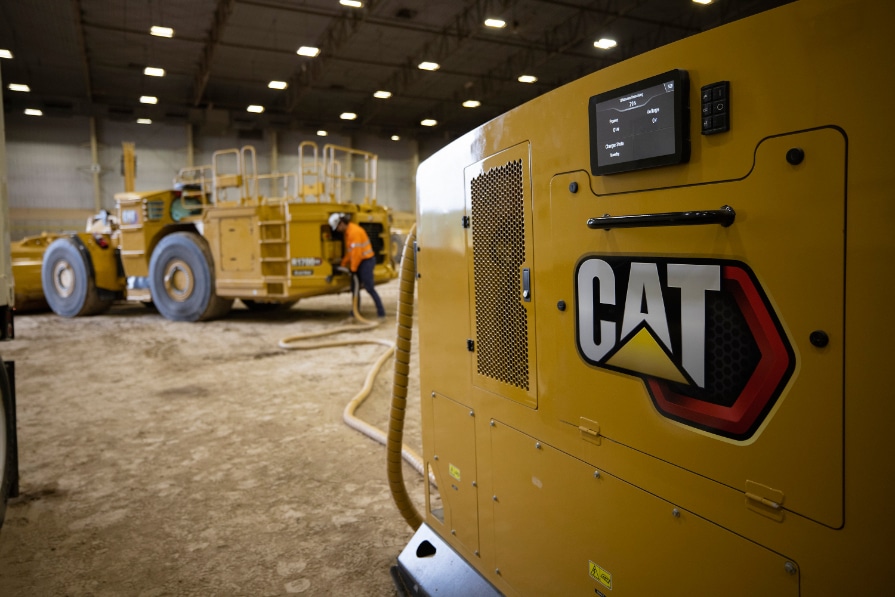
Consequently, many manufacturers have already developed – or are in the process of developing – electric-powered construction equipment to meet increasing emissions regulations, provide efficiency improvements, and lower operating costs. All electric, electric/hydraulic, and battery-operated versions rival their diesel and gas counterparts in performance, notes Joel Honeyman, Vice President of Global Innovation at Bobcat.

“People say electric machines are not going to perform as well as a diesel machine,” Honeyman observes. “That is simply not true. In many cases they can outperform them.”

“Many people are so used to what they have and are afraid of new technology. Some companies have been running diesel- and gas-powered equipment for 40, 50 years. Hydraulics have been on equipment for 80 years. Adjusting to an electric-powered machine is quite a paradigm shift.”

“We see electric-powered technologies and their applications spilling into our industry,” says Honeyman. “Look at what is happening in the auto industry. Tesla has really driven the battery electric concept and an entire industry is shifting.”

Asphalt Industry Seeks Efficiency in Electric Construction Equipment

Green construction technology is only getting better and smarter with new machine and equipment applications and opportunities, he adds.

Among the many advantages of electrification, says Honeyman, are “noise and vibration reduction, instantaneous power, and software features that are otherwise unavailable with a diesel engine and hydraulics.”

Sagaser adds that “the software features allow us to advance and accelerate the technology. We are doing it in a way that is more efficient and cost-effective, and beyond expectations from a power perspective. Overall, our electric innovations allow us to offer customers an experience they may not have previously imagined.

“We could have very easily removed the diesel engine and replaced it with a battery. Instead, our innovation team, which leads this project, wanted to see what other advantages we could achieve if we made it all electric and removed the hydraulics as well. That opened up a lot of possibilities.”

Honeyman, along with Matt Sagaser, Director of Innovation Accelerated at Bobcat’s Acceleration Center, will hold an Education Session – “Electrifying the Future: Get Plugged In” – at CONEXPO-CON/AGG 2023. They will examine the advantages of electric construction equipment beyond just being “green.” They will also discuss what an all-electric platform allows construction equipment manufacturers to do.

Catch their session by registering for CONEXPO-CON/AGG here and use code MEDIA40 by October 28 to save 40 percent off your badge.

Train All Workers Now for Safety, Quality Later

We’re entering the ideal time for training all crewmembers—veteran workers, newer hires and those you may have seen as “extras” on a side crew. You’ll see a list of training schools and consultants who partner with us at AsphaltPro.com. The point behind holding schools during January, February and March is to give you the best opportunity to send key personnel to training when you’re not experiencing high production.

Knowing how to perform paving and pavement maintenance tasks properly leads to safe equipment operation and safe practices, too. Your crewmembers have their best chances of going home safe and sound at the end of the day when they know how to do their jobs correctly and know how to use their equipment properly. Even if you have workers you would consider transitory or short-term, you care about their health and safety and you care about their impact on their co-workers’ health and safety.

A chain is only as strong as its weakest link.

Look at the milling machine as an example. Ensure the milling machine operator knows how to lock out and tag out before replacing a tooth on the cutter drum. Give ground personnel the opportunity to sit or stand atop the machine to learn what the operator can and cannot see from the operator platform; they need to be made aware of blind spot dangers from this machine. Teach the operator and/or the mechanic how to safely clean and maintain silica dust suppression equipment on larger mills where such equipment is required.

Look at the broom. You probably have workers who actively avoid being stuck with running the broom on the job, but they each need to understand its proper operation to keep dust clouds down without flooding the job and to keep filters at peak performance for clean cab air. Make all the personnel who might run this equipment aware of how to tether fall-arrest protection when cleaning the windshield. If someone has a problem with such safety precautions, that person needs to revisit his or her OSHA 10-hour before being turned loose on the job.

You can apply similar concepts to nearly every machine on the paving train.

Then look beyond the heavy equipment. Have you assigned “buddies” so each member of the crew has a partner in the field? The two are responsible for one another. If one is a veteran of the company, he could serve the dual purpose of mentoring the newer worker, helping to raise quality as well as safety for the operation. It’s important to let the long-time employee know that his job is secure and he is valued to protect against resistance to training the newbie. Remind veteran employees of their importance to the organization when adding them to a buddy system. Remind all workers of their importance to you when offering them advanced education for their safety and the organization’s improved quality. Remind them and all levels of management that it’s NOT a waste of time to train any worker on your team.


Get more tips like this delivered to your inbox each week! Sign up now for AsphaltPro‘s Toolbox Tips newsletter.