Risk in the Time of Suicide

During a recent interview, a company spokesperson suggested I rethink my idea of encouraging crewmembers within construction companies be empowered to talk to one another about the potential for suicide. The spokesperson’s fear—which I understand—was company liability considering HIPPA violations inherent in such conversations. I also understand we’re talking about a potentially lifesaving conversation to inquire of a colleague if he or she is in crisis or if he or she is considering an act of violence against himself or herself.

Perhaps it’s time to have an editorial note about the goals of a safety culture that considers the whole person. And timing that note with September’s Suicide Prevention Month works for me.

While preparing information for the National Asphalt Pavement Association’s safety and health committee’s push for mental health wellness and suicide prevention in the construction industry, I have had the opportunity to take courses for certification in suicide prevention. These courses have afforded me a better understanding of the risk factors to watch for in colleagues, family, friends, myself, and others. Now I know acceptable, non-judgmental language to use to approach and visit with those persons in a helpful manner. This is an underlying skill set that I believe every person in our industry should have.

If that makes human resources directors nervous about potential litigation, then I believe the companies for which they work should purchase additional legal insurance and get a lawyer on retainer. Because the construction industry overall has a significant problem: Many of our workers are in crisis. To solve that problem, we must all be willing to help one another. I refuse to recognize a friend in the industry is suffering and walk away to find the nearest HR manager—who my friend may or may not be as willing to open up to—because someone else thinks I’m exposing the company to invasion-of-privacy concerns. Personally, I’d be more unhappy if a co-worker went to HR and tattled about perceptions of me rather than walking up to me and saying, “Hey, Sandy, it looks like you’re about to break down. How can I help prevent that?”

The problem of ignoring mental health wellness in macho industries like ours is real. Seeing members of the construction community rally around solving the problem has been heartening; therefore, I don’t want to present my worries in too flippant a manner.

Just because some folks who have endured the litigious side of society are being cautious doesn’t mean they’re being callous. It means they’re being careful and looking at multiple sides of the issue for us. I’d like to hear more opinions on this. I want to learn alongside you as we develop plans to help the workers who may be struggling with any of the suicide risk factors we’re being trained to pick up on.

Let me ask this favor of you: Tell me what you think.

Would you rather have members of your crews trained to notice suicide risk factor behavior in one another and to approach one another to assist, or would you rather have your safety director and/or upper management be the ones trained in intervention for the purpose of protecting your company from any perceived health information violations?

I know that I would rather each member of the crew be able to approach any person he or she is most comfortable approaching to say, “Hey, I’m having some mental anguish and I can’t concentrate on this 16,000-pound machine I’m supposed to be operating next to high-speed traffic.” I would prefer the potential for someone to misunderstand motivations and feel their health privacy has been shared incorrectly, than to having the person zoning out and trying to power through his or her shift until he or she can get back to the shop to walk into the office of the company-approved crisis management officer, with everyone watching.

But have I oversimplified the problem? Have I made it too cut and dry? Let me know your thoughts, because I’m working with a safety-oriented entity to prepare for NAPA’s website a course that will train your workforce (for free) to recognize the signs and help one another. If that isn’t desired—if that will expose you to litigation you don’t want—then now is the time to re-think the training.


Visit the National Asphalt Pavement Association’s new page with resources related to mental health and suicide prevention in the construction industry.
How to Recognize Heat Exhaustion in Crewmembers

If a laborer stands to the side of the project, leaning heavily against the lute while he rubs a cramp out of his arm, and then stumbles or weaves his way back to the mat, you need to react. Someone on the crew needs to recognize and react to what’s wrong with this worker before his condition progresses. In the blazing heat of August paving, he may be suffering from dehydration and heat exhaustion; you want to help him before he succumbs to heat stroke.

The Occupational Health and Safety Administration has oodles of resources to help you train your workers to see the signs and convince the worker of what’s going on.

Some symptoms of heat exhaustion crewmembers should watch for in one another include weakness, headache, excessive thirstiness, nausea (and actual vomiting), muscle cramps, dizziness, confusion, and pale and clammy skin. The foreman is typically the member of the crew who will have responsibility for the workers on site, but it is each person’s goal to watch out for his colleagues. Safety is everyone’s responsibility.

Here are some ways to help your co-worker:

  • Move him to a shady (or air-conditioned) spot.
  • Loosen/remove tight tool belts, etc.
  • Give him plenty of fluids (not caffeine).
  • Place a cool, wet towel on his neck or face.
  • If he hasn’t recovered in 15 minutes, it’s time to visit the emergency room.

These symptoms and tips come from Web MD.

Bonus Tip: Don’t forget the plant personnel during the dog days of summer. Make sure your plant operator knows to keep an eye out for ground workers who appear to be “weaving” when they walk or for equipment operators who have been out of sight for an extended period of time. Your plant team members should also know the signs of heat exhaustion and should be on the lookout for those signs in one another. Stay safe out there!


Sign up now to receive tips like this to your inbox each week!

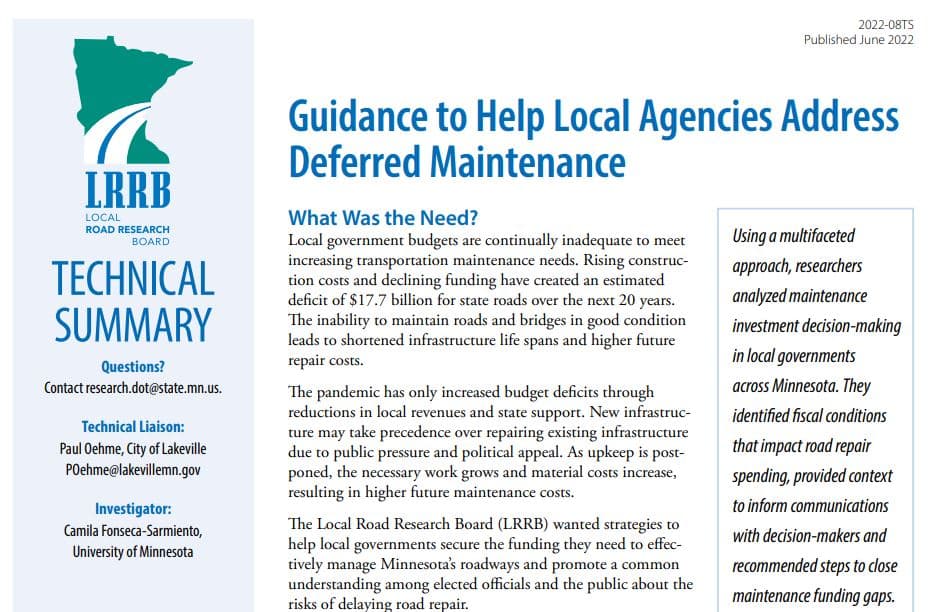
Minnesota DOT Research Offers Guidance to Help Local Agencies Address Deferred Maintenance

Budget shortfalls, higher material costs and the ongoing pandemic are just some of the causes behind Minnesota’s local governments postponing road maintenance work. However, delaying road maintenance activities in the short-term can result in deteriorating asset conditions, which only makes maintenance and repair more expensive. 

That’s why the Minnesota Department of Transportation has conducted a recent project to help local transportation agencies make better-informed expenditure decisions and understand the impacts of deferring maintenance on state roads.

“The goal of this project was to better understand how local governments across the state make transportation maintenance expenditure decisions, the primary factors influencing those decisions and the impacts of deferring maintenance on state roads,” reads the report.

Project Details

Researchers engaged in a multifaceted approach to analyze transportation maintenance decision-making in local governments across Minnesota, from which the research team was able to develop case studies on local government road maintenance decision-making.

“Building on the learnings from the case studies, researchers conducted a survey in which representatives from 31 local Minnesota governments described the size and condition of their roadway networks, challenges with managing maintenance investments, funding gaps and strategies they use to minimize deferred maintenance,” the report continues.

Although infrastructure conditions and safety needs primarily drive local government maintenance investments, the research team found other factors also play a role, including infrastructure age, maintenance history, public input, material and labor costs, and staff capacity. 

Research Findings

Ultimately the researchers concluded that although overall investment has generally increased, there was a lot of variation in the agencies’ unmet needs ranging from $1 million to $30 million to restore pavements to acceptable condition levels. 

Researchers also found that the larger the share of federal and state grants in total revenues, the smaller the share of total roadway expenditures is spent on maintenance. “This finding suggested that intergovernmental funding is invested in transportation projects other than maintenance, such as construction,” reads the report.

On the other hand, the more debt a local government pays back, the more maintenance spending tends to increase. The report suggests this may be due to a hesitancy to invest in construction under those circumstances. 

With decreased state support and limited local funding capacity, the report states cities and counties are trying to close maintenance gaps by using new funding sources such as taxes or fees, completing more work in-house and performing more preventive maintenance. 

Researchers’ Recommendations

Based on their findings, researchers have several recommendations to help local transportation agencies secure and maintain adequate funding to meet their road maintenance needs, including the following: 

  • Adopt a standard definition of deferred maintenance. 
  • Identify pavement and bridge condition targets. 
  • Estimate funding needed to achieve and maintain condition targets. 
  • Monitor and report road conditions, trends and target achievement. 
  • Plan and coordinate maintenance activities with other stakeholders. 
  • Maintain a consistent funding stream for roadway maintenance activities. 

Going forward, the conclusions and recommendations from this research will serve as a reference tool for local public works directors and engineers who are responsible for budgets and work with elected officials to secure adequate maintenance budgets.

ARTBA Foundation Announces 2022 Hall of Fame Class

Pennsylvania highway contractor Donald B. Stabler, Utility & Transportation Contractors Association (UTCA) of New Jersey CEO Robert A. Briant, Jr., E-Z Pass co-founder James “J.J.” Eden, and iron plow inventor John Deere are the 2022 inductees into the American Road & Transportation Builders Association (ARTBA) Foundation’s “Transportation Development Hall of Fame.”

The Hall “honors individuals or families from the public and private sectors who have made extraordinary contributions to U.S. transportation development during their careers.”

Nominees are in two categories:

  • Transportation Design & Construction Industry Leaders (Individuals or Families): Recognizesmen, women and families who have made significant contributions—beyond just having successful businesses or careers—that have notably helped advance the interests and image of the transportation design, construction and safety industry.
  • Transportation Design & Construction Industry Innovators: Honors the men and women who discovered or created a “game changing” product or process that significantly advanced transportation design, construction and/or safety.  It seeks to honor the original innovator.

The class will be formally inducted during a May 2023 event at ARTBA’s Federal Issues Program, held in the Nation’s Capital.

Leader: Pennsylvania Contractor Don Stabler (1908-1997)

Donald B. Stabler entered the highway construction business in 1940 as a sole proprietorship. In 1955, he merged that proprietorship into Stabler Construction Company, laying the foundation for Stabler Companies Inc., which would employ 1,200 people throughout Pennsylvania and other states. New Enterprise Stone & Lime Company acquired the Stabler Companies in 2008.

Stabler was the founding president of The Road Information Program (TRIP) and nicknamed “Mr. TRIP” in recognition of his support and dedication to the organization’s efforts to promote public awareness of the nation’s transportation needs. TRIP celebrated its 50th anniversary in 2022. Stabler was a past president of the Associated Pennsylvania Constructors, and an active member of ARTBA, the American Society of Highway Engineers, and the National Asphalt Pavement Association.

He and his wife formed the Donald B. and Dorothy L. Stabler Foundation to provide financial support and material aid to charitable, religious, scientific, and educational organizations. In 2008, Lehigh University announced a $34 million bequest from the Stabler Foundation to provide scholarships to students with demonstrated need—it was the largest gift in university history at that time.

Leader: UTCA of New Jersey CEO Robert A. Briant, Jr.

In four decades of advocating for New Jersey contractors, Robert A. Briant, Jr., has become a champion of transportation investment.

Serving as CEO of the UTCA of New Jersey since 2006, Briant has continued in the footsteps of his father Robert Sr., who held the same position for 33 years starting in 1973. With the membership’s help, father and son built UTCA into the Garden State’s most effective voice for investing in transportation, water, and utility infrastructure.

A confidante of the state’s governors, legislative leaders and transportation officials from both parties, Robert Jr., has led efforts to pass two dozen laws that are shaping the state’s infrastructure network and the work environment for contractors building it. Most notable was his leadership of a broad-based coalition that pushed for a transformative renewal of the state’s Transportation Trust Fund in 2016. It included a long-overdue fuels tax increase and unprecedented 8-year capital program that is putting that new revenue to work.

Innovator: James “J.J.” Eden

If you have an E-Z Pass device on your windshield that expedites your toll booth trips, you have James “J.J.” Eden to thank. His passion for learning, innovating, and embracing modern technologies have made him a pioneer in the transportation and tolling industries for more than a half-century.

Eden’s career path included posts as assistant chief engineer with the Pennsylvania Turnpike Authority, head of Lockheed Martin’s electronic toll collection division, and the lead of transportation programs and services at AECOM. He is the current executive director of the North Carolina Turnpike Authority.

In 1988, he co-founded the Interagency Group, better known to motorists as E-Z Pass. He wrote the business rules and operating procedures for the group, which launched in 1990 in New York, New Jersey, and Pennsylvania. Today, E-Z Pass is the world’s largest interoperable toll collection program, consisting of 45 agencies in 19 states, serving 49 million transponders, and collecting more than $14 billion annually in electronic toll revenues.

Eden’s future focus remains on developing innovations that will prepare transportation agencies and partners worldwide for connected vehicles, autonomous vehicles, cloud-based systems, and national interoperability.

Innovator: John Deere (1804-1886)

A blacksmith by trade, John Deere found himself making the same repairs to plows repeatedly in his Grand Detour, Ill., shop.

Realizing the wood and cast-iron plows used at the time were not up to the challenges presented by Midwestern prairie soil, Deere began experimenting with new designs. He eventually crafted a new piece of equipment: a self-scouring plow made of steel from a broken sawblade.

Deere sold his first one in 1838. He then produced 10 improved plows by the following year, and 40 more the year after that. Increasing demand in 1843 led Deere to partner with Leonard Andrus to produce more inventory and by 1857, their annual output of plows was 10,000.

In 1868, Deere’s business incorporated under the name Deere & Company, and today is a world-leading equipment manufacturer headquartered in Moline, Ill., with 2021 revenue of $44 billion.

Established in 1985, the ARTBA Foundation is a 501(c)3 tax-exempt entity designed to “promote research, education and public awareness” about the impacts of transportation investment.  It supports an array of initiatives, including educational scholarships, awards, management and education programs, roadway work zone safety training and certificates, special economic research and reports, and an exhibition on transportation at the Smithsonian National Museum of American History.

FleetWatcher Partners with OnStation to Pinpoint Location of Each Asphalt Load

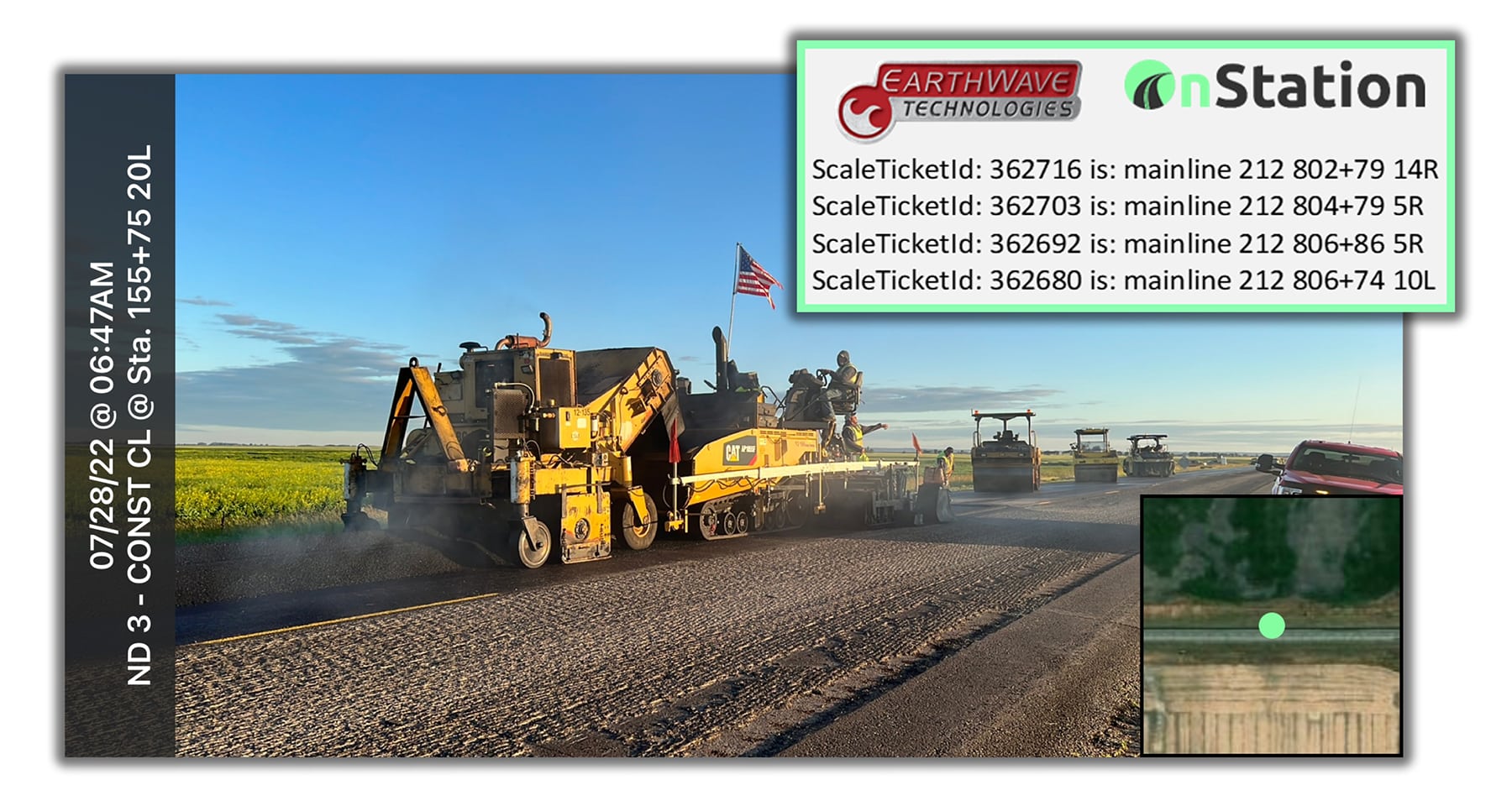
Earthwave has integrated their e-ticketing functionality with OnStation to allow users to pinpoint the exact Station Location where each load of asphalt is placed on a jobsite.

This new functionality automatically tracks the load from the time it is loaded at the asphalt plant, through its dumping into the paver on the jobsite.  The exact Station location becomes a part of the digital e-ticket, with no operator intervention required.

Operators and transportation agency officials can know precisely on a jobsite where a specific load of asphalt was laid, so that if a future problem arises, they can investigate other parameters around that location, including core tests, density, drainage, or others, to determine the scope of the problem.  Specific station locations on each e-ticket replace the latitude/longitude indications which are commonly included now, but which are not readily referenceable on the jobsite.

This versatile functionality is also applicable for loads of aggregate or other materials commonly used on road construction jobsites.  Because it is automatically added to the e-ticket, the information is readily available to DOT and construction crew personnel, whether they reference it in a week or a year.

Best Practices for a Smooth Mat on Your Overlay

Whether your crew must perform the “fill” portion of a mill-and-overlay or the county is only paying for a 1-inch overlay atop a suspect pavement, getting the basics right is what contributes to your success and full pay. Here we go.

Auger height affects the head of material, of course. To get the head of material right, the paver operator will set the paver speed and auger rotation so that mix reaches the center of the augers as it feeds under the tractor. Your mat depends on getting the head of material right. That means you want to train the crew to set up the augers for success; train them to get the center of the augers in the right space.

They have to start with a tape measure and the job specs. They need to know the depth they’re paving and the height of the pavement they’re matching. They need to know which part of the paver is the auger, and they have to understand which part of the auger is the head of its curl. These things are a given to you and me; make sure you point them out to new members of the crew so no one has to feel “behind the eight ball” asking what they are.

When you feel confident in your crew’s knowledge of the equipment, have them set the screed down and pull ahead of the pavement they’re going to match. Then have one of the screed operators measure from the augers to the ground with a tape measure. Is the bottom of the auger sitting 6 or 7 inches off the ground? That’s too high and the crew will end up fighting with too much mix as they pave. Instead, teach them to go with the rule of thumb that augers should be 2 inches above the existing mat. If they have a 2-inch mat to match, they want the bottom of the auger to be 4 inches off the ground. They should measure and set the bar appropriately.

Also teach them to measure from the head of the auger curl to the pre-strikeoff. This area/length should be 5 to 6 inches. If the augers have worn too much, the worker will see a larger space in there—6 to 7 inches—which will create the over-feeding problem as well. That’s one of the reasons it’s important to check the condition of the augers for thickness and wear.

Also remind your workers of the importance of cleaning the box, giving equipment a proper wash-down so the area isn’t dropping chunks of old, cold material into the hot, tested mix.

The training you give the crew before the overlay project starts will set them up for success and full pay at the end.