NAWIC Philadelphia Foundation partners with NEST Nurtures to Inspire Next Generation of Women in Construction

The National Association of Women in Construction (NAWIC) Philadelphia Foundation and NEST Nurtures announced the 13th annual MyWIC camp will bring real-world experiences and mentorship to girls in the Philadelphia area this summer. The free in-person construction camp for girls will provide education about the opportunities that exist in the construction industry, regardless of gender.

The MyWIC camp, which stands for Mentoring young Women In Construction, will take place up to three days per week throughout Philadelphia from July 6 to Aug. 10. MyWIC is run by the NAWIC Philadelphia Foundation, which partnered with companies like NEST, a leading national facilities management company, and Girls Inc. of Greater Philadelphia to make it a reality. NEST Nurtures is NEST’s philanthropic division.

“We are thrilled to see the lasting impact of the MyWIC camp, as many of our girls have gone on to successful careers in the trades and construction over the last 13 years,” said Mary Gaffney, NAWIC Phila. Foundation President. “By the end of the camp each summer, we see a tangible increase in the girls’ self-confidence, self-esteem, and their overall self-image.”

“Through the coordination of companies like NEST, we provide the girls with real-life experiences and access to leaders across the Philadelphia area,” added Gaffney.

“When we first partnered with MyWIC in 2021, our team at NEST, along with many of our retail partners in Philadelphia, saw firsthand the impact this camp can have on the girls,” said Rob Almond, CEO of NEST, which is based in South Jersey. “We’re thrilled to help support and add resources for MyWIC this year and continue to introduce the opportunities that exist in our industries for the next generation of women in construction.”

The day camps will take place at several trade locations throughout the Philadelphia area during the months of July and August. Each day, the girls will learn about a specialty within the trades, including carpentry, sheet metal, safety training, electricians, finishing trades, steamfitters, plumbers, and retail construction.

NAPA Releases First-of-its-Kind Emissions Inventory for Asphalt Pavement Mixtures

Cradle-to-gate emissions associated with asphalt mix production in the United States represented approximately 0.3% of total U.S. greenhouse gas (GHG) emissions in 2019. By comparison, U.S. Environmental Protection Agency data indicate that transportation emissions from fossil fuel combustion represented 27.8% of total emissions in 2019, while industrial emissions represented 25.3%.

That’s according to a new report from the National Asphalt Pavement Association (NAPA), authored by its Director of Sustainable Pavements, Joseph Shacat; Vice President of Engineering, Research, & Technology, J. Richard Willis, Ph.D.; and TriSight LLC Partner Ben Ciavola, Ph.D.

The report, GHG Emissions Inventory for Asphalt Mix Production in the United States (SIP 106), is the first national cradle-to-gate assessment of GHG emissions associated with the production of asphalt pavement mixtures that uses a life cycle assessment-based methodology. The emissions inventory includes upstream raw materials inputs, transportation of those materials to the production site, and plant emissions (including upstream energy processes) for the years 2009-2019.

“Publishing this report puts NAPA and the asphalt pavement industry at the forefront of transparency among carbon emitters,” said NAPA President & CEO Audrey Copeland, Ph.D., P.E. “We’re demonstrating our commitment to doing better – as prescribed in The Road Forward initiative we announced in January – by taking stock of where we are and identifying proven as well as innovative strategies to reduce carbon emissions.”

“To our knowledge, this is one of the first cradle-to-gate GHG emissions inventories for any major U.S. industry,” added Shacat. “While there are several studies that show cradle-to-gate emissions intensities for various industries, we’re not aware of any publicly available reports that add up all of the emissions for a given industry nationwide.”

Jim Mertes, Director of Environmental Affairs at Construction Resources Management, Inc., A Walbec Group Company, and Chair of NAPA’s Sustainability Committee, described the report as “a comprehensive industry benchmark, which can be used to measure future industry improvements in carbon reduction.” What’s more, said Mertes, “It identifies what we can achieve using existing strategies and technologies and demonstrates the unprecedented technological challenge ahead to get to net zero.”

By identifying ‘avoided emissions,’ the report demonstrates how existing environmentally preferable technologies like reclaimed asphalt pavements (RAP), reduced-temperature asphalt mix production (called warm-mix asphalt, or WMA), and switching to alternative fuels for plant operations have already had an industry-wide impact on limiting emissions.

In 2019 alone, the industry avoided 2.9 million metric tons (MMT) CO2e emissions – equivalent to the annual emissions from approximately 630,000 passenger vehicles.

The authors note that increased implementation of such measures could further reduce emissions by up to 24% relative to 2019. In fact, each ton of RAP used in new asphalt mixtures reduced 2019 GHG emissions by approximately 27 kg CO2e.

However, they caution, “Although the report provides an estimate for the national average GHG emissions associated with asphalt mix production, it is not an industry average Environmental Product Declaration (EPD) and should not be used as a benchmark for project-level decision making during procurement or project delivery.”

Nonetheless, the report “will be a valuable tool as discussions with government, agencies, and owners accelerate in the coming years,” said Ron Sines, P.E., Vice President, Performance – Asphalt, CRH Americas Materials, Inc. “Additionally, it provides clear direction on what the industry should be doing today, as well as what the industry could do in the future, if the identified obstacles can be overcome,” added Sines, who chaired NAPA’s Climate Stewardship Task Force, which created The Road Forward, the industry’s goal to reach net zero carbon emissions by 2050.

To advance that goal, the report states, “New technologies and additional innovative practices will need to be developed and implemented to achieve more significant GHG emission reductions.” The industry, along with its suppliers, partners, and customers, must invest in emission reduction strategies related to materials, transportation, and mix production. Examples include carbon capture, utilization, and storage (CCUS); use of carbon sequestering bio-based materials; use of local recycled materials and alternative fuels for trucking; and technologies that reduce burner fuel consumption.

Raven Adams, Vice Chair of NAPA’s Sustainability Committee and Granite Construction’s Sustainability Manager, remarked, “NAPA’s publication of this document will empower our industry to advocate for the funding, research, and support needed to allow us to respond to climate change.”

Micromanage the Stockpile for Micro Surfacing Success

One pavement preservation method to monitor closely throughout the project is micro surfacing. Among the materials that require quality control/quality assurance so you get proper coverage and a smooth, clean end result is the aggregate.

Just because you test the stockpile back at the plant and come up with numbers that fall within spec doesn’t mean the rock fed from the nurse truck to your micro surfacing paver will be on spec. “Things” happen.

For best practices, have your loader operator feed material from the stockpile to a vibrating screen. On-spec material can then be fed through the screen, up a conveyor, and into the nurse truck or directly into your micro surfacing paver. Even if your stockpile is located onsite, are you sure your loader operator is feeding the on-spec material to the machine?

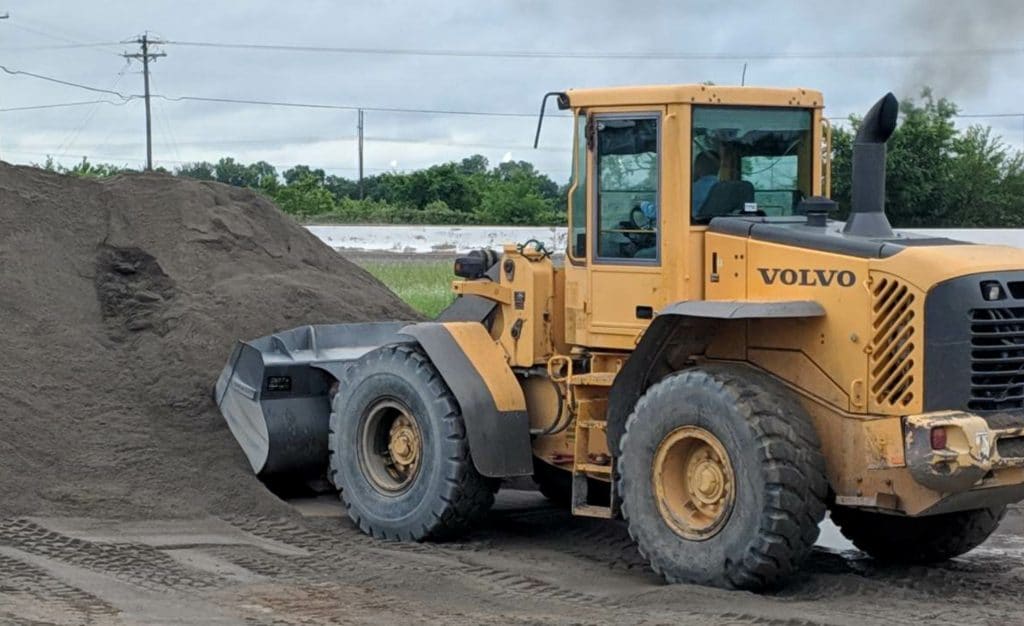
If you’re lucky enough to have the stockpile built on a clean, paved surface, you may be golden. But if the stockpile is on a gravel or dirt area, your loader operator must be trained to avoid scooping along the ground. You don’t want contamination getting into the micro surfacing operation. Your best bet is to screen your micro surfacing aggregate to ensure it’s on target.

Is there someone in your organization or network you should share this tip to?


Subscribe now to receive tips like this to your inbox every week!

Five Excavator Technologies to Improve Your Bottom Line

While technology has been enhancing excavator performance for more than a decade, end-user demand for certain features has accelerated in the past few years.

We talked with leading manufacturers to get their take on those innovations that provide the typical construction company with the best bang for the buck—innovations that allow excavator operators to:

  • Dig and grade faster
  • Eliminate guesswork
  • Reduce fuel consumption
  • Enhance operator comfort
  • Improve safety

1. GET TO GRADE IN CONSIDERABLY LESS TIME

Ryan Neal, Market Professional and Product Application Specialist for Large Excavators at Caterpillar, says 2D grade control has been a game-changer. The operator simply selects target depth and slope, and sensors and onboard processors provide real-time guidance on the distance to grade. That eliminates all of that in and out of the cab to set up stakes and lasers, oftentimes slicing an operator’s productivity in half.

Matthew McLean, Product Manager for GPE Products at Volvo Construction Equipment, says interest in 2D indicate systems has exploded over the past two years. Demand was initially driven by the typical contractor’s desire to save time. More recently, it is all about the industry-wide challenge of finding skilled workers.

“A newer operator might not be as fast, but at least they’ll be on grade because the monitor screen in the cab will let them know both visibly and audibly,” McLean points out. “Volvo’s system, Dig Assist, as seen in the above photo, is also designed to be easy to use, which is why we’ve made it standard on our 22- to 55-ton excavators. On virtually all other models, Dig Assist is an option.”

2. SEMI-AUTONOMOUS DIGGING AND GRADING

Volvo calls its system Active Control and offers it as standard equipment on five excavator models: the EC220EECR235EEC250EEC300E, and ECR355E. “We’ve gone electric-over-hydraulic in the controls because we now have joysticks talking directly to computers and the valve and pump,” McLean explains. “When Active Control is turned on, once you get within a window of 4 inches (10 cm), you can just pull back on the arm lever and the computer helps you dig.”

At the basic level, Active Control controls the boom to prevent operators from over-digging. But it can also be set up to control bucket angle and can even control a tiltrotator. Operators can allow the system to control back grading and can also specify if they need to achieve a finer or rougher (normal) grade. Finally, functionality such as swing control and swing fence help operators dig and load more efficiently while avoiding side obstacles.

On that note, Caterpillar has made its swing-control technology, 2D E-Fence, standard on its excavators. This safety system uses data from position sensors to automatically stop motion when the front linkage reaches the operator-defined boundaries.

3. CALCULATING MATERIAL WEIGHT

Caterpillar’s Neal points to one other game-changing technology that has come to excavators in recent years. Cat Payload uses cylinder pressure data and machine sensors to continuously calculate material weight while the excavator works.

Neal recalls visiting a contractor in the Boston area recently. The contractor was using a Cat 395 Excavator to dig a massive foundation. “The contractor was using both the 2D grade control and the payload system—just as we’d intended for them to be used,” Neal says. “The contractor said they loaded 136 trucks and were within 2% accuracy on all of them. That almost brought a tear to my eye.”

4. HIGHER PRODUCTION, LOWER FUEL CONSUMPTION

With the right equipment and technologies, improved productivity can also result in reduced fuel costs. Doosan excavators feature two innovations that can reduce machine fuel consumption.

The D-ECOPOWER system, an option on select models, features an electronically controlled pump, a closed-center main control valve, and nine sensors that electronically detect and control the precise amount of hydraulic oil required to perform a task.

“The exact amount of oil required is metered instead of a fixed amount continuously being forced through the system,” says Aaron Kleingartner, Product and Dealer Marketing Manager for Doosan Infracore North America. “The hydraulic system output requirements are optimized with engine horsepower. The resulting efficiency reduces fuel consumption and improves productivity substantially. Improved feedback through the controls also results in an outstanding level of operator comfort and much smoother machine management.”

A second innovation from Doosan is its Smart Power Control. Controlled by the ECU (engine control unit), this technology is implemented through two systems, variable speed control, and pump torque control, that work together to improve efficiency while maintaining productivity. “Smart Power Control can save as much as 5-7% in fuel consumption,” Kleingartner says.

5. CAMERA SYSTEMS

Cameras are also taking excavator productivity and safety to another level. For instance, Caterpillar excavators come standard with two cameras, one on the right side and one at the rear. A four-camera system is also an option for contractors who want to maintain a 360° view around the excavator.

Over the past five years, Doosan’s Kleingartner says technological innovation has accelerated with respect to cameras. Doosan offers a standard rearview camera and an optional side view camera. Operators can view one or both (side-by-side) on the LCD screen in the operator’s cab.

“At CONEXPO-CON/AGG 2020, Doosan previewed its newest camera system, an all-around view monitoring system (AVM), that gives operators a 360° view of their surroundings,” Kleingartner says. Five unique perspectives can be seen from the separate AVM monitor: top view, rear view, top-right view, rear-corner view, and 3D view.

Volvo’s McLean also agrees camera systems have come a long way. The company began adding backup cameras more than a decade ago. Most recently, in 2020, Volvo Smart View was developed and has since been made standard on Volvo general purpose excavators (EC140 and larger).

Now the industry is beginning to work on a camera system that warns the operator when certain movement is detected, McLean points out. Additionally, the future of excavator tech is likely to include increased adoption of things like 3D grade control, remote control operation, and even certain levels of autonomous operation. But as of right now, more construction contractors are making better use of game-changing technologies that have been available and continually improved for years.


Monitor Thermal Mapping Intelligently

The concept of intelligent compaction (IC) is not new to the asphalt industry. We’ve been talking about it and sharing “how to” achieve density of asphalt mats with IC for as long as AsphaltPro has been in publication. (That would be since 2007 for those of you following along at home.)

I remember in the early days having a screen at the operator’s platform that showed black-and-white vertical lines that filled in as roller operators completed passes, merely helping the operator keep count. While that might seem rudimentary to us today, it was a steppingstone on the path to intelligent compaction/infrared (IC/IR) technologies some state departments of transportation (DOTs) are now considering as part of quality assurance and pay factors.

In the June 2020 issue of AsphaltPro, we gave a breakdown of paver-mounted thermal profiling (PMTP) so I won’t re-hash that here. We’ve shared a handful of thermal mapping camera technologies that manufacturers such as Vögele—and others—have released to the market so I won’t re-hash them all here. I’m not trying to “sell” thermal mapping systems with this editorial message. Instead, I wish to remind readers of the evolving technology.

Not all systems are built the same, not all systems offer the same number of data points, and so on. But all the manufacturers I’ve spoken to have answered my “depth” question the same: these thermal cameras are measuring the surface of the mat directly behind the screed. You’re not receiving a reading 2 or 3 inches into the mat where a segregation problem may reside or where the shade of a road-adjacent structure is not influencing the temperature.

Malcolm Swanson of e5 Engineers and Sandy Lender discuss plant and production best practices at the AsphaltPro booth during World of Asphalt 2022 in Nashville.

Does that mean I distrust thermal mapping for assisting with IC? Not at all. I merely suggest we hesitate to treat current thermal mapping’s results as Gospel when determining pay factors.

I see its efficacy for assisting roller operators in monitoring rolling patterns and for assisting screed and paver operators in monitoring equipment and mix temperatures. Achieving density means you get a longer lasting pavement. This is known far and wide. Any technology we can leverage to achieve compaction is worth looking into.

The idea of tracking lots and sublots while assigning temperatures and density percentages to them makes me nervous if we’re doing that prior to having a “camera” that can accurately plumb the depths of the mat being placed.

While a thermal imaging device atop a pole that can be set to measure exact temperature at 2.75 inches below the mat’s surface might frighten the average non science fiction fan, we could look at today’s thermal mapping cameras as a steppingstone. We may very well be on our way to the more robust measuring tools the DOTs would have more confidence in if seeking to pay contractors based on temperature of lots behind the screed.

Stay Safe,

Sandy Lender

Industry Expresses Opposition to Gas Tax Holiday

On June 22, 2022, President Biden called on Congress to send him a bill suspending the 18.4 cents per gallon federal gasoline tax for 90 days. Members of the House and Senate proposed fuel tax suspensions earlier this year, but this is the first Biden has expressed his position. The President has also called on states to pause their gasoline taxes, as well.

Although Biden added that the Highway Trust Fund should be compensated for the $10 billion in foregone revenue that would result from his proposed gas tax suspension, industry leaders have come out against the gas tax holiday.

“A temporary gas tax holiday sets a bad precedent and undermines the funding mechanism in the infrastructure investment law that has been the signature policy achievement of the Biden presidency,” said Dave Bauer, president and CEO, American Road & Transportation Builders Association (ARTBA). “Senior administration officials know full well the 18.4-cents-per gallon federal gasoline tax is not the factor driving increased prices at the pump.”

ARTBA recently released an analysis of 177 changes in gasoline tax rates in 34 states between 2013 and 2021 that found only 18 percent of price increases, or decreases, were passed through to motorists in the two weeks after a change took effect. “We urge members of Congress to continue resisting such a proposal on a bipartisan basis as they have been doing since the beginning of the year,” Bauer said.

“On the heels of receiving the largest package for infrastructure funding in the nation’s history, the Biden Administration has asked Congress to suspend the gas tax,” said National Stone, Sand & Gravel Association (NSSGA) President and CEO Michael Johnson. “Suspending the federal gas tax will upend the historic investments just put into law and jeopardize our surface transportation programs that are in desperate need of updates and modernization.”

“Repeated studies show a gas tax holiday is a shortsighted fix and will not help in alleviating higher prices paid by consumers,” Johnson said. “NSSGA shares the views of many leaders on both sides of the aisle in Congress that this proposed tax holiday will not put money back in the hands of the consumer and will harm the economy.”

The congressional response to President Biden’s call is unclear at this time, reported ARTBA. House Speaker Nancy Pelosi (D-Calif.) today was noncommittal on whether the plan would be taken up in the House, and Senate Minority Leader Mitch McConnell (R-Ky.) in a Senate floor statement called the proposal an “ineffective stunt.” When a similar gas tax suspension was floated in 2008, then President Barack Obama referred to the proposal as a “gimmick.”

“The federal gasoline tax is the single largest revenue stream that supports the federal highway and public transportation investment commitments from the 2021 infrastructure bill,” writes ARTBA. “Pausing collections not only jeopardizes the bipartisan compromises that enabled that landmark measure, but such a maneuver would establish a precedent that these user fee revenues could be halted whenever elected officials feel the price of gas is too high.  There would be no guarantee the fuel tax would return and no guarantee any future suspensions would include a reimbursement for lost highway and transit program revenue.”