Prepare Tomorrow’s Transverse Joint for a Fast Start in the Morning
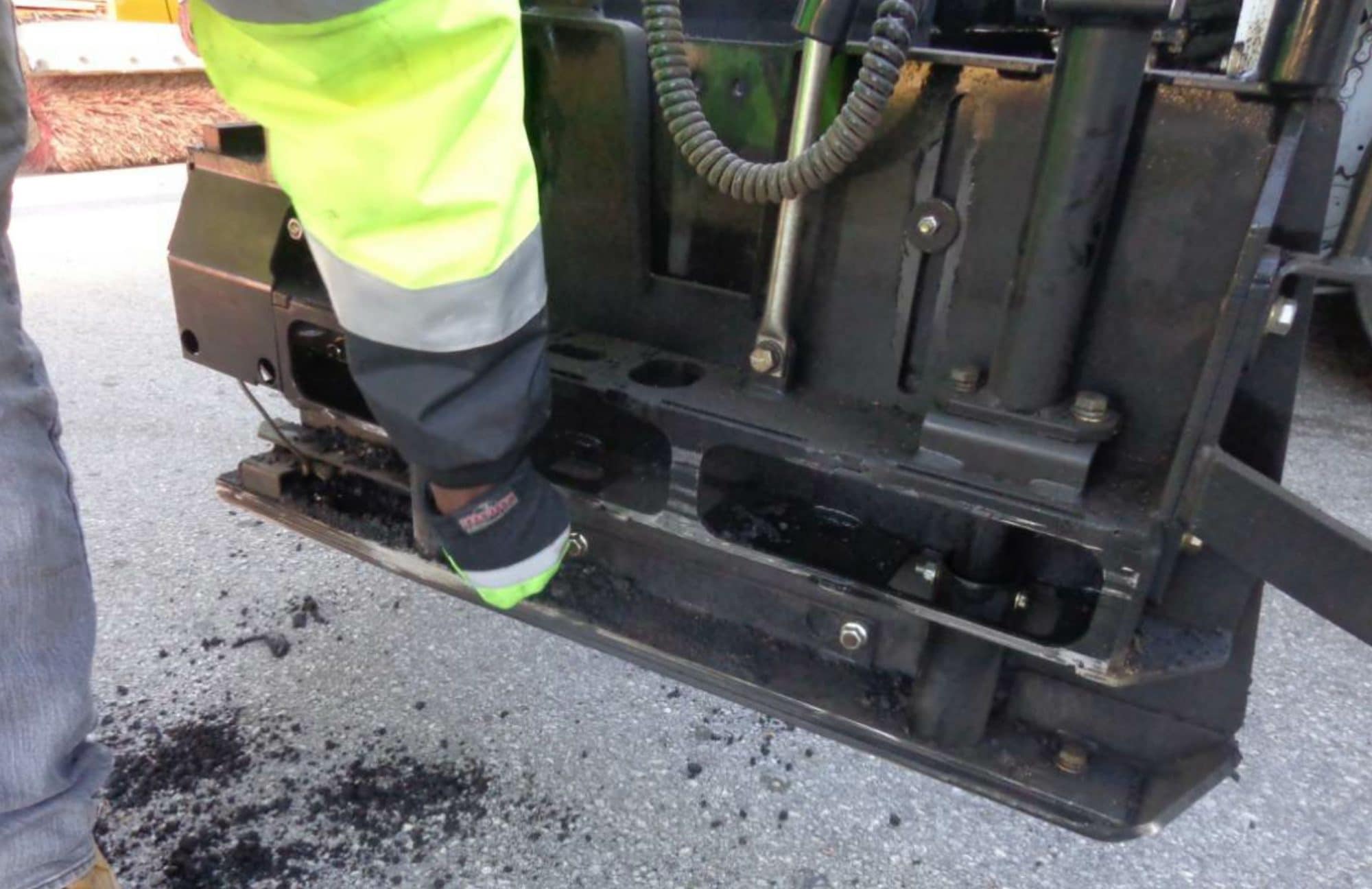
At the end of the paving day, you can make tomorrow start more easily with some quick and easy planning. Make sure you have some heavy plastic on hand and follow these steps from industry consultant John Ball.

Step 1. Put mix from the hopper in the skid steer loader bucket so the operator can take the paver away for end-of-shift cleaning.

Step 2. Lay a two-foot-wide strip of 6-mil thickness black plastic sheeting down across the transverse joint.

Step 3. Shovel mix from the bucket on top of the plastic so you cover it almost completely, tamping it down with tamping shoes while you work.

Step 4. Go over the strip of mix with the plate compactor to get it set in place.

In the morning: Have one worker on each end of the transverse joint lift the plastic up. The laborers will “fold” the plastic and pavement into sections, and toss them into the waiting loader bucket. Have them shovel and sweep the area completely before tacking the vertical edge of the transverse joint, and then back the paver into position.

QUICK TIP: 

Don’t put the plastic with the mix into the same pile that goes back to the plant for the RAP pile.

When you purchase the Asphalt Paving 101 online course, you get immediate lifetime access to training like this on any device at any time, and you can use it to train any number of paving crew members any number of times necessary. To make the course yours, click the green “enroll” button at this link.


Sign up now to receive tips like this to your inbox every week!

Stealth Taxation and Tradeshow Iron Make Perfect Bedfellows

Unless lobbyists can convince members of Congress to enact some fancy legislation to the contrary, business owners have until the end of this year to enjoy 100% of equipment bonus depreciation when figuring their tax burdens. Starting in 2023, that percentage dips to 80. In 2024, it drops to 60%. Then it’s 40% in 2025. Then it’s 20% in 2026. It’s nothing in 2027. Nothing. No incentive. Back to business as usual.

Here’s an interesting rub. The rules say you must not only purchase the equipment, but you must also take delivery and put the equipment into operation prior to year-end. With some delivery schedules currently out to February and March 2023, that means some business owners are already looking at the 80% category for their tax incentive to pull the trigger.

Obviously, you purchase equipment for more reasons than a tax incentive, but you must admit, getting a big-dollar break versus not getting a big-dollar break makes a difference to the bottom line. The best, most concise, layperson-language article I’ve seen on the program enacted in 2017 is found on the Stansteel blog here: stansteel.com/bonus-depreciation/. It’s a shame to see the program going away.

Enter World of Asphalt/AGG1 2022. The tradeshow floors were hoppin’ with customers making purchasing decisions on the spot. The team at Dynapac was not at liberty to put the contractor’s name on the record for its new made-in-America D30T paver, which was on display, but that hunk of highway-class iron had a home waiting on it. Another paver OEM joked about auctioning the equipment from the tradeshow floor to make the offering fairer.

Edgar Chavez, the North American president of Allu Group, told AEM that his company was having a successful first showing at WOA. “During the first day we had more than 15 qualified leads with $250,000 in orders,” Chavez told AEM.

The climate was perfect for that kind of purchasing desire and power. Brittany Weltcheff, show manager for World of Asphalt, shared, “we were able to bring together more than a record-breaking 11,400 asphalt paving and aggregates professionals to learn, experience everything that’s new and important in our industries, and make more than 30,000 connections.”

Next year’s big industry event is CONEXPO/CON-AGG in Vegas, then we return to Nashville for WOA, March 25-27, 2024. Even if we don’t convince Congress to renew the 100% bonus depreciation of equipment purchases, the need for the people, education, technology, and equipment to keep our infrastructure maintained and renewed will see us gathering to get the job done. For more coverage of WOA/AGG1, check out all TheAsphaltPro social media channels where we had regular updates throughout the week of March 28-31.

Stay Safe,

Sandy Lender

April 22: STEM Signing Day in Missouri

On April 22, the Missouri Chamber of Commerce and Industry will recognize 20 outstanding students from across the state as they sign letters of intent to study science, technology, engineering and math.

STEM Signing Day puts the spotlight on brilliant Missouri high school seniors as they make the big decision on where to further their education, much in the same way athletes are celebrated as they choose a school.

This year’s signing day event will bring together 20 STEM students from across Missouri for a virtual program streamed live on Facebook, including remarks from Gov. Mike Parson and additional state and business leaders. Each student participating in the event will receive a $1,000 scholarship. The event was created in 2019 by the Missouri Chamber Foundation’s Mathematics and Science Coalition in partnership with The Boeing Company.

“Building a world-class STEM workforce is critical to the future of Missouri’s economy. STEM Signing Day is a chance for our state to celebrate and recognize the academic achievements of some of our brightest young scholars,” said Daniel P. Mehan, president and CEO of the Missouri Chamber. “STEM Signing Day is a great opportunity to let these young people know how much Missouri values their contributions and that there are outstanding career opportunities right here in Missouri when they are ready to enter the workforce.”

Members of the press are invited to watch the ceremony on the Missouri Chamber’s Facebook page.

Missouri STEM Signing Day
April 22, 2022
11 a.m. -12 p.m. CST

2022 STEM Signing Day Scholarship Recipients

  • Jaylana Ahmetspahic — Parkway South High School, attending University of Health Sciences and Pharmacy in St. Louis
  • Rayan Bouchama — Battle High School, attending University of Missouri – St. Louis
  • Aaliyah Brooks — McCluer North High School, attending St. Louis Community College – Florissant Valley
  • Benjamin Byrd — Troy Buchanan High School, attending University of Missouri – Columbia
  • Haley Hunsel — Troy Buchanan High School, attending University of Missouri – Columbia
  • Vahdet Karatas — Gateway Science Academy, attending Washington University in St. Louis
  • Leonia Konde — Gateway STEM High School, attending Saint Louis University or University of Missouri – St. Louis
  • Samara Lewis — Midway High School, attending University of Missouri – Columbia
  • Nevin Ndonwi — Metro Academic and Classical High School, attending Washington University in St. Louis
  • Christian Pease — Lutheran High School North, attending Missouri University of Science and Technology
  • Jeannette Ramirez — Marquette High School, attending Missouri University of Science and Technology
  • Koen Schaffer — Francis Howell North High School, attending University of Missouri – Columbia
  • Ethan Vanderwert — Rock Bridge Senior High, attending University of Missouri – Columbia
  • Michael Viermann — Raymore-Peculiar Senior High, attending University of Missouri – Kansas City
  • Benjamin Wiseman — Eureka Senior High School, attending Saint Louis University
  • Jenna Woelfel — Francis Howell Central High School, attending University of Missouri – Columbia
  • Javon Armstrong — Riverview Gardens High School, attending Harris-Stowe State University
  • Dalton Berhorst — Canton High School, attending State Technical College of Missouri
  • Alejandro Espinoza — Gateway STEM High School, attending St. Louis Community College Forest Park
  • Daniel Svistun — Ozark High School, attending Drury University

This year’s STEM Signing Day sponsors include The Boeing Company, Cerner, Orscheln Industries, the Missouri Department of Higher Education & Workforce Development, and the Missouri Mathematics and Science Coalition.

The Missouri Chamber of Commerce and Industry is the largest business association in Missouri. Together with the Missouri Chamber Federation, the Missouri Chamber represents more than 75,000 employers. To learn more, go to www.mochamber.com, or follow us @MissouriChamber on Twitter.

Clean Water Act Rules Hurt Transportation Sector’s Ability To Fix Nation’s Roads & Bridges, Construction and Materials Groups Tell U.S. Supreme Court

Confusing rules promulgated by federal agencies under the Clean Water Act (CWA) are hurting the transportation construction sector’s ability to deliver infrastructure improvements that benefit all Americans, according to an amicus brief filed April 13 with the U.S. Supreme Court by the American Road & Transportation Builders Association (ARTBA) and National Stone, Sand & Gravel Association (NSSGA).

In the brief, ARTBA and NSSGA contend that existing regulations are “impacting the ability to efficiently supply the materials needed for and to build the infrastructure projects under the Infrastructure Investment and Jobs Act, as well as increasing the costs of public works across the country without environmental improvement.”

In Sackett v. EPA [Environmental Protection Agency], ARTBA and NSSGA are asking the high court to determine the extent of the federal government’s regulatory powers under the CWA. The associations contend that the methods the EPA and the U.S. Army Corps of Engineers (Corps) use to determine the CWA’s scope should be abandoned.

A major issue is the EPA’s definition of what constitutes “waters of the United States” (WOTUS) under the CWA. The agency has advocated for a broad definition of WOTUS to encompass virtually any wet area. ARTBA and NSSGA have maintained that reading WOTUS in such an expansive way improperly creates permit obligations for features such as roadside ditches, which serve the necessary safety function of collecting water during and after rain events. This type of overregulation serves only to delay critical infrastructure improvements and increase costs without providing any environmental benefits, the groups say.

“The transportation construction industry needs regulatory clarity to deliver economic benefits from record new federal highway investment,” ARTBA President & CEO David Bauer said. “The Court has the opportunity to end decades of unpredictable agency decisions, deliver clarity and help us demonstrate that infrastructure improvements and environmental stewardship need not be conflicting objectives.”

“For too long, our members have spent countless hours and dollars navigating an unclear and often punitive permitting system that arbitrarily will consider dry land a federally regulated water,” NSSGA President & CEO Michael Johnson said. “In order to successfully provide the materials crucial for infrastructure projects, including those in the recent bipartisan infrastructure law, we need clarity from the Court.”

ARTBA and NSSGA have been funding litigation to ensure their members voices are heard on CWA jurisdiction since 2005.

The Court is expected to hear arguments in late October, with a decision expected in the first half of 2023.

Teach Workers to Track Settings

We’re looking at getting a good start to the new season this month. One of the quick items we mention in our Asphalt Paving 101 course is that the foreman or superintendent on the paving project should keep a project notebook. Even if that’s an electronic tablet these days, it’s a place where he logs important information to help the process go as smoothly as the mat.

Consider this: On the first day of a parking lot, larger residential or highway project, you do all the labor-intensive work of setting the paver and screed just right to pave a consistent and smooth mat. As you set each component, mark in your project notebook the feed sensor position, screed height, auger height, crown, slope, angle of attack, and so forth, so you know exactly what settings to dial in when the crew arrives on day two, day three and so on.

If you need to adjust a setting during the first pass to prevent overfeeding or starving the head of material, make that notation so you have it right for tomorrow. It sounds simple, but it can save time and frustration if you have this “cheat sheet” to refer to for the real numbers, the real settings, that really work for the job at hand. This cheat sheet also comes in handy if the automation on your machine isn’t equipped (yet) with this kind of backup system.


Subscribe now to receive Toolbox Tips emails like this to your email each week.

Public & Private Sectors Expand Safety Services with Launch of New Roadway Work Zone Clearinghouse Website

The American Road & Transportation Builders Association’s (ARTBA) Foundation and the Federal Highway Administration (FHWA) have worked together for the past 10 months to significantly expand services aimed at improving roadway work zone safety in preparation for the additional project sites to come as recently-enacted Infrastructure Investment and Jobs Act (IIJA) funding flows to the states.

ARTBA and FHWA April 13 announced the launch of an all-new National Work Zone Safety Information Clearinghouse website: www.workzonesafety.org in conjunction with the 22nd Annual National Work Zone Awareness Week.

Established in 1998, the Clearinghouse has become the world’s largest online resource of free information, handling more than 250,000 requests annually. More than half of Clearinghouse users are public agency officials. The Texas A&M Transportation Institute manages the facility’s day-to-day operations and led the website redesign.

More than 850 people were killed and 44,000 injured during 2020 in roadway work zone accidents—the highest in two decades.

On average, federal funds support 15,300 construction projects annually, according to FHWA data.

ARTBA’s Chief Economist Dr. Alison Premo Black estimates there will be an additional 4,000 new work sites over the next two years as IIJA-related projects ramp up, underscoring the need for greater awareness of this public health issue, and ongoing public and private sector commitment to significantly reducing the number of safety incidents.

The new website features a modern interface, easier navigability, improved search function capability, and expanded user-demanded content, including:

  • Centralized crash, injury, fatality, and congestion data so users have a complete picture of the issues affecting safety.
  • Dashboards and info-graphs to illustrate trends over the past six years.
  • Interactive maps with national and state traffic data, laws, training and policies, crash information and statistics, and worker fatalities and injuries – including charts showing how workers are killed.

“Comprehensive data is now easy to locate and understand and users can search through thousands of records to find relevant material typically in less than a minute,” says Brad Sant, the association’s senior vice president for safety and education.  “We urge public and private sector professionals to use the Clearinghouse often. Together, we can save lives.”