TradesLink Aims to Be ‘LinkedIn’ for Trades Workers

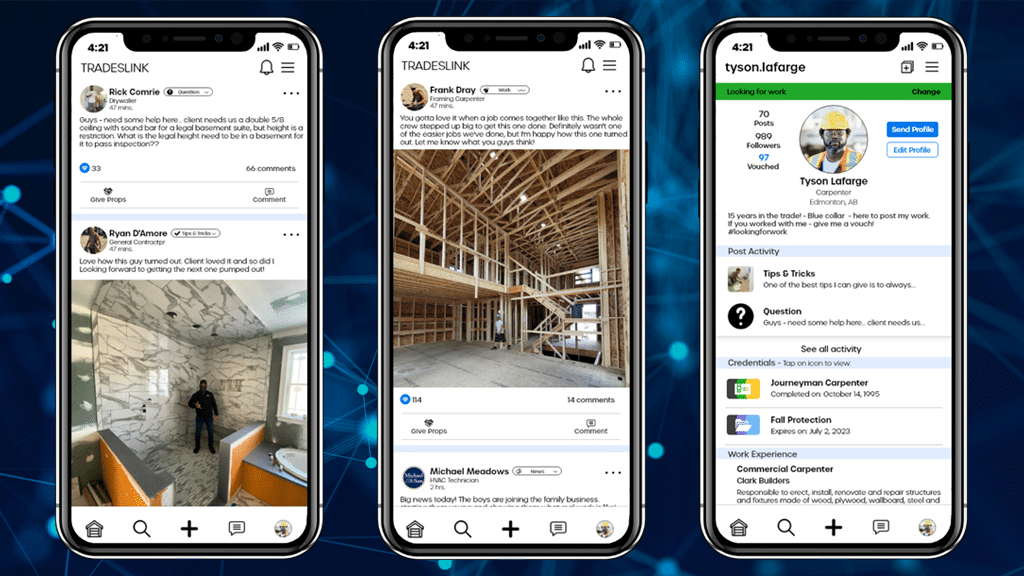
TradesLink is a free social networking app that aims to advance the careers and build an online community for workers in the trades.

Founded by Edmonton-based entrepreneurs Sam Beaudoin and Rob Bartko, TradesLink aims to fill a gap left by the employment-oriented social networking platform LinkedIn.

“A platform like TradesLink is long overdue and I’m proud to say that we’ve created something that will truly benefit the trades community and careers,” said TradesLink Co-Founder Sam Beaudoin. “It’s really exciting to build something that will positively impact people’s lives & I can’t wait to see how we continue to improve.”

A shortlist of platform features:

  • Connect with other like-minded tradespeople, laborers and machine operators
  • Keep a “Digital Wallet” of safety tickets with expiry notifications
  • Access & create job postings, add work experience & projects
  • Social feed to share knowledge, accomplishments, & job opportunities

The TradesLink platform launched for workers in December 2021 and launched its employer tools in February 2022.

The TradesLink app is available for free on the Apple & Google Play store. 

Here’s a Way to Check for Screen Media Gaps

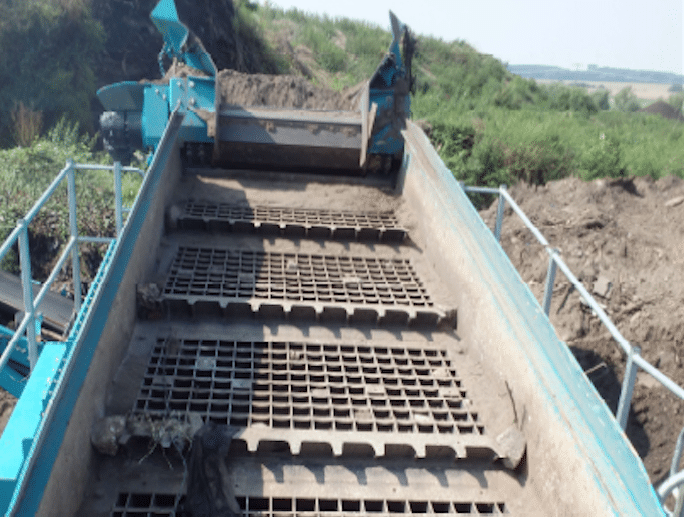
While you’re performing equipment repairs around the plant, check out the crushing and screening operations, too. If screen media has been installed incorrectly, you could see slow production, material that goes out of spec, and screen media wearing out quickly. These are not good things.

Routine Screen Repair for Recycling

One test that costs nothing is the string test. This works on media installed with crown bar rubber. You want to make sure you have it installed correctly, so run a string from one side plate to the other side plate, going over the crown bars. Pull the string tight. You want to look for gaps between the string and the crown bars. If you see gaps, you know the media won’t sit properly on the crown bars. You need to correct the height of the crown bars to get the media installed correctly.

Also watch out for over-tensioning. A gentleman from Astec Mobile Screens shared that over-tensioning can result in a curved tension bar. Multiple sources recommended replacing a curved tension bar.


Subscribe to our Toolbox Tips newsletter to receive tips like this to your inbox each week!

Hawaii Asphalt Paving Industry Inducts Garret Okada into HAPI Hall of Fame

Established in 2021, the Hawaii Asphalt Paving Industry (HAPI) Hall of Fame honors and recognizes those individuals that have:

  • Made significant and lasting contributions to the Asphalt Paving Industry.
  • Unselfishly and generously served HAPI and the industry.
  • Demonstrated a consistent high standard of ethics.
  • Made outstanding contributions of time and or ideas to the industry.
  • Helped mold our industry, reshape, and improve the way the industry operates.

Garret Okada is our 2022 HAPI Hall of Fame Inductee.

Garret’s contributions to the asphalt industry make him an ideal inductee into the HAPI Hall of Fame. He has spent almost his entire life in Hawaii. He graduated from Aiea High School and continued his education at Chaminade College and the University of Hawaii. In 1969, he graduated from the university with a Bachelor of Science in Civil Engineering.

His career started in the County of Los Angeles, but he soon made his way back to the islands to work for the Hawaii Department of Transportation (HDOT). His journey with the HDOT started in 1971 with the Highways Division. In 1980, he transferred to the Airports Division for a couple of years. He then returned to the Highways Division where he spent the last 22 years of his career as the Bituminous Materials Engineer.

As the Bituminous Materials Engineer, he made significant contributions to the asphalt industry. He authored the following publications:

  • Research Report for Superpave Pilot Project on Moanalua Freeway Ramps.
  • Materials Quality Assurance Manual for Highways Construction, Department of Transportation (DOT)
  • Laboratory Quality Manual for AASHTO Accreditation Program, Highways Division (HWY)

He helped raise the bar for the asphalt paving industry by doing pilot projects to introduce new technologies and methods such as a project to evaluate Stone Matrix Asphalt (SMA) and Superpave.

However, he is remembered most for his efforts in developing a smoothness specification. His leadership brought agency and industry together to bring about a positive change for the ride quality of the State of Hawaii. The specification introduced the use an MTV (Material Transfer Vehicle). Garret was brave to start this requirement as it was a major capital expenditure for the contractors. Initially, smoothness bonuses gave contractors the incentive to improve. In later years, besides smoothness, the use of the MTV was found to provide a more uniform mat temperature, which lead to more uniform compaction, resulting in longer lasting pavements.

Upon his retirement in 2004, HAPI awarded Garret the title of “Mr. Smooth” in recognition and appreciation of this major accomplishment for our industry,

Since his retirement, Garret spends time with his wife Layne Okada, daughter Lena Toti, and son-in-law, Joshua Toti. He keeps himself busy by doing volunteer work in Bible education as one of Jehovah’s Witness.

How to Improve Job Site Metrics with Wearables

Wearables have become a very fashionable topic in the construction industry, but it’s not all window dressing, every day, wearables are promoting health, safety, connectivity, productivity and accuracy on construction sites.

An Accessory for Every Occasion

A number of employee monitoring systems have been introduced to the construction industry with the aim of making employees safer.

Dash cams are being installed into truck cabs—but not to record traffic—to record the activities of the driver. Truck companies want to make sure drivers are checking their mirrors and especially aren’t using their phones when behind the wheel.

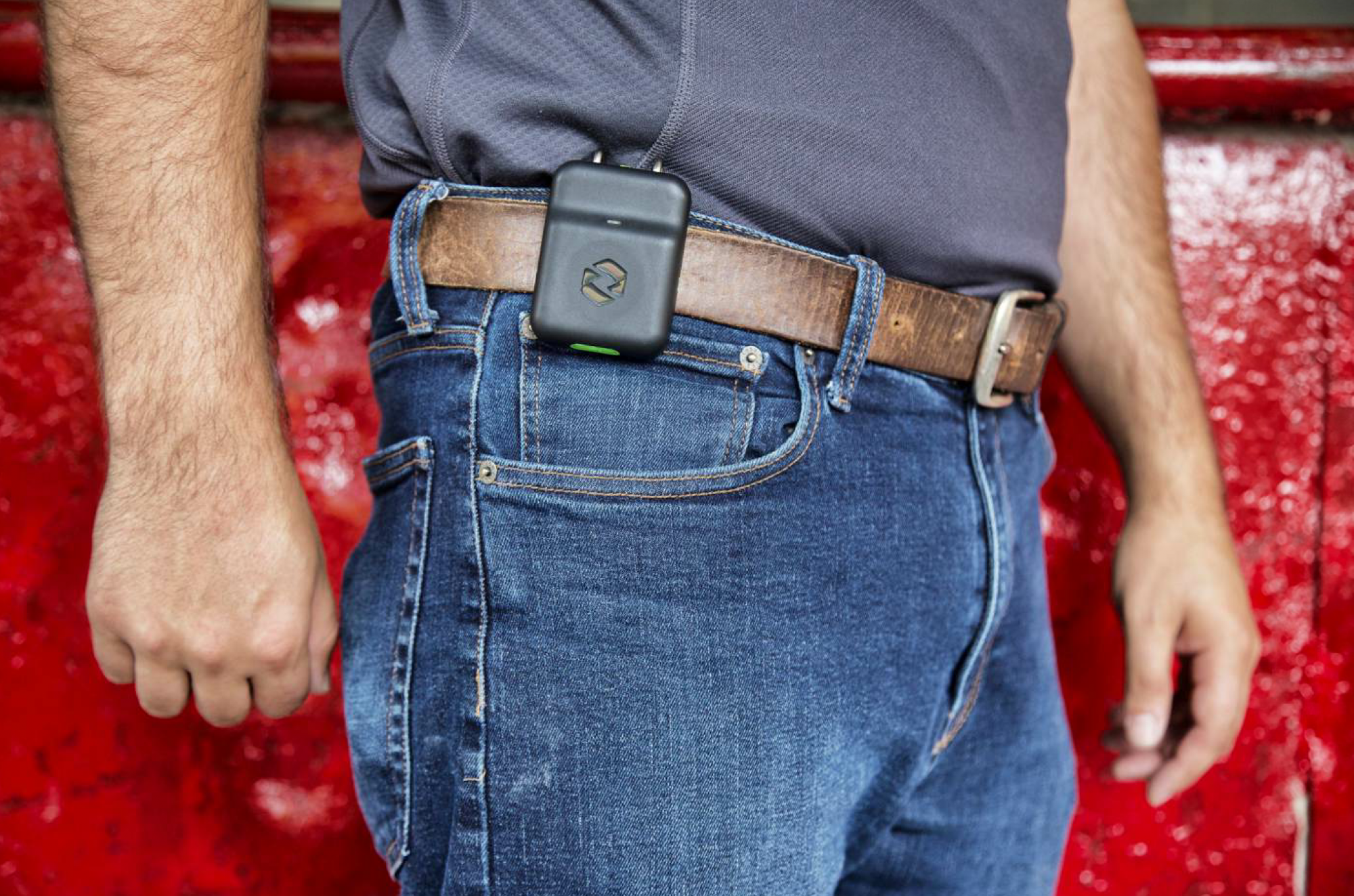
The Spot-R fall alert and emergency evacuation system from Triax Technologies monitors employees’ movements to alert safety personnel if the device changes elevation quickly, indicating a fall. And it alerts workers of a emergency evacuation

The Scan-Link RFID tags monitor employees’ locations and alerts equipment operators of employees who are located behind the machine.

Some smart watches detect vibration; that technology is used to monitor the ramifications to the body from using power equipment for a long time. Alerts tell the end-user when power tool use exceeds what the body can safety perform, and this is to prevent hand-arm vibration syndrome (HAVS).

Smart helmets monitor several health elements, such as fatigue, heart rate and stress, so workers and management can modify worker’s activities in ways that promote employee health and job site safety and productivity.

Turning Historical Data into Predictive Analytics

A lot of times, this monitoring can lead to policy changes and coaching opportunities.

“One customer who uses our Scan-Link RFID technology reported to me the following story,” says Jonathan Fava, president, Scan-Link Technologies, a CONEXPO-CON/AGG exhibitor. “‘We were looking at the number of times equipment operators were alerted to the presence of a nearby worker, and we noticed one person was causing a lot of alerts, so we pulled that individual aside and asked him why. He explained that he’s the flagger so, when operators load the machine onto a float, he gets up on the float to aid the operator place the machine. We advised him that behavior is unsafe; he could get struck by the machine or fall of the float. So, we told him a safer way to perform his job and wrote down new safety protocols into our guidelines and training.”

Using historical data to learn how things happen is the first step to promoting safety on the job site. “It’s not enough just to learn how accidents have happened,” says Fava. “The next step is to analyze data in order to prevent accidents from happening.

With all of the employee detections picked up by the Scan-Link system, managers can identify “hot spots”—spots where machines detect people the most frequently.

“Using this data, customers can identify areas where a struck-by incident is most likely to occur. Then, customers can make decisions that will decrease the risk of an accident from happening by moving the location of materials, so workers don’t have to walk in a machine’s workspace or by putting up signage warning employees of high-risk areas,” says Fava.

Track Leading Safety Indicators with Safesite

Assisted Reality Connects Two Physical Worlds

Wearables are also instrumental in merging realities, which is bringing connectivity, productivity and accuracy to job sites.

Exoskeleton and assisted reality headset manufacturer Real Wear just released the second version of their assisted reality headset, called the RealWear Navigator 500.

It is sleeker, lighter and is more ergonomic than the previous model (the HMT100) for all-day comfort yet is rugged and durable for use on construction sites and in industrial settings.

It features a modular design, a 48-megapixel camera sensor with enhanced zoom capability, incredible low light performance, and is compatible with more than 200 optimized apps. A hot-swappable battery allows for continuous use the whole day.

“With the Navigator 500, we wanted to provide scale enterprise solutions as part of the digital transformation movement. Today, we see the acceleration of digital transformation on the future of work, especially since the pandemic,” says Andrew Chrostowski, chairman and CEO, RealWear Technologies. “Our device is hands free and keeps you present. You don’t want your head stuck in the meta verse when you’re working around heavy equipment.”

The device allows the user to take photo and video at six different zoom levels, as well as call someone. The device takes audio commands for all features; you say the words “take a picture” or “zoom” or “call Herald” and it does it, so you can keep your hands on what you’re doing.

With it, users can aid in remote inspections and diagnostics. By equipping someone at the job site with the Navigator 500, they can act as the eyes for inspectors and technicians, so inspections and troubleshooting equipment can be done remotely, saving time and travel costs.

Securely Track Vaccination, Test Status on the Job Site

Augmented Reality Expands by Becoming Handheld

The Trimble XR10 with Microsoft HoloLens brings a different kind of connectivity and reality. The technology connects virtual reality to physical reality to provide mixed reality.

HoloLens users can see both the physical world and the virtual world; the digital image is overlaid onto the physical world.

This technology is especially handy to trades; now, they no longer need to look at paper designs for what they are installing and then try to map out where that is in the physical world by establishing a frame of reference and taking out the measuring tape; they can simply see, for example, the virtual pipes and their detailed measurements, and install the pipes with high accuracy. They can also see what is being installed nearby, so they can identify potential complications.

Trimble, a featured exhibitor at CONEXPO-CON/AGG, recently expanded the potential for BIM (business information modeling) users to deploy augmented reality on the job site by introducing the Trimble Connect AR app, which is compatible with Trimble Connect. The app is downloaded to a phone or tablet and allows users an augmented reality experience by pushing BIM data to their phone and overlaying it onto images of the real world on the device’s screen.

“This eliminates what can be a costly financial barrier to some customers,” says Martin Holmgren, general manager of building field solutions at Trimble. “And users can interact with Trimble Connect AR users in the digital space. For example, I can leave a message in the digital space with my Trimble XR10 and someone with the Trimble Connect AR app on their phone can detect the message, even weeks later as they walk by the location where it was left and read it. This greatly enhances communications and streamlines workflows.”

Trimble expects people who don’t need to be fully hands-free, such as supervisors, managers, inspectors, and building owners will use it to perform tasks, such as QA/QC, updating punch lists, and measuring construction progress.

“The app allows for the incorporation of AR into workflows that don’t require the user to be hands-free, and we think our app will ultimately drive AR in a much wider range of adoption,” says Holmgren.

Five Equipment Manufacturing Trends to Watch in 2022

Both the immediate and long-term future of the equipment manufacturing industry will be defined by the development of a number of prominent trends, each of which are poised to have a significant impact in 2022 (and, in many cases, beyond).

It’s critically important for equipment manufacturers to not only develop a keen understanding of these trends, but also how they will evolve over time. Perhaps most importantly, however, those within the industry must be able to assess their impact on equipment manufacturing and the customers it serves.

So, with that fact in mind, let’s look at 5 key trends poised to impact equipment manufacturers this year:

Workforce Challenges and Solutions

— Julie Davis, AEM Senior Director of Workforce and Industry Initiatives

When it comes to workforce, 2021 has proven that doing what we’ve always done will no longer get us what we used to get. Demographic research shows that employment challenges are not going to return to what they have been pre-pandemic. If anything, the pandemic acted as an accelerator that took labor force trends already sneaking up on the industry and exploded them into a new reality.

The most significant trends include the shift from a baby boomer pre-pandemic drift towards retirement to a pandemic mass exodus of retirements. Second, a labor force participation rate that was declining since 1980 dropped to record lows with 2.4 million women leaving the workforce, fewer millennials seeking careers of their own, working age males increasing preferring part-time over full-time work, and an opioid epidemic siphoning off prime-age men by the hundreds of thousands per year. Finally, we have to recognize that the U.S. birthrate has been steadily declining, hitting a 35-year low in 2019, according to census data. With fewer and fewer people available, the labor market will continue to tighten. If you are looking to immigration as a solution, be cautious, as the same decline in birth rate is happening in countries we typically look to for sources of immigrant labor.

So, what can companies that have been willing to be curious teach us?

First, if your HR department says they are “doing everything they can,” consider it a red flag. The war for talent is being won by HR departments whose mantra has become, “What else can we do?” Being curious includes evaluating and offering competitive compensation, meaningful benefits, potential career development opportunities and, most of all, flexible work. The employee experience needs to be reconsidered, much like we’ve analyzed the customer experience in the past. Important considerations include:

  • Streamlining the application process
  • Meaningful onboarding
  • Mental health supports
  • Opportunities for upskilling
  • Internal career path or debt-free education

In addition, hourly workers want flexibility, even if they have to show up in person. Creative companies are finding ways to provide flexibility and predictability in scheduling to support health and wellness, childcare and caregiving responsibilities.

Bipartisanship

— Kip Eideberg, AEM Senior Vice President of Government and Industry Relations

At the close of 2021, federal lawmakers delivered a long-awaited holiday gift to the American people – passage of the Infrastructure Investment and Jobs Act (commonly known as the “bipartisan infrastructure bill”). While many were elated at the congressional approval and enactment of the bill (AEM included), we were — and still are — frustrated and disillusioned with the time it took to get the job done. In a recent op-ed in Real Clear PoliticsI shared how the unnecessarily drawn-out and overly political infrastructure debate spells trouble for our country. So what can be done in order to end the petty partisan squabbling during a critically important election year? One word: bipartisanship.

While the infrastructure bill has been signed into law, much work remains to be done. Now it is up to U.S. Secretary of Transportation Pete Buttigieg and President Biden’s recently appointed infrastructure czar, the former mayor of New Orleans Mitch Landrieu, to work with state and local governments to smooth the rollout and ensure the successful implementation of the $1.2 trillion bill. And the work doesn’t stop at infrastructure. We need our elected officials at the state and federal level to put policy ahead of politics and advance pro-growth economic policies that will ensure the long-term growth and prosperity of the equipment manufacturing industry. Lawmakers must also make investments to help attract, train and retain the next generation of skilled workers to address our industry’s growing workforce needs. Finally, we need commonsense policies that will help revitalize American manufacturing, bolster rural communities across our country and reenergize the U.S. economy.

Supply Chain Management

— Jason Malcore, AEM Director of Global Standards and Compliance

In 2021, off-road, heavy-duty equipment industry stakeholders found themselves dealing with a relatively new concept for U.S.  manufacturers; chemical management issues. On Jan. 6 of last year, the EPA announced its Final Rule regarding the prohibition on introducing Phenol, Isopropylated, phosphate (3:1) into commerce. This ban on a commonly used flame retardant struck the equipment manufacturing industry especially hard. Overnight, a wide swath of economic actors needed to rewire their manufacturing and design processes, and perhaps most importantly, learn how to manage a wide ranging, deep, and complex global supply chain, not familiar with the needs of tracking chemical components.

Managing supply chains, communicating chemical requirements, educating suppliers and managing data will be the only way to meet the coming challenges. With the size and complexity of the global off-road, heavy-duty equipment manufacturing industry, meeting this challenge will be an enormous task. To achieve this goal, industry stakeholders will need to work together to establish new industry best practices and efficient lines of communication to ensure information can effectively travel from one end of the supply chain to the OEMs. The industry has not yet found all the answers, but this will be a very important issue for 2022 and beyond.

Covid-19 and Employee Safety

— Sara Feuling, AEM Senior Director of Construction

As we enter 2022, COVID-19 continues to have a significant impact on the manufacturing industry. While we have developed health and safety protocols and best practices to combat the virus, COVID-19 has done what viruses do best – change and evolve.

Thankfully, the manufacturing industry continues to change and evolve right along with it, adapting to new CDC guidelinesOSHA regulations, and local mask and vaccine mandates to keep business owners and their employees safe.

If the last two years have taught us anything, it’s that our industry remains strong and resilient, even in times of tremendous uncertainty. The pandemic has affected the way we do business, our economic outlook, our supply chain and, maybe most importantly, our workforce.

All this change will come to an end eventually. Until that happens, we will need to keep adapting to keep our industry safe.

Leveraging Data for Better Decisions and Traceability in Agriculture

— Austin Gellings, AEM Agriculture Services Manager

Now more than ever, farmers are operating on the notion of doing more with less. Whether this is because they must deal with resource constraints or are now expected to because of societal pressures, we are seeing this happen. As AEM showed early in 2021 with the release of the Environmental Benefits of Precision Ag Study, technology has brought us a long way and still leaves a lot of room to grow. However, data is the key to accomplishing this goal even further.

Data enables farmers to make better decisions for the year based on the 4R principle of right rate, right place, right time, and right source. Thus, using historical data to make decisions on what to apply where and when. Farmers have been doing this for years, but with costs of fertilizer and other on farm inputs on the rise utilization of this data has never been more important. It can also help provide input into other areas of the farm to increase efficiencies there as well.

Asphalt paving professionals can still register for World of Asphalt for up to 15 percent off through February 26.

Ten Attributes of Successful Supervisors

When asked about the toughest part of a job, there is one answer that stands above the rest: dealing with people. Employees often get frustrated or annoyed with their job because of the people around them. These interpersonal problems can lead to the downfall of the hierarchal system within a company.

To better explain how to build work relationships and supervise employees at all levels, Larry Kokklenberg, of Leath Group, LLC, and a World of Asphalt education speaker, provided ten simple guidelines for effective supervision.

Build trust

There are very few relationships, work, personal or anything in between, that can survive without trust. Kokklenberg says that trust is the foundation for all positive and sustained relationships and that these relationships are vitally important if a team wants to perform at a high level.

When looking at behavior that helps build trust, Kokklenberg said that communication, consistency and leading by example are all important behaviors. On the contrary, poor communication, lack of integrity and lack of reliability were listed as behaviors that hurt trust within a company.

Manage by influence, not power 

An important distinction to make between power and influence, Kokklenberg said, is that power is the authority or right to give orders and make decisions, while influence is the ability to positively affect ideas and actions. Furthermore, an autocratic top-down model of employment can hurt a business if not handled correctly. Rather than increasing your power, grow your influence by being knowledgeable, respectful, caring and flexible.

Create a culture of appreciation

As simple as it sounds, “thank you” goes a long way. Saying thank you costs nothing and gives more than you expect in return. 76 percent of employees say that being recognized by their superiors motivates them in their job. Kokklenberg says that after being more personable with your staff, acknowledging all extra efforts and thanking people for their work every day, the culture of the company will become more positive in 30 days.

Be fair and just

No employee should be treated differently, better or worse, than another. Being impartial, unprejudiced and simply fair will show everyone that they are all as equally important and will help build trust and morale within the company.

Be respectful

This is an easy one. Would you rather have a boss that is considerate, caring and patient or one that is harsh, abrupt and difficult? When people fear or dislike their superiors, they are constantly stressed or tense about their work situation, which also negatively affects their work.

Be a role model

Whether you like it or not, being a boss also makes you a role model by default and being a role model comes with responsibilities. Manage yourself in a positive manner and live by your own values and the values of the company. In return, your employees will respect you and trust that the company is in good hands.

Be helpful

Understand that people will come to you for help and advice; boss is synonymous to teacher in this respect. One of the responsibilities of being a boss is to help make everyone else’s jobs easier. Give instructions, feedback and advice to help develop people and their skills.

Be positive

Everything you do will reflect back on your staff – your attitude is highly contagious. Positive supervisors will breed positive employees and positive employees tend to do great work for their company.

Build the team

Every company or business is one large team. Work gets done by the entire team, never by just one person. Build a collaborative mindset by encouraging cooperation and helpfulness and always reiterating the teamwork aspect of the workplace. In return, you’ll get employees that not only work well together, but enjoy doing so.

Link work to a higher purpose

Kokklenberg encouraged everyone to not give people jobs, but to give them a purpose. Be sure to always link your work to your mission statement. This will encourage employees to work for the good of the company instead of working for a paycheck.

Asphalt paving professionals who want to learn more about leading people and building their team can still register for World of Asphalt for up to 15 percent off through February 26.