Takeuchi Family Fun Day and Food Drive Raise $4000 for Local Food Bank

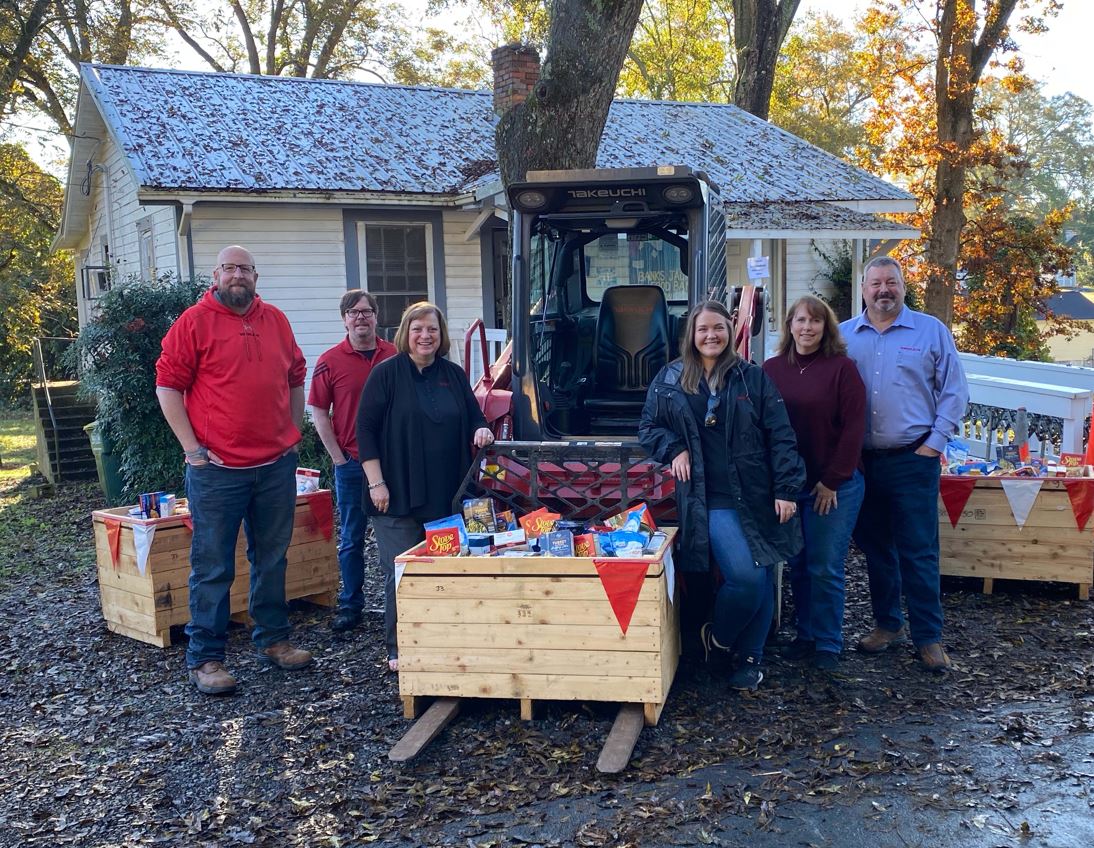
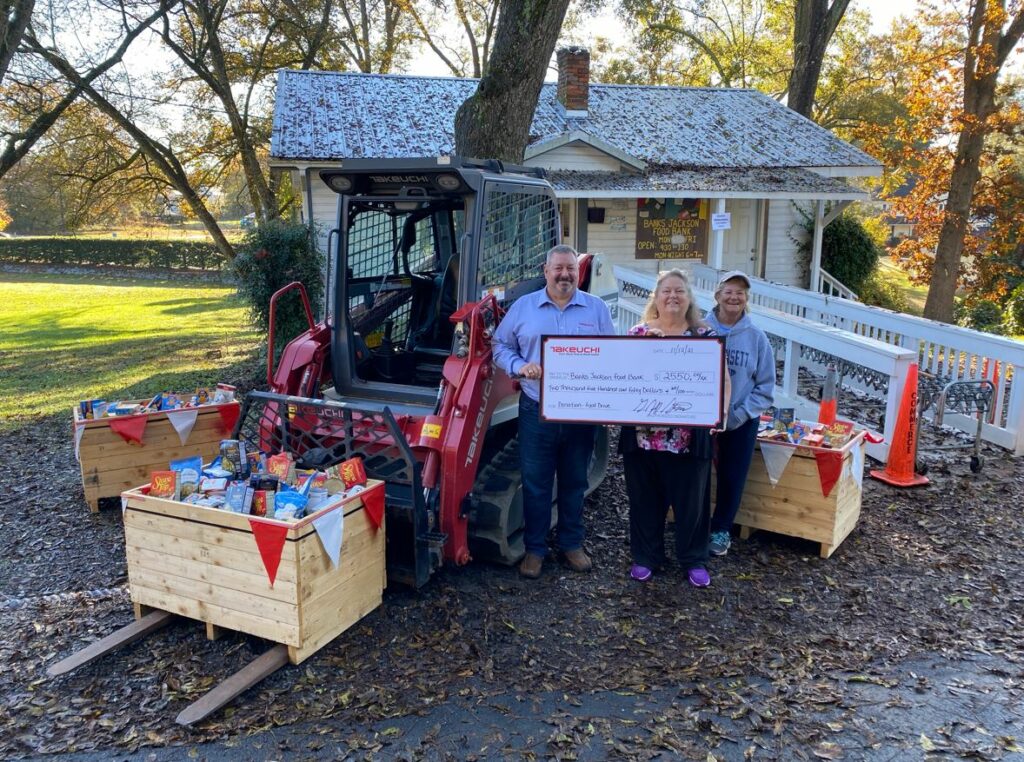
On November 12, 2021, Takeuchi-US employees, including President Jeff Stewart, presented the Banks Jackson Food Bank in Commerce, GA with enough food for 200 Thanksgiving dinners and an extra $2,550 to buy additional turkeys to feed even more needy families. This donation, worth a total of about $4,000, started out as a simple accompaniment to a fun company event and morphed into something far more meaningful.

In October, Takeuchi hosted employees and their families for Family Fun Day. Leading up to the event, Takeuchi had a food drive to collect both food and monetary donations for the Banks Jackson Food Bank.

At Family Fun Day, approximately 200 adults and children enjoyed a pumpkin patch, food from local food trucks and numerous activities including bouncy houses, pumpkin painting, an egg race, a magician, corn hole games, a photo booth, a giant “Jenga” game and hayrack rides. One particularly popular event was “Meringue the Manager,” where employees paid money to throw whipped cream pies at their managers, raising an additional $600 for the food bank.

Takeuchi then agreed to double whatever employees raised, which resulted in the total donation of 200 Thanksgiving dinners and $2,550 in additional funds.

“We wanted to host Family Fun Day for our employees so that they could bond after a long year apart following the pandemic,” said Takeuchi-US President Jeff Stewart. “It was also a great way for us to come together and do something for our community. I’m proud of how our employees stepped up and raised a significant amount of money that will help local families enjoy Thanksgiving dinners that they wouldn’t have otherwise been able to afford.”

Quick Primer on the Starter Plate

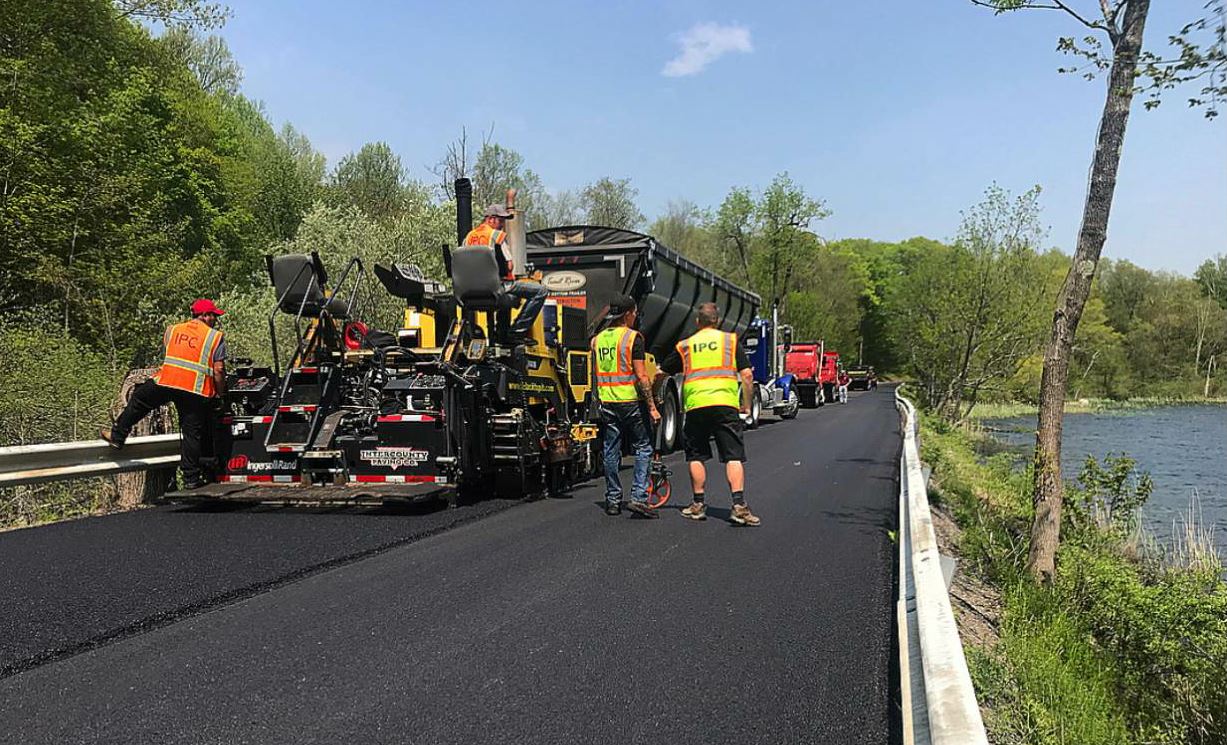
Not all members of the paving crew are at the same experience level. During this week’s toolbox talk, introduce the new guys (or everyone) to the starter plate.

The starter plate does more than support the screed; it sets the height of your mat with fluff factor figured in. We’ve learned how to figure the fluff factor in these tips before, but I’ll put that equation at the bottom of this for folks who have joined us more recently.

The starter plate is, simply, a piece of metal that you place on the surface to be paved. The paver operator backs the tractor toward the plate(s); the screed operator lowers the screed to rest on the metal plate(s). This is the height from which you “start” paving.

If you don’t have starter plates, you’ll spend time building a starter pad—or starting point—with asphalt mix, shovels, rakes, lutes, and elbow grease. I’ll provide a link to an article that discusses how to “take off with stability” below.

Quick Tip:

To calculate the fluff factor, and assuming you’re paving with a smooth screed, add a quarter of an inch height for each inch of finished compacted mat.

2-inch compacted lift = 2.5 inches placed

1-inch compacted lift = 1.25 inches placed

HAPI’s 2020 Photo Contest Winners Announced

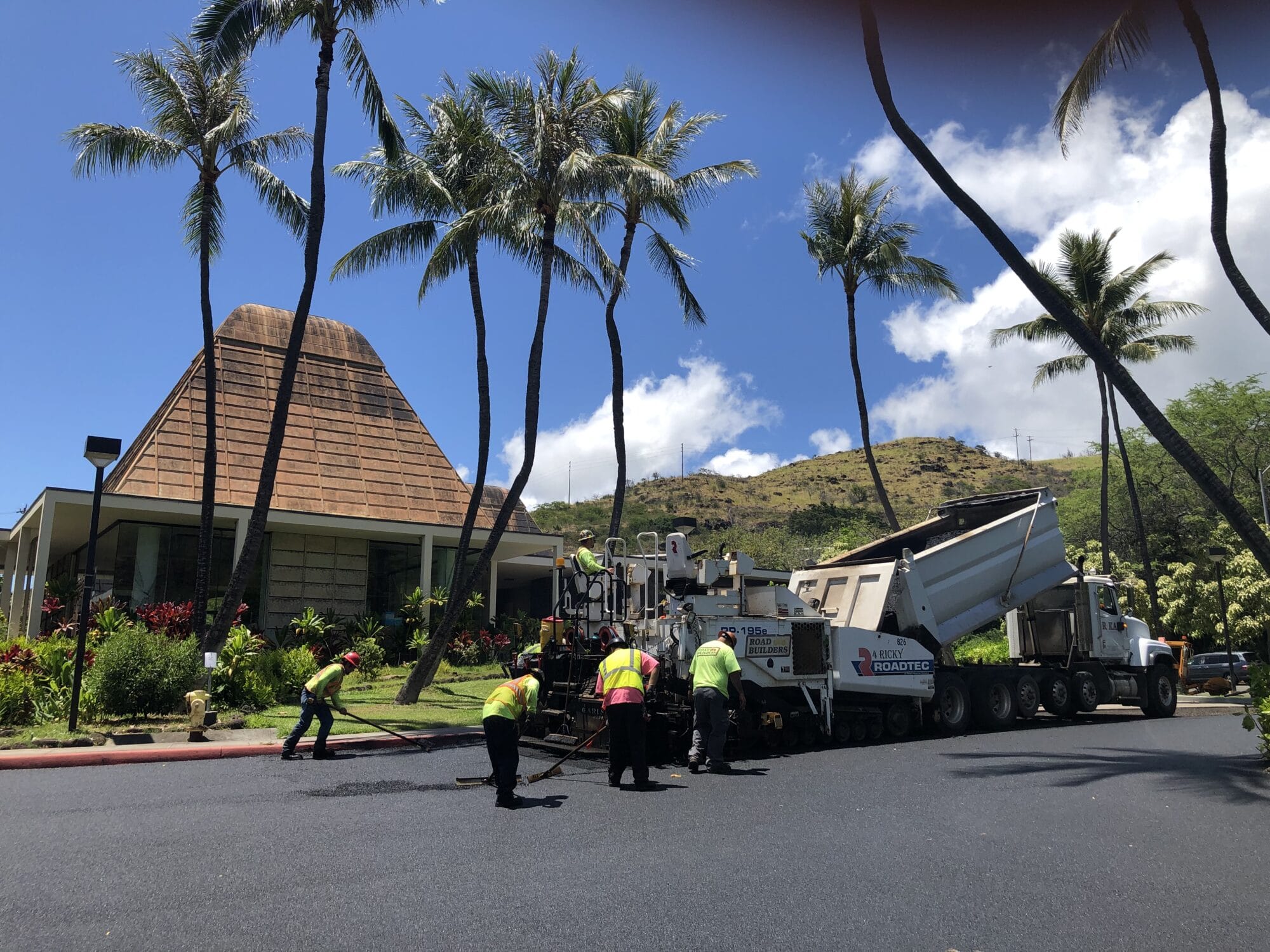
The Hawaii Asphalt Paving Industry has announced the 2021 winners of its annual photo contest. Entries included photos from its member companies’ paving or pavement treatment projects in Hawaii, either under construction or after completion.

This year’s winning photo was snapped by Keola Goo of Road Builders Corporation for a job performed for the University of Hawaii in Honolulu:

  • Name: Keola Goo
  • Company: Road Builders Corporation
  • Project: University of Hawaii at Manoa Hawaiian Studies Parking Lot
  • Contactor: Road Builders Corporation
  • Location: Honolulu, Oahu

To see all of photos recognized with honorable mentions, visit HAPI’s website.

4 Steps to Warm the Paver

A couple weeks ago, we looked at six best practices for cool-weather paving success. Let’s drill down to look at protecting the mat specifically when ambient temperatures are less than ideal, but you’ve got a project to finish before the snow flies.

If your paving crew wishes to warm the paver by stopping once a portion of the mat is placed (the goal being to let all components gain heat from the hot mix), watch the screed carefully. It will settle when not in motion. If you sit for longer than seven or eight minutes, you risk creating an indentation in the mat. Instead, stay alert.

  • Step One: The general rule of thumb is to charge the hopper from the second truck—second load—that’s arrived onsite. It will likely be a few degrees hotter than the first load, which sat in the silo cone awaiting loadout.
  • Step Two: Pave forward the length of the paver and stop.
  • Step Three: Set your timer for no more than five minutes to be sure you don’t sit too long.
  • Step Four: After four or five minutes of warming up, the paver is ready to go.

Forge ahead at 20 to 25 feet per minute, following your best paving practices.


Subscribe now to receive tips like this to your inbox each week!

Trimble Establishes Dr. Gladys West Scholarship Program

Scholarship Program to Honor Technology Pioneer and Hidden Figure Who Helped Invent GPS  

Trimble announced Nov. 8,  2021, a scholarship program to honor Dr. Gladys West, a pioneer in mathematics, minority advancement and the advent of the Global Positioning System (GPS)—one of our most widely used innovations throughout the world.

Known today as the hidden figure who helped invent GPS, Dr. West is one of the reasons why consumers can receive driving directions from a phone or tag a photo location on social media. And why professionals in industrial markets such as construction, transportation and agriculture can leverage geospatial technology to realize significant improvements in productivity, quality, safety, transparency and sustainability to transform the way they work with precision. 

Dr. West knew from a young age that education would be the key to moving forward from her family farm in rural Virginia. A scholarship recipient herself, Dr. West earned a Bachelor’s and Master’s degree in Mathematics and was offered a position in 1956 with Virginia’s Naval Proving Ground—now called the Naval Surface Warfare Center. Hired as a mathematician, she was one of only four African American employees at the time and only the second woman of color.  

With her intelligence and computational skills recognized, she quickly climbed the ranks and became project manager for the Seasat radar altimetry project in the 1960s. Knowledge gained through that work enabled her to program an IBM computer to calculate an accurate geodetic Earth model—the detailed mathematical model of the shape of the Earth that is the essential building block for GPS. 

“It’s fitting to announce this special scholarship program following Dr. West’s 91st birthday. A woman who helped pave the path to GPS—the technology that was not only core for Trimble’s early business but provided the catalyst to create the geospatial industry,” said Rob Painter, Trimble CEO. “Just as Dr. West viewed education as the pathway for the future, we are excited by the opportunity to support a new generation of stars to help them pursue their educational journey.”

“We must appreciate our past, learn in the present and prepare those behind us for the future. We must encourage our youth to pursue a higher-level education so that they will be equipped to change the world. We must be willing to use our talents and strengths to work for the betterment of the world,” said Dr. West. 

Supported by the Trimble Foundation, a donor-advised fund, the Dr. West scholarship program will enable Virginia State University, North Carolina A&T State University and Florida International University to award a 4-year scholarship to one student each year. These universities were carefully chosen to reflect Dr. West as a woman of color and science, and to align with two of the Trimble Foundation’s key support pillars:  female education and empowerment and diversity, equity and inclusion.   

Virginia State University—Dr. West’s alma mater and a Historically Black College and University (HBCU)—will award the Dr. Gladys West “Constellation” Scholarship from Trimble to a student in the College of Engineering and Technology. In addition, the VSU scholarship is also being matched by an anonymous donor. North Carolina A&T State University—a top-ranked public HBCU—will award the Dr. Gladys West HBCU Scholarship from Trimble to a student in the College of Engineering. And Florida International University—a minority serving institution—will award the Dr. Gladys West Trimble Technology Lab Scholarship to a first generation student in the College of Engineering & Computing. The scholarship is also being matched. FIU is the home to a recently established Trimble Technology Lab, which provides students hands-on access to Trimble technologies within the Moss Department of Construction Management. 

Military Vets Could Be the Answer to Your Construction Staffing Challenges

As construction companies struggle with finding skilled labor, military veterans are a segment of the labor force that deserves attention. Vets currently make up about 7% of the construction workforce and each year approximately 200,000 vets transition out of the military.

Those construction firms that have been successful in recruiting and retaining veterans say their hard and soft skills as well as attitudinal characteristics make them great new hires. In addition, several programs are in place that makes it advantageous and cost-effective to train and hire vets.

CONEXPO-CON/AGG is sharing the key benefits vets offer, how to recruit, and how to help vets transition from military to civilian employment.

G-FORCE and BlueSky Create Single-Source Success

5 Traits That Make Veterans a Great Hire

  1. Assume high levels of trust– Veterans are highly trustworthy. “Vets know how to take orders and show up for work in the morning,” says Bob Nilsson, a retired veteran and former president of Turner International, which has a long history of hiring vets. Nilsson is currently president and founder of 100 Entrepreneurs Foundation, a resource for vets who are interested in entrepreneurship.
  2. Know the importance of discipline and teamworkBecause of their military training and experience, veterans tend to have a strong sense of discipline, focus, team-orientation, and leadership“ says Erica Gilliland, director of Craft Recruiting for McCarthy Building Companies. According to Gilliland approximately 10% of employees are veterans. “We know that we can teach technical skills, but it’s more complicated to teach those types of soft skills that are so important on our project teams.”
  3. Adept at skill transfer – Military personnel are often trained in one area and moved to another. They have to quickly embrace change, train, learn and adapt. At the same time, they learn how to leverage their existing training, skills and knowledge in new roles.
  4. Comfortable in discontinuous environments – “A military member could be sitting in an office one day, and the next day they could be deployed to a disaster area or war zone, “says Julie Davis, AEM Director of Workforce Development. This translates well to the construction industry where employees move from project to project as needed.” Gilliland concurs. “Many veterans are willing to travel to projects in different states around the country, and that is a big benefit.”
  5. Advanced technical training – “The military is always on the leading edge of technology,” says Davis. “Military veterans have been conditioned to be very technology-minded, always thinking about how innovation could advance their mission.” McCarthy has veterans succeeding in areas such as logistics, safety, quality control and operations as well as in hands-on craft positions.

Where to Post your Construction Jobs to Attract Vets

These websites focus specifically on jobs for vets:

  • GI Jobs– is a commercial base job board that advertises heavily in the military community (Stars and Stripes newspaper, Military Times, etc.).
  • Helmets to Hardhatsis a national, nonprofit program that connects transitioning active-duty military service members, veterans, National Guard and Reservists with skilled training and quality career opportunities in the construction industry.
  • HireMilitary Jobs-is a subscription-based jobs board that allows direct connection with candidates. Candidates are eligible from 90 days prior to separation through 90 days following separation.
  • HireHerosUSAis a nonprofit that provides free job search support to U.S. military members, veterans and military spouses.
  • Vet Fast Trackis a website that helps connect vets with careers in a variety of industries, including construction.

Army Skills Apply to Asphalt Maintenance

Easing the Transition

For many veterans the transition from the very structured environment of the military to an unstructured civilian work environment can be difficult. “Veterans are scared to death about the civilian world,” says Nilsson. “What we found at Turner was that we had to not only pay attention to hiring vets, but to keeping them employed.”  A mentoring program proved highly successful in improving retention. Newly employed vets were paired with employees who also shared a military background.

Training is a big part of McCarthy’s efforts to retain workers of all backgrounds. They offer an in-depth hands-on training program that focuses on continual improvement of safety, quality, and productivity, which is rooted in SIX Sigma and LEAN construction principles.

“Because we want to help people with an interest in becoming part of the rapidly growing solar construction industry, we’ve developed accredited and formal training programs that provide best practice measures in workforce development,” says Gilliland. “These programs accommodate entry level positions as well as training for vets with some level of experience.” The programs focus on the development of general foreman, mentors who train craft employees, apprenticeships in solar and a program to transition solar laborers into general construction.

Take Advantage of Incentive Programs

Hiring vets has an added bonus because there are incentives and programs to support employers:

  • Workforce Innovation and Opportunity Act(WIOA) offers incentives for training and wage reimbursement.
  • The Work Opportunity Tax Credit(WOTC) incentivizes employers to hire “underutilized” workers, including veterans. A company can receive a tax credit of $2,400 to $9,600 for a veteran’s first year of employment.
  • Veteran Tax Credits(VTC) is an organization that helps veterans get approved for WOTC.
  • An employer also can bring on a veteran as an apprentice, paid for by the Department of Veterans Affairs (VA), if approved by the GI Bill. The Post-9/11 GI Bill offers veterans entry-level wage and a monthly housing allowance.
  • DOD Skill Bridge Programemployers can train vets to work on a temporary basis for up to six months — and it doesn’t cost a dime because the Department of Defense foots the entire bill.
  • VA Special Employer Incentive Program provides reimbursements for portions of veteran salaries.

Options for Smaller Firms

For smaller construction firms who may not have formal training programs Gilliland recommends working with organizations that provide construction trades training for service members while they are still in the service, including Home Builders Institute (HBI). For veterans who have completed their service, there are groups like Adaptive Construction SolutionsThe Warrior Alliance and Helmets to Hardhats.