OSHA Issues Guidance to Help Construction Workers During the Coronavirus Pandemic
From OSHA

The U.S. Department of Labor’s Occupational Safety and Health Administration (OSHA) has launched a webpage with coronavirus-related guidance for construction employers and workers. The guidance includes recommended actions to reduce the risk of exposure to the coronavirus.

Employers of workers engaged in construction (such as carpentry, ironworking, plumbing, electrical, heating/air conditioning/ventilation, utility construction work, and earth-moving activities) should remain alert to changing outbreak conditions, including as they relate to community spread of the virus and testing availability. In response to changing conditions, employers should implement coronavirus infection prevention measures accordingly.

The webpage includes information regarding:

  • Using physical barriers, such as walls, closed doors, or plastic sheeting, to separate workers from individuals experiencing signs or symptoms consistent with the coronavirus;
  • Keeping in-person meetings (including toolbox talks and safety meetings) as short as possible, limiting the number of workers in attendance, and using social distancing practices;
  • Screening calls when scheduling indoor construction work to assess potential exposures and circumstances in the work environment before worker entry;
  • Requesting that shared spaces in home environments where construction activities are being performed, or other construction areas in occupied buildings, have good air flow; and
  • Staggering work schedules, such as alternating workdays or extra shifts, to reduce the total number of employees on a job site at any given time and to ensure physical distancing.

Visit OSHA’s coronavirus webpage frequently for updates. For further information about the coronavirus, please visit the Centers for Disease Control and Prevention.

Force Majeure Clause to Construction Projects’ Rescue

As a survivor of CONEXPO-CON/AGG 2020, I feel uniquely positioned to comment on the resiliency of the construction industry. As a whole, the construction industry is an optimistic entity. Contractors estimate what a project will cost to execute weeks, months or even years prior to its completion, and then submit a bid based on that estimate, believing an owner or agency will award the work and pay for it in the end. This is a system built on a level of trust and optimism, yes, but it’s also built on contracts spelled out in excruciating detail.

As of late, those details are getting a workout. Not many contracts prior to the 2003 outbreak of Severe Acute Respiratory Syndrome coronavirus (SARS-CoV) included language specifying bacteria, viruses and contagions as acceptable reasons to institute a Force Majeure clause. Theresa Bevilacqua of Dorsey™ explained that these specific words have been finding their way into contract language after SARS, but, pre-COVID-19, interpretations of “standard property damage” in Force Majeure clauses were excluding these concepts unless they were spelled out. In other words, look at your contract for specific language. But don’t lose hope if you don’t see “global pandemic” listed as a reason for delayed work.

If you’ve had to suspend a portion of a project’s completion due to a member of your crew testing positive for COVID-19, and thus sending the rest of the crew to mandatory testing and possibly 14-day quarantine, you have a case for using the Force Majeure clause. The team at Dorsey explained during its May 1 webinar COVID-19’s Immediate Impact on Civil Litigation, “there will be changes in law that no one could have predicted before now. Clearly, every business has been interrupted by COVID. But it all depends on what the contract says.”

The bottom line? Review your contract. If your projects have been interrupted by the Novel Coronavirus outbreak this year, you must provide notice of the Force Majeure event. Your contract will spell out the number of days you have to provide notice, and it might be a surprisingly small number. If you have two days to let the general contractor or the state know you’re having a COVID-19-related interruption, then your chances for using Force Majeure in this troubling time decrease when you dawdle.

Make Your Voice Heard! Show Support for Transportation Funding Issues Today

We all need to be active citizens AND active members of the asphalt paving community. Take a few minutes to make your voice heard! https://hardhatsforhighways.org/

U.S. Department of Labor Adopts Revised Enforcement Policies For Coronavirus

From OSHA

The U.S. Department of Labor’s Occupational Safety and Health Administration (OSHA) has adopted revised policies for enforcing OSHA’s requirements with respect to coronavirus as economies reopen in states throughout the country.

Throughout the course of the pandemic, understanding about the transmission and prevention of infection has improved. The government and the private sector have taken rapid and evolving measures to slow the virus’s spread, protect employees, and adapt to new ways of doing business.

Now, as states begin reopening their economies, OSHA has issued two revised enforcement policies to ensure employers are taking action to protect their employees.

First, OSHA is increasing in-person inspections at all types of workplaces. The new enforcement guidance reflects changing circumstances in which many non-critical businesses have begun to reopen in areas of lower community spread. The risk of transmission is lower in specific categories of workplaces, and personal protective equipment potentially needed for inspections is more widely available. OSHA staff will continue to prioritize COVID-19 inspections, and will utilize all enforcement tools as OSHA has historically done.

Second, OSHA is revising its previous enforcement policy for recording cases of coronavirus. Under OSHA’s recordkeeping requirements, coronavirus is a recordable illness, and employers are responsible for recording cases of the coronavirus, if the case:

Under the new policy issued today, OSHA will enforce the recordkeeping requirements of 29 CFR 1904 for employee coronavirus illnesses for all employers. Given the nature of the disease and community spread, however, in many instances it remains difficult to determine whether a coronavirus illness is work-related, especially when an employee has experienced potential exposure both in and out of the workplace. OSHA’s guidance emphasizes that employers must make reasonable efforts, based on the evidence available to the employer, to ascertain whether a particular case of coronavirus is work-related.

Recording a coronavirus illness does not mean that the employer has violated any OSHA standard. Following existing regulations, employers with 10 or fewer employees and certain employers in low hazard industries have no recording obligations; they need only report work-related coronavirus illnesses that result in a fatality or an employee’s in-patient hospitalization, amputation, or loss of an eye.[1]

For further information and resources about the coronavirus disease, please visit OSHA’s coronavirus webpage.

Safely Celebrate National Public Works Week, May 17-23

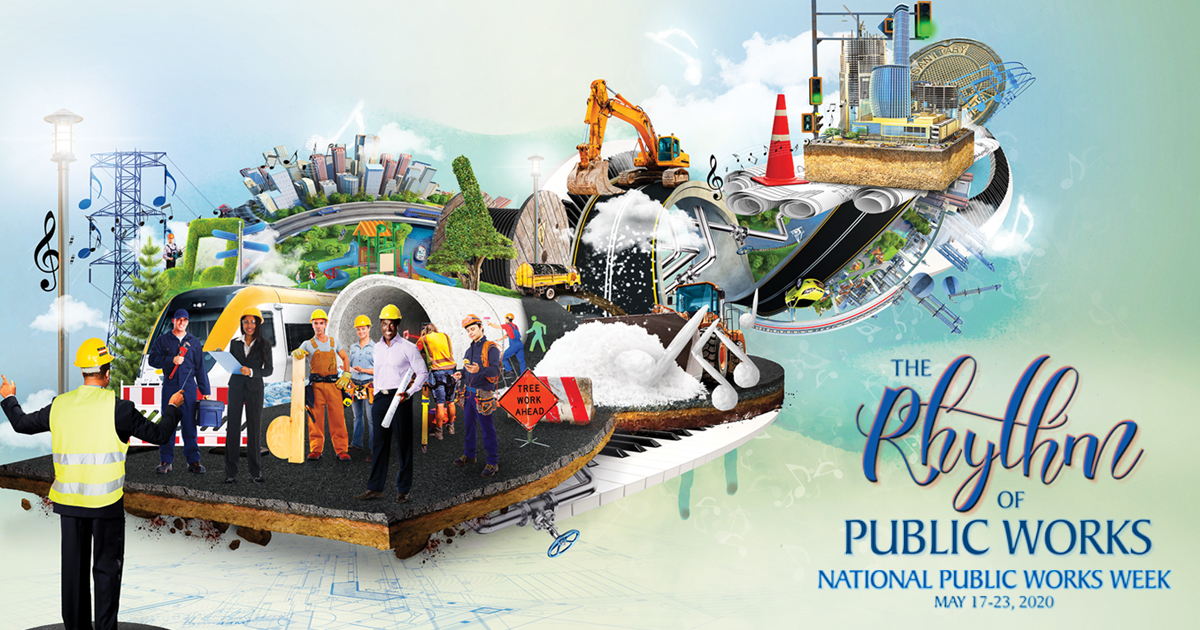
This week is, May 17-23, 2020, is National Public Works Week. Each year since 1960, the American Public Works Association (APWA) has sponsored National Public Works Week as a way to educate the public on the importance of public works to their daily lives.

This year’s theme is “The Rhythm of Public Works” and encourages citizens to think about their communities as “a symphony of essential services, working in concert to create a great place to live. Every community has a rhythm, a heartbeat that reflects its essence and tempo of life.”

“Every year National Public Works Week gets bigger and better,’ states APWA’s website. “The number of participating municipalities continues to grow, which means the number of citizens who are exposed to the value of public works grows. At APWA one of our main goals is to educate the general public about the value and necessities of public works projects throughout North America, and public works professionals like you are our best ambassadors.”

APWA encourages public works agencies and professionals to take the opportunity to make their stories known in their communities. States, provinces, cities/towns and municipalities from across North America are encouraged to celebrate with official government proclamations and resolutions in honor of the contribution public works makes to their communities. The National Public Works Week How-To Guide and Downloadables area are available to agencies to assist in the development and implementation of their own individual celebrations.

Although many of the opportunities outlined in the NPWW How-To Guide may not be an option this year, particularly events and other in-person plans, there are still plenty of ways for your company to celebrate. From T-shirt design contests to keep kids at home busy or have an employee appreciation day.

Many construction activities are considered essential, so showing employees a bit of appreciation by–for example–bringing in a treat some day this week, is a great way to celebrate.

Another way to stay safe and celebrate NPWW is to post your projects to social media using the official hashtag, #NPWW.

State DOTs Would Get $15B In Phase 4 COVID-19 Bill

The “Health and Economic Recovery Omnibus Emergency Solutions” or “HEROES” Act is a $3 trillion COVID-19 relief measure proposed by the House of Representatives on May 12. The proposed “Phase 4” COVID-19 bill contains $15 billion in stopgap funds for state departments of transportation.

This is well below the $50 billion the American Association of State Highway and Transportation Officials projects state DOTs will need to continue operations as they face “drastic falloffs in motor fuel tax revenues, toll road receipts, and other funding sources.”

According to AASHTO’s analysis of the “Phase 4” relief bill, “state DOTs would receive $14.775 billion distributed by formula funding, with tribal DOTs getting $150 million, Puerto Rico getting $60 million, and territorial DOTs receiving $15 million,” AASHTO’s article states. “Additionally, HEROES Act funds would be subject to Surface Transportation Block Grant Program or STBGP eligibilities and be provided at 100 percent federal share, with those funds allowed to cover operational, maintenance, and administrative expenses, including payroll needs.”

The HEROES Act would also provide remaining fiscal year 2020 Federal-aid Highway formula dollars from the Fixing America’s Surface Transportation or FAST Act at 100 percent federal share, as well as allow those funds to be used to cover operational, maintenance, and administrative expenses, including payroll.

“We want to thank House leadership for acknowledging the challenge facing state DOTs due to impacts from the COVID-19 pandemic,” noted Jim Tymon, AASHTO’s executive director, in a statement. “While this isn’t the $49.95 billion we asked for, it’s a good start. We look forward to working with House and Senate leadership to determine a level of funding that will allow state DOTs to continue to meet the needs of a nation and its economy that is getting ready to return to work.”

Bipartisan support had been growing for the nearly $50 billion state DOT funding “backstop,” with more than 130 members of the House of Representatives supporting that request in a letter sent on May 11 to House Speaker Nancy Pelosi, D-Calif., and Minority Leader Kevin McCarthy, R-Calif. “Our transportation system is essential to America’s economic recovery, but it is facing an immediate need as the COVID-19 pandemic is significantly impacting states’ transportation revenues,” the letter said. “With millions of Americans following ‘stay-at-home’ orders to reduce the spread of COVID-19, many state governments are facing steep across-the-board reductions in tax revenues.”

As vehicle traffic has declined by 50 percent in many parts of the country due to work and travel restrictions, state DOTs expect a 30 percent average decline in forecasted revenues over the next 18 months – with some potentially experiencing revenue losses as high as 45 percent

“Due to these grim realities, some states are unable to make contract commitments for basic operations such as salt and sand purchases for winter operations,” the members said. “Both short-term and long-term transportation projects that were previously set to move forward are being delayed, putting construction jobs at risk.”