5 Tips for New Laborers on a Paving Crew
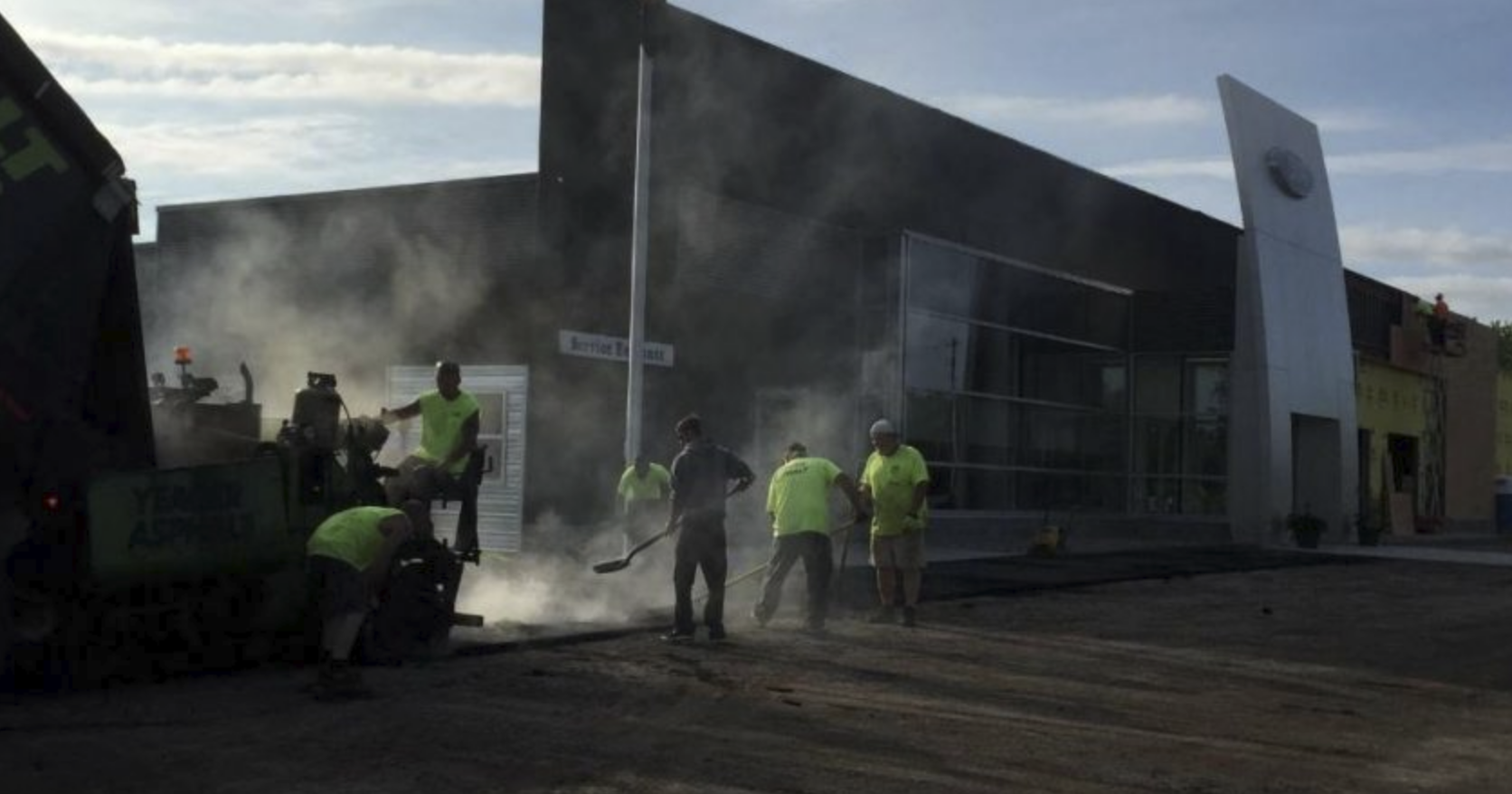
Earlier this month, AsphaltPro asked our followers across all of our social media channels–Facebook, Instagram, LinkedIn and Twitter–how they can tell that a laborer is a total newbie.

Here, we share the top tips from our readers to help new laborers catch up to speed on the paving train.

1) Stay safe–and aware–on the job site.

It’s important that every member of the crew, including the new guy, knows how to operate safely within the job site.

One of the most obvious things you shouldn’t do is stepping out into traffic, like Bradley Gonnering commented on LinkedIn. Also important is not walking between or standing between a backing haul truck and the paver, adds Mike Drew (@RealMikeDrew on Twitter) and Chase Collard on LinkedIn.

You should also become familiar with the hand signals used with haul truck drivers on the job and be sure to make eye contact with the driver through the mirrors to ensure he or she is aware you are there, adds Lisa Stamblesky-Butler on Facebook.

2) Wear proper attire for the job.

Wearing proper personal protective equipment (PPE) is also imperative for safety on the job, says Steve Hodder on LinkedIn.

But, that’s not the only bit of advice regarding proper work attire. Clint Hanson (@cdubya81 on Twitter) warns against showing up in shorts and tennis shoes. Long pants and sturdy work boots will protect you from the hot asphalt and other risks.

As James Roy chimed in on LinkedIn, you can always tell a laborer is new by his clean work boots. That’s something only time and experience on the paving train will resolve!

3) Take initiative! Don’t just stand there.

Getting to the “next level” often relies on your own initiative and desire to learn.

“Be vocal; always ask what’s next and pay attention,” replied @usoutworkers on Instagram. Constantine Paving (@Constantine_Paving on Instagram) suggests asking questions, learning, doing your best to figure out what comes next and how you can contribute to the end goal. Oh, and don’t just stand around.

“Standing around doing nothing is a rookie move,” said @LiftyRob on Instagram. “There’s always something to clean, shovel, rake. Watch someone’s back, spot a truck driver, traffic control, etc.”

4) Know proper shovel technique.

Knowing proper shovel technique is important, both to prevent injury and to be efficient in your job, “especially if it’s a day or a week straight of handwork” commented Ryan LeClaire on Facebook. “They either hold the shovel all the way down at the bottom of the handle or at the very top,” Vincent Engongoro added.

“We always tell the rookies to ‘Fill up the back of the shovel and the front takes care of itself’ when learning how to shovel,” replied @LiftyRob on Instagram; @Domjr6 recommends never taking a shovel of mix from the paver unless the driver knows you’re there (another great safety tip).

Proper shovel technique also  means keeping your shovel clean, commented Rick Rallo on Facebook. One key to this is to lubricate your shovel, said AggTec, LLC (@AggTec on Twitter).

Knowing how to properly cast and spread mix across the mat–without getting any on fellow crew members, Charles Parent adds–is also important, say Mike and Brandi Jones on Facebook.

5) Don’t harm the final product.

The last one sounds simple, but you’d be surprised how many experienced crew members still make this mistake. “Don’t walk on unrolled asphalt,” urges Carly Buchanan on LinkedIn.
Protect our Recycle Supply

Finding a reliable primary source regarding international news is often difficult, thus I relegated to my editorial column the topic of keeping and using our own recycle streams. I want to talk specifically about the potential use of recycle products in North America’s road mixes, as seen in my article, “High-Density Plastics Work for Central Asphalt Mix, Paving” on page 32. That begins with a brief explanation of why we get to keep more of our recyclables these days.

Readers may be aware that China imports trash from other countries for the purpose of recycling it. Within the past few years, China has instituted a policy it refers to as its “Green Fence,” by which it refuses recyclables from countries based on whether those recyclables will be too difficult to clean and put through its recycling system. The oversimplified concept is it takes a certain amount of financial resources to sort and clean trash into usable, crushable, shreddable bits and so forth. If China wishes to remain profitable in its recycling efforts, it must accept only the best of the best in terms of trash. If entities wish to continue sending recyclables to China, changes must be made.

I’m temped to trust the Vangel website, a woman-owned business enterprise (WBE) specializing in customized office recycling programs and electronics recycling services, for more information on this. Their take on how to get materials past China’s Green Fence is stated well (at vangelinc.com): “Because of our long-term dependence on exporting our recyclables to China, we in the U.S. do not have the facilities readily available to adequately sort and clean materials so that they’re up to China’s standards.”

Assuming China has “standards” is akin to hearing Obi-Wan tell young Luke that blast points on a sandcrawler couldn’t be made by Jawas because Imperial Stormtroopers are far more precise. It’s laughable. But the statement in Vangel’s report should stop us in our tracks. Read it slowly. And then: “As a result of China’s Green Fence, U.S. recycling centers that once accepted scrap plastic for recycling are being forced to send it to American landfills.”

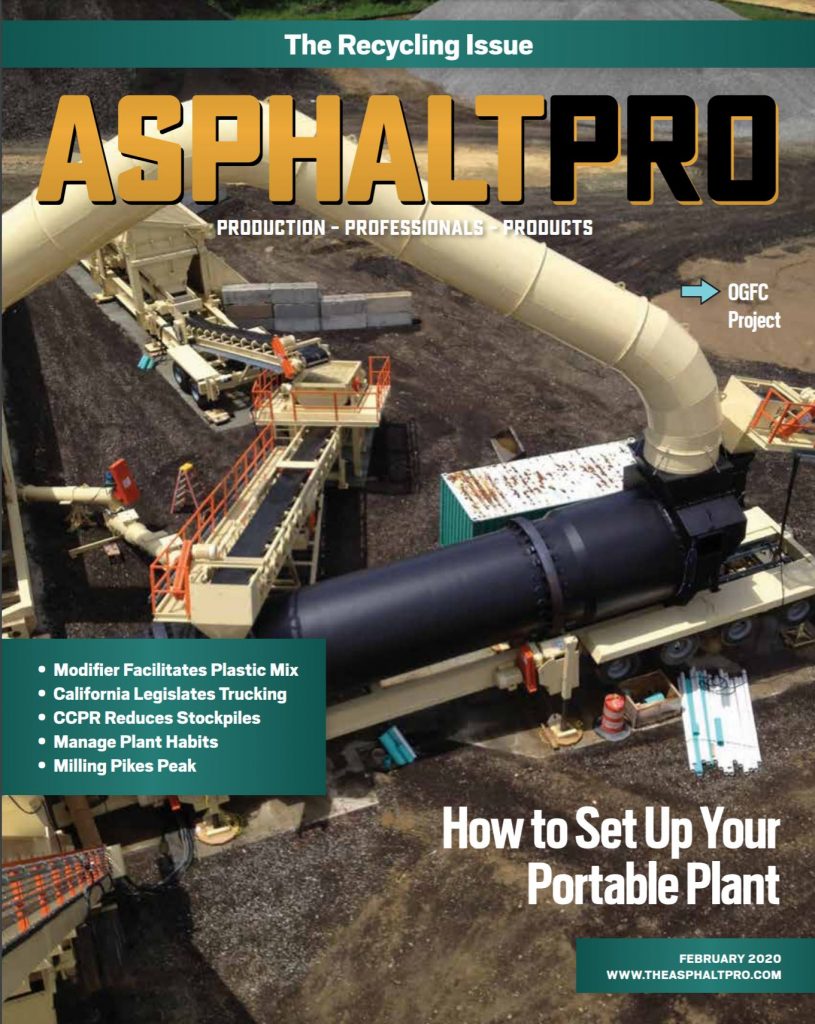
AsphaltPro’s February 2020 issue

The tariffs placed on steel imported from China (albeit a small portion of the steel we import to the United States) exposed a similar problem.

For the past few decades, the United States has grown reliant on foreign steel manufacture, production plants have closed and our workforce has boasted fewer skilled laborers in that arena. As I hinted at the start of this note, online “news” sources tend to bandy announcements around rather than report facts, so it’s difficult to track down exact numbers of blast furnaces that have been restarted or new furnaces built since the rates of duty were put in place on imported steel and aluminum. One organization (www.Steel.org) has kept its audience updated on the global over-capacity crisis in the steel industry while reporting U.S. import percentages decreasing (of course), while U.S. steel mills are seeing year-to-date increases in tons of steel shipped. Instead of sending every student to university for a four-year, lifetime debt, we’re offering skilled trades to students for high-paying, lifetime careers.

The same may come to pass with the recycling efforts aimed at saving our planet.

It’s no secret I’m a proponent for protecting our oceans. I’ve donated to Boyan Slat’s ocean-cleaning System 001, and I carry my stainless steel straws around so I’m one less human using plastic straws. But we Americans have multitudes of single-stream recycling centers dotting our cities where we now need to make decisions regarding job creation. We could put more people to work diverting the high-density polyethylene items from the stream to the mills for additional asphalt industry testing, mixing, blending and paving. It looks like we have a winning strategy developing there. If China with its “standards” isn’t helping us save the planet, the asphalt industry can assist by using a portion of the stream.

Rather than packaging up our plastics and literally shipping them across the ocean to a foreign country imposing standards to make its processing easier, I propose we up our game. If we have to clean and sort our recyclables more precisely for other countries, let’s go ahead and institute those policies for ourselves and re-use our materials for ourselves. Build our own facilities and train our own workers in earth-saving careers and put quality recyclables into quality road building concepts. We have the ingenuity to accomplish such goals on our own.

Stay Safe,
Sandy Lender

Nominations for ARTBA Hall of Fame, Leadership Program Now Open

The American Road & Transportation Builders Association (ARTBA) Foundation is now accepting nominations for the 2020 Transportation Development Hall of Fame.  Launched in 2010, the Hall “honors individuals or families from the public and private sectors who have made extraordinary contributions to U.S. transportation development during their careers.”

Nominees are considered in two categories:

  • Transportation Design & Construction Industry Innovators: Honors the men and women who discovered or created a “game changing” product or process that significantly advanced transportation design, construction and/or safety.  It seeks to honor the original
  • Transportation Design & Construction Industry Leaders (Individuals or Families): Recognizes men, women and families who have made significant contributions—beyond just having successful businesses or careers—that have notably helped advance the interests and image of the transportation design, construction and safety industry.

ARTBA’s Transportation Development Foundation is also accepting nominations for its 2020 Industry Leader Development Program (ILDP), the 25th annual class of the first-of-its-kind introduction to federal and state advocacy for transportation infrastructure market development and protection. It will be held May 12-14 in the Nation’s Capital.

The ILDP and its associated Industry Leader Development Council (ILDC), boasts of nearly 750 graduates from over 200 industry firms, state contractor chapters and public agencies since its inception in 1995. The immersive, two-and-a-half day program provides an understanding of industry economics, how transportation work in the U.S. is funded and financed, how actions by the federal government impact the industry, and how to become politically engaged to help shape transportation policy. ILDP fellows will also visit with their members of Congress to discuss the need for congressional action on a permanent Highway Trust Fund solution and new infrastructure investment package.

The ILDP is held in conjunction with ARTBA’s annual Federal Issues Program (FIP) and the Transportation Construction Coalition (TCC) Washington Fly-In.

Admission to the ILDP is a competitive process. Eligibility requirements include the following:

  • Nominees should be ages 30-50 and have at least three years of experience in the transportation design and construction industry, have made a significant contribution to the work of his or her firm, and shown evidence of strong leadership potential for the industry.
  • To be considered for admission, candidates must be nominated by a sponsor and submit a completed application form.

Admission to the ILDP is competitive.  A letter of nomination and recommendation written by a principal of the firm, a senior executive within the governmental agency, or a senior-level faculty member at the university which employs the applicant must accompany each application.

Applications for both the Hall of Fame and the Leadership program are due by Wednesday, April 1. For more information, visit here for the Hall of Fame or here for the Leadership program.

Streamline Controls so Start-up Takes One Flip of the Switch

This week’s quick tip centers on cleaning up the control house a bit.

The control house no longer has to look like a jungle of wires taking over control panels filled with a multitude of switches.

Consider replacing manual switches with a PLC-based human-machine interface. Think of a monitor with a touchscreen. So much more organized. And so much easier to start the plant if the steps are automated and tethered to a single click of the mouse.


Get more quick tips like this. Sign up for our weekly Toolbox Tip newsletters.

Asphalt Pavements: Tracking America’s Most Recycled Material

All U.S. Asphalt Mix Producers and In-Place Recyclers Encouraged to Participate in Annual Industry Survey by April 1

Greenbelt, Maryland — Each year, the National Asphalt Pavement Association (NAPA) surveys the industry to document the volume of recycled materials used in new roads. Since 2009, this survey has confirmed that asphalt pavement mixtures are the most recycled material in the United States. Every year, nearly 100 percent of the material removed from old roads and parking lots is reclaimed for use in new pavements.

To quantify the amount of recycled material used during the 2019 construction season, NAPA is encouraging every asphalt mix producer in the United States to participate in its latest survey on the use of recycled materials and warm-mix asphalt. This confidential survey is conducted by NAPA under a contract with the Federal Highway Administration (FHWA). Responses are sought from producers of all sizes and from every community in all 50 U.S. states, as well as all U.S. territories. Additional information is also being sought about the use of in-place recycling technologies during 2019.

“In 2018, data from more than 1,300 asphalt plants were included in the survey, ensuring a high level of reliability for its findings. Greater industry participation in the survey helps ensure the industry’s environmental impacts are properly understood by federal and state agencies, as well as the public,” stated Brett Williams, NAPA Director of Engineering and Technical Support, who is administering the survey. “It is thanks to companies’ willingness to participate in the survey that we can prove the inherent sustainability of asphalt pavements, as well as encourage greater use of reclaimed asphalt in new pavements.”

NAPA and FHWA have tracked usage of reclaimed asphalt pavement (RAP), recycled asphalt shingles (RAS), and warm-mix asphalt (WMA) annually since the 2009 construction season. The survey has been cited more than 350 times in academic literature, and is used by FHWA, the Department of Energy, and other public agencies to measure the impact of these technologies.

The results from the 2018 construction season were released in September 2019, showing that more than 84.7 million tons of recycled material was used in asphalt pavement mixtures during 2018. This includes RAP and RAS, as well as other reclaimed and recycled materials, such as ground tire rubber, steel and blast furnace slags, coal combustion products, and cellulose fibers.

In addition, about 79.5 million tons — more than 20 percent of total asphalt pavement mixture produced in 2018 — used WMA technologies to reduce mix-production temperatures. The full results of the 2018 survey are available at www.AsphaltPavement.org/recycling.

All asphalt mix producers operating in the United States and in U.S. territories are encouraged to participate in the confidential 2019 construction season survey by April 1. To participate, visit www.surveymonkey.com/r/2019_RMWMA_Survey.

For the 2019 construction season, FHWA asked NAPA to expand the survey collection effort to include in-place recycling techniques, including cold-in-place, hot-in-place, cold central plant recycling, and full-depth reclamation. Companies using these technologies are also encouraged to participate in a short supplementary survey at www.surveymonkey.com/r/2019_IPR_Survey.

Data from the surveys are kept completely confidential and are only reported in aggregate and used to determine quantities. State-level data are reported only if three or more companies from the state or territory participate. No company-specific information is disclosed or used for any purpose.

Transportation Research Board Celebrates its Centennial

Nearly 14,000 people – including industry leaders, policymakers, administrators, and researchers from government, industry, and academia – will gather for the Transportation Research Board’s 99th Annual Meeting (you can still register at this link too) in Washington, D.C., from Jan. 12-16, 2020.

TRB is celebrating its centennial with the launch of a book chronicling the history of how the once-small group established in 1920 by the National Academy of Sciences grew to the nationally recognized organization it is today. In The Transportation Research Board, 1920–2020: Everyone Interested Is Invited, author Sarah Jo Peterson details the transportation milestones of the last 100 years and the role that TRB has played in shaping the current transportation landscape. The centennial celebration is the meeting’s spotlight theme.

The Chair’s Luncheon (Wednesday) draws an audience of 750 leaders in transportation from the public and private sectors throughout the United States and abroad. New Executive Committee members and officers and TRB’s most prestigious awards will be presented. U.S. Secretary of Transportation Elaine L. Chao will offer the keynote and Sarah Jo Peterson will also address the luncheon.

Secretary Chao’s priorities for 2020 and the future include the U.S. DOT’s Rural Initiative, tax-incentivized Opportunity Zones, permitting reform, and railroad crossing safety and will be highlighted during a roundtable discussion, Infrastructure Policy in 2020 and Beyond (Monday). Participants can hear from additional U.S. Department of Transportation senior officials at the panel Laying a Foundation for Advanced Transportation Technology (Monday). Both U.S. and European Commission officials will be on hand to discuss three projects “twinned” in Preparing for Connected and Automated Vehicles: Results from EU – U.S. Research Collaboration (Tuesday).

State DOT officials play a prominent role in the meeting. A roundtable will examine methods addressing transportation-related deaths and injuries by raising public awareness, using technological advancements, and deploying innovative designs in Toward Zero Deaths: State DOTs Renewing Focus on a National Public Health Crisis (Tuesday). Women CEOs lead a discussion in the CEO Session: Equity’s Role in Transportation Decision Making (Wednesday).

In looking toward the future, several sessions will focus on autonomous vehicles and shared mobility. Shared Mobility and Traveler Choices (Monday) explores different perspectives on personal decisions. Furthering the conversation, Making Autonomous Vehicles Accessible for All (Monday) identifies and addresses potential barriers. Roadway assets like signs, markings, signals, and communications systems are studied in Impact of Connected/Autonomous Vehicles on Roadway Maintenance Operations (Tuesday).

An exhibit hall features more than 300 exhibitors from government agencies, research organizations, and commercial businesses showcasing their products and services.

Attendees can download the free annual meeting app to access information on the schedule of events, program participants, floor plans, exhibitors, and more. To download, search for “TRB 2020” in the iTunes App Store or Google Play. To follow online conversations about the annual meeting, use the hashtag #TRBAM and follow TRB on Twitter @NASEMTRB.