“We strongly support the America’s Transportation Infrastructure Act released today by the Senate Environment and Public Works Committee. Aggregates producers not only stand ready to build and rebuild America’s infrastructure, we also rely on a dependable, efficient transportation system in our daily lives.
“The ATIA will provide much needed funding to maintain and repair America’s roads and bridges. This is a positive step in addressing necessary infrastructure investment. Our nation’s roads, bridges, highways and the many other aspects of our infrastructure are in need of repair, improvement and advancement to meet the needs of today and tomorrow. Bold steps such as today’s bill are critical to address infrastructure investment across the board for America’s economic future.
“I commend the bipartisan leadership of Chairman John Barrasso (R-Wy.), Ranking Member Tom Carper (D-De.), Transportation Subcommittee Chairman Shelley Moore Capito (R-WVa.) and Ranking Member Ben Cardin (D-Md.). Their commitment to provide this level of funding is a very positive step forward. We look forward to working with the committee as the legislation moves forward and urge the Senate to pass the ATIA.”
NSSGA is the leading advocate for the aggregates industry. Its members – stone, sand and gravel producers and the equipment manufacturers and service providers who support them – produce the essential raw materials found in homes, buildings, roads, bridges and public works projects, NSSGA represents more than 90 percent of the crushed stone and 70 percent of the sand and gravel produced annually in the United States. Learn more at www.nssga.org.
Protect Your Image
The number of less-than-safe construction practices I’ve seen photographed and posted on social media is rivaled only by the number of commenters mocking one another for bothering with personal protective equipment (PPE) in the heat of summer. Both of these trends should alarm human resources directors as well as safety directors, supervisors and any other person with a shred of common sense.
I know we all get a kick out of sharing stories such as “crazy things we’ve discovered in the paver hopper.” Those silly pictures don’t necessarily present a safety hazard and certainly don’t have to include a company logo or be accompanied by anyone’s name for shaming. But these pictures and posts beg the question: Should we encourage one another to show off our mistakes or to show off our triumphs?
I vote we share the positive, bonus-worthy asphalt images—even if an occasional wacky-things-found-growing-in-the-stockpile stories can be comical.
The asphalt industry with its adherence to complex mix design specifications while performing detail work with heavy equipment should be above childish behavior, yet too many company policies apparently allow random paving crewmembers to play with their smart phones while working. They further allow the crewmembers to post the results of their playtime online for competitors and the Occupational Safety and Health Administration (OSHA) to review. Does anyone else in this industry see the folly in letting workers capture mistakes—and even hazardous conditions—for posterity?
I put it to you: It is wiser to prepare a policy that forbids the use of smart phones for activities other than work-related and to forbid workers below a set “director” grade to post pictures to social media without a foreman or supervisor’s approval.
August 2019
Posting good pictures that glorify a company’s exemplary work, clean equipment and safe workers in proper PPE is a smart marketing move. That kind of imagery is worth its weight in PR gold.
Posting bad pictures that demean a co-worker or subcontractor for mistakes, broken and/or dirty equipment, and inexperienced or apathetic employees ignoring safety protocol is an unwise move.
Keep in mind, instructional videos are educational and hopefully aren’t seen as bullying in nature. But pictures posted to entice others to comment negatively are irresponsible. That kind of imagery hurts your company and the industry as a whole. It’s unfortunate to see the level of grumbling and negativity that lives in any community online; a discussion about an improved company policy could go a long way to curing pessimism in our little niche of the Internet. As you work to reprogram your workers to appreciate the job, the company, the industry, you could request they show off the good and the exemplary in asphalt production and paving.
In fact, AsphaltPro magazine has a Facebook page with which we try to request positive, good practices for conversation. Join us there and share positivity instead of a company’s marketing nightmare. We’re working toward showing the great side of the asphalt industry.
Stay Safe,
Sandy Lender
Troxler Purchases TestQuip to Round Out Balanced Mix Design Portfolio
Troxler Electronic Laboratories, Inc., a global leader in testing and measurement equipment for the road construction industry, and TestQuip, LLC, a producer of crack testing equipment and accessories for contractors, states and research groups, announced last week the purchase of TestQuip by Troxler.
This union rounds out Troxler’s portfolio of Balanced Mix Design products. The Balanced Mix Design (BMD), or Performance-Engineered Mixture Design (PEMD), is an adjustment to the current USA Superpave volumetric testing that adds performance testing to the equation in the form of both rut and crack testing. This means that pavement designers will be able to model consistency in volumetrics and performance in BMD with these new tests, enabling states and contractors to build long-lasting asphalt roads with minimum maintenance required.
“We already make the premiere Hamburg rut testing equipment and adding the next piece of the puzzle will give us the best Balanced Mix Design offering available in both quality, accuracy and durability,” said William F. Troxler, Jr. “We hope to help each state choose the tests that will best predict performance for that area.”
Across the nation, many DOTs are already implementing or testing the BMD approach with six DOTs already using it and another 20 DOTs using some sort of rut and crack testing in mix design. Troxler is proud to offer a complete BMD product portfolio to the road construction industry.
Harbor Freight Tools for Schools to Award Skilled Trades Teachers
Fifty skilled trades teachers and teaching teams from across the country were named today as semifinalists for the 2019 Harbor Freight Tools for Schools Prize for Teaching Excellence. They and their high school skilled trades programs are in the running for a share of $1 million in total cash awards.
The semifinalists hail from 26 states and specialize in trades including manufacturing, welding, construction, automotive and agriculture mechanics. The teachers—some competing as individuals and some as teams—were selected by an independent panel of judges from among a field of 749 applicants. The list of the 50 semifinalists is available here.
“We never cease to be amazed by the talent, creativity and resourcefulness of skilled trades educators,” said Danny Corwin, executive director of Harbor Freight Tools for Schools. “This year’s semifinalists teach more than a dozen trades and have spent a collective 800 years in the classroom, and we couldn’t be more excited to honor their work.”
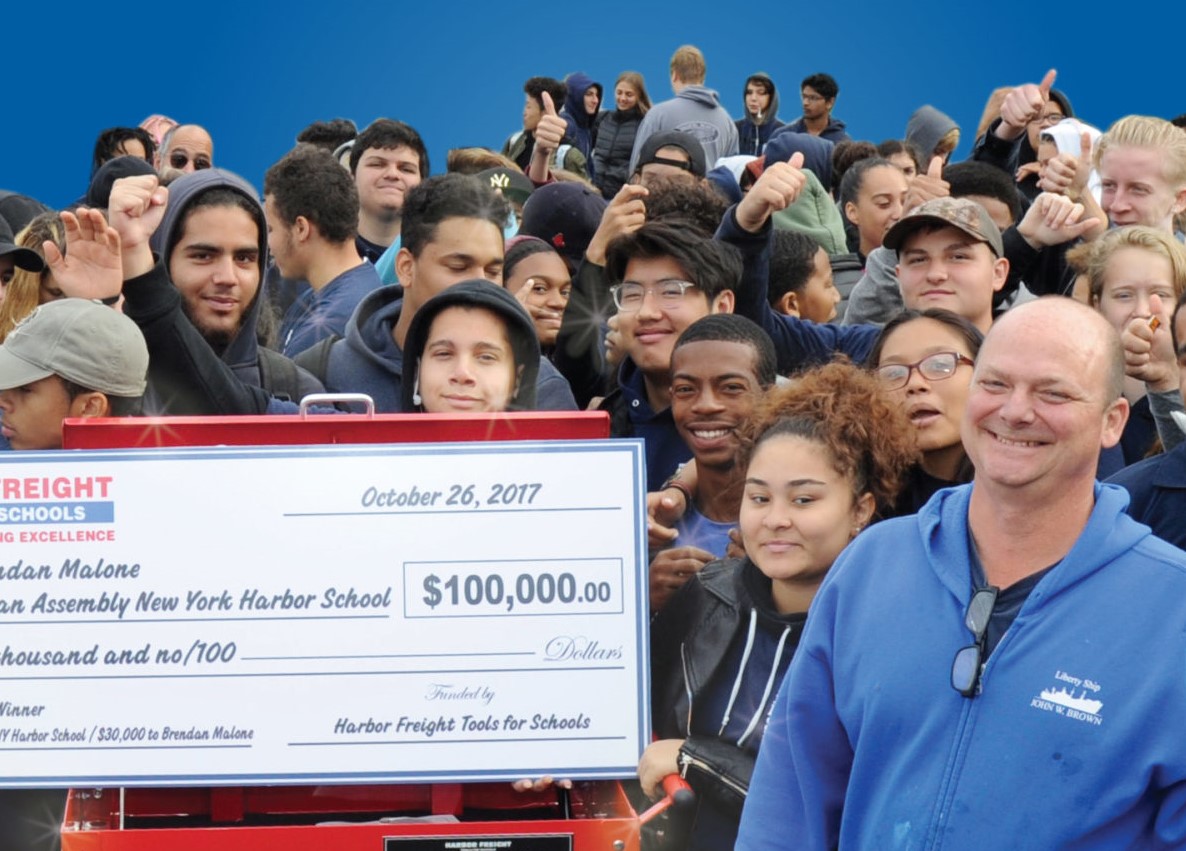
The Harbor Freight Tools for Schools Prize for Teaching Excellence was started in 2017 by Eric Smidt, the founder of national tool retailer Harbor Freight Tools. The prize recognizes outstanding instruction in the skilled trades in U.S. public high schools and the teachers who inspire students to learn a trade that prepares them for life after graduation. Now, in the third year of the prize, more than 150 teachers have been recognized as winners or semifinalists. Winners are invited to attend an annual convening to share best practices for advancing excellence in skilled trades education.
“Skilled trades teachers help hundreds of thousands of students each year experience the satisfaction and sense of accomplishment that comes from learning a trade,” Smidt said. “These teachers, their students and skilled tradespeople everywhere, too often don’t receive the respect and gratitude they deserve. Without them, construction would halt, homes, cars and appliances would fall into disrepair, and our infrastructure would crumble. We are thrilled to be able to honor and elevate the importance of their work.”
The 2019 semifinalists now advance to a second round of competition, where they will be asked to respond to online expert-led video learning modules designed to solicit their insights and creative ideas about teaching practices. The contenders will be asked how ideas from the modules might be used to inspire students to achieve excellence in the skilled trades. Two rounds of judging, each by separate independent panels of reviewers, will narrow the field to the 18 finalists and, finally, name the three first-place winners and 15 second-place winners.
The 18 winners will split the $1 million prize. First-place winners will each receive $100,000, with $70,000 going to their public high school skilled trades program and $30,000 to the individual skilled trades teacher or teacher team behind the winning program. Second-place winners will each be awarded $50,000, with $35,000 going to their public high school program and $15,000 to the teacher or team. Past winners have dedicated their winnings to modernizing their shops, investing in specialized tools, promoting their programs to families and purchasing equipment that will prepare students for higher-level accreditations. Semifinalists whose school, district or state policy prohibits receipt of the individual portion of prize earnings were eligible to apply on behalf of their school’s skilled trades program. If they win, the entire prize will be awarded to the school.
Winners will be announced on Oct. 24.
About Harbor Freight Tools for Schools
Harbor Freight Tools for Schools is a program of The Smidt Foundation, established by Harbor Freight Tools Founder Eric Smidt, to advance excellent skilled trades education in public high schools across America. With a deep respect for the dignity of these fields and for the intelligence and creativity of people who work with their hands, Harbor Freight Tools for Schools aims to drive a greater understanding of and investment in skilled trades education, believing that access to quality skilled trades education gives high school students pathways to graduation, opportunity, good jobs and a workforce our country needs. Harbor Freight Tools is a major supporter of the Harbor Freight Tools for Schools program. For more information, visit us at harborfreighttoolsforschools.org/ and on Facebook, Instagram and Twitter.
What’s the Deal with Seal Treatments?
Surface treatments, such as the chip seal and fog seal, originated in the early 1900s. However, seal treatments have evolved and expanded over time. As less well-known surface treatments, such as scrub seals, grow in popularity, it’s important to know how these treatments differ.
A chip seal consists of one or more layers of asphalt binder and embedded aggregate.
A fog seal is a single, light application of emulsified asphalt. Rejuvenating fog seals can be used on pavements with greater surface distress.
A slurry seal relies on specialized equipment to combine asphalt emulsion, mineral aggregate, water and additives, and uniformly spread this mixture over a properly prepared surface. Micro surfacing is similar, but utilizes a polymer-modified asphalt emulsion.
A cape seal consists of a chip seal treatment that is then covered by a slurry seal or micro surfacing treatment.
A scrub seal is initially performed like a chip seal treatment, but then the asphalt distributor pulls a broom sled across the surface to “scrub” the emulsion into any cracks.
Many of these seal treatments can be used in conjunction with one another, or with other pavement treatments.
Sign up for our Toolbox Tips to receive tips like this to your inbox every week.