Flexing Concrete Still Cracks

The concrete industry adds odd things to their mix to get a flexible pavement—like asphalt—but still full of their pricy ingredients.

Sometimes, it’s necessary to add an anti-strip, polymer or warm-mix additive to an asphalt mix design to augment the performance characteristics of the final pavement. This adds some cost to what you’re building, but the tradeoff, typically, is a longer-lasting pavement system for the end user. I tend to look askance at the oddities people want to add to mix designs. When you start talking about throwing pig feces or plastics into mixes, I wonder if the tradeoff has been studied properly, or if someone in a lab is getting overzealous about recycling.

For example, the concrete industry has caused me to snicker to myself more than once over the years with odd things they want to mix in with cement to make the gray matter do different things upon placement. The concept of adding very fine aggregates and polyvinyl alcohol (PVA) fibers to make a flexible casting is on the radar screen as of late.
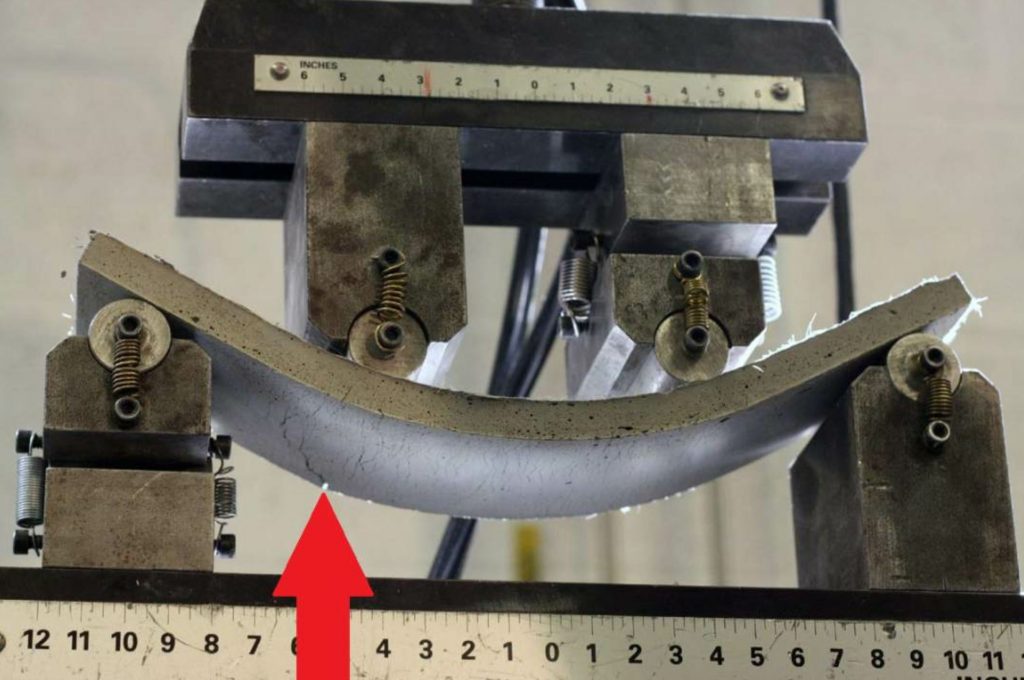
Notice that the ECC bends without developing “large” cracks, according to the concretecountertopinstitute.com website, but it will develop cracks that are visible to the naked eye, as indicated by the red arrow I added. Photo from the website: concretecountertopinstitute.com

I found the most information about the “artisan concrete” from the Concrete Countertop Institute, leading me to wonder why an engineer would design a pavement from one’s lavatory. Whatever my thoughts on the subject, a professor of structural and materials engineering at the University of Michigan was looking for a form of concrete that could keep its strength after cracking, according to the CCI. Enter engineered cementitious composite (ECC), which is defined by the CCI as “a specialized form of concrete developed in the early 1990s by Dr. Victor Li.” ECC is similar to precast concrete in that workers mix it, cast it and take it to the location to be set in place, or it can be poured and cast-in-place. It includes cementitious binder, very fine aggregates and the aforementioned PVA fibers for movement. You’ll notice Professor Li worked on that back in the early 1990s, but the concrete industry is considering it for your roadways now. They want something flexible—like asphalt—but still full of their pricy ingredients.
Up north near Michigan, the Minnesota Department of Transportation (MnDOT) took a look at concrete cracking on bridges. In the technical report MN/RC 2019-09 published February 2019, Deterioration of Mixed Rebar and Fiber-Reinforced Concrete Bridge Decks, Authors Corin Treat and Benjamin Z. Dymond concluded that “[t]hrough-deck cracking may be a key indicator for future underdeck spalling of mixed bar decks since the cracks provide a clear path for the chlorides to reach the uncoated bottom mat.” What’s happening there is the 600 bridges constructed with two levels of differently coated rebars within the concrete are spalling and failing despite MnDOT’s efforts to protect the lower levels. They further conclude they should “[c]onsider a more robust crack sealing method such as flood coating with methyl methacrylate (MMA) or applying an impermeable wearing course…”

Look. Asphalt is already flexible and various asphalt membranes already represent impermeable barriers to prevent water intrusion to lower bridge decks where rebar rests inside the cracked and/or cracking concrete systems. Asphalt is the answer. If concrete is letting water in to rust and corrode your system, then take the concrete—whether it was doctored to flex after it cracks or not—out of the equation.

Stay Safe,
Sandy Lender

Celebrate National Public Works Week

This week is National Public Works Week, May 19 to May 25. NPWW’s 2019 theme is “It Starts Here”, which represents “the many facets of the modern civilization that grow out of the efforts put forth by the public works professionals across North America.”

“What starts here?” reads the NPWW website. “Infrastructure starts with public works… Growth and innovation starts with public works… Mobility starts with public works… Security starts with public works… Healthy communities start with public works… The bottom line is that citizens’ quality of life starts with public works.”

The American Public Works Association has sponsored NPWW since 1960, and the event continues to grow. This week, APWA’s 30,000+ members in North America strive to engage and educate the public on the value of public works to their daily lives.

APWA encourages public works agencies and professionals to take the opportunity to make their stories known in their communities, reads the NPWW site. We at AsphaltPro encourage you to do the same.

The National Public Works Week How-To Guide and Downloadables area are available to agencies to assist in the development and implementation of their own individual celebrations.

Asphalt Pavement Alliance Announces Perpetual Pavement Award Winners

Asphalt Pavement Alliance has honored six departments of transportation for the success of their long-lasting asphalt roads. These DOTs have been named as winners of APA’s 2018 Perpetual Pavement Awards.

The award is presented to state DOTs and local agency road owners for well-performing asphalt pavements that are at least 35 years old with proven high-quality structural design. The pavement cannot have suffered a structural failure and should have an average interval of 13 years between resurfacing.

“One of the keys to sustainability is long life,” said Amy Miller, P.E., National Director of the Asphalt Pavement Alliance. “Asphalt roads can be engineered to last indefinitely with only routine maintenance and periodic surface renewal.”

The pavement must demonstrate the characteristics expected from long-life, Perpetual Pavement design: excellence in design, quality in construction and value to taxpayers, reads APA’s press release.

This year’s winners are:

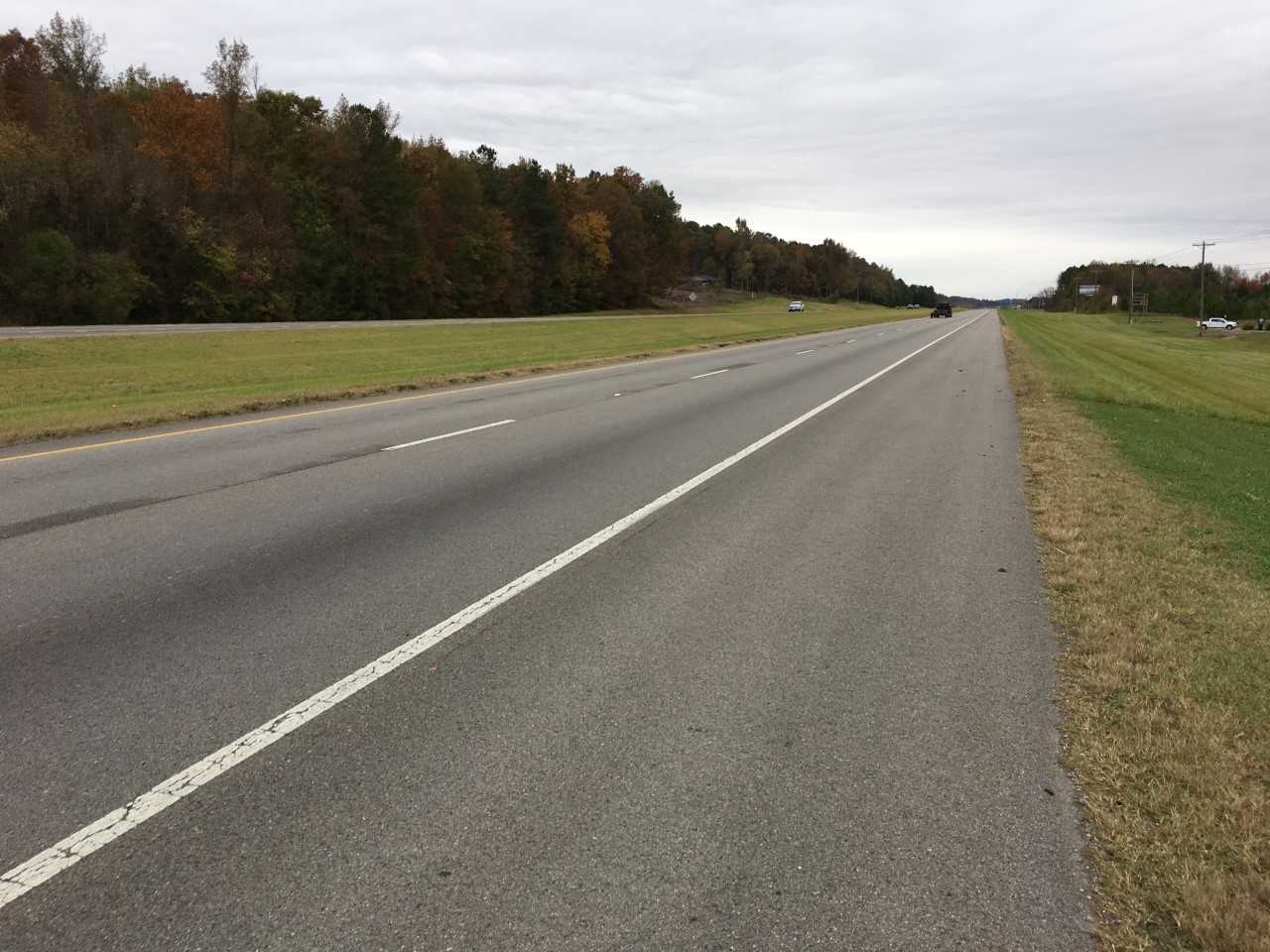
  • Alabama Department of Transportation, North Region, for a 2.4-mile section of four-lane divided highway on U.S. Highway 72/State Route 2 in Jackson County. This is the 10th Perpetual Pavement Award for ALDOT.
  • Arkansas Department of Transportation for a 4.81-mile stretch of two-lane Arkansas Highway 92, Section 1, in Conway County. This is the ninth Perpetual Pavement Award for ARDOT.
  • Florida Department of Transportation for a 3.17-mile section of four-lane highway on U.S. Highway 192/State Road 500 in Brevard County This is the ninth Perpetual Pavement Award for FDOT.
  • Pennsylvania Department of Transportation, Engineering District 4-0, for a 2.5-mile section of two-lane road on Pennsylvania Route 424 in Luzerne County. PennDOT has earned eight Perpetual Pavement Awards.
  • Tennessee Department of Transportation for a 2.77-mile stretch of two-lane highway on State Route 56 in Putnam County. This is the 14th Perpetual Pavement Award earned by TDOT.
  • Washington State Department of Transportation for a 5.88-mile section of two-lane U.S. Highway 195 in Spokane and Whitman counties. This is the fifth Perpetual Pavement Award earned by WSDOT.

The nominated pavements were evaluated by engineers at the National Center for Asphalt Technology (NCAT) at Auburn University. Winning agencies are honored by their local state asphalt pavement association and presented with an engraved crystal obelisk, ad their names and projects are added to a plaque on permanent display at the NCAT Research Center at Auburn University.

Since the Perpetual Pavement Award was established in 2001, 132 pavements in 30 U.S. states and one Canadian province have been honored with the award.