The EIS Gets Streamlined, Accountable

Wouldn’t it be great if your doctor had to pay you a fine for making you wait past your scheduled appointment time? We’ve all thought about it. You’re held hostage to his or her authority while you wait, unable to move forward with your day, your job, your life…

Apply this aggravation to something much grander.

Imagine, if you will, you’ve financed the purchase of a large piece of equipment to undertake a highway project for which you won the bid at the beginning of one construction season. Now you wait on environmental reviews, authorizations, inter-agency double-speak and red tape, before you can break ground. Equipment payments are due. Workers need paychecks. The utility bills don’t stop because the OMB hasn’t issued guidance yet.

There’s finally good news on this front. The policy of One Federal Decision (OFD) requires a lead Federal agency to not only develop a permitting timetable for major infrastructure projects; it also requires that agency to follow the timetable. Let me quote a fact:

“Each major infrastructure project shall have a lead Federal agency, which shall be responsible for navigating the project through the Federal environmental review and authorization process, including the identification of a primary Federal point of contact at each Federal agency. All Federal cooperating and participating agencies shall identify points of contact for each project, cooperate with the lead Federal agency point of contact, and respond to all reasonable requests for information from the lead Federal agency in a timely manner.”

The August issue of AsphaltPro

The August issue of AsphaltPro

That is from the Federal Register Volume 82, Number 163, Executive Order 13807 of Aug. 15, 2017. That EO established “Discipline and Accountability in the Environmental Review and Permitting Process for Infrastructure Projects.” Its overarching goal, as stated in the document, is “to ensure that the Federal environmental review and permitting process for infrastructure projects is coordinated, predictable, and transparent.”

As a sea turtle conservationist, I’m inclined to investigate such things closely. Let’s face it; I carry my own multi-use, stainless steel straws to keep those unsustainable, single-use straws out of the ecosystem. When someone, whether he’s the President of the free world or not, suggests we skip steps in environmental review, I get nervous. Here’s the thing: if you read all nine pages of EO 13807, which is not hard to do, you’ll see, as I did, that no one will be allowed to skip steps in anything.

In fact, steps are being made transparent and streamlined. Section 2, letters f through h, state: “It is the policy of the Federal Government to conduct environmental reviews and authorization processes in a coordinated, consistent, predictable, and timely manner in order to give public and private investors the confidence necessary to make funding decisions for new infrastructure projects; speak with a coordinated voice when conducting environmental reviews and making authorization decisions; and make timely decisions with the goal of completing all Federal environmental reviews and authorization decisions for major infrastructure projects within 2 years.”

There it is. Environmental review processes for infrastructure projects aren’t supposed to be mired in red tape for a decade or so while a water system’s pipes disintegrate into the water supply or a city’s traffic backs up to the next county. The OFD policy has its own Memorandum of Understanding, in which the Office of Management and Budget and the Council on Environmental Quality worked with the Federal Permitting Improvement Steering Council to come up with a framework to implement EO 13807. They issued, March 20, the “One Federal Decision Framework for the Environmental Review and Authorization Process for Major Infrastructure Projects Under Executive Order 13807” (OFD Framework), which is free to download. It spells out, among many points, that a project will have a lead agency, which will be responsible for organizing the Federal environmental review. That agency will get everyone else to cooperate. That agency will set the permitting timetable. And that agency will prepare the environmental impact statement (EIS).

That sounds like accountability to me.

And it sounds like getting work done. Finally.

–Sandy Lender

U.S. House Releases Legislative Discussion Draft of New Infrastructure Bill

Earlier this week, Bill Shuster (R-PA), the U.S. House of Congress’ Transportation and Infrastructure Committee Chairman, released a legislative discussion draft containing the input he’s collected from his colleagues across part lines, the Trump administration and other stakeholders to address the country’s aging infrastructure system.

“The 2016 presidential campaign shined a spotlight on America’s crumbling infrastructure,” Shuster said. “Since election day, the American people have waited for action by their federal elected representatives, and I am just as frustrated as they are that we have yet to seriously consider a responsible, thoughtful proposal. That is why I have released  a discussion draft that reflects input from Members on both sides of the aisle, as well as a broad group of infrastructure stakeholders interested in building a 21st century infrastructure for our country.”

Shuster adds that the discussion draft does not represent a final infrastructure bill, but aims to “reignite discussions amongst my colleagues, and I urge all Members to be open-minded and willing to work together in considering real solutions that will give America the modern day infrastructure it needs.”

“Over the coming weeks and months, I look forward to additional input from my Republican and Democratic colleagues in order to prepare a bill for congressional consideration,” he added.

Read the discussion draft, Shuster’s vision statement and a section-by-section summary here.

Show Workers Overhead Workzone Hazards

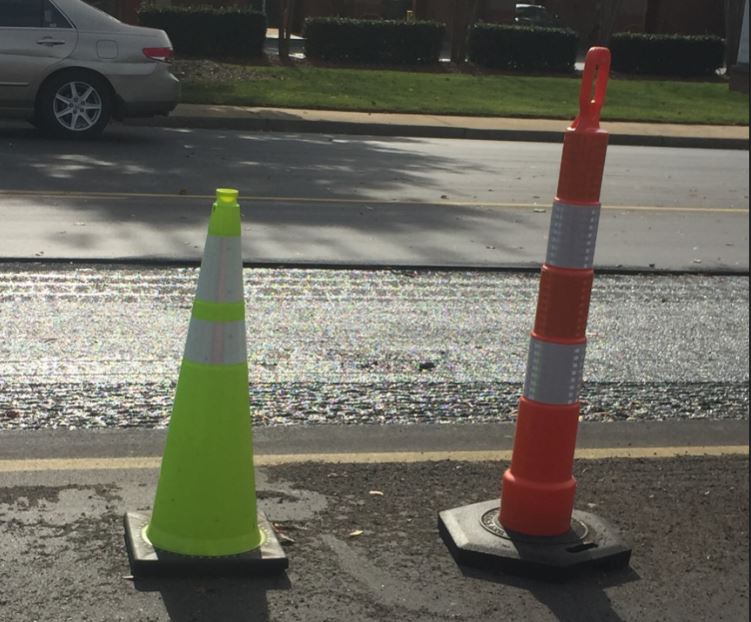
We’ve discussed this effective safety idea in the pages of AsphaltPro magazine before. You can find tips on this concept in the online training course we prepared with industry consultant John Ball. This month, The Lane Construction Corp. of West Columbia, South Carolina, received a NAPA 2017 Asphalt Operations Safety Innovation Award for it. Because it’s important to reiterate and make sure each and every member of the crew—new and veteran—knows that a differently-colored safety cone indicates something is up.

“Up” being the operative word.

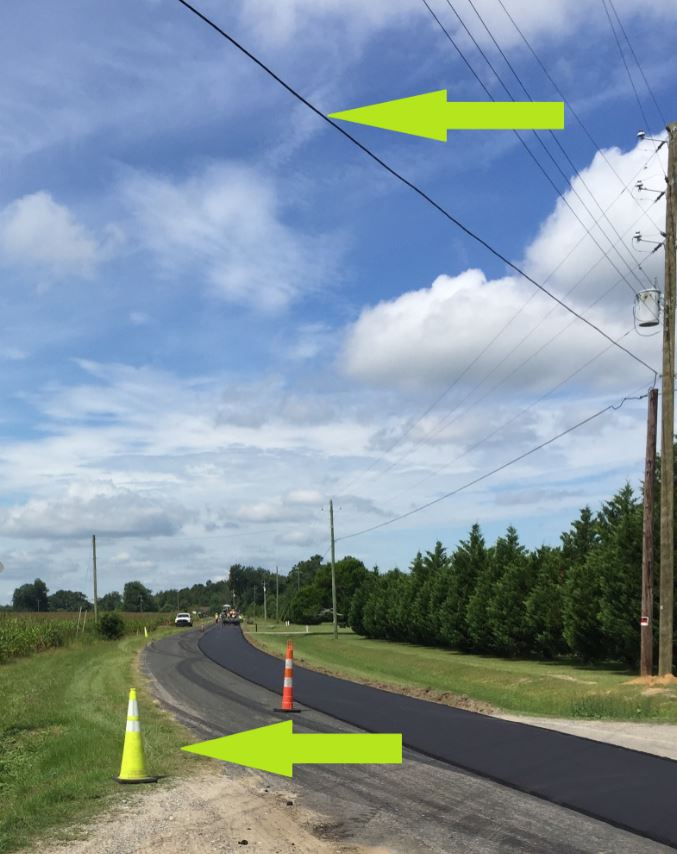
In the photo below, provided by Lane Construction and NAPA, you can see that the neon green cone is placed under an overhead wire. The cone’s uniqueness and placement is to draw attention to the overhead hazard.

Make sure your work zone includes indicators of overhead hazards.

Also make sure each worker on your team knows what those indicators mean. During the morning’s safety huddle or tailgate talk, take the time to remind crewmembers of the special cones, boxes, flags or other indicators of overhead utility lines.

While researching overhead powerline hazards, The Lane Construction Corp’s safety team for the Carolinas learned that many workers had misconceptions about the relative danger of overhead utility lines, believing that little harm could come from cable television and telephone lines. The workers were unaware that OSHA required employees and equipment be kept a minimum of 10 feet away from any line with 50,000 volts or less running through it. That’s why Lane developed the Cones for Life program, which is now a best practice for the company. You can implement the use of vibrant cones at your work sites, too.

Results Are In: NAPA’s Annual Warm-Mix and Recycled Asphalt Survey

Last week, the National Asphalt Pavement Association (NAPA) and Federal Highway Administration (FHWA) published its 8th annual report on the use of recycled materials and warm-mix asphalt.

In 2017, nearly 40 percent of asphalt pavement was produced as warm-mix asphalt, totaling 147.4 million tons nationwide. That’s nearly an 800 percent increase since NAPA and FHWA began conducting these surveys in 2009.

During that same year, more than 76.2 million tons of RAP–a 36 percent increase since 2009–and 950,000 tons of RAS were put to use in new pavements in the U.S.

That use of recycled materials saved about 50 million cubic yards of landfill space and saved taxpayers more than $2.2 billion.

By the end of 2017, NAPA estimates more than 100 million tons of RAP have been stockpiled for future use across the country.

“As early as 1993, the Environmental Protection Agency and Federal Highway Administration identified asphalt pavement as America’s No. 1 recycled product in a report to Congress,” reads the survey’s page on NAPA’s website. “Over the years, the asphalt pavement industry has been a constant innovator in finding ways to make its products more environmentally friendly — from reclaiming old asphalt pavements and rejuvenating their component parts for use in new pavements to the incorporation of recycled materials to the adoption of energy-saving warm-mix asphalt technologies.”

The survey results are based on information provided by 238 companies with 1,158 plants nationwide, along with data from state asphalt pavement associations for 32 states.

To read the full report, visit NAPA’s website or click here.

Three Ideas to Engage Employees on Your Crew

What are you doing today to ensure you have the crew you need tomorrow? Or next year? Or 10 years from now?

You may think, “I’ll cross that bridge when I come to it,” but the Association of Equipment Manufacturers (AEM) offers three strategies you can use today to ensure your company’s survival tomorrow.

First, they recommend adjusting your own attitude.

“The onus is on companies now to actively engage employees,” said Ethan Martin, consultant and executive coach at Integrated Leadership Systems. “If employees don’t like it somewhere, they’ll just leave.”

That’s why it’s important to make workforce engagement a key part of your strategy to retain employees.

Secondly, it’s important to realize that tomorrow is too late. Citing lack of time and resources as an excuse to avoid employee engagement may actually cost more in the long-run.

“Too many companies fear investment in current employees or future employees, even to the point where they actually end up losing them,” Martin said. “The investment, as it turns out, would have cost them less than replacing the employee.”

The third strategy AEM offers is to hire for character first.

“You can teach anyone to do anything if he or she has good character,” Martin said. “And if the good-character employee actually moves on at some point, you won’t be left in the lurch because the person won’t just up and leave in the middle of a big project.”

It’s also important to convey the significance of the work your crew is doing.

“It puts the focus back on the mission, and Millennials want to make a difference,” Martin said.

And our industry does make a difference–one you can see with each and every lane mile paved.

That’s a mission worth remembering.

Pavement Preservation Hits its Stride

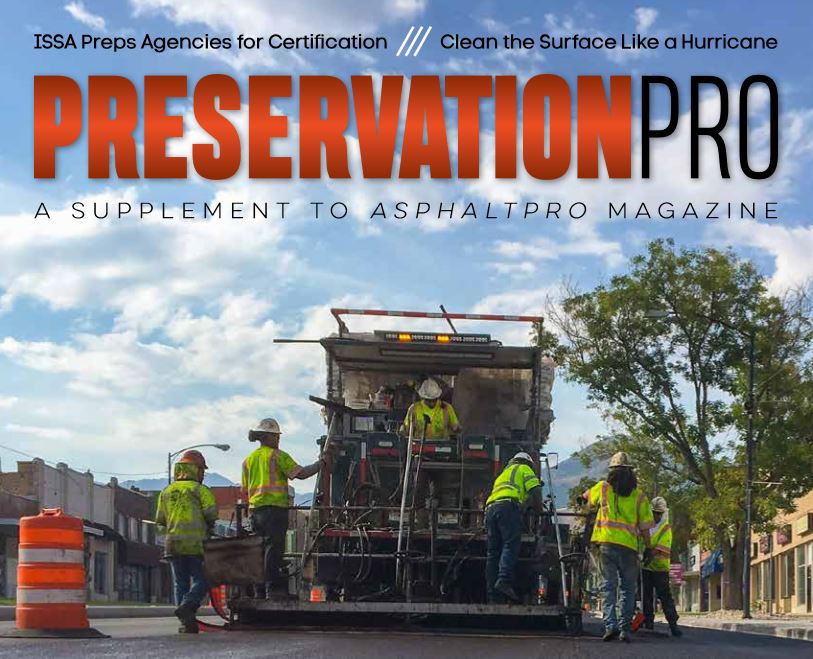
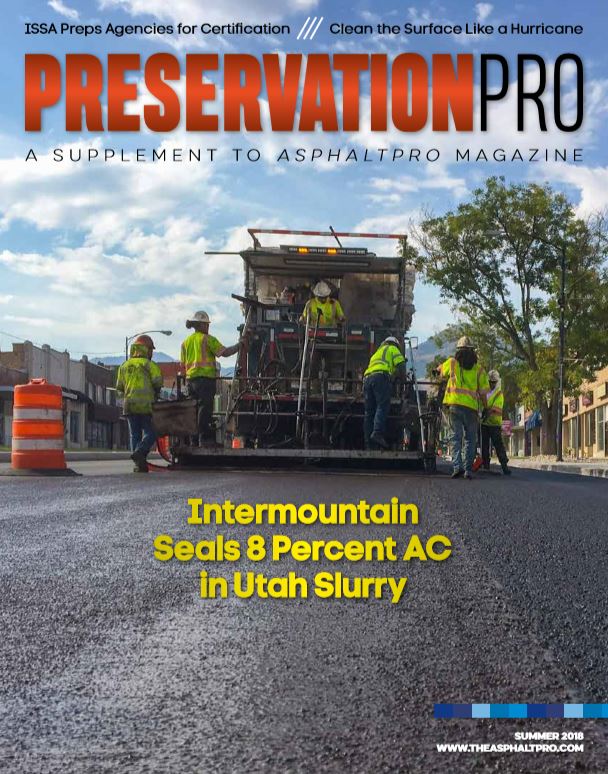
Check out PreservationPro, a new supplement to AsphaltPro Magazine, to learn about the latest tips and equipment for your pavement preservation jobs.


Today’s pavements take a terrible beating. They broil in the summer sun and experience frigid temperatures in winter. Motorists overcrowd them and trucks overload them. Pavements serve until they fall apart, and then there’s not enough money to rebuild them.

But it doesn’t have to be this way. The concept of pavement preservation—in which the right treatment to the right pavement at the right time forestalls or eliminates future high costs of reconstruction—is hitting its stride, and the nation’s road agencies are benefiting from it. Behind it, for over 25 years, FP2 Inc. has supported the spread of environmentally sustainable and economically beneficial pavement preservation principles to state, city and county governments, and the contractors who serve them.

Pavement preservation methods prolong pavement life, avoiding high future costs of reconstruction or rehabilitation through the expenditure of lesser amounts of money for specific preservation treatments at critical points in a pavement’s life.

These techniques include nonstructural preventive maintenance surface treatments such as slurry surfacings, crack sealing, chip sealing, micro surfacing, rejuvenation, hot and cold inplace recycling, and thin-lift hot-mix asphalt paving; and structural preservation techniques used in concrete pavement restoration (CPR).

Pavement preservation makes scarce tax dollars go farther in keeping roads in top shape with a high pavement condition index (PCI), providing a great return on investment. Experience shows that every $1 spent on pavement preservation will save from $6 to $10 or more in future rehabilitation or reconstruction costs.

What’s New?

In all of this, FP2 is an advocate for pavement preservation at the state, county, municipal and federal agency levels. We educate elected officials—and support legislative efforts— on Capitol Hill and in the state houses that encourage pavement preservation of federal, state and local road networks.

We also support the National Center for Pavement Preservation (NCPP), regional pavement preservation partnerships and state-based pavement preservation centers to make sure the technology gets in the hands of those who need it.

One of the hottest areas of pavement preservation this year is certification of agency and contractor workers. NCPP is managing this program, and an article from FP2 profiling this effort appears in this special supplement.

New research also is coming from the FP2-supported preservation group experiment at the National Center for Asphalt Technology (NCAT) in Alabama and the Minnesota DOT’s Road Research Facility (MnROAD), as part of the NCAT Pavement Preservation Effectiveness Study. This research at NCAT and MnROAD is underwritten by FP2 Inc. and its funding partners of state DOTs, began in Alabama in 2012, and expanded to Minnesota in 2015.

For the first time, quantitative data are being gathered on the performance of preservation treatments. The main implementable product will be life-extending and condition-improving benefit curves for treatments for low, high, and accelerated traffic in both hot and cold climates. Road agencies will then interpolate between these plots for their particular climate and traffic level.

Today, FP2 is committed to the growth of pavement preservation. We salute AsphaltPro for putting pavement preservation in the spotlight in this special supplement, and we hope you will take the opportunity to learn more about pavement preservation and FP2 at www.fp2.org.


Andrew Crow is vice president, pavement technologies, for Ingevity, and is 2018 president, FP2 Inc.