
Preventing Fatalities in Work Zones
BY AsphaltPro Staff
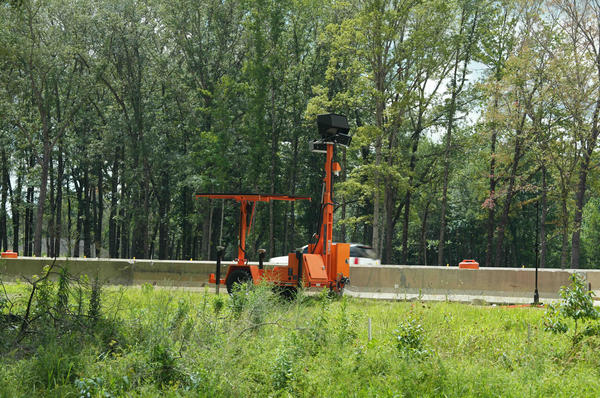
DOTs test Acusensus to prevent fatal five dangerous driver behaviors in work zones
To assist contractors in managing traffic while reducing crashes through work zones, Acusensus solutions give real-time, recordable alerts to law enforcement officers (LEOs) who are working in tandem with state department of transportation (DOT) officials. During his presentation to the Plantmix Asphalt Industry of Kentucky (PAIKY) winter training school in February, Tim Pullin of Acusensus discussed how the technology works to detect the fatal five dangerous driver behaviors:
- Speeding—Acusensus supplies speed enforcement technology and services in the United States, New Zealand and half of the Australian states.
- Distracted Driving—Acusensus supplies technology to identify distracted driver behavior.
- Seatbelt Non-compliance—Acusensus supplies technology to identify when a driver is not wearing his or her seatbelt
- Impaired Driving—Acusensus is developing technology to identify whether drivers are under the influence of drugs and alcohol, and to provide real-time notification to police officers of suspected offenders. Acusensus deployed a world-first pilot of this technology in the United Kingdom in December 2024.
- And the fifth of the fatal five is Fatigue.
Crashes Are a Fatal Problem
Anyone who has lost a colleague, friend or loved one due to a work zone incursion understands the importance of finding ways to grab the traveling public’s attention, slow drivers as they go past work zones and help motorists focus on driving safely. We shouldn’t have to provide price tags, but tax allocations often require justification beyond saving lives to implement new technologies around work zone safety. The National Highway Traffic Safety Administration (NHTSA) revised in February 2023 its 2019 Report No. DOT HS 813 403 on the economic and societal impact of motor vehicle crashes.
The report’s 2023 numbers give staggering costs of a single road fatality:
- Direct economic loss is $1.6 million—this includes medical, legal, property, lost productivity
- Total societal cost is $11.3 million—this includes quality of life, pain, suffering
- The state and local government payout per fatality is $51,700 (baseline estimate)
- Through higher insurance premiums, taxes for emergency services and lost economic productivity, the average American “crash tax” per year is $1,036
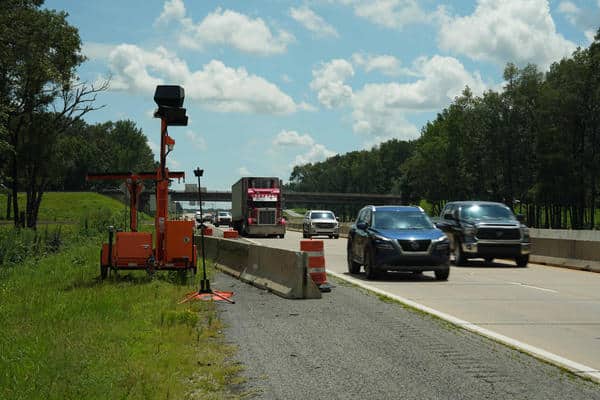
It is ideal to set up the trailer ahead of the active work area and to position marked officers after the active work area. When the solution detects a driver engaged in dangerous behavior, such as speeding, the system captures only vehicle imagery and speed data, without collecting any personally identifiable information. This evidence package is encrypted and transmitted immediately to the officer, who can pull over the driver and issue a citation in real time.
Technology Offers a Solution
Working with state authorities, teams from Acusensus use both fixed and mobile trailer-based systems to detect high-risk driving behaviors before they cause crashes. The system instantly generates certified, prosecutable evidence packages and transmits them securely to LEOs stationed a safe distance down the road.
These transportable trailers are designed to be moved along the side of the road, advancing as the work zone progresses. The trailers can “travel” through work zones due to their transportable nature, and they act as a visible reminder to encourage drivers to slow down before they reach the active work area.
Warning signs and flashing lights can be used to notify drivers they are entering an enforced zone and LEOs stationed at a safe distance from the area receive notification of which vehicles have failed to comply. The officer can then pull drivers over and issue citations in real time, with evidence packages that are gathered, encrypted, and transmitted from the cameras and radar to the officer. Armed with undeniable, real-time evidence, the officer can then use their discretion to determine the best course of action, whether that means enforcing the law with a citation or taking the opportunity to educate the driver on the specific dangers their behavior posed to the roadside workers.
Privacy protection is a core feature of the Acusensus technology. The system is engineered to safeguard the public’s data through a strict retention policy—every captured image is automatically and permanently deleted within minutes unless it is explicitly flagged and used as part of a verified evidence package.
How to Set Up the Roller and Rolling Zone for Safest Practices
Kentucky Case Study
Four out of every five fatalities in the nation’s work zones are motorists, according to the Federal Highway Administration (FHWA), reinforcing the idea that a safe work zone protects the public as much as it protects the workers maintaining our roadways. Kentucky Work Zone Statistics from 2024 reported 1,223 crashes occurred in work zones, resulting in 298 injuries and 7 fatalities. In 2025, Kentucky Legislative Session HB 664 was passed and a pilot project officially launched in September 2025 in partnership with Acusensus, the Kentucky Transportation Cabinet (KYTC), Kentucky State Police, ATS Construction, Louisville Paving and Mountain Enterprises to lessen those numbers and save lives. It began with extensive training for the Kentucky State Police. Then five trailers were deployed and rotated through select high-priority work zones:
- US23 in Lawrence County
- I-64 in Shelby County
- Kentucky 3 in Martin County
- Richmond Road in Fayette County
- I-75 in Whitley County
KYTC had the benefit of seeing how the speed enforcement system had assisted the Arkansas Department of Transportation in three work zones from 2022 to 2024. The Arkansas Work Zone Speed Program demonstrated a 45% decrease in work zone crashes and 39% decrease in CMVs during its trial period. In Saline County work zones, officers issued 4,591 warnings and 981 violations.
What Kentucky experienced was similar.
Once enforcement went live, severe speeding (more than 10 mph over the work zone limit) dropped at every monitored corridor: from 55% to 37% on I-75 in Whitley County, and by nearly half along both directions of I-64 in Shelby County. The most dramatic shift was on the rural stretch of Kentucky 3 in Martin County, where severe speeding fell from over 42% to 16.5%, the strongest behavioral correction of any site.
The underlying traffic data tells the same story. On I-64 westbound, a 55-mph corridor, average speed fell from 64.4 mph to 60.9 mph once enforcement was active, and the share of vehicles speeding dropped from 89.1% to 80.8%. On the rural Kentucky 3 corridor, a 45-mph zone, the effect was even sharper: average speed fell from 52.9 mph to 45.4 mph, and the percentage of vehicles speeding dropped from 79.8% to 43.5%.
For more information, contact tim.pullin@acusensus.com or visit www.acusensus.us.