
Build the Schedule into the Bid
BY Tarik Khribech
Commercial paving and sealcoating crews can protect their margins by taking the daily, weekly or monthly schedule into consideration when estimating each project. Consultant Tarik Khribech shares tips for pricing with weather, crew gaps and slack in mind.
Every small paving and sealcoating operation runs on two documents that almost never talk to each other: the estimate and the schedule. The estimate is tidy, factoring in square footage, material, labor and a margin you can live with. The schedule is where reality happens—the crewmember who calls in sick the morning of a big sealcoat, the rain that pushes Project A two days and shoves Projects B and C right along with it, the supplier who’s a day late on material delivery.
When those two documents don’t talk, the margin you priced in the office quietly disappears in the field. The good news is you can close most of that gap before you ever sign the bid, by treating the estimate as what it really is—a schedule in disguise.
View Your Estimate as a Schedule
Walk through any winning bid and you’ll find time hiding in every line. Take labor as an example. Labor isn’t really a dollar figure; it’s crew-hours, and crew-hours assume the crew shows up, the weather holds, and the day runs in the order you planned. Think of material and mobilization that way, too. Material isn’t just a cost; it’s a delivery window. Mobilization isn’t a number; it’s a half-day you can’t bill twice if a job slips.
The crews that stay profitable don’t estimate cost and then deal with the schedule later. They estimate the schedule and let the cost fall out of it. That single reordering of time first, dollars second is the difference between a bid that survives contact with a rainy week and one that doesn’t.
Price the Weather as If You Expect It
As contractors, you know paving, sealcoating, striping and other pavement work is weather-bound in a way most trades aren’t. You can’t seal a lot at 45 degrees and falling, and you can’t pave through a thunderstorm. Yet most small-shop estimates treat good weather as the default and bad weather as bad luck.
Flip that narrative. Look at the realistic working window for the part of the construction season the job lands in, and build a weather contingency into the schedule line the same way you’d build waste into the material line.
On a five-day job during rainy season in Florida, assuming zero lost days is optimism, not estimating. One built-in buffer day costs you a little on paper; one unplanned rain day on an un-buffered bid costs you the crew’s time, the re-mobilization, and the goodwill of the customer waiting behind that job. This isn’t padding the bid. You’re pricing a known risk instead of absorbing it for free.
Workforce Accommodation
The crew-availability line that nobody writes down could be costing you. This line item rarely makes it onto a bid sheet, but it wrecks more small-crew schedules than weather. A three- or four-person crew has no bench. When one person is out, you haven’t lost 25% of the day—you’ve often lost the whole day. This is because paving work is sequenced and you can’t run the paver and rolling train shorthanded.
Big firms absorb that with depth. You absorb it with planning.
Two habits help. First, sequence your week so the weather-sensitive, all-hands work has the most daylight and the most buffer around it. Don’t schedule your tightest job for Friday afternoon. Second, know before you bid which jobs can flex and which can’t, so when someone calls in sick, you’re moving the flexible job, not blowing the deadline on the rigid one. None of that shows up as a dollar on the estimate. All of it shows up as protected margin at the end of the month.
When the estimate and schedule don’t talk, the margin you priced in the office quietly disappears in the field.
Build In Slack on Purpose, With Discipline
The instinct under a tight bidding market is to strip every cushion out to win the job. It feels disciplined but it’s the opposite, because a schedule with no slack doesn’t just risk one job. A single delay cascades through every job stacked behind it, and now you’re late on three customers instead of one.
Disciplined estimating means deciding where the slack lives and pricing it in deliberately instead of hoping you won’t need it. Maybe that slack looks like a buffer day, a not-fully-booked Friday, or a standing rule that you don’t promise a completion date you can only hit if nothing goes wrong. The shops that look lucky with their schedules aren’t lucky. They built the luck into the bid.
A Pre-Bid Gut Check
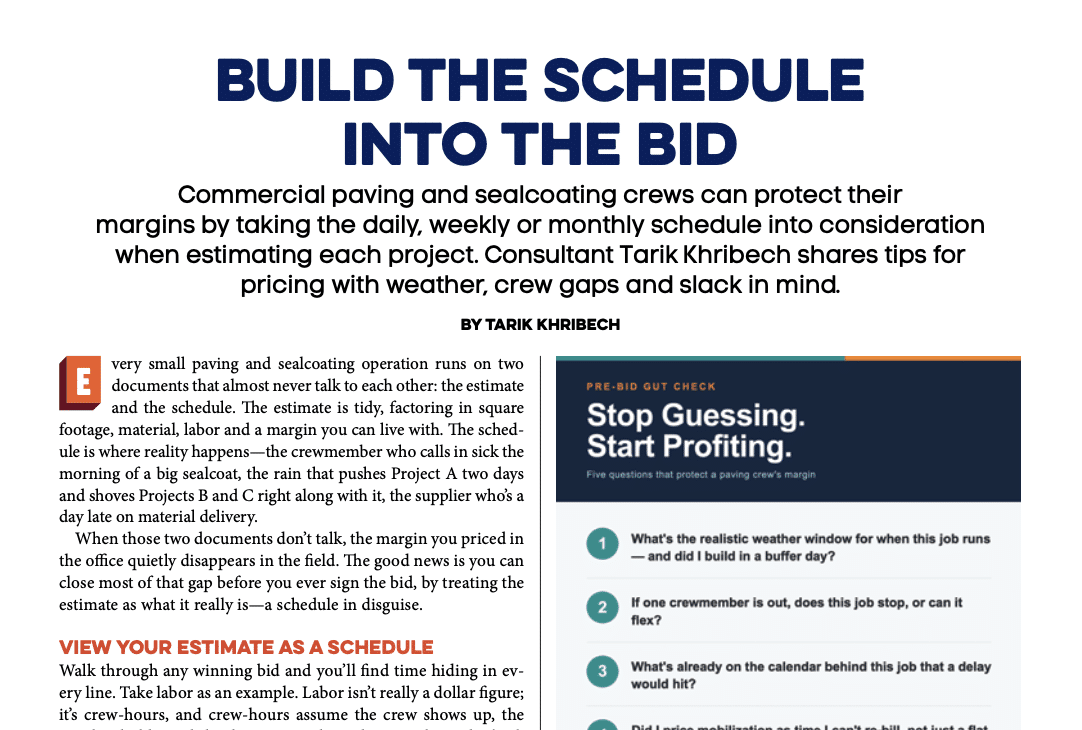
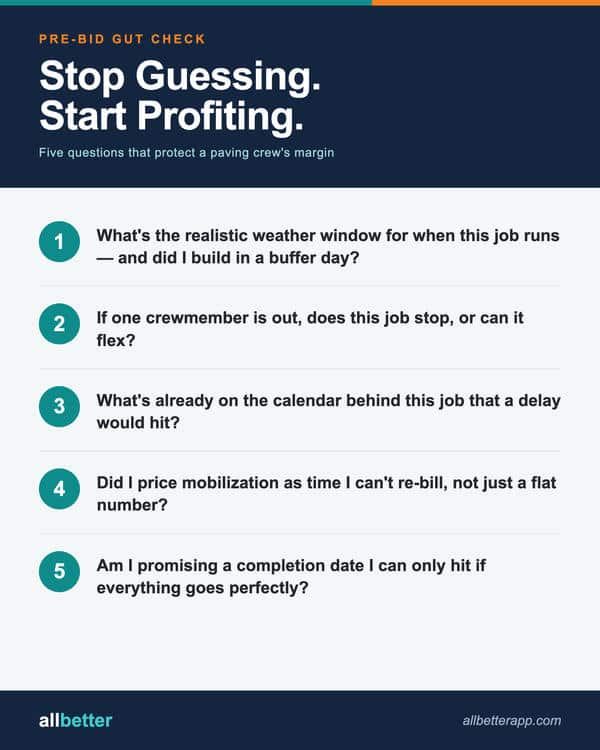
Before you send the next estimate, run it through five questions. This is the kind of thing worth taping to the wall by the estimator’s desk.
- What’s the realistic weather window for when this job runs? (And did I build in a buffer day?)
- If one crewmember is out, does this job stop, or can it flex?
- What’s already on the calendar behind this job that a delay would hit?
- Did I price mobilization as time I can’t re-bill, not just a flat number?
- Am I promising a completion date I can only hit if everything goes perfectly?
If you can answer those five honestly, you’ve already done more schedule-aware estimating than most of your competition. This is how you protect the margin you quoted.
The Estimate is a Promise About Time
A bid isn’t really a promise about price. It’s a promise about time—that you’ll show up, sequence the work, handle the weather and finish when you said. The contractors that keep their margins are the ones whose estimate and schedule were the same document all along.
Stop guessing at the schedule after you’ve won the job and start pricing it before you bid. Rather than appearing on the estimate, the difference shows up in what’s left when the season’s over.
Tarik Khribech is the founder and CEO of AllBetter (allbetterapp.com), a home-services marketplace and field-service software company. He started the business in 2016 and works with small trades and paving operations on the estimating and scheduling discipline that keeps a crew profitable.