
Reduce Risk Around Conveyors
BY AsphaltPro Staff
OEMs share how to reduce risk around conveyors with guarding
Asphalt and aggregate suppliers can implement guarding strategies to protect employees who work around conveyors, but the best guard against accidents is to reduce their root cause. During a webinar June 16, Martin Engineering’s Jerod Heitzler presented a number of best practices to prevent injury around the conveyors that move your material.
The key takeaway from the hour was not in mechanical structures but in mindset. Heitzler told the attendees, “The most at-risk workers are those performing maintenance.” Because of this, employers need to remind personnel to slow down and perform maintenance right and safely.

Employers should also consider the age of the conveyors being maintained. Are these the most current components with the latest, safest technology incorporated? Many original equipment manufacturers (OEMs)—not just Martin Engineering—design components to enable best practices and reduced, if not easier, maintenance today. By taking advantage of new technologies, producers provide employees with a safer work environment.
QUICK TIP: Workers become complacent when they grow accustomed to old, dated and familiar messages. If your signage around the plant or quarry is no longer effective, it may be time to change it around and add new, fresh and brighter signs.
To reduce injuries around conveyors, much hinges on proper training. Make sure workers understand the importance of wearing proper personal protective equipment (PPE) and “safe” clothing that won’t flap in the breeze or get caught by a speeding belt.
Make sure the policies and procedures you have in place for safe, clean and efficient conveying practices are known, followed and enforced. Make sure safety equipment, such as emergency stops and guarding, are effective, up to date and understood. Again, training workers on the proper use and maintenance of safety equipment is vital. Heitzler listed six aspects of shoring up your guarding, which we’ll outline here.

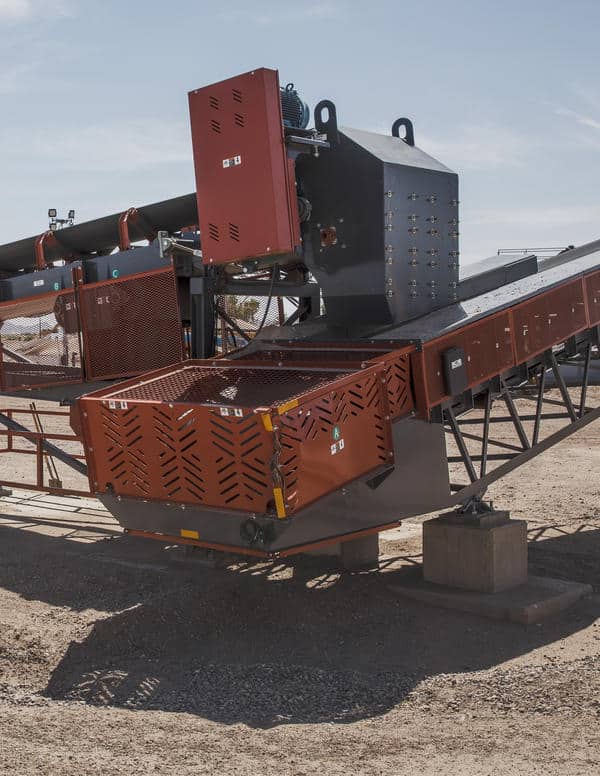
Notice these two different types of guards below an idler roll on the return side of the conveyor require either effort or a tool to open and clear them. This adheres to the spirit of the rule to protect workers from accessing moving parts by accident.
1.
The structure (guard) you use to protect workers from accessing moving parts and conveyors cannot be a hazard itself. It cannot introduce its own risk to workers.
In other words, make sure the guard has no sharp edges. And consider how workers will move it to perform maintenance behind it. The guard should have handles and weigh 50 pounds or less to prevent back injuries.
2.
Check your prepositions. Make sure a worker cannot get around, under, through or over the guard. Routine maintenance can include checking to ensure no one has cut holes in the guard for “reaching in” to access parts.
3.
The guard must be a proper distance from the hazard. See the second point above. You don’t want a worker to be able to reach through an opening in the guard to access a rotating piece of equipment. You can double-check with the Occupational Safety and Health Administration (OSHA) guidelines for specifics on opening size and safe distance from the hazard.
Every worker should be trained to lockout/tagout the conveyor to be maintained or repaired. But have you considered the danger posed by moving parts in the vicinity of that conveyor? Look for surrounding hazards and make sure those are shut down and locked out as well.

One rule when guarding conveyor components is to paint the guard a color that is different from the equipment it protects workers from contacting. This basket below an idler roll on the return side of the conveyor is a vivid contrast to its surroundings.
4.
Guards should require a tool to remove them. If you’re looking at OSHA regulations, the rules are very clear on this. MSHA rules are more vague, but you want to adhere to the spirit of the law. Make it difficult for someone to accidentally set aside a guard and access a rotating part.
5.
The guard must stand out in color. In other words, you want to make the guard a different color than the equipment it’s guarding.
But here’s something interesting Heitzler pointed out during his presentation. The color yellow can draw the eye’s attention, thus limiting the worker’s ability to visually inspect anything behind it. It may be in your best interest to consider a color other than yellow when painting your guards.

Notice these two different types of guards below an idler roll on the return side of the conveyor require either effort or a tool to open and clear them. This adheres to the spirit of the rule to protect workers from accessing moving parts by accident.
6.
Maintain the guard properly and replace or reinstall it properly according to the policies and procedures you’ve put in place. Then make sure someone is reinforcing these policies and procedures.
As mentioned at the outset of the article, the best way to ensure equipment operates at its most efficient and safest is to maintain it properly. Because performing maintenance introduces potential for injury, owners can reduce the need for intrusive or laborious maintenance by updating components with the latest, safest technology and best operating practices.
For more conveyor tips and training, access Martin Engineering’s library of online webinars at foundations.martin-eng.com.